

For eighty years this was the only place in Munich where anyone could be buried. Painters, anatomists, mayors, opera singers and the architects who built the city all went into the same ground, and most of them are still here.
At a glance
The Alter Südfriedhof lies half a kilometre south of the Sendlinger Tor, between Thalkirchner and Pestalozzistraße. Duke Albrecht V opened it in 1563 as a plague cemetery, outside the walls where such things belonged. It took the dead of the Sendling uprising of 1705, and from 1788 to 1867 it served as the single burial ground for the whole city — which is why the walks between the tombs read like an index to nineteenth-century Munich.
Key facts
- What it is: Munich’s old south cemetery, now a protected monument and a public park
- Founded: 1563, by Albrecht V, Duke of Bavaria, for victims of the plague
- 1705: burial ground of the dead of the Sendling uprising, in which over eleven hundred were killed after surrendering
- 1788–1867: the only cemetery for the entire city
- Where: Thalkirchner Straße 17, Munich
- Buried here: among many others the architect Friedrich Bürklein (1813–1872), the philosopher Franz Xaver von Baader (1765–1841), the theologian Ignaz von Döllinger (1799–1890) and the landscape painter Johann Georg von Dillis (1759–1841)
History
A plague cemetery is a practical thing: you put it outside the gate and downwind. Albrecht V had this one laid out in 1563, and for two centuries it did the work such places do — epidemics, and the aftermath of violence. In 1705 the men killed in the Sendling uprising were brought here; more than eleven hundred had been cut down after surrendering to the troops of the Emperor Joseph I.
Its second life began in 1788, when it became the only burial ground for the whole of Munich, and lasted until 1867. Those eighty years are exactly the decades in which Munich turned from a residence town into a capital of art and science, and the cemetery filled with the people who did it: painters, sculptors, lithographers, anatomists, opera singers, mayors, architects. The result is not a monument but a directory.
What you see
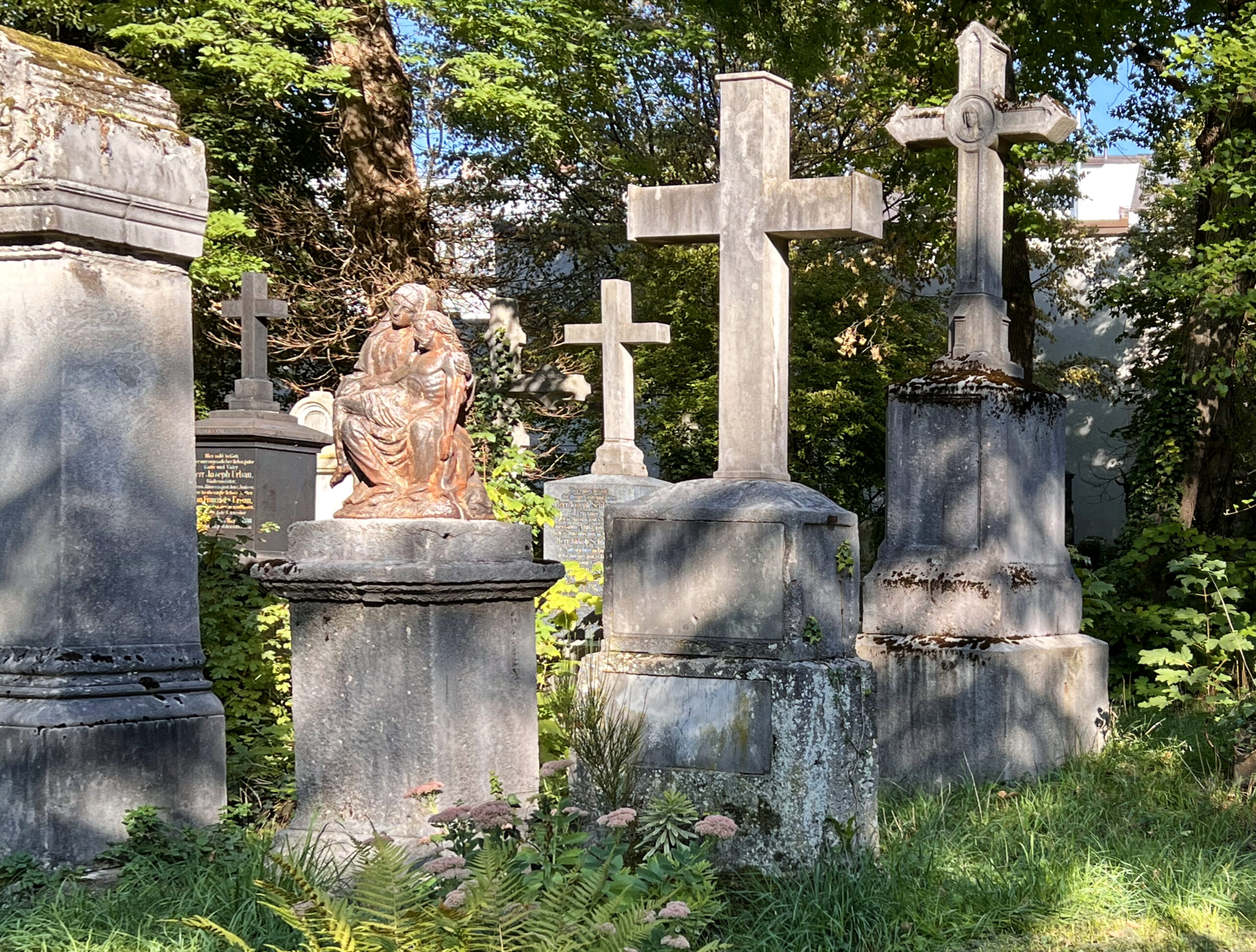
Stone crosses of several generations, tomb chests, obelisks and the occasional figure — a weathered Pietà in reddish stone among the grey — standing in long grass under mature trees. Ivy has taken some of the older monuments, and the inscriptions go in and out of legibility as the light moves.
It is used as a park. That is the other half of the experience: people walk through on their way somewhere, past the graves of men whose names are on the streets outside.
Practical information
- Open as a public green space; no burials take place here now.
- Guided walks are run through the year and concentrate on the notable graves.
- Quiet ground: the cemetery is in daily use as a park by the people who live around it.
Getting there
U-Bahn to Sendlinger Tor, then about ten minutes on foot south along Thalkirchner Straße; the main entrance is at number 17.
Nearby
- The Sendlinger Tor, the surviving medieval gate at the end of the street.
- The Glockenbachviertel, the quarter immediately east.
- The Isar, ten minutes further on.
Sources
- English Wikipedia, Alter Südfriedhof — the 1563 foundation by Albrecht V, the location south of the Sendlinger Tor, the burial of the dead of the 1705 Sendling uprising, the years 1788–1867 as the city’s sole cemetery, and the list of notable interments.
- Wikidata (Q438199) — coordinates, address and protected status.
Find it on the map
See this place and what’s around it →Historical events at this place (1)
📷 Become a Cultural Heritage Online photographer
Share your photos of places: they stay published under your name as the author. The more they're seen, the more you get noticed — and soon a contest will reward the most appreciated photos.
Log in or sign up free to add a photo