
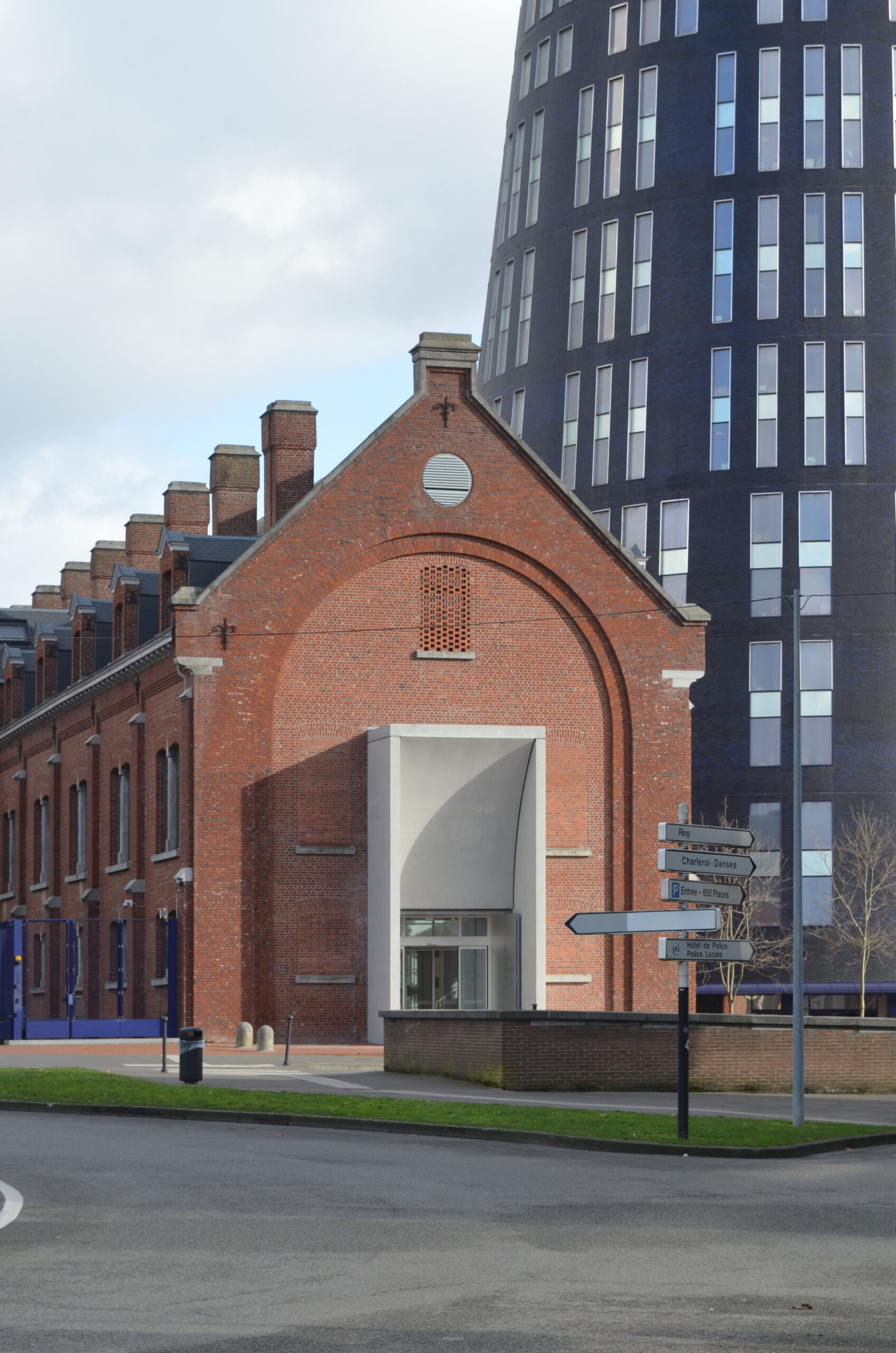

The city’s pictures spent decades on the top floor of the town hall, visitable by appointment. They now live in a gendarmerie stable, which is a better address than it sounds.
At a glance
The Musée des Beaux-Arts is Charleroi’s municipal art collection: some four thousand works, of which about a hundred are on permanent show. Since 2022 it has occupied the former Defeld barracks in the Ville-Haute, next to Jean Nouvel’s blue police tower — a building that once held the stables of the gendarmerie, converted into three thousand square metres of museum by the architects Goffart-Polomé. Admission to the permanent collection is free.
Key facts
- What it is: the municipal fine arts museum of Charleroi
- Collection begun: 1889, with the bequest of the Comité Navez; developed under the politician and writer Jules Destrée
- The building: the Defeld barracks, former gendarmerie stables, converted by Goffart-Polomé in 2022
- Size: 3,000 m²; about 4,000 works in the collection, around a hundred shown at a time
- Where: Boulevard Mayence 67, 6000 Charleroi
- Open: Tuesday to Friday 09:00–17:00, Saturday and Sunday 10:00–18:00; closed Monday
- Admission: permanent collections free; temporary exhibitions €7.50 full, €3.50 reduced, free on the first Sunday of the month
History
The municipal collections start in 1889, with a bequest from the Comité Navez. Jules Destrée — politician, writer and art collector, and a son of this region — pushed the city to keep building a public collection of its own.
In 1936 a museum of fine arts was installed on the top floor of the town hall: fifty or so works, shown by appointment. It opened to the public properly only in the 1980s. Purchases, gifts, deposits from public and private bodies and the works of the old Destrée museum brought the holdings to about four thousand pieces.
Then the roof leaked. In 2007 water got in and the whole collection was moved to the Palais des Beaux-Arts. In January 2019 the museum closed to the public altogether, pending a new home; the city chose the Defeld barracks, and in 2022 the stable building was converted into the museum that stands today.
What you see
A long brick range of the kind military engineers built everywhere in the nineteenth century. The gable end carries a wide blind arch and a round oculus, and into that end the architects have driven the new entrance: a white folded volume, glazed at the bottom, set into the brick without pretending to match it. The conversion left the rhythm of the openings and the chimneys along the roof; what changed is behind them.
Its neighbour is the opposite argument: the blue tower Jean Nouvel built for the police, which the museum now shares a plot with. The two together are a fair summary of what Charleroi has been doing with its industrial fabric.
Practical information
- Closed Monday; open to 18:00 at the weekend.
- The permanent collection is free for everyone; the temporary exhibitions are charged, and free on the first Sunday of each month.
- The Glass Museum, the city’s other collection, is at Marcinelle, on the Bois du Cazier site.
Getting there
Charleroi-Central station is about twenty minutes on foot, 1.5 km uphill; the metro stops at Janson, buses at Casernes.
Nearby
- The Bois du Cazier at Marcinelle, a UNESCO World Heritage colliery and the site of the 1956 disaster.
- Jean Nouvel’s police tower, immediately alongside.
- The Ville-Haute, the upper town laid out inside the old fortress.
Sources
- French Wikipedia, Musée des Beaux-Arts de Charleroi — the 1889 Navez bequest and Jules Destrée, the 1936 installation in the town hall and the opening in the 1980s, the size of the collection, the 2007 water damage and the move, the closure of January 2019, and the 2022 conversion of the Defeld stables by Goffart-Polomé.
- Charleroi Museum — hours and access — opening times, prices, address and transport.
- Wikidata (Q115773939) — coordinates and address.
Find it on the map
See this place and what’s around it →Historical events at this place (1)
📷 Become a Cultural Heritage Online photographer
Share your photos of places: they stay published under your name as the author. The more they're seen, the more you get noticed — and soon a contest will reward the most appreciated photos.
Log in or sign up free to add a photoIs this page about you?
This page is read by travellers and heritage enthusiasts who find it on Google. Tell us how you are connected to this place and we will take it from there.