
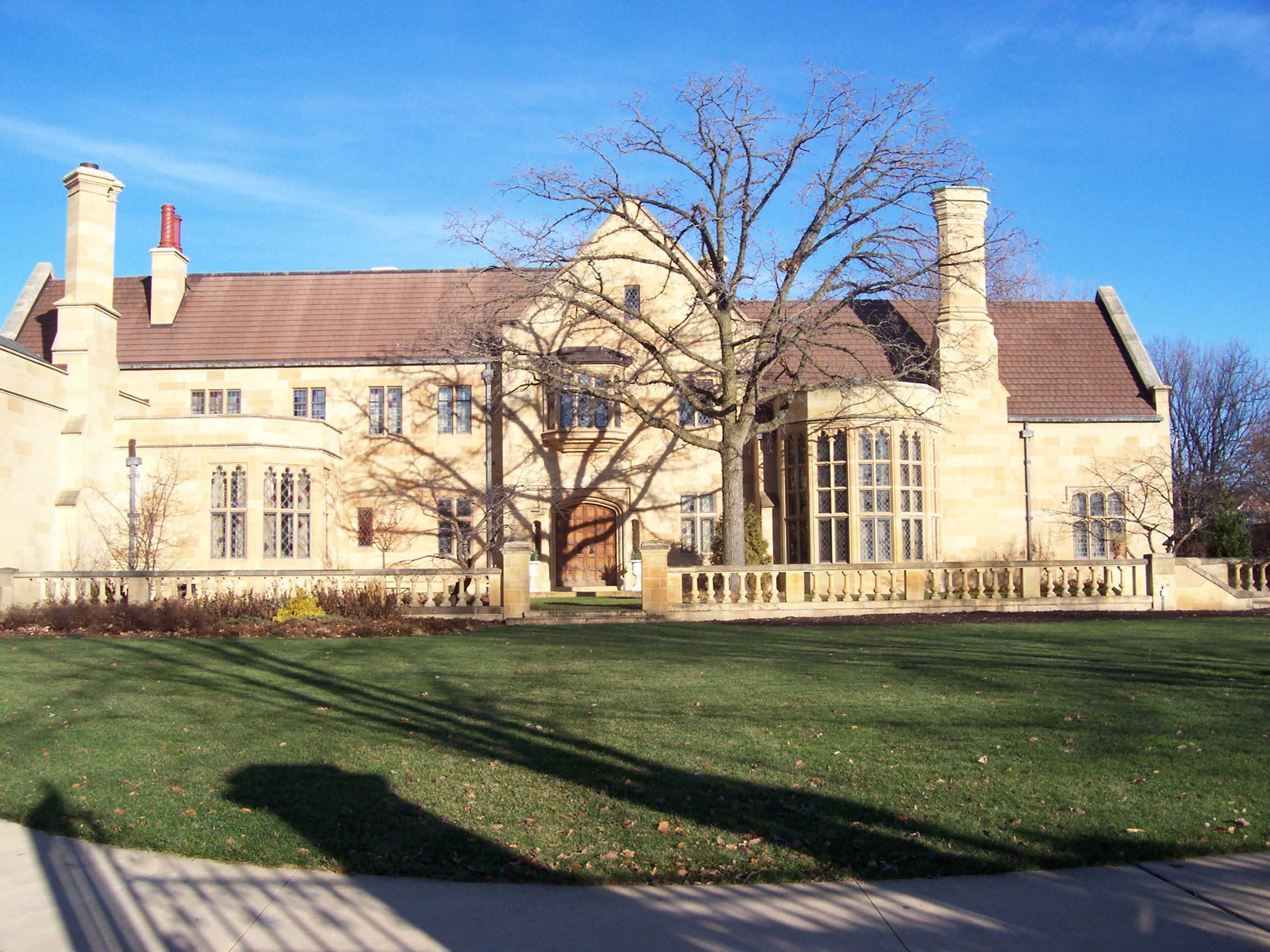

A house built for a family that never moved in. The Depression stopped the work in 1932, the owners came back to it fourteen years later, and what they finished they gave away.
At a glance
The Paine is a preserved estate in Oshkosh, Wisconsin: a Tudor Revival mansion with public galleries, standing in three acres of botanic gardens, and listed on the National Register of Historic Places. It was commissioned by the lumber baron Nathan Paine and his wife Jessie Kimberly Paine, who wanted from the start a house that would be opened to the public for education and culture. It duly was, in 1948 — and they never lived in it.
Key facts
- What it is: a historic house museum with art galleries and botanic gardens
- Architect: Bryant Fleming, of Ithaca, New York, commissioned in 1925 on the recommendation of Mary K. Shirk
- Built: begun 1927, exterior finished by 1930, work halted in 1932 by the Depression, resumed 1946
- Opened to the public: 1948, under a non-profit set up by the Paines in 1946
- Grounds: three acres of gardens
- Protection: listed on the National Register of Historic Places
History
Nathan Paine’s money came from timber — the Paine Lumber Company, in a state that had been felled and rebuilt on the proceeds. In 1925, on the recommendation of Jessie Paine’s sister Mary K. Shirk, the couple engaged Bryant Fleming to design an estate that would show architecture, furnishing, art and planting together, and that would be open to the public.
Building began in 1927 and the exterior was complete by 1930. Then the Depression reached Wisconsin, the lumber company was crippled, and in 1932 all remaining work stopped. The house stood unfinished for fourteen years.
The Paines returned to it in 1946 and set up a non-profit organisation to own and run the estate for public benefit. Nathan died in 1947, at seventy-seven. Jessie oversaw what was left to do, the property opened to the public in 1948, and she remained the museum’s president until her death in 1973, at the age of a hundred, from her home in La Jolla, California.
What you see
Pale limestone, a steep tiled roof, tall chimney stacks and mullioned windows in stone surrounds: Tudor Revival done thoroughly, at the scale of an English manor transplanted to the American Midwest. A stone balustrade holds the terrace above the lawn, and a great tree stands where it was left.
The gardens are part of the design rather than a setting for it — Fleming’s training was in landscape, and the estate was planned as one piece.
Practical information
- Galleries and gardens are open to visitors; the exhibition programme changes through the year.
- Check the museum’s current hours and admission before travelling.
Getting there
Oshkosh lies on the western shore of Lake Winnebago, between Milwaukee and Green Bay; the estate is in the city, a short drive from the centre.
Nearby
- The University of Wisconsin–Oshkosh, immediately alongside.
- Lake Winnebago and the Fox River.
- The Winnebago County Courthouse of 1937, in the centre of town.
Sources
- English Wikipedia, Paine Art Center and Gardens — the commission of 1925 and Bryant Fleming’s authorship, the building dates 1927–1930, the halt of 1932, the non-profit of 1946, Nathan Paine’s death in 1947, the opening in 1948, Jessie Paine’s presidency until 1973, and the National Register listing.
- Wikidata (Q7124860, Q15997331) — coordinates and the identification of Bryant Fleming as a landscape architect.
Find it on the map
See this place and what’s around it →Historical events at this place (1)
📷 Become a Cultural Heritage Online photographer
Share your photos of places: they stay published under your name as the author. The more they're seen, the more you get noticed — and soon a contest will reward the most appreciated photos.
Log in or sign up free to add a photoIs this page about you?
This page is read by travellers and heritage enthusiasts who find it on Google. Tell us how you are connected to this place and we will take it from there.