
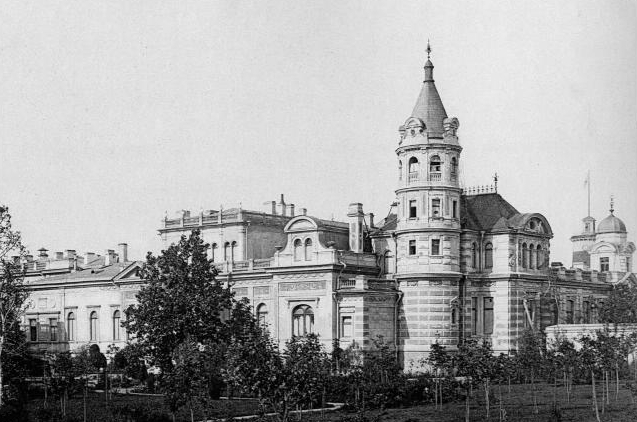
On the Moika embankment stands a Revivalist palace built for a Grand Duke, its towers and mismatched façades still an oddity among Saint Petersburg’s classical rows.
At a glance
Alexeevsky Palace is an eclectic residence designed by architect Maximilian Messmacher in the mid-1880s for Grand Duke Alexei Alexandrovich. Officially heritage-listed, it now functions as the St. Petersburg Music House, hosting concerts and excursions. The building’s asymmetry sets it apart from the river’s more uniform frontages.
History
The palace rose in the mid-1880s as a private residence for Grand Duke Alexei and his household. It stayed in family hands into the early twentieth century. In 1910, part of the surrounding gardens was sold off for a candy factory, shrinking the estate’s original footprint. The palace was declared a national landmark in 1968. Recognition brought no immediate relief. Through the Soviet decades it sat in disrepair, its rooms and roofline slowly deteriorating. Only at the behest of musician Sergei Roldugin did a major restoration begin in the early 21st century, culminating in the building’s reopening in 2008.
What you see
Messmacher gave each façade its own character, a rare approach in a city built on repetition. Two towers break the roofline, paired with a set of exuberant, irregular rooftops unlike anything else along the Moika. Inside, the dining hall once held ten paintings by Ernst Friedrich von Liphart, adding a painterly layer to the eclectic architecture. A wrought iron and stone fence originally enclosed the park. The central gates survive, still bearing the Grand Duke’s monogram worked into the ironwork.
Cultural significance
The palace documents a moment when Saint Petersburg’s aristocracy commissioned architecture that broke from strict classicism. Its survival through Soviet neglect, then restoration under private patronage, makes it a case study in post-Soviet heritage rescue. As a working concert venue, it now links imperial-era design directly to contemporary musical life in the city.
Key facts
- Location: Moika River embankment, Saint Petersburg, Russia
- Architect: Maximilian Messmacher
- Built: mid-1880s
- Style: Eclectic (Revivalist)
- Original occupant: Grand Duke Alexei Alexandrovich
- Heritage status: National landmark, listed 1968
- Current use: St. Petersburg Music House (reopened 2008)
Practical information & getting there
The palace sits directly on the Moika River, within the historic core of Saint Petersburg. You can join scheduled concerts or excursions through the Music House, though the venue closes for July. Check the official website before visiting, since programming and access can shift with the concert calendar.
Sources & resources
Find it on the map
See this place and what’s around it →📷 Become a Cultural Heritage Online photographer
Share your photos of places: they stay published under your name as the author. The more they're seen, the more you get noticed — and soon a contest will reward the most appreciated photos.
Log in or sign up free to add a photoIs this page about you?
This page is read by travellers and heritage enthusiasts who find it on Google. Tell us how you are connected to this place and we will take it from there.