
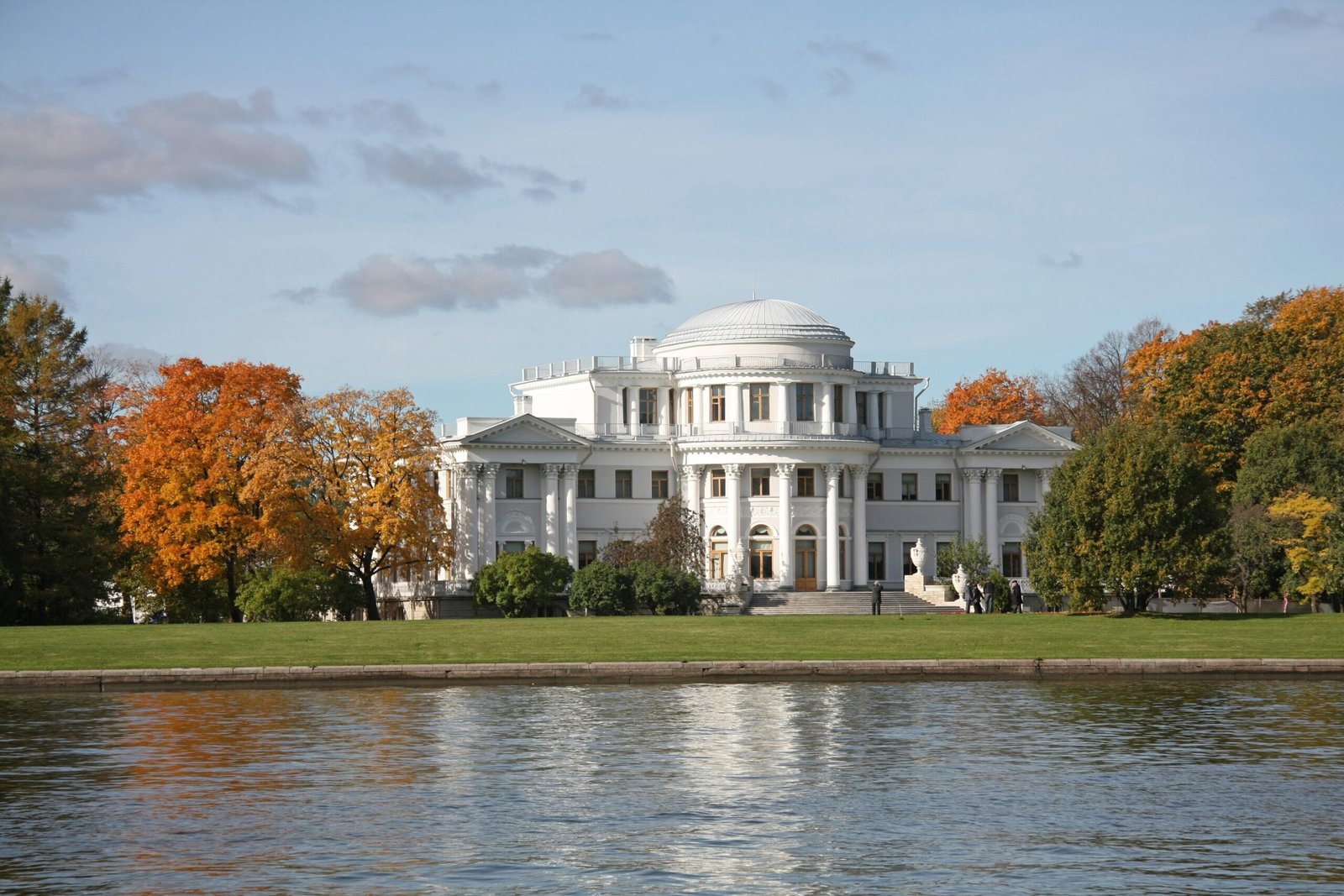
A Neoclassical villa on a quiet island north of the Neva, built for a dowager empress who wanted her summers closer to home.
At a glance
Yelagin Palace stands on Yelagin Island, once the private retreat of courtier Ivan Yelagin and later a royal summer residence. Carlo Rossi redesigned the estate in 1822 for Maria Fyodorovna, mother of Alexander I. An earlier mansion on the site may date to Yelagin’s own occupancy in the 1780s, possibly designed by Giacomo Quarenghi. Today the palace holds a museum of decorative arts.
History
The island takes its name from Ivan Yelagin, a close ally of Catherine the Great. He used the estate for secretive alchemical experiments, once summoning Count Cagliostro for assistance. The visit ended badly. Yelagin’s secretary slapped the count, who fled the island soon after. Decades later, Maria Feodorovna found the imperial residences at Pavlovsk and Gatchina too far for daily travel. Her son Alexander I bought the estate from Yelagin’s heirs and commissioned Rossi to rebuild it. After her death the palace sat empty for long stretches. Nicholas II later leased it to his prime ministers, including Sergei Witte and Pyotr Stolypin, who lived there in 1908. The Council of Ministers under Ivan Goremykin met at the palace in July 1914. The Bolsheviks converted the compound into a museum of pre-revolutionary life. During the Siege of Leningrad, a shell struck the building and it burned to the ground. It was rebuilt in the 1950s as a workers’ resort.
What you see
Rossi’s villa is Palladian in spirit, restrained and symmetrical. Its interiors, by contrast, are lavish. Giovanni Battista Scotti painted the decorative schemes, while sculptors Vasily Demuth-Malinovsky and Stepan Pimenov contributed reliefs and ornament. Two lion sculptures flank the entrance, modeled on the Medici lions in Florence. Inside, rooms now display 18th- and 19th-century objets d’art, with a notable collection of glassware.
Cultural significance
The palace records two distinct eras of Russian court life. First, the eccentric world of an 18th-century courtier obsessed with alchemy. Then the ceremonial and political life of the late empire, when prime ministers worked and even convened cabinet meetings within its walls. Its postwar reconstruction reflects a broader Soviet effort to restore imperial-era landmarks destroyed in the war, repurposing them for public and civic use.
Key facts
- Location: Yelagin Island, Saint Petersburg, Russia
- Architect: Carlo Rossi (1822 rebuilding); earlier structure possibly by Giacomo Quarenghi
- Style: Palladian / Neoclassical
- Original site occupied since around 1780
- Destroyed by shellfire during the Siege of Leningrad, rebuilt in the 1950s
- Museum collection open to visitors since 1987
- Heritage-listed site
Practical information & getting there
Yelagin Island sits in the delta of the Neva, a short trip from central Saint Petersburg. You can reach the park by metro and bus, or on foot across the island’s bridges. Check the official website before visiting for current hours and exhibition details, as museum access can vary by season.
Sources & resources
Find it on the map
See this place and what’s around it →📷 Become a Cultural Heritage Online photographer
Share your photos of places: they stay published under your name as the author. The more they're seen, the more you get noticed — and soon a contest will reward the most appreciated photos.
Log in or sign up free to add a photoIs this page about you?
This page is read by travellers and heritage enthusiasts who find it on Google. Tell us how you are connected to this place and we will take it from there.