

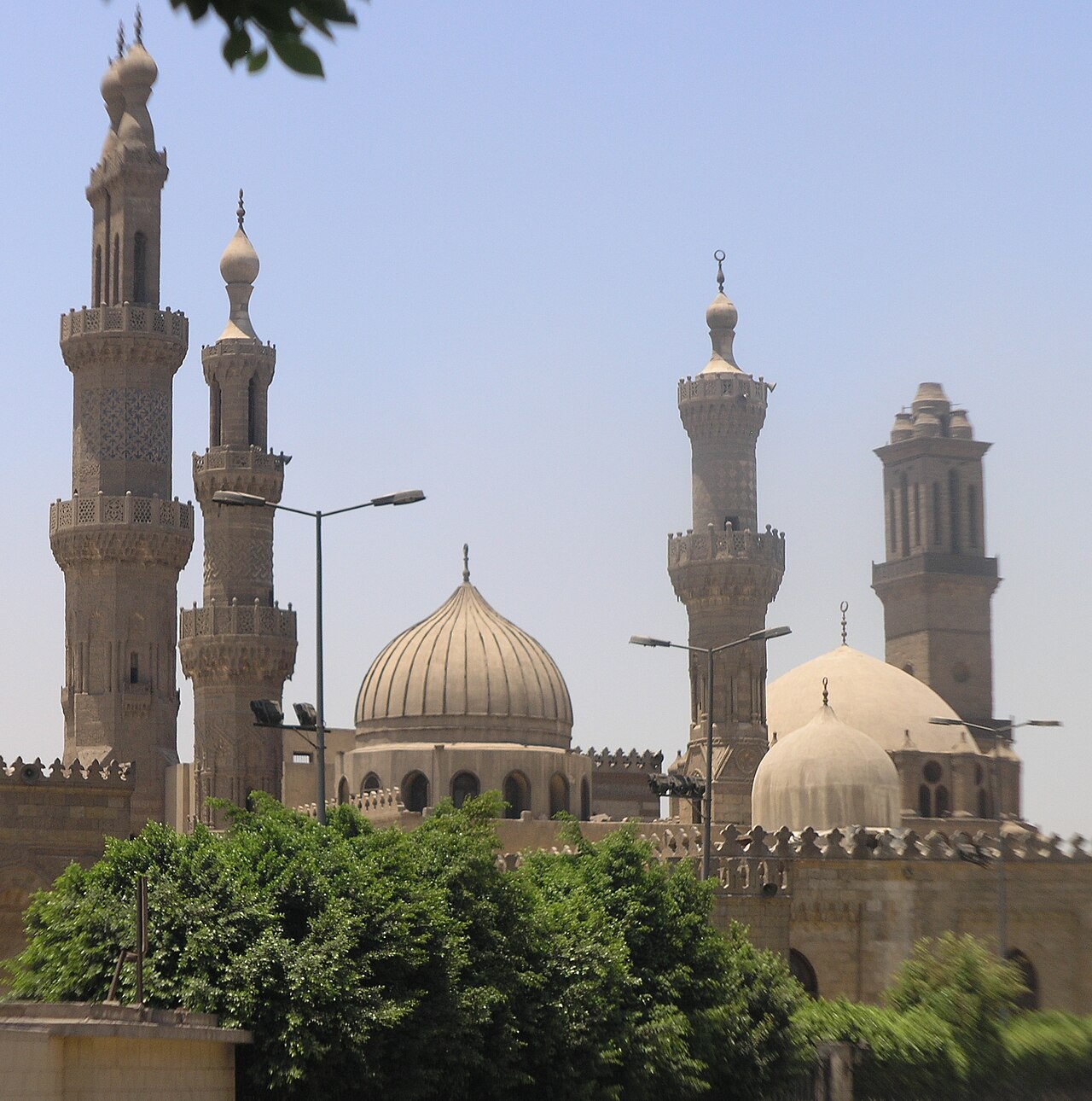
Sunni Islam’s teaching heart for a millennium – the Fatimid mosque of 972 whose five minarets crown Islamic Cairo and whose fatwas reach the world.
At a glance
- Type
- Mosque and university
- Period
- 970-972; minarets 14th-16th c.
- Style
- Fatimid with Mamluk-Ottoman additions
- Location
- Islamic Cairo, Egypt
- Coordinates
- 30.0459, 31.2625
- Founder
- Fatimid caliph al-Muizz, general Jawhar
Overview
Al-Azhar – the Resplendent, for Fatima al-Zahra – rose with Fatimid Cairo itself in 972, its teaching circles formalized by 988 into the institution that became Sunni Islam’s premier authority: the Grand Imam’s seat, the global curriculum’s source, forty thousand students from every Muslim land. The white courtyard’s keel-arched arcades and the five-minaret skyline anchor UNESCO’s Historic Cairo.
History
Founded Shia, converted to Sunni orthodoxy by Saladin, endowed by Mamluk sultans whose madrasas and minarets accreted the complex; Napoleon’s 1798 occupation profaned it and Egypt’s revolts began here more than once – 1919’s pulpit speeches among them. Nasser’s 1961 reforms added secular faculties; the mosque’s lessons-in-the-round continue between prayers as for ten centuries.
Architecture and Design
The Fatimid sanctuary’s stucco conserves the dynasty’s florid Kufic; Qaytbay’s and al-Ghuri’s minarets – the double-headed crown – sign Mamluk Cairo’s silhouette. Madrasa courts (Taybarsiyya’s mihrab the jewel) ring the whitewashed sahn where students cram under arcades.
Cultural significance
Al-Azhar is Sunni Islam’s Vatican-and-Sorbonne – doctrinal compass, diplomatic voice, and Cairo’s soul; al-Muizz street’s monuments parade from its gates.
Visiting today
Open outside prayers; dress modestly, women cover hair. Pair Khan el-Khalili opposite and the al-Muizz street’s Mamluk mile.
Getting there
Taxis to al-Azhar square from downtown cross in fifteen minutes; the pedestrian underpass surfaces at the mosque.
Sources and resources
Find it on the map
See this place and what’s around it →Record researched and written by Luigi De Marchi for Cultural Heritage Online, 2026.
📷 Become a Cultural Heritage Online photographer
Share your photos of places: they stay published under your name as the author. The more they're seen, the more you get noticed — and soon a contest will reward the most appreciated photos.
Log in or sign up free to add a photoIs this page about you?
This page is read by travellers and heritage enthusiasts who find it on Google. Tell us how you are connected to this place and we will take it from there.