
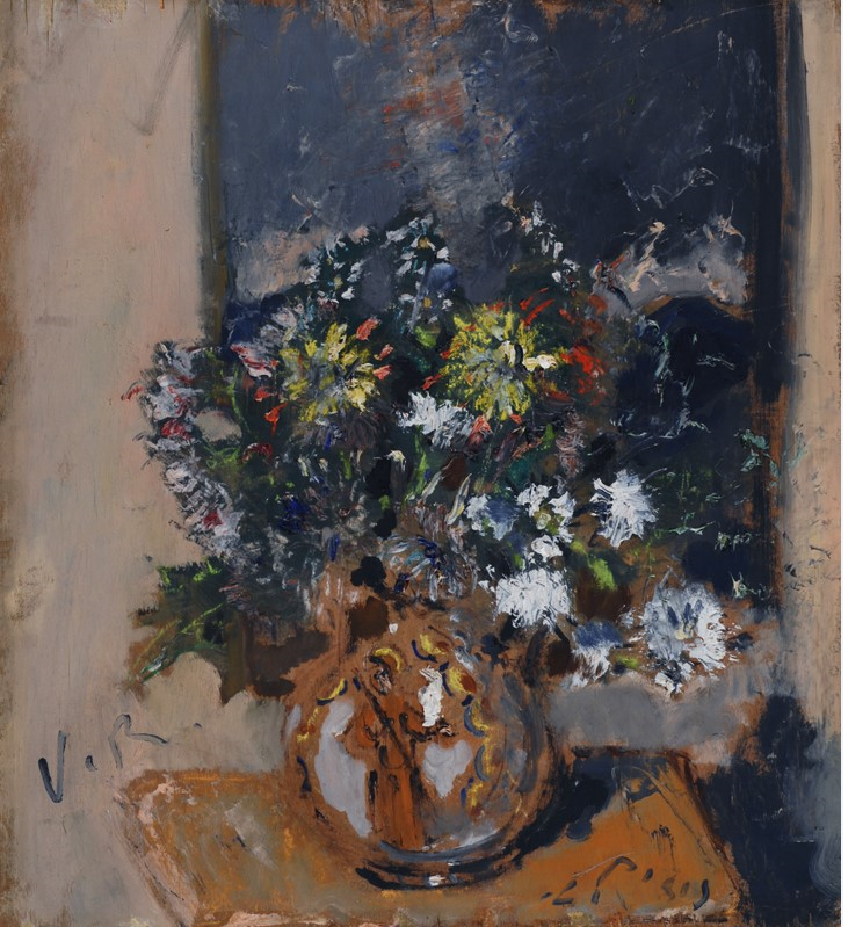
Vaso con fiori is a still-life painting by Italian painter and poet Filippo De Pisis, created in 1941. The work depicts flowers arranged in a vase, exemplifying the genre for which De Pisis earned considerable recognition throughout his artistic career.
De Pisis brought a distinctive sensibility to the still-life form, combining meticulous observation with an emotional intensity characteristic of his practice. His floral arrangements possess an airy, immediate quality—a sense of spontaneity captured on canvas. The interplay of light, colour, and form in such works reflects the artist’s broader aesthetic preoccupations: unexpected juxtapositions of scale and spatial relationships that blur the boundary between intimate domestic space and expansive natural world.
About Filippo De Pisis
Born Luigi Filippo Tibertelli in Ferrara in 1896, De Pisis studied literature and philosophy before turning to painting in Rome around 1919. He became known for cityscapes, metaphysically-inflected maritime scenes, and still lifes—particularly flowers. His work is distinguished by emotional directness and formal sophistication. De Pisis spent his creative life between Rome, Paris, and Venice, dying in 1956.
Details
- Artist: Filippo De Pisis (1896–1956)
- Year: 1941
- Subject: Still life with flowers and vase
- Movement: Italian modernism
On video
Frequently asked questions
Why is De Pisis celebrated for flower paintings?
De Pisis is best known for still lifes, especially those depicting flowers, which showcase his ability to infuse domestic subjects with emotional depth and formal innovation. His floral works possess an airy, in-the-moment quality laden with what he called a kind of pathetic pleasure-pain.
Where did De Pisis spend his career?
De Pisis spent his life moving between Rome, Paris, and Venice, each city influencing his subject matter and artistic development from 1919 until his death in 1956.
What makes his compositions distinctive?
De Pisis created unexpected juxtapositions of scale and space in his still lifes, arranging objects on surfaces that seem to merge seamlessly with landscapes or seascapes beyond, blurring the boundary between intimate interior space and expansive natural world.
Sources
- S1 — Pontiggia, Elena. Il Novecento Italiano. Abscondita, 2003. ISBN 978-88-8416-048-5.
- S2 — Bossaglia, Rossana. Il Novecento italiano. Electa, 1995. ISBN 978-88-435-6178-0.
Spotted an error? Write to editorial@culturalheritageonline.com and we correct it the same day.


