
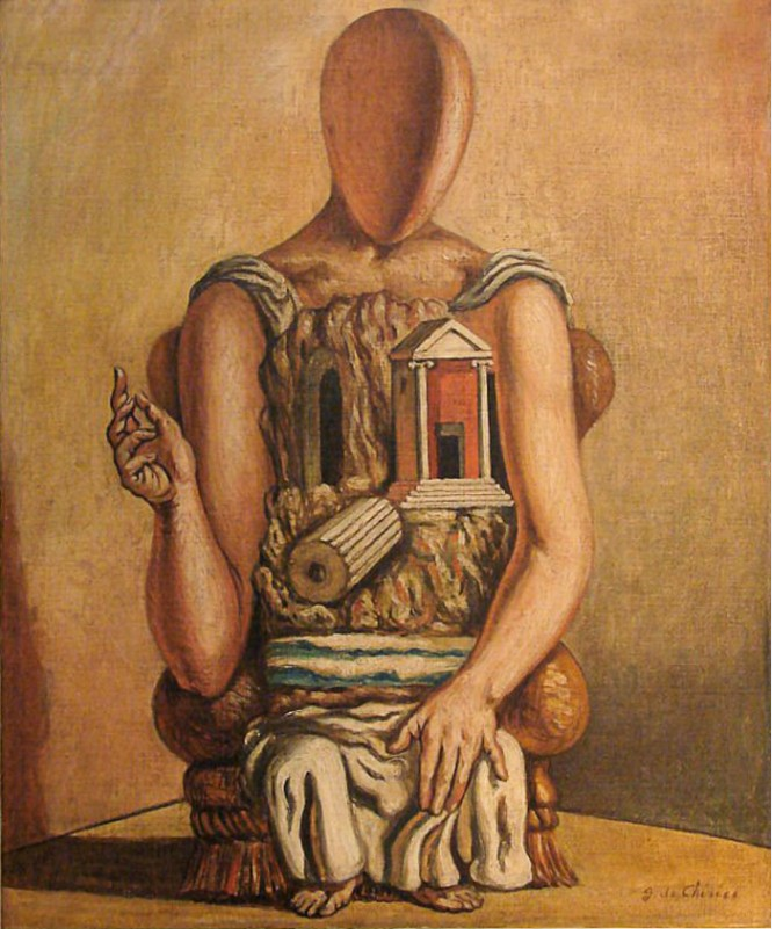
Archeologo solitario is a 1937 painting by Giorgio de Chirico, the Greek-Italian artist and founder of the Scuola Metafisica movement. The work presents a solitary archaeologist in a composition that reflects de Chirico’s characteristic interests in Roman imagery, unusual perspective, and philosophical isolation.
De Chirico’s metaphysical paintings emerged before World War I and profoundly influenced the Surrealists. His art draws on the philosophy of Schopenhauer and Nietzsche, as well as the mythology and classical heritage of his Greek birthplace. Archeologo solitario demonstrates his enduring engagement with archaeological and classical subject matter, rendered through an unsettling spatial logic and contemplative mood. The solitary figure, a recurring motif in de Chirico’s work, embodies the artist’s exploration of human isolation and psychological depth.
About Giorgio de Chirico
De Chirico was born in Volos, Greece, and developed the Scuola Metafisica in the years before World War I. His paintings often feature Roman arcades, long shadows, mannequins, trains, and illogical perspective—elements that became hallmarks of his visionary approach to modern art.
Details
- Artist: Giorgio de Chirico
- Year: 1937
- Movement: Scuola Metafisica
- Subject: Solitary archaeologist
On video
Frequently asked questions
Who created this painting?
Giorgio de Chirico, a Greek-Italian artist and founder of the Scuola Metafisica movement, painted Archeologo solitario in 1937.
What is the Scuola Metafisica?
The Scuola Metafisica was an art movement founded by de Chirico before World War I that profoundly influenced the Surrealists through its exploration of dreamlike spaces, unusual perspective, and psychological isolation.
What themes recur in de Chirico’s work?
De Chirico’s paintings frequently feature Roman arcades, long shadows, mannequins, trains, and illogical spatial arrangements, reflecting his interests in classical mythology, Schopenhauer’s philosophy, and the intellectual landscape of his Greek heritage.
Sources
- S1 — Pontiggia, Elena. Il Novecento Italiano. Abscondita, 2003. ISBN 978-88-8416-048-5.
- S2 — Bossaglia, Rossana. Il Novecento italiano. Electa, 1995. ISBN 978-88-435-6178-0.
Spotted an error? Write to editorial@culturalheritageonline.com and we correct it the same day.


