
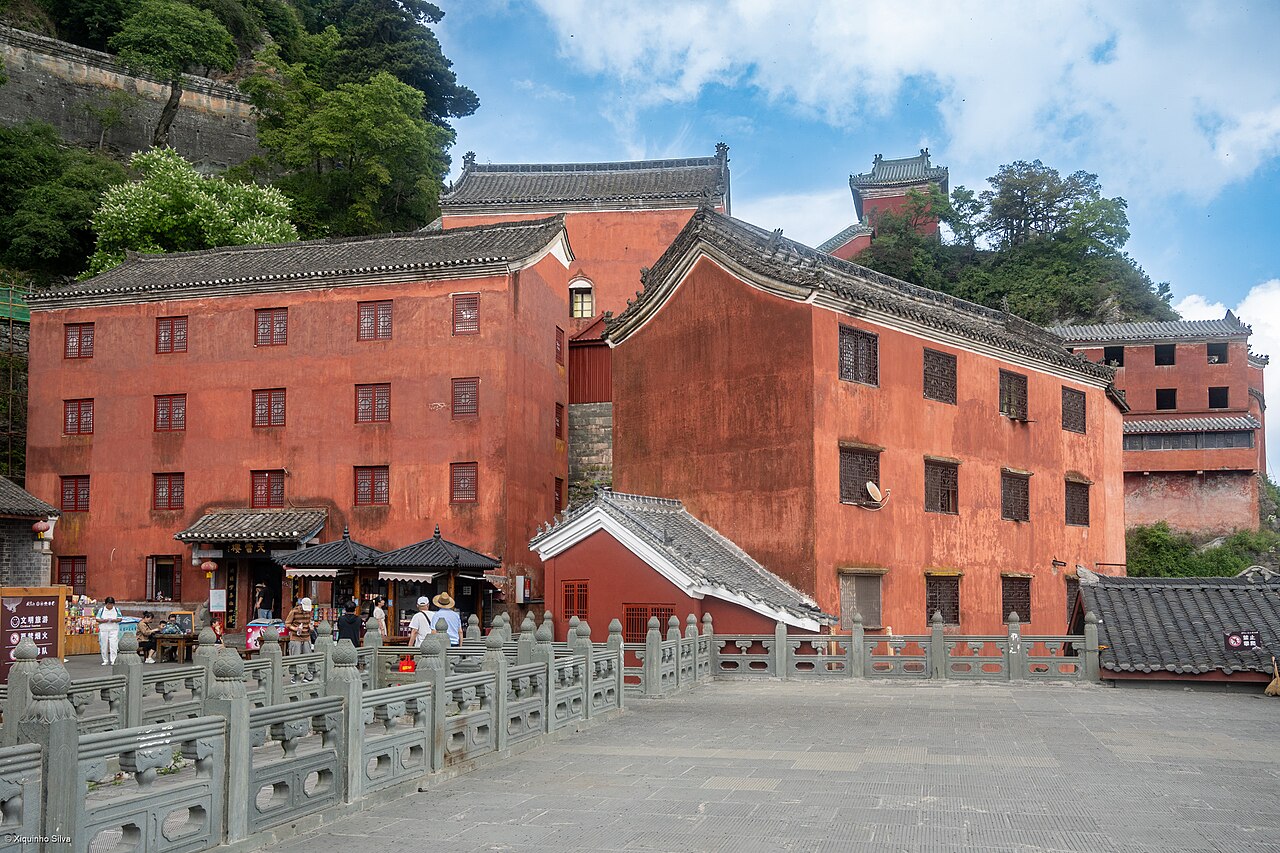
The Ancient Building Complex in the Wudang Mountains was inscribed as a UNESCO World Heritage Site in 1994. The complex comprises 53 surviving structures from an original total of 33 architectural groups built across 72 peaks and 36 cliffs between the Tang dynasty (7th century) and the late Ming period; the main construction campaign was ordered by the Yongle Emperor (r. 1402–1424), who dispatched approximately 300,000 workers and soldiers to build the complex between 1412 and 1424 in gratitude for what he described as divine assistance during his military campaign to seize the throne from his nephew. The site is the principal sacred mountain of Taoism in China, dedicated to the deity Xuantian Shangdi (Perfect Warrior), and is credited in the Ming period with being the origin of the Wudang school of internal martial arts, which later traditions identify as the source of taijiquan (tai chi).
Hubei and Henan neighbours: natural reserve and ancient grottoes 300–400 km, 3–4 hours by highway or HSR
Shennongjia National Park was inscribed as a UNESCO World Heritage natural site in 2016, covering 79,058 hectares of mountain forest in western Hubei Province approximately 300 kilometres west of Wudang Mountains by road through Yichang. The park takes its name from the mythological figure Shennong (the Divine Farmer), one of the Three Sovereigns of Chinese mythology, who is said to have tested and classified medicinal plants in these mountains; a plank-road monument 500 metres above the valley floor at Shennongjia marks the traditional site of his work. The UNESCO inscription recognises Shennongjia as one of China’s most intact examples of mixed humid and continental forest ecosystems spanning an altitudinal range from 420 to 3,105 metres (Shennong Peak); the park contains the largest intact primary forest remaining in central China and supports populations of the clouded leopard, Asian black bear, golden pheasant and the Shennongjia golden monkey (a subspecies of the golden snub-nosed monkey), whose population of approximately 1,300 individuals is endemic to the Shennongjia highlands. The forest also contains approximately 3,767 recorded plant species, including 26 species found nowhere else. The thematic contrast between Wudang and Shennongjia is direct: Taoism’s engagement with the natural world—its cosmological framework of Dao as the underlying pattern of nature, its medical tradition based on plant pharmacology and its cultivation practices that require mountain retreat—makes the Shennongjia forest landscape legible as a context for, rather than a departure from, the Wudang complex. Several Taoist hermits historically chose Shennongjia as a retreat location precisely because its extreme remoteness and forest density made it continuous with the mountain-wilderness ideal that the Wudang temples architecturally celebrated. The Longmen Grottoes at Luoyang were inscribed in 2000 and contain approximately 100,000 Buddhist figures carved into limestone cliffs along the Yi River, with the main concentration spanning the period from 493 CE (Northern Wei) to 755 CE (Tang). Luoyang is approximately 400 kilometres northeast of Wudang, reachable in approximately 3.5 hours by high-speed rail from Shiyan (the nearest HSR city to Wudang, 60 km north by expressway) via Zhengzhou. The Longmen inscription’s interest in the context of a Wudang visit lies in the contrast it provides: where Wudang documents the Taoist tradition’s imperial patronage under the Ming Yongle Emperor, Longmen documents the Buddhist tradition’s equivalent imperial patronage in the Tang period, when Empress Wu Zetian (r. 690–705 CE) sponsored the carving of the colossal Vairocana Buddha at Fengxian Si (completed 675 CE, head 4 metres tall, ears 1.9 metres long). The two traditions—Buddhism and Taoism—were in sustained dialogue and competition throughout Chinese history, and visiting both sites in sequence gives the intellectual conflict concrete spatial form: the Longmen Buddha whose ears were measured to ensure they exceeded all previous images, and the Wudang temples whose construction documentation records the number of craftsmen by specialty (7,000 lacquerers, 3,500 carpenters, etc.) as proof of imperial commitment.
Southwest and southeast extensions: Dazu and the Yangtze 200–600 km, 2–5 hours by road or HSR
The Dazu Rock Carvings in Chongqing Municipality were inscribed in 1999 and comprise 75 sites of Buddhist, Taoist and Confucian devotional carving across the Dazu County hills, with the main concentrations at Beishan (begun 892 CE) and Baoding Shan (begun 1177 CE). Dazu is approximately 600 kilometres west of Wudang by road, reachable in approximately 5 hours by high-speed rail from Shiyan via Chengdu; alternatively, from Wuhan (Hubei’s capital, 400 km east of Wudang) there are direct HSR services to Chongqing North in approximately 4 hours. The Baoding Shan sculptural program is the most densely conceived of any Chinese rock-carving site: the founder, Zhao Zhifeng, designed it over 70 years as a single unified doctrinal exposition carved into a U-shaped cliff, covering the full narrative from the Buddha’s life through the hells and purgatory scenes to the paradise realms in a continuous circuit of approximately 500 metres. The Parinirvana of the Buddha at Baoding is a reclining figure 31 metres long; the Wheel of Reincarnation scene, 7 metres in diameter, is accompanied by verse inscriptions explaining each symbolic element, making it function as a carved doctrinal textbook for a largely illiterate audience—a pedagogical technique that Zhao Zhifeng developed in direct response to his observation that painted temple murals were too easily damaged to serve as permanent teaching tools. The Taoist dimension of Dazu (Beishan’s more eclectic program includes Taoist deities carved alongside Buddhist figures) provides a further connection to Wudang’s Taoist context; the site overall demonstrates the doctrinal syncretism of Song and Yuan-period religious practice in which the boundaries between Buddhism, Taoism and Confucianism were deliberately blurred in public devotional art. The Three Gorges of the Yangtze River, while not inscribed as a UNESCO World Heritage Site, occupy the geography between Wudang and Dazu in a corridor approximately 200 kilometres south of Wudang by road through Yichang. The Three Gorges Dam, completed 2009 at Sandouping near Yichang, created a reservoir 660 kilometres long that permanently inundated approximately 1,300 archaeological sites and the historic townscapes of more than 100 towns; the Yangtze River Cruise between Chongqing and Yichang (3 days downstream, 4 days upstream, offered by multiple operators) passes through the Qutang, Wu and Xiling gorges and connects the Wudang area with the Dazu area by water as well as by land, though the geography requires accepting Wuhan or Yichang as a base for Wudang and Chongqing as a base for Dazu rather than treating the cruise as a direct Wudang–Dazu connection.
Practical information
The Wudang Mountains are in Shiyan municipality, Hubei Province. The nearest high-speed rail station is Wudangshan station (not to be confused with Shiyan station) on the Zhengzhou–Chengdu HSR line, opened 2019, which places Wudang within 3.5 hours of Luoyang, 2.5 hours of Zhengzhou and approximately 5 hours of Chengdu. From Wuhan, the connection via Xiangyang or Shiyan takes 2–3 hours depending on service. The Wudang site has two main access points: Wudangshan town at the foot of the mountain (where most accommodation is located) and the scenic area entrance gate 5 kilometres from town. A scenic area shuttle bus connects the entrance to the main temple clusters and the cable car base for the ascent to the Golden Summit (Jinding), the highest and most significant site at 1,612 metres. The cable car takes 8 minutes from its lower station to the ridge above the Golden Hall complex; the ascent on foot via the Ancient Road takes 3–5 hours from the mountain base and is the traditional pilgrim route, lined with Tang and Ming-period shrines and inscription stelae. The Golden Hall itself, cast in bronze in Nanjing in 1416 and transported to the summit in sections, covers 4.4 metres by 5.8 metres at its base; its perfect preservation over 600 years in an exposed summit location is attributed to a lightning-rod effect of the surrounding iron-chain enclosure installed in the Ming period.
March to May and September to November are the recommended months; summer (June–August) brings heat and high humidity in the valleys, though the summit remains cooler. The Wudang Martial Arts Festival in late September attracts practitioners of Wudang-style taijiquan and internal martial arts from across China; accommodation books up several weeks in advance for that period. The main trail from the Taihe Palace at the mid-mountain to the Golden Summit takes approximately 1.5 hours on foot and is the standard visitor circuit; allow a full day for a comfortable visit including cable car descent.
Frequently Asked Questions
Who was the Yongle Emperor and why did he build the Wudang complex?
The Yongle Emperor (Zhu Di, r. 1402–1424) was the third emperor of the Ming dynasty and came to power through the Jingnan campaign (1399–1402), a civil war in which he, as the Prince of Yan (based in present-day Beijing), defeated the armies of his nephew, the Jianwen Emperor, who had attempted to curtail the power of the imperial princes. The campaign lasted four years and Zhu Di’s victory was not militarily inevitable at several points; the official court history of the reign records that the deity Xuantian Shangdi (the Perfect Warrior, Wudang’s patron deity) appeared to the prince in a vision during a critical battle and provided supernatural assistance. The Wudang construction project was the Yongle Emperor’s formal acknowledgement of this debt: the imperial rescript of 1412 ordering the construction explicitly states that Wudang should be built as an act of gratitude to Xuantian Shangdi for divine support during the military campaign. The practical scale was enormous: Ming administrative records preserved in the Wudang archives document the deployment of approximately 300,000 workers and soldiers over a 12-year period from 1412 to 1424, with craftsmen brought from across China and materials (timber, stone, bronze, lacquer) transported overland and by river. The Yongle Emperor simultaneously ordered the construction of the Forbidden City in Beijing (begun 1406, completed 1420) and the dispatch of Zheng He’s ocean voyages (1405–1421); the Wudang project was thus concurrent with two of the largest construction and exploration enterprises in Chinese history, reflecting a reign whose resources and ambitions were exceptional by any standard. The emperor died in 1424 before personally visiting the completed Wudang complex.
What is the Wudang school of martial arts and what is its connection to taijiquan?
The Wudang school (Wudang pai) refers to a tradition of internal martial arts (neijia quan) associated with Wudang Mountain and distinguished by emphasis on the cultivation of internal energy (qi) and soft yielding technique over muscular strength. The tradition is attributed in late Ming and Qing texts to a semi-legendary figure, Zhang Sanfeng, whose dates are given variously as 12th, 13th or 15th century CE depending on the source; the historical evidence for Zhang Sanfeng is thin, but his association with Wudang and with the development of taijiquan became canonical in the 19th century when Wudang taijiquan was distinguished from the Chen family’s lineage of taijiquan (developed in Chenjiagou village, Henan Province, from the 17th century onward). Modern scholarship generally regards the Wudang origin story as a retroactive legitimising narrative—taijiquan historians identify the Chen village lineage as the documentable origin of the art—but the Wudang tradition has developed its own distinct syllabus that emphasises internal cultivation practices (zhan zhuang standing meditation, qi cultivation through the Wudang taiji 13 posture form) adapted to the Taoist context of the mountain. Today, the Wudang scenic area contains numerous registered martial arts schools offering training programmes from 3-day introductions to multi-month residential courses. The training focus is Wudang-style taijiquan, bagua zhang and Wudang sword, all framed within the Taoist internal cultivation philosophy of the mountain. The martial arts dimension adds a living-practice layer to the architectural heritage visit: monks in residence at the Taihe Palace and Purple Cloud Palace (Zixiao Gong) maintain daily training schedules that visitors can observe in the early morning hours before the general tourist circuit begins.
How are the Dazu Rock Carvings different from other Chinese Buddhist rock-carving sites?
Chinese Buddhist rock-carving sites fall into two broad categories: those that grew organically over centuries through the accumulation of individual donor gifts (Mogao at Dunhuang, Yungang in Shanxi, Longmen at Luoyang) and those that were conceived as unified doctrinal programs by a single directing intelligence. Dazu’s Baoding Shan falls into the second category in a way that has no parallel among UNESCO-inscribed Chinese sites. Zhao Zhifeng (1159–1249 CE), a Buddhist monk who studied under the Southern Song tantric master Feng Zhiliang, designed and supervised the entire Baoding program from approximately 1177 CE until his death, producing a coherent iconographic sequence in which every figure’s position, gesture and accompanying inscription was predetermined by doctrinal logic rather than accumulated independently. The program circles a U-shaped cliff approximately 500 metres in perimeter and covers the complete doctrinal arc from agricultural life (the Farming and Silk scene, depicting rural labour as a form of dependent origination teaching), through the hells (the Hell realm panel with its vivid punishment scenes designed to discourage specific sins by depicting their consequences in concrete visual form), to the Parinirvana of the Buddha (the 31-metre reclining figure whose feet protrude beyond the cliff face). The Beishan site, older than Baoding and begun in 892 CE as a military votive complex, grew organically through Tang, Five Dynasties, Song and later patronage and reflects the more typical accumulative model; it contains some of the finest Song-period Buddhist sculpture in China alongside Taoist figures that document the doctrinal syncretism of the period. Visiting both Beishan and Baoding in a single Dazu day makes the contrast between organic accumulation and unified design immediately visible as a material difference in surface density and iconographic coherence.
Sources
- S1 — UNESCO World Heritage Centre — Ancient Building Complex in the Wudang Mountains (Ref. 705) — https://web.archive.org/web/20230601000000/https://whc.unesco.org/en/list/705/
- S2 — Wudang Mountains Special Economic Zone Tourism Bureau — https://whc.unesco.org/en/list/705/
- S3 — Kuhn, Dieter. <em>The Age of Confucian Rule: The Song Transformation of China</em>. Harvard University Press, 2009. ISBN: 978-0-674-03661-1.
Spotted an error? Write to editorial@culturalheritageonline.com and we correct it the same day.


.jpg)