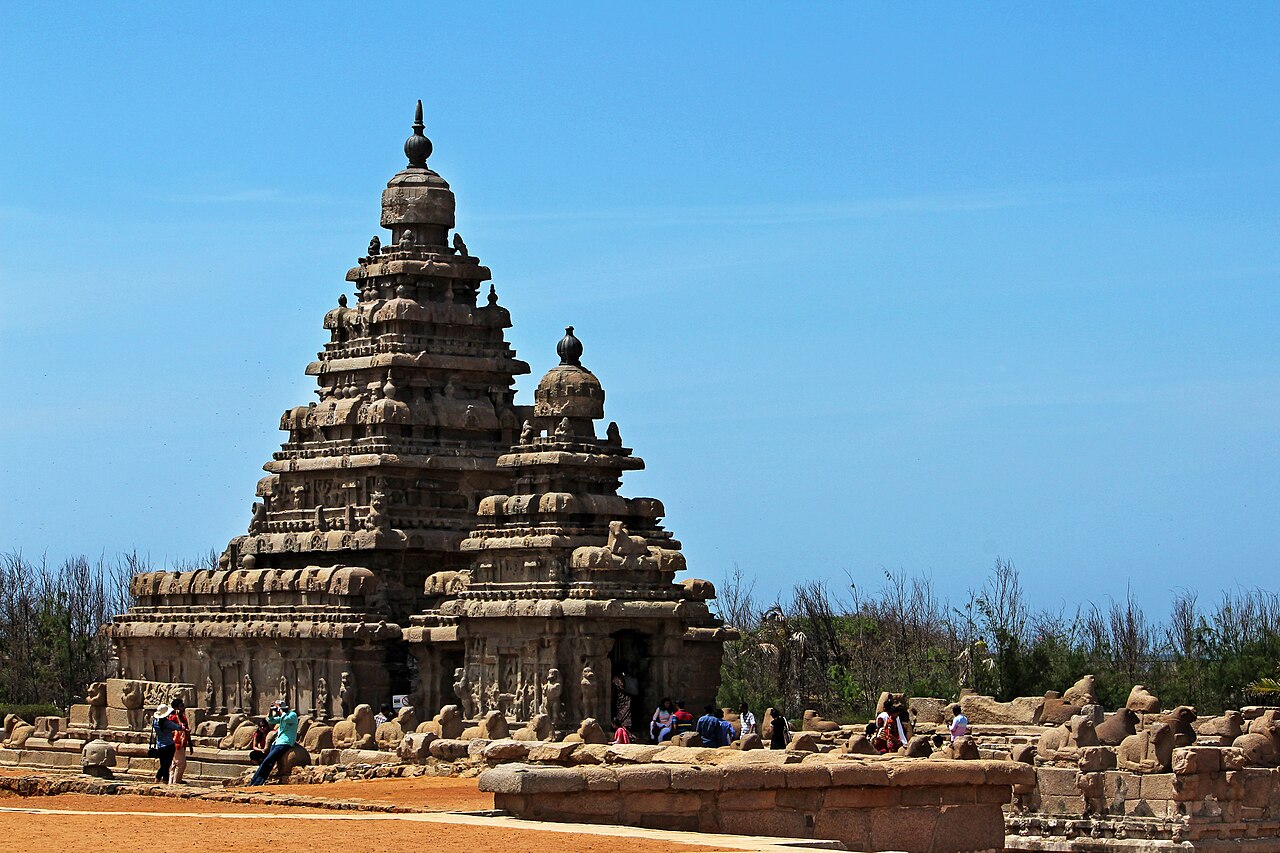
The Group of Monuments at Mahabalipuram (Mamallapuram, மாமல்லபுரம்), inscribed by UNESCO in 1984, is a complex of 7th–8th century CE Pallava dynasty rock-cut temples, cave sanctuaries, open-air bas-reliefs, and structural temples at Mahabalipuram (60 km south of Chennai on the Coromandel Coast), created primarily under the rule of Narasimhavarman I “Mamalla” (r. approximately 630–668 CE) and his successor Narasimhavarman II “Rajasimha” (r. approximately 700–728 CE) — the earliest structural stone temples in South India, and one of the foundational sites of the entire Dravidian temple architecture tradition that continued to develop in the Chola, Pandya, and Vijayanagara kingdoms for the following 800 years. The site’s defining monuments include: the Shore Temple (approximately 728 CE, a multi-spired structural temple of dressed granite blocks overlooking the Bay of Bengal — the waves have eroded the lower portions of its carved surfaces over 1,300 years but the five distinct shikhara towers rising from the beachfront remain the most photographed image in Tamil Nadu); the Descent of the Ganges / Arjuna’s Penance (the world’s largest open-air bas-relief — a cliff face 27 m × 9 m carved with approximately 100 life-size and larger figures of gods, humans, and animals descending towards a natural fissure in the rock that represents the sacred river — the most ambitious compositional achievement in Indian narrative relief sculpture); and the Five Rathas (five monolithic rock-cut temples each carved from a single granite boulder, named after the five Pandava brothers of the Mahabharata, each demonstrating a different regional temple architecture form).
The Mahabalipuram monument complex and the Tamil Nadu coastal heritage corridor Shore Temple · Five Rathas · Descent of the Ganges · Kanchipuram · Chennai — 0 to 75 km
The Mahabalipuram complex rewards slow exploration across approximately half a day — the principal monuments are distributed across the rocky coastal terrain, with the Shore Temple (on the beach), the Descent of the Ganges relief (approximately 500 m inland), and the Five Rathas (approximately 1 km south of the Shore Temple) forming the three principal poles of the site visit. The Shore Temple (approximately 728 CE, commissioned by Narasimhavarman II Rajasimha) is the most significant structural temple at the site — three shrine chambers (two dedicated to Shiva, one to Vishnu) enclosed in an elegant compound of carved wall panels and secondary shrines, the granite ashlar masonry of its towers weathered to a silhouette that is simultaneously ancient and serene against the Bay of Bengal horizon. The Descent of the Ganges relief (alternatively titled Arjuna’s Penance — scholars debate which of two epic narratives the central composition depicts, though both interpretations are supported by specific iconographic details within the frieze) is the most intellectually overwhelming monument at Mahabalipuram: standing at its base and looking up at the 27-metre canvas of carved granite (approximately 9 m in height from ground level at its base), the viewer encounters the full hierarchy of the Hindu cosmos in a single continuous composition — the Naga serpent king and queen emerging from the fissure that represents the Ganges, celestial beings (gandharvas, kinnaras, apsaras) floating above the clouds, a life-size elephant family descending in procession, and in one corner a famous scene of a cat performing austerities (mimicking the sage posture of the central ascetic figure) while mice cavort below it, in a vein of humour rare in monumental sculpture. The Five Rathas (unfinished — the Pallava workshop that created them appears to have been interrupted before the temples could be formally consecrated, as the rear faces of several rathas are still partially uncarved) demonstrate five distinct South Indian architectural forms: the Draupadi Ratha (the smallest, a thatched hut form), the Arjuna Ratha (a two-storey Dravidian tower), the Bhima Ratha (barrel-vaulted oblong plan), the Dharmaraja Ratha (the tallest, three-storey, the model for later gopuram gateway towers), and the Nakula-Sahadeva Ratha (apsidal plan, with a full-scale elephant carved from the boulder beside it).
Kanchipuram (approximately 75 km northwest of Mahabalipuram by road, accessible by bus or car) is the Pallava dynastic capital and the complementary heritage site for understanding the Mahabalipuram monuments in their full context — the Kailasanatha Temple at Kanchipuram (720–728 CE, built by Narasimhavarman II simultaneously with the Shore Temple at Mahabalipuram) is the finest surviving Pallava structural temple, its pink sandstone compound wall lined with individual shrine niches each containing a different iconographic elaboration of Shiva, in a theological programme that the Shore Temple’s Mahabalipuram counterpart continues. Chennai (60 km north of Mahabalipuram on the East Coast Road) is the nearest major airport hub. The Tamil Nadu government has invested significantly in infrastructure connecting the Mahabalipuram–Kanchipuram–Thanjavur (Chola Temples, UNESCO 1987) coastal and interior heritage corridor, making multi-site day trips feasible by hired car.
Practical information
Mahabalipuram (Mamallapuram) is 60 km south of Chennai on the East Coast Road (ECR), approximately 1.5 hours by road in normal traffic (longer during Chennai rush hours). From Chennai International Airport, taxis run directly (approximately 1.5–2 hours, metered or app-based). The major monuments are managed by the Archaeological Survey of India (ASI). The Shore Temple complex is open daily 06:00–18:00; admission fee applies (foreign visitors). The Descent of the Ganges relief and most cave temples are open-air and can be viewed freely from dawn to dusk. The Five Rathas area is a separate ASI site with its own admission. Visiting time: allow 4–5 hours for all major monuments at a comfortable pace; a focused 2.5-hour visit covers Shore Temple, Descent of the Ganges, and the Five Rathas. The beach immediately adjacent to the Shore Temple is pleasant in the early morning before tourist activity builds. Best visiting season: October–February (temperatures 24–32°C, post-monsoon clarity; Tamil Nadu’s northeast monsoon brings heavy rainfall October–December — verify conditions before planning). Mahabalipuram has a growing accommodation sector with boutique hotels and beach resorts on the ECR strip north and south of the monument area. Sculpture workshops and stone carving demonstrations are a local tradition since the Pallava period — the artisan quarter is still active.
Frequently Asked Questions
What are the Five Rathas at Mahabalipuram and why are they historically important?
The Five Rathas (Pancha Rathas, “five chariots” in Sanskrit — named after the five Pandava brothers and their shared wife Draupadi from the Hindu epic Mahabharata, although the naming is a later popular attribution rather than original Pallava nomenclature) are five monolithic rock-cut temples at the southern end of the Mahabalipuram complex, each carved from a single large granite boulder (not assembled from blocks — the carver began at the top and carved downward, removing material progressively until the temple form emerged from the living rock, the same rock-cutting technique used for the cave temples but extended to create a three-dimensional freestanding temple form). Their historical importance is extreme: the Five Rathas are the most comprehensive single-site demonstration of the range of South Indian temple architecture forms at their earliest datable period of development (approximately 630–668 CE, the reign of Narasimhavarman I “Mamalla”), each ratha demonstrating a different architectural plan and roof form that would subsequently develop into the major traditions of Dravidian temple architecture over the next 900 years. The Arjuna Ratha (approximately 10 m in height, a two-storey structure with a Dravidian tower form that is the prototype for the later gopuram gateway tower tradition of Tamil Nadu temple architecture) and the Dharmaraja Ratha (the tallest of the five at approximately 12 m, three storeys, with corner turrets and a stacked pyramidal tower) are the two most architecturally influential. The Bhima Ratha (barrel-vaulted oblong form, resembling a Buddhist chaitya hall form translated into Hindu monumental stone) demonstrates the persistence of the earlier Buddhist architectural vocabulary in this Pallava period. The Nakula-Sahadeva Ratha (apsidal plan, approximating the earlier Buddhist barrel-vault chaitya form from the opposite axis) is accompanied by a full-size elephant carved from a separate boulder — the elephant being an important element of the royal iconographic programme at Mahabalipuram, as Narasimhavarman I’s title “Mamalla” (“great wrestler”) commemorates his personal victory over the Chalukya ruler Pulakesi II in single combat, and the Pallava royal imagery is replete with elephant symbolism. The rathas are unfinished — the carving of the interior shrine chambers was never completed, and the rear faces of several rathas show the work in progress state — which is archaeologically significant because it reveals the Pallava workshop method: the exterior forms were carved first (from top down), the interior chambers were to be carved from a separate excavation process. The interruption of the work (possibly due to the death of the patron, Narasimhavarman I, in approximately 668 CE) means the Five Rathas are the rare case of a monument preserved in its construction process rather than at completion.
What is the Shore Temple and why is it significant in the history of South Indian architecture?
The Shore Temple (approximately 700–728 CE, built by the Pallava ruler Narasimhavarman II “Rajasimha”, also known as “Pallava Malla”) is significant for a specific architectural-historical reason: it is the earliest surviving structural temple in South India built of dressed stone blocks (as opposed to rock-cut temples hewn directly from natural outcrops or living rock). The distinction between rock-cut and structural temple architecture in South Indian architectural history is fundamental — the same Pallava workshop at Mahabalipuram that created the rock-cut cave temples and the Five Rathas monoliths under Narasimhavarman I also developed the structural stone block temple under Narasimhavarman II, and the Shore Temple is the earliest surviving example of this structural tradition. The Shore Temple’s architectural composition (three distinct sanctuary chambers in a linear arrangement — Shiva lingam facing east, Shiva lingam facing west, and Vishnu Anantasayin shrine facing the Bay of Bengal, each with its own tower form in Dravidian style, the composite ensemble surrounded by a compound wall with a carved capstone parapet of miniature bull (nandi) figures alternating with pilasters) established the standard plan that Chola, Pandya, and later Tamil temple builders elaborated over the following centuries. The Shore Temple’s most important context is geological: the Bay of Bengal’s waves have been eroding the granite at its base since 728 CE, and the lower portions of the compound wall panels (which originally bore carved images similar to those at the Kailasanatha Temple at Kanchipuram) are now largely obliterated by 1,300 years of salt spray and wave action. The ASI built a granite seawall in the 1990s to protect the remaining foundation, and UNESCO-funded monitoring has documented the rate of stone surface loss. After the 2004 Indian Ocean tsunami, which temporarily receded the ocean from the shore near the temple and revealed underwater stone structures (possibly submerged Pallava monuments, supporting the medieval Tamil literary tradition of “seven pagodas” at Mahabalipuram of which only one survives above water), the Archaeological Survey of India launched an underwater excavation project that has confirmed the presence of structured stone elements submerged approximately 50 m offshore — possibly remains of additional shore temples or a Pallava harbour structure.
EXCERPT: Group of Monuments at Mahabalipuram, UNESCO-inscribed in 1984, is the foundational site of South Indian temple architecture — the Shore Temple’s five granite spires at the Bay of Bengal, the world’s largest open-air bas-relief (27m × 9m Descent of the Ganges with 100 carved figures), and five monolithic rathas each demonstrating a different Pallava architectural form, 60 km south of Chennai.
META: UNESCO World Heritage Sites near Group of Monuments at Mahabalipuram Tamil Nadu India: Great Living Chola Temples Thanjavur 300 km south (UNESCO 1987), Hampi 650 km northwest (UNESCO 1986), Pattadakal 700 km northwest (UNESCO 1987) — Tamil Nadu–Karnataka UNESCO heritage corridor from Mahabalipuram through Chennai and the Coromandel Coast to Kanchipuram (Pallava capital) and south to Thanjavur (Chola capital).
Sources
- S1 — UNESCO World Heritage Centre — Group of Monuments at Mahabalipuram (Ref. 249) — https://web.archive.org/web/20230601000000/https://whc.unesco.org/en/list/249/
- S2 — UNESCO World Heritage Centre — Statement of Outstanding Universal Value (Ref. 249) — https://whc.unesco.org/en/list/249/
Spotted an error? Write to editorial@culturalheritageonline.com and we correct it the same day.