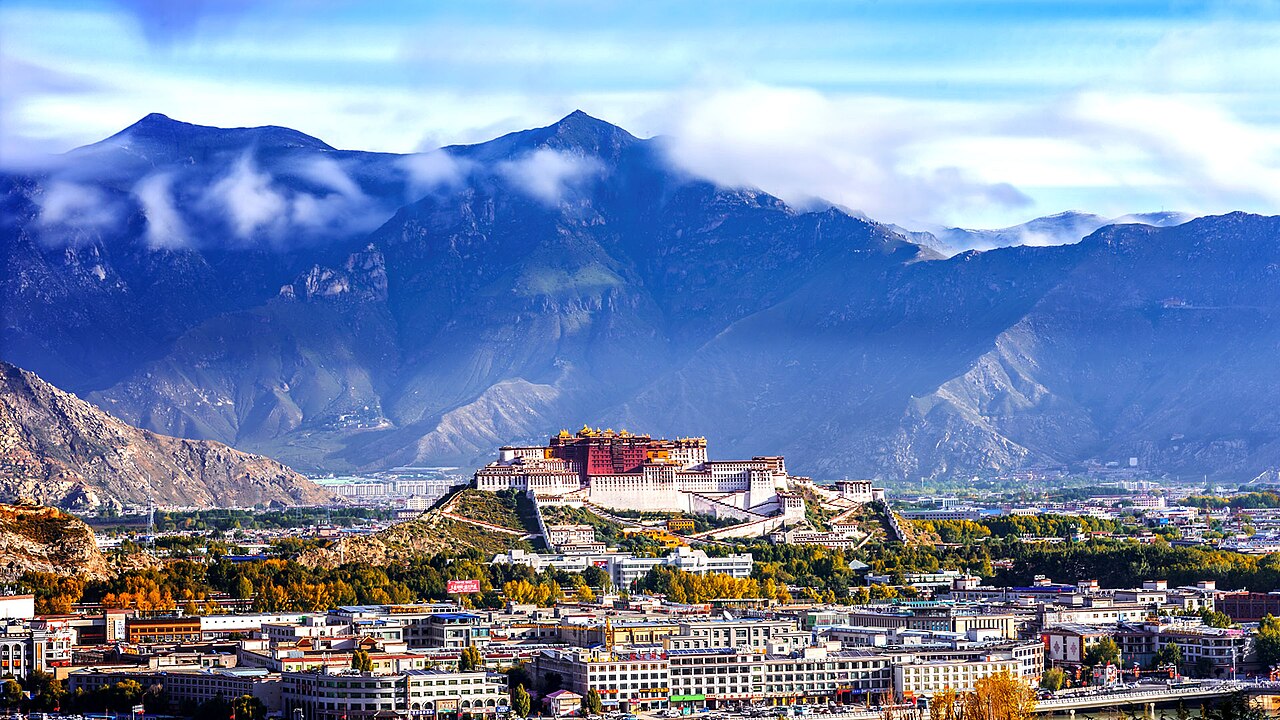
The Historic Ensemble of the Potala Palace in Lhasa was inscribed as a UNESCO World Heritage Site in 1994, with the Jokhang Temple added in 2000 and the Norbulingka Summer Palace in 2001, bringing the serial inscription to three components. The Potala Palace is a 13-storey structure on Marpo Ri hill rising 117 metres above the valley floor to an elevation of 3,767 metres; it was built in its current form beginning in 1645 by the Fifth Dalai Lama on the site of an earlier 7th-century fortress erected by Songtsen Gampo, who is credited with unifying the Tibetan plateau. The Red Palace wing, completed 1694, contains the gilded stupas (chortens) of eight Dalai Lamas from the Fifth to the Thirteenth, which collectively contain 3,717 kilograms of gold according to Tibetan administrative records.
The three components of the Lhasa inscription 0.6 km and 2.5 km from the Potala Palace
The Jokhang Temple stands 0.6 kilometres east of the Potala Palace in the old Barkhor district, reachable on foot through the Barkhor market circuit that pilgrims circumambulate clockwise year-round. Founded traditionally in 647 CE by Songtsen Gampo to house the Jowo Rinpoche—a statue of the young Shakyamuni Buddha said to have been brought to Tibet by the Nepali princess Bhrikuti as part of her marriage dowry—the Jokhang is regarded as the most sacred site in Tibetan Buddhism. The current structure dates principally from the 7th century with substantial reconstruction in the 13th, 15th and 17th centuries; the roof terraces feature gilded ornaments whose style reflects a synthesis of Tang Chinese, Nepali and Central Asian architectural influences active at the time of the temple’s original construction. The Jowo Rinpoche in the innermost chapel, approximately 1.5 metres tall and encased in jewelled offerings accumulated over 13 centuries, receives a continuous queue of pilgrims that operates from before dawn to evening daily; the scale of devotion visible at the Jokhang—prostrations on the stone pavement outside, butter lamps numbering in the hundreds inside, the smell of yak butter and incense in each successive chapel—provides a living-religion dimension that the Potala Palace, closed as a royal residence since 1959, cannot supply in the same way. The Norbulingka Summer Palace lies 2.5 kilometres west of the Potala Palace by road or on foot; it was established in 1755 by the Seventh Dalai Lama as a seasonal retreat and expanded by each subsequent Dalai Lama through the 1950s. The complex covers 36 hectares and contains five palace buildings within a walled garden; the Kelsang Potrang (built for the Seventh Dalai Lama), the Chensel Potrang (built for the Thirteenth Dalai Lama, 1922) and the Takten Migyur Potrang (built for the Fourteenth Dalai Lama, 1954–1956, and the last structure he occupied before going into exile in 1959) are the three most architecturally significant. The Norbulingka is used today as a public park; the palace interiors are open to visitors and contain furnishings and painted murals dating from the 18th through the mid-20th century in a domestic scale that contrasts with the Potala’s monumental public spaces. A full circuit of all three UNESCO components—Potala in the morning (tickets strictly timed and limited to 2,300 visitors per day), Jokhang and Barkhor by mid-day, Norbulingka in the afternoon—is achievable in a single long day but leaves little time for the individual depth each site warrants; two days is the standard recommendation.
Beyond Lhasa: natural and Silk Road heritage along the Qinghai-Tibet corridor 500–3,000 km, by the Qinghai-Tibet Railway or highway
The Qinghai Hoh Xil National Nature Reserve was inscribed as a UNESCO World Heritage natural site in 2017, covering 60,000 square kilometres of the Tibetan Plateau in Qinghai Province approximately 500 kilometres northeast of Lhasa. The reserve is accessible from the Qinghai-Tibet Railway, which passes along its southern boundary: the railway runs 1,956 kilometres from Xining in Qinghai to Lhasa and crosses the Tanggula Pass at 5,072 metres, the world’s highest railway pass. The train journey from Lhasa to Golmud (the nearest functional city to Hoh Xil) takes approximately 12 hours; the reserve itself has no public visitor infrastructure and entry is restricted to scientific and conservation missions, but the railway journey across the plateau passes through terrain that is ecologically continuous with the reserve and offers direct views of the high-altitude plateau landscape at the scale that makes the chiru (Tibetan antelope) migration understandable. Hoh Xil’s significance in the UNESCO context rests on its role as the primary breeding ground for the chiru: the reserve supports approximately 40 per cent of the world’s remaining chiru population, estimated at 200,000 animals in 2017, whose near-extinction through poaching for shahtoosh wool in the 1980s and 1990s (when numbers fell below 20,000) prompted the Chinese government to establish the reserve in 1995 and the railway planners to install animal crossing corridors beneath the track embankments—the first such provision for a large mammal species on a Chinese infrastructure project. The Sichuan Giant Panda Sanctuaries, inscribed in 2006, cover 9,245 square kilometres of mountain habitat in Sichuan Province approximately 2,000 kilometres east of Lhasa; the Qinghai-Tibet Railway terminates at Lhasa but the highway and air corridor to Chengdu (Sichuan’s capital, approximately 2,000 km east) allows this connection by domestic flight in 2.5 hours. The sanctuaries cover the core of the giant panda’s remaining wild habitat across Qionglai and Jiajin mountain ranges and contain approximately 30 per cent of the world’s wild giant panda population; the UNESCO inscription specifically acknowledges that the site supports the highest density of giant pandas in any protected area. The cultural and natural contrast between Lhasa and the panda sanctuaries—Buddhist monastic civilisation at 3,650 metres and primary bamboo-forest habitat at 1,000–3,500 metres—makes the pairing unusual by proximity guide standards, but the Qinghai-Tibet air and rail corridor links them as a continuous physical geography across the eastern Tibetan Plateau margin. The Silk Roads of the Steppe Corridor and the Dunhuang cave complex lie approximately 3,000 kilometres northwest of Lhasa along routes that cross the Tibetan Plateau’s northern margins through Qinghai and Gansu. Dunhuang’s Mogao Caves (UNESCO 1987) preserve 492 painted cave chapels from the 4th to 14th centuries documenting the artistic and religious exchange between China, Central Asia, India and the Tibetan world at the eastern end of the Silk Road; the iconographic parallels between Mogao’s Tibetan-period paintings (from the Tibetan occupation of Dunhuang, 781–848 CE) and the mural programs of Lhasa’s Jokhang Temple make a Dunhuang visit one of the most intellectually coherent extensions of a Lhasa itinerary, even if the distance requires a separate trip.
Practical information
Lhasa is accessible by air from Beijing, Shanghai, Chengdu, Chongqing and Xi’an, with Chengdu offering the most frequent connections (approximately 2.5 hours flying time); or by the Qinghai-Tibet Railway from Xining (22 hours) or Beijing (40+ hours). All visitors to Tibet Autonomous Region require a Tibet Travel Permit in addition to a Chinese visa; the permit is not available to travellers booking independently and must be arranged through a registered Tibet travel agency, which also designs the official itinerary. Permit processing takes 10–20 business days; apply before purchasing flights. The altitude of Lhasa (3,650 metres above sea level) causes symptoms of acute mountain sickness in a significant proportion of visitors during the first 24–48 hours: headache, fatigue, nausea and disturbed sleep are common and generally resolve without medication if the traveller rests, stays well hydrated, and avoids alcohol and strenuous activity on arrival. Pharmacies in Lhasa stock acetazolamide (Diamox) and traditional Tibetan altitude remedies; most tour groups allow an acclimatisation day before beginning temple visits. The Potala Palace tickets are strictly managed at 2,300 visitors per day, divided between morning and afternoon sessions; pre-booking through the official Tibet tourism platform or through a registered agency is obligatory. The Jokhang Temple imposes no daily limit but entry queues during peak season (May–October) can be 30–60 minutes. May to October is the main tourist season; winters are cold (temperatures below −10°C at night) but the plateau air is clear and crowds are minimal.
Frequently Asked Questions
What is the Red Palace inside the Potala Palace and which chapels were sealed for 300 years?
The Potala Palace is structurally divided into two wings by colour and function. The White Palace (Podrang Karpo) forms the lower and larger portion and served as the administrative and residential quarters of the Dalai Lamas from the 17th century onward: it contains audience halls, residential apartments, offices and the printing house that produced the official religious texts used across Tibetan Buddhism. The Red Palace (Podrang Marpo) rises above the White Palace at the centre and is the purely religious zone, containing the main assembly halls, chapels dedicated to specific deities and protectors, and the gilded chorten stupas of eight Dalai Lamas from the Fifth (Ngawang Lobsang Gyatso, 1617–1682) to the Thirteenth (Thubten Gyatso, 1876–1933). The Fifth Dalai Lama’s stupa is the largest, 14.85 metres high and gold-encased; its construction in 1694 required 3,721 kilograms of gold (some sources give the total for all eight stupas combined as 3,717 kg—Tibetan records use both figures in different documents). The chapels that were sealed relate primarily to restricted tantric practices: certain innermost chapels in the Red Palace were accessible only to the Dalai Lama and senior monks performing specific rituals, and their contents were not documented in texts available to outside observers. Chinese administrative records from the 1950s–1960s, drawn up after the Chinese People’s Liberation Army took control of the palace in 1959, described finding sealed rooms whose interiors appeared not to have been entered for generations; the precise duration of any given sealing is not uniformly documented across sources. The palace has been open to tourists as a museum since 1980, with visitor numbers managed from 2002 onward and reduced to the current daily limit of 2,300 from 2012 to protect the interior decoration and murals from moisture damage caused by visitor respiration.
How does the Qinghai-Tibet Railway manage the altitude and what precautions does it take for passengers?
The Qinghai-Tibet Railway (Qing-Zang Railway) runs 1,956 kilometres from Xining in Qinghai Province to Lhasa, with the section from Golmud to Lhasa (1,142 km, completed July 2006) entirely above 4,000 metres for most of its length. The summit at Tanggula Pass reaches 5,072 metres, where the train slows but does not stop. The railway addressed the altitude challenge for passengers through a supplemental oxygen system built into each passenger car: oxygen is piped directly to individual outlets above each seat and berth, allowing passengers who feel symptomatic to increase their personal oxygen supply without leaving their seat. The cars are sealed and pressurised to approximately the equivalent of 3,600 metres altitude (roughly Lhasa’s elevation) rather than the outside ambient altitude, which reduces but does not eliminate the altitude effect. Train staff are trained in basic altitude sickness response and carry medical oxygen cylinders in each car. Despite these measures, a proportion of passengers—estimated at 30–50 per cent in the absence of preventive medication—experience symptoms during the Golmud–Lhasa segment; those who are at higher risk include individuals with pre-existing cardiac or pulmonary conditions, for whom the railway journey is contraindicated and medical clearance is strongly advised before purchase. The journey from Xining takes approximately 22 hours; from Beijing’s West Station, the full journey is approximately 40 hours with a stop in Xining. The train also incorporates 33 wildlife crossing passages beneath the embankment on the Hoh Xil plateau section to allow chiru migration, the first such provision on a Chinese railway project.
What permit do visitors need to enter Tibet, and how do they obtain it?
Entry to the Tibet Autonomous Region (TAR) requires three documents in addition to a standard Chinese tourist visa. The first is the Tibet Travel Permit (also called the Tibet Entry Permit), issued by the Tibet Tourism Bureau in Lhasa; it specifies the destinations approved for the visit and must be carried at all times and presented at checkpoints on roads and at the entrances to major monuments. The second is an Aliens’ Travel Permit (required for destinations outside Lhasa city, including most other regions of Tibet). The third is a Military Area Entry Permit (required for specific border areas, including Everest Base Camp). Independent travel to Tibet is not permitted for foreign nationals; all visits must be arranged through a registered travel agency that obtains the permits on the visitor’s behalf and provides a licensed Tibetan guide. The Tibet Travel Permit application requires a scanned copy of the visitor’s passport and Chinese visa; the agency submits these to the Tibet Tourism Bureau, and permit processing takes 10–20 business days under normal conditions (longer during politically sensitive periods around major anniversaries in March and October). Permits are not available at the Lhasa airport or railway station; visitors who arrive without a valid permit are turned back at the entry checkpoint. Chinese citizens and nationals of Hong Kong, Macau and Taiwan require a separate permit but are not required to use an agency. The permit situation can change at short notice; checking current requirements with a registered Tibet agency 6–8 weeks before departure is the reliable minimum lead time for planning a Lhasa visit.
Sources
- S1 — UNESCO World Heritage Centre — Historic Ensemble of the Potala Palace, Lhasa (Ref. 707) — https://web.archive.org/web/20230601000000/https://whc.unesco.org/en/list/707/
- S2 — Potala Palace Cultural Relics Administration Tibet — https://whc.unesco.org/en/list/707/
- S3 — Kuhn, Dieter. <em>The Age of Confucian Rule: The Song Transformation of China</em>. Harvard University Press, 2009. ISBN: 978-0-674-03661-1.
Spotted an error? Write to editorial@culturalheritageonline.com and we correct it the same day.