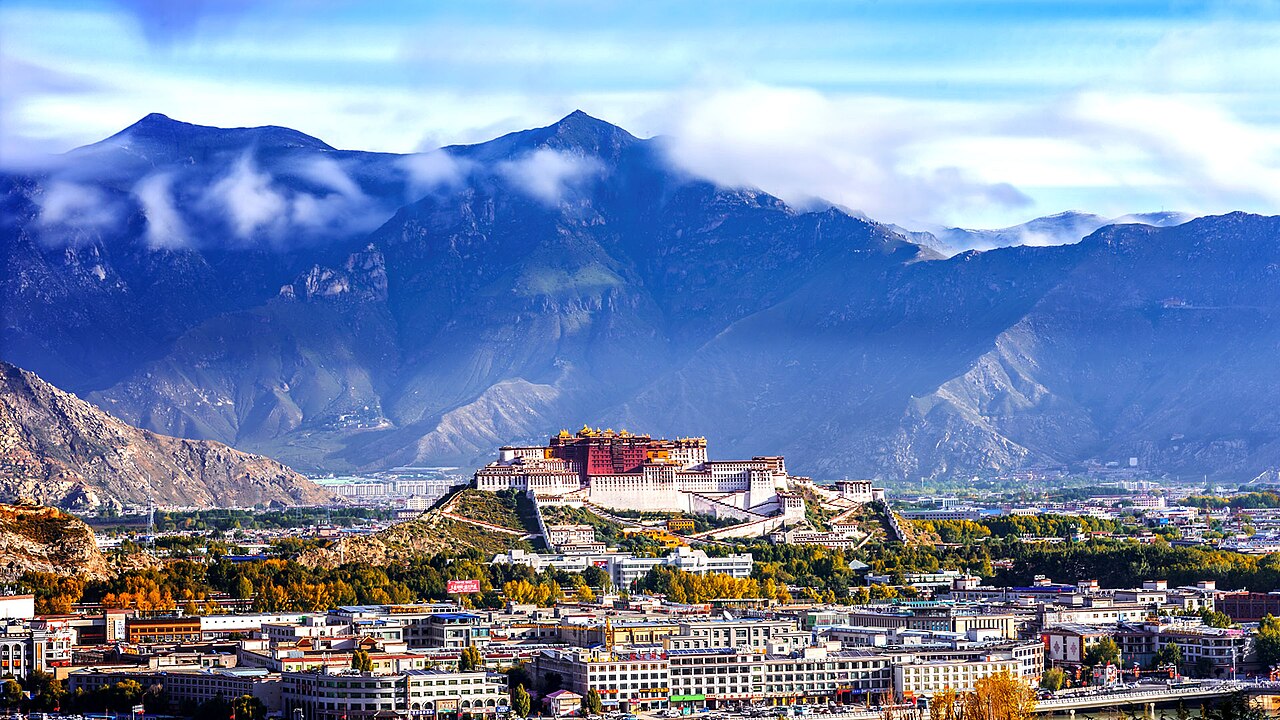
The Historic Ensemble of the Potala Palace in Lhasa — inscribed in 1994 and extended in 2000 and 2001 to include the Norbulingka and Jokhang Temple — preserves the spiritual and political centre of Tibetan Buddhism: the winter palace of the Dalai Lamas, the most sacred Buddhist temple in Tibet, and the summer garden palace on the edge of the Lhasa plain. Shigatse’s Tashilhunpo Monastery extends the Tibetan heritage itinerary west along the Friendship Highway.
Potala Palace: The Thirteen-Story Seat of the Dalai Lamas Central Lhasa — Marpo Ri hill
The Potala Palace, inscribed in 1994 as the first element of the Historic Ensemble of the Potala Palace in Lhasa under criteria (i), (iv), and (vi), is the most imposing building in Central Asia — a 13-story palace-fortress built on the 130-metre Red Hill (Marpo Ri) above Lhasa by the Fifth Dalai Lama Ngawang Lobsang Gyatso (r. 1617–1682) beginning in 1645, replacing an earlier seventh-century palace on the same site. The palace has 1,000 rooms, 10,000 shrines, and 200,000 statues; the White Palace (Potrang Karpo) was the administrative and residential centre of the Tibetan government, while the Red Palace (Potrang Marpo) is the spiritual heart — containing the chapels, meditation chambers, and golden stupas housing the remains of eight Dalai Lamas. The Fifth Dalai Lama’s funeral stupa (chorten) is 14.85 metres high and plated in 3,721 kg of gold leaf; the Thirteenth Dalai Lama’s stupa (completed 1936), at the same scale, holds 590 kg of gold. The palace is now a state museum administered by the People’s Republic of China; the current (Fourteenth) Dalai Lama has lived in exile in Dharamsala, India since 1959. Daily visitor numbers are capped at 2,300; tickets must be booked in advance through the official system.
Jokhang Temple: The Heart of Tibetan Buddhism Barkhor district, Lhasa old town
The Jokhang Temple, inscribed in 2000 as an extension of the Potala Palace inscription, was founded in 641 CE by King Songtsen Gampo of the Yarlung dynasty as a palace for the Jowo Rinpoche — the most sacred image in Tibetan Buddhism, a golden statue of Shakyamuni Buddha as a twelve-year-old, brought to Tibet by Songtsen Gampo’s Chinese wife (Princess Wencheng). The Jowo Rinpoche, still in situ in the innermost sanctuary of the Jokhang, is the most revered Buddhist image in the world for Tibetan Buddhists; pilgrims from across the Tibetan plateau prostrate themselves in front of the temple door after circuits of the Barkhor market street (the circumambulation route around the Jokhang that has been walked continuously by pilgrims for 1,380 years). The Jokhang’s first-floor chapels contain the Jowo Rinpoche, a statue of Avalokitesvara (Chenrezig, the bodhisattva of compassion), and a chapel to Princess Wencheng; the roof terrace with its golden dharma wheels and deer — the emblems of the Buddha’s first teaching at Deer Park in Sarnath — commands a view across the Lhasa valley. The temple was severely damaged during the Cultural Revolution (1966–1976) and substantially rebuilt; the original seventh-century elements in the inner chapels are among the oldest surviving Tibetan Buddhist structures.
Norbulingka: Summer Palace and Garden of the Dalai Lamas Western Lhasa, 3 km from Jokhang
The Norbulingka (Jewel Park), inscribed in 2001 as a further extension of the Potala Palace inscription, is the summer palace complex of the Dalai Lamas — a walled garden of 36 hectares in which successive Dalai Lamas from the Seventh (mid-eighteenth century) through the Fourteenth built a sequence of palaces, pavilions, and garden compounds. The Seventh Dalai Lama chose the site (a natural spring area west of Lhasa) as a summer retreat from the Potala’s monumental stone interior; the Fourteenth Dalai Lama, who would escape from the Norbulingka in 1959, built his new palace (Takten Migyur Podrang) in the Norbulingka gardens in 1956 — its interiors include an early Tibetan experiment with modern concrete construction. The Norbulingka is now a public park and festival venue; the traditional Shoton (Yogurt) Festival, held in early autumn, brings the largest traditional opera performances in Tibet to the Norbulingka grounds, attracting Tibetan families who picnic for a week under the willows.
Tashilhunpo Monastery: Seat of the Panchen Lama 🚗 ~4 hrs west at Shigatse
Tashilhunpo Monastery in Shigatse, 280 kilometres west of Lhasa, is the seat of the Panchen Lama — the second most senior figure in Tibetan Gelug Buddhism after the Dalai Lama. Founded in 1447 by Gendun Drup (later recognized as the First Dalai Lama), the monastery was developed as the principal Panchen Lama institution from the seventeenth century; it houses the world’s largest gilded statue of a seated Buddha — the Maitreya (Future Buddha) statue at 26.2 metres, built between 1914 and 1916 at a cost requiring the melting of 279 kg of gold and 33,000 kg of copper. The monastery’s administrative complex, chapels, and the funeral chortens of the Panchen Lamas were largely spared during the Cultural Revolution because the Tenth Panchen Lama (who remained in Tibet while the Dalai Lama went into exile) protected it; however, he was imprisoned for 10 years after submitting a 70,000-character petition to Chairman Mao documenting the destruction of Tibetan culture. The monastery is fully operational with approximately 1,000 monks.
Practical information
Lhasa Gonggar Airport (LXA), 65 km south of the city, connects to Chengdu, Beijing, Chongqing, and other Chinese cities. Travel to Lhasa requires a Tibet Travel Permit for all non-Chinese foreign nationals; it must be arranged through a licensed Tibetan travel agency in advance (minimum 2–3 weeks). The train from Beijing (Qinghai-Tibet Railway) takes 40 hours and crosses the Qinghai-Tibet Plateau at over 5,000 metres; the train has pressurised carriages. Altitude at Lhasa is 3,650 metres; acclimatisation of 2–3 days is strongly recommended. The Potala Palace requires advance ticket booking; the Jokhang Temple opens at 8 a.m. and is busiest in the morning. Buddhist religious practice at these sites is ongoing; visitors should be respectful and avoid interfering with pilgrims. The best season is May–October (September is optimal, combining mild weather with the post-harvest festivals).
Frequently Asked Questions
Is the Potala Palace a UNESCO World Heritage Site?
Yes. The Historic Ensemble of the Potala Palace in Lhasa was first inscribed in 1994, then extended in 2000 to include the Jokhang Temple and surrounding squares, and in 2001 to include the Norbulingka summer palace. The three-phase inscription covers the full historic ensemble of the Tibetan Buddhist capital under criteria (i), (iv), and (vi).
Do I need a special permit to visit Lhasa?
Yes. All foreign nationals (except mainland Chinese citizens) require a Tibet Travel Permit in addition to a standard Chinese visa. The permit is issued only through licensed Tibetan travel agencies, not by individual applicants. The agency arranges the permit, books accommodation, and assigns a mandatory guide — independent travel in Tibet is not permitted for foreign nationals. Permit availability varies; it is sometimes suspended before politically sensitive dates. The application process takes 2–3 weeks minimum; plan at least a month in advance.
What happened to the Jokhang Temple in the Cultural Revolution?
The Jokhang was severely damaged between 1966 and 1979 during China’s Cultural Revolution. Red Guards removed most of the statues, burned scriptures, used the temple as a military barracks, army storeroom, and pig farm, and destroyed many of the chapels. The Jowo Rinpoche (the central sacred image) survived because it had been removed to Beijing in 1966 and returned to the temple after the Cultural Revolution ended; some experts believe the current statue is a replacement. The temple was substantially rebuilt from the 1980s onward, with new gilt bronze and painting work; the oldest surviving original elements date from the seventh and ninth centuries.