West Lake (Xihu) is a freshwater lake covering approximately 6.5 square kilometres on the western edge of Hangzhou, capital of Zhejiang province, China. Surrounded on three sides by forested hills and shaped by 1,500 years of deliberate cultural cultivation — including the construction of two major causeways, multiple island pavilions, and a sequence of codified scenic views — it became the model for picturesque landscape design across East Asia. UNESCO inscribed it as a Cultural Landscape in 2011.
The Ten Scenes and a Thousand Years of Landscape Cultivation Hangzhou, Zhejiang Province
West Lake is not a natural landscape that humans chose to admire. It is a landscape that humans chose to construct over fifteen centuries, then codified into a system of named views that taught subsequent generations how to see it. This combination of physical engineering and aesthetic theory is what UNESCO recognised in 2011 — not the lake itself, but the sustained cultural act of making it meaningful.
The lake was originally a bay of the Qiantang River estuary. Natural silting gradually enclosed it from the sea, forming a lagoon that Tang dynasty officials began managing with dykes and water control structures from the 7th century CE onwards. The Tang poet Bai Juyi served as governor of Hangzhou from 822 to 824 CE and oversaw significant hydraulic works, including the construction of a dyke across the northern part of the lake that bears his name — the Bai Causeway. His poems about the lake, widely read across literate China, established a poetic vocabulary for the landscape that writers and painters quoted for centuries afterwards.
The Southern Song dynasty (1127–1279 CE) was the decisive period. When the Jin dynasty overran northern China and forced the Song court to relocate south, Hangzhou became the imperial capital — a city that Song writers called Lin’an. The court’s residence transformed a wealthy provincial town into the centre of Chinese cultural production. Artists, scholars, poets, and garden designers congregated here. The lake became the site of imperial pleasure excursions and the subject of intense artistic attention. It was during this period that the Ten Scenes of West Lake were codified: a list of ten specific views within the landscape, each with a four-character poetic title that described a particular atmospheric condition at a particular location. “Autumn Moon Over the Calm Lake” designated the view from the Platform of the Autumn Moon on the northern shore on a clear night. “Dawn on the Su Causeway in Spring” described the willow-lined causeway at first light in the third lunar month. “Lingering Snow on the Broken Bridge” depicted the Bai Causeway after snowfall, when snow melts first from the bridge’s arch, making it appear broken.
These titles functioned as perceptual frames: they told visitors not merely where to stand but when to be there and what quality of attention the scene required. The concept of named scenic sequences — a route through a landscape with designated stopping points and prescribed aesthetic responses — proved enormously influential. Japanese garden designers adopted the principle of named views (keshiki) in the design of stroll gardens during the Edo period. Korean landscape painters referenced the West Lake scenic sequence when documenting the Eight Views of Korea. UNESCO’s inscription noted that West Lake “inspired garden designers in Japan, Korea and beyond” and had “influenced garden design in the rest of the world over many centuries.”
The Causeways, the Coin-Lake, and Marco Polo’s Report Accessible from Shanghai (200 km NE)
The two causeways that traverse West Lake are its most physically distinctive features. The Su Causeway runs south to north across the western portion of the lake, spanning approximately 2.8 kilometres with six arched stone bridges at intervals. It was built during the governorship of the Song dynasty polymath Su Shi — also known by his literary name Su Dongpo — who oversaw its construction in 1089 to 1091 CE. Su Shi dredged accumulated silt from the lake bottom and used the excavated material to raise the causeway above water level. The project served both hydraulic and agricultural purposes: it improved water circulation in the lake and connected formerly separated tracts of farmland. The causeway is planted on both sides with peach trees and willows, which produce the spring spectacle described in the scenic name “Dawn on the Su Causeway in Spring.” Six stone bridges interrupt the causeway at regular intervals to allow water circulation; the Song-era originals were replaced during later dynasties, but the structure of the crossings follows the original design.
The Bai Causeway, in the north, is shorter — approximately one kilometre — and older, though its current form dates largely from Song-period reconstruction rather than its original Tang configuration. Together the two causeways divide the lake into five sections, creating varied visual experiences as visitors move between the enclosed inner portions and the broader open water.
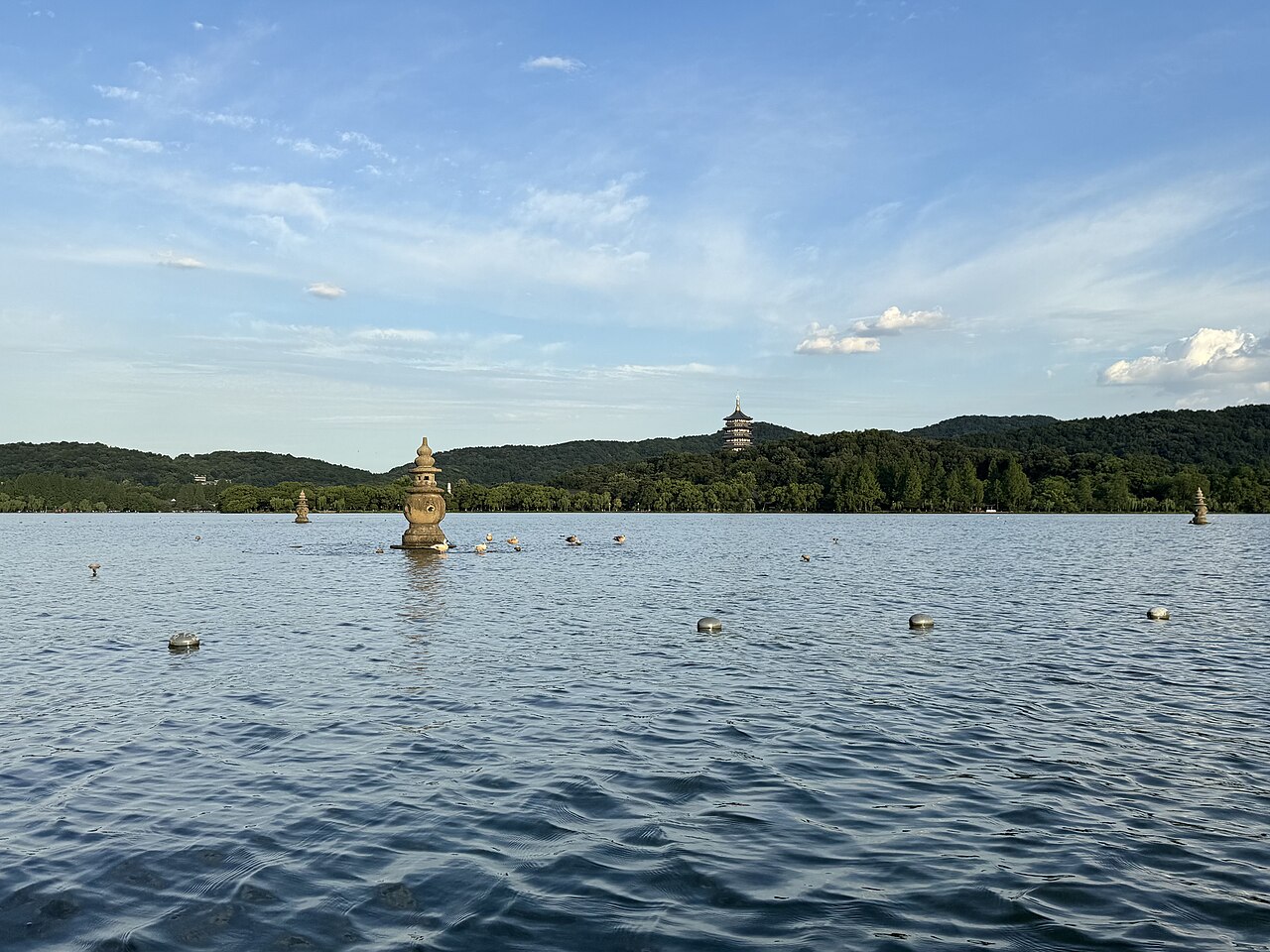
At the southern end of the lake, three small hollow stone pagodas rise from the water’s surface: the Three Pools Mirroring the Moon (Sanyou Yinyue), constructed in their current form during the Ming dynasty. Their bases rest on a platform of artificial islands connected by low embankments. During the Mid-Autumn Festival (the 15th night of the 8th lunar month), candles are placed inside the hollow globes of the pagodas and circular paper discs cover the small holes in their walls; the light passing through creates a pattern of multiple reflected moons on the water surface that has been depicted in Chinese art for centuries. The Three Pools image appears on the reverse of the Chinese 1-yuan coin.
Marco Polo visited Hangzhou around 1275 CE, during the Yuan dynasty’s occupation of the formerly Song imperial capital. He called the city Quinsai — a transcription of the Chinese term for “temporary residence” (xingzai), referring to the Song court’s displaced status. In his account, he described it as “the most noble city and the best that is in the world” and gave detailed descriptions of its canals, markets, silk industry, and lake: “In the middle of the lake there are two islands, on each of which stands a palace of marvellous work, so large and spacious and so sumptuous that it seems as though it were the palace of an emperor.” Polo’s account circulated throughout medieval Europe and established a European image of Chinese urban luxury that persisted for centuries.
The lake’s cultural density reflects its continuous use as a site of aesthetic and spiritual practice. Temples on the surrounding hills — including the Lingyin Temple, one of the ten largest Buddhist monasteries in China, founded in 326 CE — draw pilgrims and visitors simultaneously. The Leifeng Pagoda, originally built in 975 CE, collapsed in 1924 after local residents spent decades removing its bricks for use in foundations (a folk belief held that the bricks possessed protective properties); a steel-and-bronze replacement structure was completed in 2002 over the ruins of the original.
Practical information
West Lake sits within Hangzhou city limits and is freely accessible on foot or by bicycle; the perimeter path around the lake is approximately 15 kilometres. The lake district is served by Hangzhou’s metro system (Line 1 to Longxiangqiao station for the northern shore; Line 6 for the southern shore). Electric boat tours of the lake, including stops at the mid-lake island of Gushan and the platform of the Three Pools, depart from multiple jetties and run throughout the day. The West Lake Scenic Area charges no general admission, though individual attractions such as boat trips, temple entries, and the Leifeng Pagoda interior carry separate fees. Hangzhou is reached from Shanghai by high-speed rail in 45 minutes (Shanghai Hongqiao to Hangzhou East station); from Beijing, the journey takes approximately 4.5 hours by G-class train. The peak season is April (cherry blossom and peach blossom on the causeways) and October (autumn foliage); the Mid-Autumn Festival night brings large crowds to the lakeside for the Three Pools moon-viewing tradition. Accommodation ranges from international-standard hotels on the lakefront to smaller guesthouses in the Nanshan Road area.
Frequently Asked Questions
What are the Ten Scenes of West Lake and why do they matter?
The Ten Scenes of West Lake (Xihu Shi Jing) are a codified list of ten viewpoints within and around the lake, each identified by a four-character Chinese title that describes a specific atmospheric or seasonal effect at that location. They were systematised during the Southern Song dynasty (1127–1279 CE), when Hangzhou served as the imperial capital and was the centre of Chinese artistic production. The ten classical scenes are: Dawn on the Su Causeway in Spring; Lotus in the Breeze at Crooked Courtyard; Autumn Moon Over the Calm Lake; Evening Bell at Nanping Hill; Remnant Snow on the Broken Bridge; Sunset Glow at Thunder Peak; Watching Fish at Flower Harbour; Three Pools Mirroring the Moon; Twin Peaks Piercing the Clouds; and Orioles Singing in the Willows. Each title encodes a precise seasonal moment — the third lunar month for the Su Causeway’s willows, the night of the full autumn moon for the lake reflection, the post-snowfall thaw for the Broken Bridge’s illusory gap. The scenes function as a programme for experiencing the landscape: they prescribe not just location but time, weather, and quality of attention. Their significance extends beyond aesthetics: the codification of named views as a formal genre influenced landscape design and garden theory across East Asia. Japanese daimyo gardens of the Edo period frequently incorporated named-view sequences directly referencing the West Lake model. The system demonstrated that a landscape could be designed not just as a visual object but as a sequence of experiences structured in time — an insight that shaped garden architecture from Kyoto to Seoul.
Who built the causeways and what was their original purpose?
The two causeways that divide West Lake — the Su Causeway (Sudi) and the Bai Causeway (Baidi) — were built as hydraulic engineering projects before they became scenic features. The Bai Causeway takes its name from Bai Juyi, the Tang dynasty poet who served as Hangzhou’s governor from 822 to 824 CE. Bai Juyi oversaw significant waterworks on the lake to regulate irrigation for the surrounding farmland, and the northern causeway was associated with this project in popular memory, though the current structure dates largely from later reconstruction. Bai Juyi’s poems about the lake — particularly his descriptions of spring willow light on the water and the sound of frogs in summer — were widely anthologised and established the lake as a poetic subject across literate China for centuries. The Su Causeway was built under the direct supervision of Su Shi (Su Dongpo), the Song dynasty writer, calligrapher, and statesman, who served as Hangzhou’s governor from 1089 to 1091 CE. Su Shi faced a practical problem: the lake was silting up from agricultural runoff, reducing its capacity to supply irrigation water to the surrounding rice paddies. He organised the dredging of approximately 130,000 cubic metres of accumulated silt from the lake bed and used the excavated material to construct the causeway as a raised embankment across the western portion of the lake. The causeway’s six bridges maintained water circulation between the lake’s sections. Su Shi also planted peach trees and willows along the causeway — the aesthetic intervention that transformed a flood-control measure into one of the Ten Scenes.
How has West Lake influenced landscapes and gardens outside China?
UNESCO’s 2011 inscription of West Lake as a Cultural Landscape explicitly recognised its influence on garden design beyond China’s borders. The influence operated through several channels: literary transmission (Chinese poetry and painting describing West Lake scenes were studied by educated elites in Japan and Korea); direct diplomatic exchange (Chinese court officials and artists visited neighbouring countries, and vice versa); and the circulation of Chinese woodblock-printed landscape manuals that codified West Lake compositions. In Japan, the concept of named views — a prescriptive list of specific scenes to be experienced at designated locations within a garden or landscape — was directly adopted from the Chinese model. The Eight Views of Omi, the Eight Views of Kanazawa, and dozens of similar named-view sequences in Japanese cultural geography follow the structural template of the West Lake Ten Scenes. Japanese stroll gardens (kaiyū-shiki teien) of the Edo period, such as Kōraku-en in Okayama and Kenroku-en in Kanazawa, incorporated topographic and planting elements explicitly referencing West Lake — islands accessible by causeways, willow-lined embankments, and pavilions oriented toward lake reflections at specific times of day. In Korea, the Eight Views of the Xiaoxiang River — a Chinese scenic genre related to the West Lake tradition — were adapted into Korean painting as the Eight Views of Korea (Gwanseo palgyeong), demonstrating how the named-view concept migrated across cultural boundaries while adapting to local geography.
Sources
- S1 — Xiaolin Wei — West Lake: A Cultural Landscape of China, Zhejiang University Press, Hangzhou, 2011, ISBN 978-7308088480
- S2 — Nancy Shatzman Steinhardt — Chinese Architecture: A History, Princeton University Press, Princeton, 2019, ISBN 978-0691169989
Spotted an error? Write to editorial@culturalheritageonline.com and we correct it the same day.