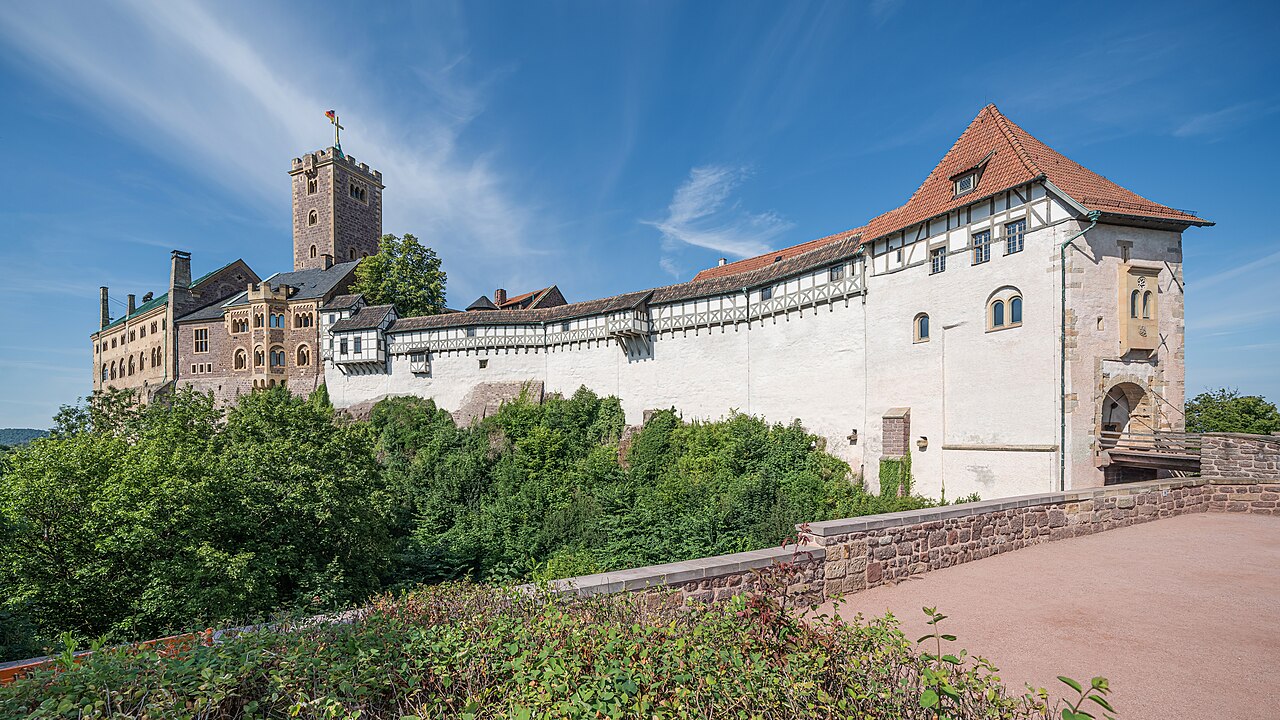
Wartburg Castle stands on a forested spur of the Thuringian Forest above Eisenach, Germany, and was inscribed as a UNESCO World Heritage Site in 1999. Founded in 1067 by Ludwig the Springer, Count of Thuringia, the castle became the site of Martin Luther’s New Testament translation in 1521–1522 and the childhood home of Elisabeth of Hungary. Its Romanesque Palas, built between 1157 and 1170, is one of the best-preserved secular Romanesque structures in Germany.
Luther, Language and the Lutherstube Eisenach old town, 3 km south on foot or by bus
In April 1521, Martin Luther appeared before the Diet of Worms, where he refused to recant his writings and was declared an outlaw under the Edict of Worms by Emperor Charles V. On his way home, he was intercepted — according to plan — by agents of Elector Frederick the Wise of Saxony, who brought him in disguise to Wartburg for his own protection. Luther arrived at the castle in May 1521 and remained until March 1522, living under the alias “Junker Jörg” (Knight George).
In the small study known as the Lutherstube, Luther translated the New Testament from the original Greek into German in approximately ten weeks — a feat of extraordinary intellectual speed and cultural consequence. He worked from the Greek text edited by Erasmus (the 1519 Novum Instrumentum) and produced a German text that drew on the spoken language of the Saxon chancelleries rather than the fragmented dialects of the regions. The translation, published in September 1522 as the Septembertestament, sold thousands of copies within weeks and became the foundational text of modern written German. Linguists point to Luther’s Wartburg translation as the event that began the standardisation of the German language across its regional varieties.
The Lutherstube is preserved at the castle and is accessible to visitors as part of the main tour. The room contains a writing table, a stove, and the famous inkstain on the wall (according to tradition, Luther threw his inkwell at the devil who disturbed his work; the stain has been refreshed so many times by souvenir-hunters chipping pieces away that it now requires periodic maintenance). Whether or not the anecdote is literal, the Lutherstube functions as one of the most significant rooms in the history of the German language — and by extension in the history of the Protestant Reformation, since Luther’s accessible German Bible made scriptural reading possible for ordinary literate people for the first time.
The Wartburg Festival of October 1817 added another layer to the castle’s significance. German student fraternities (Burschenschaften) assembled here to mark the 300th anniversary of Luther’s Ninety-Five Theses and simultaneously to call for German national unity. The gathering, attended by about 500 students, is regarded as an early public event of the German nationalist movement, predating the revolutions of 1848 by three decades.
Elisabeth of Hungary, the Minnesingers and Wagner’s Tannhäuser Within the castle complex
Elisabeth of Thuringia — better known as Elisabeth of Hungary — arrived at Wartburg in 1211 at the age of four, brought from Hungary to be raised at the Thuringian court as the future bride of Landgrave Ludwig IV. She spent her formative years in the castle and married Ludwig in 1221. Her time at Wartburg gave rise to the most famous legend associated with her: one winter day, confronted by her husband as she descended the castle stairs carrying bread for the poor in her apron, the bread was said to have miraculously transformed into roses when he demanded to see what she carried. The legend of the roses has been the subject of painting, sculpture, and stained glass across Europe for eight centuries. Elisabeth left Wartburg after Ludwig’s death in 1227, devoted herself to charitable work, founded a hospital at Marburg, and died in 1231 at the age of twenty-four. She was canonised in 1235, just four years after her death — one of the fastest canonisations in medieval history.
The castle also preserves the Sängerhalle, the great hall associated with the minnesingers — the German-speaking troubadour poets of the 12th and 13th centuries. The legendary Sängerkrieg (Minnesingers’ Contest) of around 1207, in which major poets including Walther von der Vogelweide supposedly competed at Wartburg, gave the castle a central place in German literary mythology. The contest may have been embellished or partially invented in later tradition, but the Sängerhalle’s association with courtly poetry was real enough that Richard Wagner visited Wartburg in 1842 specifically to research the setting for his opera Tannhäuser (1845), which depicts the Sängerkrieg as its central dramatic event. The opera’s premiere in Dresden in 1845 made Wartburg famous across Europe as a cultural landmark, and visitor numbers rose sharply in the following decades.
The Romanesque Palas (great hall), built between 1157 and 1170 under Landgrave Ludwig II, is structurally the oldest and architecturally the most significant part of the complex. Its three-storey facade, with arcaded galleries of paired columns, is considered one of the finest examples of Romanesque secular construction surviving anywhere in Germany. Much of the interior was restored in the 19th century under Grand Duke Carl Alexander of Weimar, who commissioned decorative murals based on the castle’s history — including scenes of Elisabeth and the Sängerkrieg — in a Romantic historicist style that reflects 19th-century attitudes toward the medieval past as much as the medieval past itself.
Practical information
Wartburg Castle is located 3 kilometres south of Eisenach in Thuringia. From Eisenach railway station — well served by trains from Erfurt (30 minutes), Göttingen, and Frankfurt — the castle is reached on foot via a marked uphill path (approximately 45 minutes) or by shuttle bus running from the old town in season. The castle car park is accessible by road for those arriving by car.
The main castle complex is open year-round; most interior spaces are accessible only on guided tours, which depart at regular intervals and are available in German and English. The Lutherstube, the Palas great hall, and the castle museum are all included in the standard tour ticket. An additional audio guide covers the Elisabeth cycle and the Minnesingers in more depth.
Eisenach is also the birthplace of Johann Sebastian Bach (1685), and the Bach House museum in the town centre is a natural complement to a Wartburg visit. Bauhaus-Weimar, approximately 60 kilometres east, is the nearest UNESCO World Heritage Site and can be reached by regional train via Erfurt in under 90 minutes. There is no UNESCO site immediately adjacent to Wartburg; the castle stands somewhat apart from the denser cluster of heritage sites in Saxony and Thuringia.
Frequently Asked Questions
Why was Wartburg Castle designated a UNESCO World Heritage Site?
Wartburg received its UNESCO World Heritage designation in 1999. The listing recognised the castle’s outstanding universal significance across three distinct historical dimensions. First, its architectural value: the Romanesque Palas (great hall) built between 1157 and 1170 is one of the best-preserved secular Romanesque structures in Germany, and the castle as a whole retains its medieval silhouette and spatial organisation in a way that few German castles of comparable age do. Second, its role in the history of the German language: Martin Luther’s translation of the New Testament into German at Wartburg in 1521–1522 produced the text that began the standardisation of written German across its regional dialects, a cultural achievement whose consequences extend across literature, religion, and national identity. Third, its associations with Elisabeth of Hungary, canonised in 1235, and with the tradition of the Minnesingers, which gave the castle a central place in medieval German literary and religious culture. UNESCO’s evaluation noted that Wartburg represents a place where several major strands of European history — the Reformation, medieval chivalric culture, and the emergence of national literary languages — converged in a single physical site.
How long did Luther stay at Wartburg and what did he produce there?
Luther arrived at Wartburg in disguise in May 1521 and remained until March 1522 — approximately ten months in total. He lived as “Junker Jörg,” an assumed identity as a minor nobleman, to conceal his presence from the imperial authorities who had declared him an outlaw at the Diet of Worms. His most concentrated period of work was the ten weeks during which he translated the entire New Testament from the Greek text of Erasmus into German. The result — published in September 1522 as the Septembertestament — sold out its first print run of several thousand copies almost immediately and required a second printing within weeks. Luther also wrote pamphlets and letters during his stay, and began work on translating the Old Testament, which he completed in stages over the following decade in collaboration with colleagues at Wittenberg. The Wartburg translation is considered the most consequential single act of the German Reformation from a cultural standpoint: it put the New Testament directly into the hands of German readers in their own language for the first time and established a standard of written German that shaped the language for centuries.
Who was Elisabeth of Hungary and what is her connection to Wartburg?
Elisabeth of Thuringia — called Elisabeth of Hungary because she was born to the Hungarian royal family in 1207 — arrived at Wartburg at the age of four in 1211, brought to the Thuringian court to be raised and later married to Landgrave Ludwig IV. She married Ludwig in 1221 and is remembered for acts of extreme charity toward the poor and sick, which she practised from Wartburg against the disapproval of some members of the court. The legend of the roses — in which bread she was carrying to the poor miraculously became roses when her husband challenged her — originated in stories told after her death and was first recorded in hagiographic accounts from the 1230s. After Ludwig’s death on Crusade in 1227, Elisabeth left Wartburg, renounced her wealth, founded a hospital at Marburg dedicated to Saint Francis, and devoted the remaining four years of her life to direct care of the poor and sick. She died in 1231 aged twenty-four. Pope Gregory IX canonised her in 1235 — remarkably quickly by medieval standards — and she became one of the most venerated female saints of the German-speaking world. The Elisabeth Window in Marburg Cathedral, commissioned shortly after her death, is among the earliest surviving cycles of Gothic stained glass in Germany.