Kernave is an archaeological site on the Neris River in central Lithuania, 35 kilometres northwest of Vilnius, where five earthwork hillforts rise 30 to 40 metres above the river valley floor. The site served as the first capital of the unified Lithuanian state in the thirteenth century and was destroyed by the Teutonic Knights in 1390, then never rebuilt — leaving ten millennia of human occupation sealed under undisturbed ground. UNESCO inscribed the Kernave Archaeological Site on the World Heritage List in 2004, recognising it as an exceptional example of a preserved medieval urban landscape that survived intact precisely because it was abandoned.
The Mounds and the Millennium: What Kernave Preserves Neris River valley, 35 km northwest of Vilnius
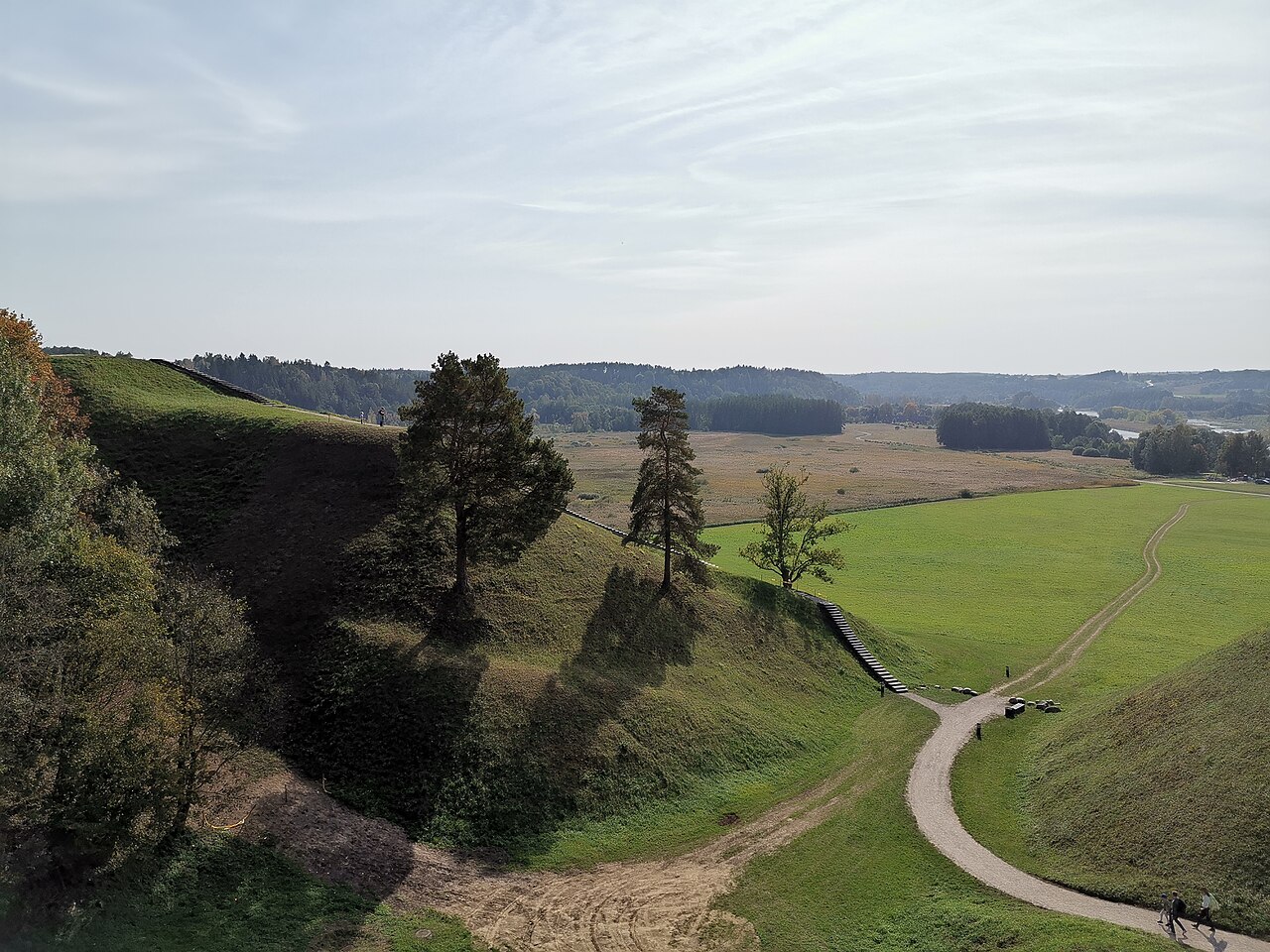
The landscape at Kernave is immediately legible. Five steep-sided earthwork mounds rise in a line above the Neris valley, their flanks too regular and their profiles too uniform to be natural features. These are hillforts: elevated defensive positions whose current form is the product of ten or more centuries of deliberate construction, modification, and reinforcement, with successive generations adding to the height and altering the defensive profiles of positions that had served as places of refuge and control since prehistory. Below the mounds, on the flat terrace between the hillfort ridge and the river, the traces of the medieval town survive under the surface as buried structural remains, pits, post-holes, and artefact deposits that have been systematically documented since the 1980s.
The archaeological sequence at Kernave begins approximately 10,000 years ago, in the Mesolithic period following the retreat of the last Ice Age glaciers from Lithuania. The site appears to have attracted human activity continuously through the Neolithic, Bronze Age, Iron Age, and into the historic medieval period. This kind of unbroken occupation sequence — covering the entire human prehistory of the region in a single location — is unusual anywhere, and the fact that the medieval town was abandoned rather than continuously occupied means the later layers did not destroy the earlier ones. Kernave is, in the language of archaeology, a deeply stratified site: one where digging down through successive occupation layers allows researchers to read time vertically, with each stratum representing a distinct period of human activity.
The hillforts themselves were built through the accumulation of sand, clay, and occupation debris into progressively higher mounds, with timber palisade walls on their crests. The process of building a hillfort of this kind takes place over generations: each phase of occupation adds material, each defensive enhancement raises the profile slightly, and the final form of the mound represents an aggregate of all previous phases rather than a single construction event. The five Kernave mounds are named in Lithuanian tradition: Pilies kalnas (Castle Hill), Mindaugo sostas (Mindaugas’ Throne), Aukuro kalnas (Altar Hill), Kriveikiškių kalnas, and Lizdeikos kalnas. The largest, Pilies kalnas, was the primary fortress of the thirteenth-century capital. The names given to the others in later tradition reflect the long resonance of the site in Lithuanian cultural memory — “Mindaugas’ Throne” connects the mound to the only crowned king Lithuania ever had; “Altar Hill” suggests the persistence of memory of pagan religious practice at the site.
The town that existed below the hillforts in the thirteenth and early fourteenth centuries covered an area of approximately 15 hectares on the Neris terrace. Archaeological excavations have recovered timber-framed buildings, craft workshop remains including evidence of ironworking and bone-working, imported goods showing long-distance trade connections, and substantial quantities of ceramics. The settlement was organised and urban in the medieval sense — not a village but a town with specialised economic functions, a market, and administrative structures connected to the ducal power based in the hillforts above.
The Grand Duchy and the Teutonic Destruction: How the Capital Disappeared Historical context spanning the 13th–14th centuries
Kernave’s emergence as a political centre coincides with the formation of the Lithuanian state itself. The Livonian Chronicle of Henry of Latvia, written in the early thirteenth century, records Kernave as the seat of Grand Duke Traidenis in 1279 — one of the earliest documentary references to the site as a political centre. Traidenis ruled a Lithuanian territory that was already expanding, pressing against the territories controlled by the Livonian Order to the north and the Teutonic Order to the west and south. The political context was one of constant military pressure: the crusading military orders had been active in the Baltic region since the early thirteenth century, and pagan Lithuania was their stated target as well as a practical obstacle to their territorial ambitions.
The Grand Duchy of Lithuania that grew from this period became, at its maximum extent in the late fourteenth and early fifteenth centuries, the largest state in Europe by territory, stretching from the Baltic Sea in the north to the Black Sea shores in the south — a vast multi-ethnic polity encompassing what is now Lithuania, Belarus, much of Ukraine, and parts of Russia and Poland. The cultural and political centre of this expansion shifted southward over time, with Vilnius replacing Kernave as the primary capital by the early fourteenth century. The hillforts at Kernave continued to function as a secondary defensive position and administrative centre, but the main apparatus of ducal power moved to the site on the Neris and Vilnia rivers that would become Vilnius.
King Mindaugas — the only ruler in Lithuanian history to receive a royal crown — was crowned in 1253, almost certainly with papal recognition and the political goal of legitimising the Lithuanian state in European diplomatic terms. The connection between Mindaugas and Kernave is preserved in the name given to one of the hillforts (Mindaugas’ Throne), though the historical record does not precisely establish whether the crowning ceremony itself took place at Kernave or elsewhere. Mindaugas was assassinated in 1263 by Lithuanian nobles who regarded his Christian baptism as a political betrayal, and Lithuania reverted to paganism. The state he had created survived the internal conflict and continued to expand under pagan rule for another century and a quarter, making Lithuania one of the last regions of Europe to adopt Christianity — not formally until 1387, when Grand Duke Jogaila accepted baptism as part of his union with Poland through marriage to Queen Jadwiga.
The destruction of Kernave in 1390 was carried out by the Teutonic Knights during one of their periodic military campaigns (Reisen) into Lithuanian territory. The summer of 1390 saw a major Teutonic operation that targeted the Neris valley and reached Kernave, which was burned and the population dispersed. The town was not rebuilt after the destruction — by this date Vilnius had been established as the unambiguous political centre of the Grand Duchy, and Kernave had no compelling reason to be reconstructed as an urban centre. The hillforts were gradually abandoned. Over the following centuries the vegetation reclaimed the site, the mounds remained as earthworks but the town below them was ploughed over or simply left to grass and time, and the archaeological layers were sealed. This abandonment is precisely what makes Kernave scientifically extraordinary: six centuries of non-disturbance preserved what would otherwise have been destroyed by the normal processes of urban continuity.
Practical information
Kernave is 35 kilometres northwest of Vilnius, reachable by car in approximately 40 minutes via the A2 motorway toward Ukmergė and then regional roads. Public bus connections from Vilnius to Kernave town are limited and infrequent — most visitors arrive by private car or organised tour. The Kernave Archaeological Museum is located at the site and provides the primary interpretation of the hillfort complex, including displays of Iron Age jewellery, weapons, coins, and objects connected to pagan Lithuanian religious practice, including material relating to the Eternal Fire cult. The museum is open Tuesday through Sunday; opening hours vary by season and should be confirmed before visiting. The hillforts themselves are accessible on foot via marked trails from the museum; the climb to the crest of Pilies kalnas takes approximately 15 minutes from the valley floor and provides extensive views across the Neris valley. The annual Kernave Festival of Historical Reenactment takes place each July and includes medieval combat demonstrations, craft workshops, and Baltic tribal ceremonies; it draws visitors from across Lithuania and neighbouring countries. Vilnius Historic Centre, another UNESCO World Heritage Site, is 35 kilometres southeast and easily combined with a Kernave visit in a single day. The Curonian Spit UNESCO site is approximately 200 kilometres northwest via Klaipėda.
Frequently Asked Questions
Why was Kernave abandoned after 1390 and why does its abandonment matter archaeologically?
Kernave was destroyed by the Teutonic Knights in the summer of 1390 during a military campaign into Lithuania, and it was not rebuilt because by that date Vilnius had been fully established as the unambiguous capital of the Grand Duchy of Lithuania. The political and military reasons to maintain Kernave as an urban centre had evaporated: the earlier period when it served as the primary seat of ducal power was over, and the investment required to reconstruct a burned town at this secondary location could not be justified. The abandonment was in this sense a consequence of Vilnius’s success rather than a catastrophe in itself for the Grand Duchy as a whole. For archaeology, however, the abandonment was an extraordinary stroke of preservation. When a town continues to be occupied across centuries, each phase of occupation disturbs and destroys evidence of earlier phases: buildings are demolished and their materials reused, pits are dug through earlier layers, ground levels are raised or lowered, and the stratigraphic sequence is disrupted. At Kernave, the medieval occupation layers were sealed in 1390 and left largely undisturbed for the following six hundred years. Systematic excavations begun in the 1980s found medieval timber structures, hearths, pit features, artefact assemblages, and organic materials in contexts that preserved their original spatial relationships. This allows archaeologists to reconstruct not just what objects existed at Kernave but where they were used, how the town was organised, and how its different functional areas related to each other. That quality of spatial preservation is rare for any medieval site and almost unknown for a capital-level settlement.
What was the Grand Duchy of Lithuania at its maximum extent, and how is Kernave connected to its origins?
The Grand Duchy of Lithuania was a medieval European polity that expanded from its Baltic core in the thirteenth century to reach extraordinary territorial dimensions by the late fourteenth and early fifteenth centuries. At its maximum extent — roughly the reign of Grand Duke Vytautas the Great in the early fifteenth century — the Grand Duchy controlled territory stretching from the Baltic Sea coast in the north to the Black Sea steppe in the south, and from the borders of the Teutonic Order in the west to the regions of Smolensk and Pskov in the east. This made it the largest state in Europe by area at that time, encompassing what is now Lithuania, Latvia (in part), Belarus, Ukraine, and significant portions of western Russia. It was a multi-ethnic polity: Lithuanian-speaking in its core regions, but with large populations of Ruthenian (Old East Slavic) speakers, a significant Jewish population, Tartar communities settled in the south and east, and ruling-class figures who operated across multiple languages and confessional communities. The connection to Kernave is foundational: the earliest documented political organisation of the Lithuanian state, in the mid-thirteenth century, appears to have centred on the Kernave hillforts. The Livonian Chronicle records Traidenis at Kernave in 1279; the struggle against the Teutonic Order that shaped the early Grand Duchy played out in the Neris valley where Kernave stands. The site is not a symbol of the Grand Duchy at its peak but of its origins — the point where a collection of Baltic tribal groups coalesced into a unified political entity capable of resisting the most powerful military organisation in the medieval Baltic world.
Was Lithuania really the last country in Europe to convert to Christianity, and what traces of the earlier religion survive at Kernave?
Lithuania’s formal conversion to Christianity in 1387 — when Grand Duke Jogaila accepted baptism as part of his marriage to Queen Jadwiga of Poland and subsequent assumption of the Polish throne — is conventionally cited as the last state-level conversion in Europe, and the claim is broadly accurate with some qualifications. Some Baltic tribal groups, including Latvian and Lithuanian populations in peripheral areas, retained pagan practices beyond this formal date, and the Samogitian region of western Lithuania was not formally Christianised until 1413. But as a matter of state policy and ruling-class religion, 1387 is the accepted date, and it is indeed later than any comparable conversion in continental Europe. The pagan Lithuanian religion that was practiced before and partly alongside the early Christian period was a Baltic polytheism related to the religious systems of the other Baltic peoples (Latvians, Prussians) and sharing features with the older Slavic pagan systems: sacred groves, a pantheon of nature deities, ritual fire maintenance, and complex funerary practices including cremation with rich grave goods. At Kernave specifically, archaeological evidence suggests the maintenance of sacred fire — connected to the religious concept of the Eternal Fire that Lithuanian tradition associates with the site of Kernave and later with Vilnius — and funerary deposits that reflect non-Christian burial practice. The Kernave Archaeological Museum’s displays include objects from burial contexts that show the material culture of pagan practice: bronze jewellery, horse equipment, weapons deposited with the dead, and evidence of cremation. The Altar Hill mound (Aukuro kalnas) is associated in tradition with a sacred fire site, and although the archaeological evidence for this specific claim is incomplete, the concentration of Iron Age and early medieval votive deposits in that area of the site supports some form of ritual activity.
Sources
- S1 — Luchtanas, Aleksiejus. Kernavė: Litauens Troja. Baltos Lankos, 2002. ISBN 978-9955-429-71-5.
- S2 — Kiaupa, Zigmantas. The History of Lithuania. Baltos Lankos, 2005. ISBN 978-9955-584-87-2.
Spotted an error? Write to editorial@culturalheritageonline.com and we correct it the same day.