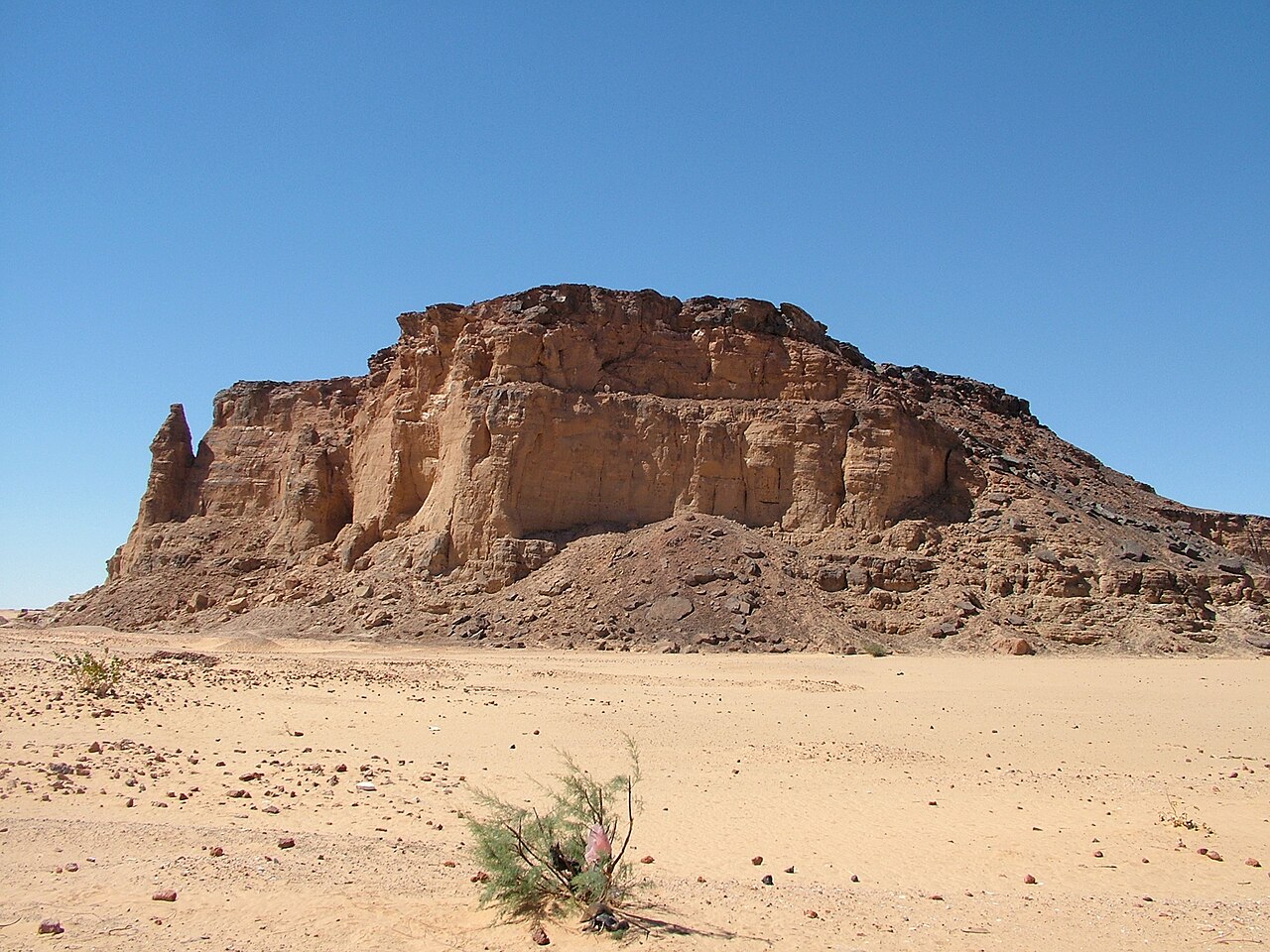
Gebel Barkal is a flat-topped sandstone inselberg rising 98 metres from the Nile floodplain near Karima in northern Sudan. It was the sacred mountain of the ancient Kingdom of Kush and the theological centre of the Napatan civilisation that produced the “Black Pharaohs” — the 25th Dynasty kings who conquered all of Egypt in the 8th century BCE. The UNESCO World Heritage site, inscribed in 2003, encompasses five archaeological areas containing royal cemeteries, pyramids, and temples across the Napatan region.
The Sacred Mountain and the Kingdom That Conquered Egypt Karima (Napata), Northern State, Sudan — 400 km north of Khartoum
Gebel Barkal stands approximately 3 kilometres from the right bank of the Nile near Karima, the modern town on the site of ancient Napata. From the desert floor, the mountain appears as an isolated flat-topped mass of Nubian sandstone that breaks the absolute horizontality of the surrounding plain. At its southern end, a separate pinnacle approximately 7 metres tall rises from the base — a feature that ancient observers interpreted as a uraeus, the upright royal cobra worn on the crowns of Egyptian pharaohs. This natural formation gave Gebel Barkal a specific theological status: if the mountain wore a uraeus, it was a divine king, and the god inside it was Amun.
The Egyptian connection predates the Kushite kingdom. The pharaoh Thutmose III of the 18th Dynasty extended Egyptian control into Nubia during the 15th century BCE, and it was he who first built a temple at the base of Gebel Barkal — the temple known today as B500, dedicated to Amun. The Egyptians identified the mountain as “Pure Mountain” and regarded it as the primeval home of Amun, the king of the gods, separate from and prior to his manifestation at Karnak in Upper Egypt. This theological claim made Gebel Barkal both a political prize and a source of legitimacy: whoever controlled the Pure Mountain controlled the original Amun.
When Egyptian power in Nubia collapsed in the 11th century BCE, the region retained Egyptian religious culture while developing its own political structures. The Kingdom of Kush emerged as a centralised state at Napata by approximately 900 BCE, with Gebel Barkal as its sacred centre. The Kushite kings rebuilt and expanded the Temple of Amun, added a series of smaller temples along the base of the mountain, and constructed royal burial pyramids at sites across the Napatan region. They were not imitating Egypt from a position of cultural inferiority — they were claiming the legitimate inheritance of Egyptian religious tradition.
The most dramatic expression of that claim was military. The Kushite king Piye (also written Piankhi) launched a campaign northward from Napata around 728 BCE, taking city after city in Egypt. By approximately 715 BCE, his successors controlled all of Egypt from the Nile Delta to Napata. The Kushite rulers became the 25th Dynasty of Egypt, and for approximately 100 years — roughly 747 to 656 BCE — Nubian kings ruled the most powerful state in the ancient world. They built more pyramids than any Egyptian dynasty: over 200 Nubian pyramids survive, compared with Egypt’s 130.
The Nubian pyramids visible at Gebel Barkal and the surrounding sites are immediately distinguishable from Egyptian examples by their profile. Egyptian pyramids slope at approximately 52 degrees; Nubian pyramids slope at 65 to 70 degrees, producing a steep, narrow form that reaches a point more rapidly. They are also smaller — few exceed 30 metres in height — and many have a small chapel attached to the east face. These differences reflect not ignorance of Egyptian forms but a deliberate Napatan aesthetic, applied with consistent intentionality across two centuries of royal tomb construction.
Five Archaeological Areas: Royal Cemeteries and the Architecture of Kush Nuri, El-Kurru, Meroe North — within 100 km of Gebel Barkal
The UNESCO inscribed property encompasses five distinct archaeological areas, each contributing a different chapter to the history of the Napatan civilisation. Together they constitute one of the most significant concentrations of ancient Sudanese heritage in existence.
At Gebel Barkal itself, the site contains at least thirteen temples and palace structures clustered along the base of the mountain. The Temple of Amun (B500) is the largest, with a forecourt, columned hall, and inner sanctuary cut partly into the rock face. The wall reliefs inside document the campaign of Piye and the theological claims of successive Napatan rulers. A second temple, B200, preserves colour in its painted reliefs to a degree unusual for open-air structures of this age. The proximity of these religious buildings to the sacred mountain was deliberate: the mountain was not a backdrop but an active participant in the ritual, believed to house the god whose authority legitimised the kings who built around it.
El-Kurru, 13 kilometres downstream from Gebel Barkal, is the earliest royal cemetery of the Napatan kingdom. The burials here predate the conquest of Egypt and trace the transition from tumulus (earth mound) burials of the early Kushite chieftains to the true pyramid form adopted by the late 8th century BCE. The pyramid of Piye himself is at El-Kurru, as are the tombs of his predecessor Kashta and several of his successors. The tomb chambers are cut into the rock below the pyramids and accessed by a stairway from the east; in several tombs, the interior walls preserve painted decorations showing the deceased before Egyptian gods.
Nuri, on the opposite bank of the Nile approximately 12 kilometres from Gebel Barkal, contains 19 royal pyramids and 52 queens’ pyramids. The most significant is the pyramid of Taharqa, the greatest of the 25th Dynasty pharaohs, who ruled Egypt from approximately 690 to 664 BCE. Taharqa’s pyramid at Nuri, standing 65 metres tall, is the largest Nubian pyramid ever built. Below it, the burial chamber — accessible to trained archaeologists — contains inscriptions from the Egyptian Book of the Dead and the Pyramid Texts, demonstrating the depth of Egyptian religious tradition internalised by the Kushite rulers.
The site known as Meroe North in the UNESCO inscription refers to Napatan-period sites in the northern sector of the region, distinct from the later Meroitic kingdom centred 300 kilometres to the south, which is a separate inscribed property. This distinction matters because the two Sudanese UNESCO World Heritage sites document different periods and capitals of the same civilisation’s evolution: Napata (here) for approximately 900-270 BCE, and Meroe (the southern site) for approximately 270 BCE to 350 CE.
Access to the Gebel Barkal area requires reaching Karima, which has road connections to Khartoum and a small airport. Political conditions in Sudan have affected access significantly since 2019 and visitors should consult current travel advisories before planning a trip. When conditions allow, the site is managed by Sudan’s National Corporation for Antiquities and Museums (NCAM); local guides can be engaged in Karima town.
Practical information
Karima is approximately 400 kilometres north of Khartoum by road via Shendi, or accessible by the slower Nile route. A domestic flight operates between Khartoum and Merowe (the nearest airport to Karima, 35 km away) when schedules permit. The Gebel Barkal site is approximately 3 kilometres from Karima town centre; tuk-tuk and donkey cart are the standard local transport options for reaching the mountain.
The temples and pyramid fields are open during daylight hours; there is no fixed admission system at the time of writing, but a voluntary contribution to the site guard is expected. Climbing the mountain is possible via a marked route on the north face and takes approximately 30 minutes to the summit, where views extend across the Nile bend and the pyramid fields are visible in three directions.
El-Kurru is 13 km downstream (south) from Karima; Nuri is across the Nile, accessible by ferry from Karima. A full visit to all five areas requires at least two days and ideally a vehicle with a local guide. The optimal travel months are November through February; summer temperatures at this latitude regularly exceed 45°C and the site is effectively inaccessible.
Travel to Sudan currently requires careful attention to current political conditions and entry visa requirements, which have changed frequently since 2019. Consult the relevant foreign ministry travel advisory before booking.
Frequently Asked Questions
Why are Nubian pyramids steeper than Egyptian ones, and are they built the same way?
Nubian pyramids slope at between 65 and 70 degrees, compared with the approximately 52-degree angle of the great Egyptian pyramids at Giza. The steeper profile gives Nubian pyramids a distinctly different silhouette — taller and narrower relative to their base, reaching a point more abruptly. This was not an engineering limitation or an approximation of the Egyptian form. The Napatan rulers who built these structures had access to the same Egyptian religious texts, the same pool of skilled builders, and the same knowledge of Egyptian construction methods. The steeper angle was a deliberate stylistic choice that emerged during the early Napatan period and remained consistent across two centuries of royal pyramid construction. Why the angle differs is not definitively established by current archaeology, but one persuasive explanation is that the Napatan builders were drawing on local architectural traditions of steep-sided tumulus burial mounds that predate their adoption of the pyramid form. The earliest Kushite royal burials at El-Kurru are earth tumuli; the transition to pyramids happened gradually, and the steep angle may preserve the visual memory of the earlier form. The construction methods are broadly similar to Egyptian practice for structures of this scale: locally quarried sandstone in roughly cut blocks, laid in courses with rubble fill. Most Nubian pyramids also feature a small chapel attached to the east face for funerary offerings — a feature derived directly from Egyptian mortuary temple tradition.
Who were the Black Pharaohs and how long did they rule Egypt?
The “Black Pharaohs” is a modern popular designation for the kings of the 25th Dynasty of Egypt, who were Kushite rulers from what is now Sudan. The term was not used in antiquity and reflects the modern interest in recovering the African dimensions of ancient Egyptian history. The 25th Dynasty began with Kashta, who extended Kushite control into Upper Egypt during the mid-8th century BCE. His successor Piye completed the conquest of the entire Nile Valley, taking Memphis and forcing the submission of the delta rulers around 728-715 BCE. The 25th Dynasty rulers — Piye, Shabaka, Shebitku, Taharqa, and Tantamani — controlled Egypt for approximately 100 years, from the early 8th century to 656 BCE when the Assyrian invasion of Egypt under Ashurbanipal forced Tantamani’s retreat to Napata. During this period, the Kushite pharaohs implemented a cultural programme that revived older Egyptian religious traditions they considered to have been neglected: they restored decayed temples, adopted archaic forms in their inscriptions, and extended patronage to cults that had lost royal support under later native dynasties. Taharqa in particular was one of the most prolific builders in Egyptian history, erecting monuments from the Nile Delta to Napata. The Assyrian sack of Thebes in 663 BCE during Taharqa’s reign — an event mentioned in the Hebrew Bible (Book of Nahum) — marked the beginning of the end of Kushite control over Egypt.
Is it safe to travel to Gebel Barkal and the Napatan sites today?
Travel to Sudan, including the Karima region where Gebel Barkal is located, has been significantly affected by the political instability and armed conflict that began in Sudan in April 2023. Prior to that date, the Napatan sites were accessible to independent travellers with appropriate visas, and small-scale heritage tourism had been developing around Karima and the nearby pyramid sites. As of mid-2026, most foreign governments continue to advise against all travel to Sudan due to ongoing armed conflict, though the Karima region in the far north has been less affected than Khartoum and the Darfur region. The situation changes frequently. Travellers interested in the Napatan sites should monitor advisories from their national foreign ministry and consult specialist tour operators who maintain current on-the-ground contacts. When conditions allow travel, the site infrastructure at Gebel Barkal — managed by Sudan’s National Corporation for Antiquities and Museums — has historically been basic but functional: a site guard, limited information panels, and a marked route up the mountain. The tombs at El-Kurru are gated and opened by arrangement. The experience rewards visitors willing to tolerate limited infrastructure in exchange for access to monuments of the first order of historical significance, typically with few other tourists present.
Sources
- S1 — Kendall, Timothy. Gebel Barkal and the Temple of Amun. Museum of Fine Arts Boston, 1986. ISBN 978-0-87846-271-1.
- S2 — Welsby, Derek A. The Kingdom of Kush: The Napatan and Meroitic Empires. British Museum Press, 1996. ISBN 978-0-7141-0986-2.
Spotted an error? Write to editorial@culturalheritageonline.com and we correct it the same day.