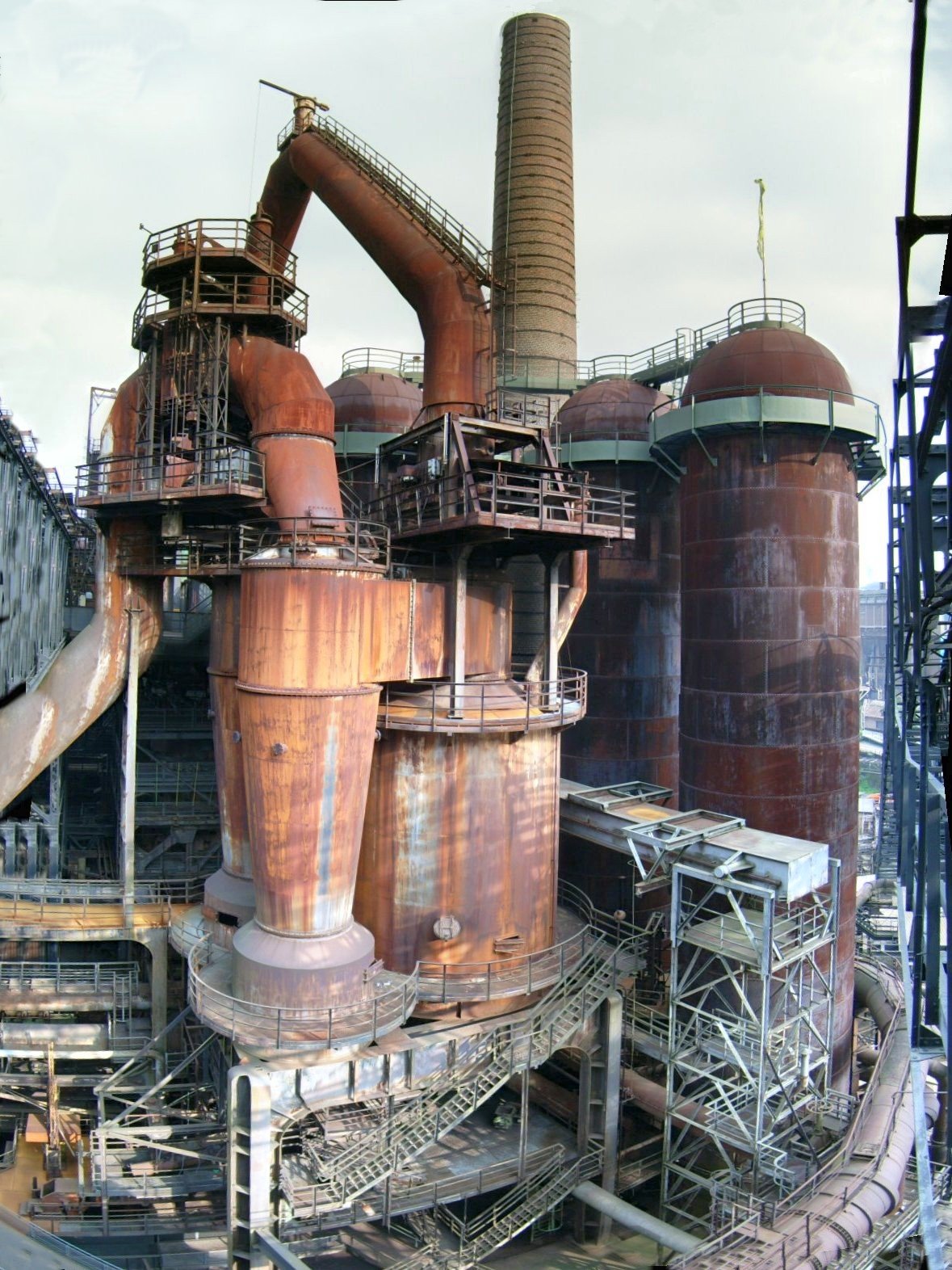
The Völklingen Ironworks in Saarland is the only intact ironworks from the 19th and early 20th century in Western Europe and North America to have been preserved in its entirety, with six blast furnaces, a coking plant, ore preparation facilities, and a blowing engine hall all still standing on the site where they operated from 1873 until the final furnace shutdown in 1986. At its mid-20th century peak the plant employed 17,000 workers and produced four million tonnes of pig iron per year. It was inscribed on the UNESCO World Heritage List in 1994 — one of the first industrial sites in the world to receive the designation.
The Ironworks: Architecture of Industrial Production Völklingen, Saarland, southwestern Germany
The Völklingen Ironworks was founded in 1873 by Julius Bach on the south bank of the Saar River, in a region where the combination of local coal deposits and proximity to iron ore fields across the French border in Lorraine created ideal conditions for integrated iron and steel production. The site changed ownership twice in its early decades before the Röchling family acquired it in 1881; under the Röchlings, who managed it for nearly a century, the ironworks grew into one of the largest producers in the German empire and later in the Weimar Republic and the Third Reich. The architecture of the plant reflects this century-long accumulation: the earliest structures date from the 1880s and 1890s in wrought iron and riveted steel, while the mid-20th century additions use welded steel and reinforced concrete, creating a layered industrial archaeology on a single site.
The six blast furnaces are the most visually dominant elements of the complex. The tallest reach approximately 60 metres; each is surrounded by a web of pipes, stairways, platforms, and conveyance systems for moving iron ore, coke, and limestone — the three raw materials charged from the top — and for removing the molten pig iron and slag tapped from the bottom. The furnaces operated continuously: a blast furnace cannot be easily stopped and restarted without expensive rebuilding, so each furnace ran without interruption for years at a time, tended by rotating crews across three eight-hour shifts. The cast-iron tapping floor, where molten metal was channelled from the furnace base into moulds, is preserved with its original equipment — ladles, troughs, sand beds — giving a direct material sense of the physical conditions of iron production at industrial scale.
The blowing engine hall, which housed the steam-powered and later electrically driven compressors that forced air into the base of the blast furnaces (the “hot blast” that gave the furnaces their oxygen), is the largest single interior space on the site. The engines here — some of the largest stationary reciprocating machines ever built in Germany — were responsible for the constant deep mechanical rhythm that characterised the working ironworks. Several of these engines remain in place, decommissioned but structurally intact. The coking plant, where coal was heated in sealed ovens to drive off volatiles and produce the pure carbon fuel the furnaces required, is also preserved; the coke oven batteries, with their distinctive bee-hive profiles, run in long parallel rows and represent a distinct building typology that was once common across the Ruhr, Saar, and Lorraine coalfields but has largely disappeared as steelmaking moved to electric arc furnaces.
The preservation of this complete production chain — from raw material preparation through coking, blasting, and tapping — is precisely what makes Völklingen significant in industrial heritage terms. In most countries, dismantling and site remediation followed immediately upon closure, motivated by land values, liability concerns, and the cost of maintaining structures with no economic function. Völklingen was saved by a combination of factors: the Saar state government’s recognition of its historical importance immediately after closure, the specific characteristics of the Saarland political context (a border region with a distinctive post-war identity that valued its industrial past), and the relatively modest land pressure in Völklingen compared to more central urban sites.
The Saarland in European History and the Ironworks Since 1994 Saarland border region, adjacent to France and Luxembourg
The Völklingen Ironworks cannot be understood without the history of the Saarland itself, which is among the most contested pieces of territory in 20th-century European history. The Saar coalfield and its associated industrial base became objects of Franco-German competition from the Napoleonic period onward; after Germany’s defeat in the First World War, the Versailles Treaty of 1919 placed the Saar under a League of Nations mandate and granted France the right to exploit the Saar coalfields for 15 years as partial reparation for French mining losses in the Pas-de-Calais. A plebiscite held in January 1935, under League supervision, returned a 90.8% vote for return to Germany; the Saar rejoined the German Reich in March 1935. After Germany’s defeat in 1945, the Saar was placed under French military administration, then given a special status as a protectorate of France with its own government, currency, and Olympic team from 1947 to 1956 — a unique political arrangement that made it neither French nor German for nearly a decade. A second plebiscite in October 1955 voted 67.7% against the proposed Saar Statute that would have maintained the protectorate; political union with West Germany followed in January 1957 and economic union in July 1959.
Throughout these political transitions the ironworks continued operating, producing pig iron for whoever controlled the territory. The Röchling family, whose ownership spanned the Imperial, Weimar, Nazi, and early postwar periods, navigated the successive political regimes with varying degrees of compliance; the family’s wartime conduct — the ironworks used forced labour during the Second World War, including prisoners from Eastern Europe — was the subject of postwar legal proceedings. The ironworks was sequestrated by the French after 1945 and operated under French administration before reverting to German ownership after reunification with West Germany.
Since the UNESCO inscription in 1994, the Völklingen Ironworks has developed as a cultural site with a programme considerably broader than static industrial heritage. The Science Centre Ferrodrom in the former ore preparation plant offers interactive exhibitions on iron, energy, and technology aimed at general audiences including school groups. The blast furnaces are accessible by guided tours that take visitors up through the working levels via original staircases and walkways, with panoramic views across the Saar valley from the upper platforms. The ironworks is illuminated at night — the towers and pipes lit in shifting colours — and since the late 1990s has hosted major music festivals (including large-scale electronic and rock events) and temporary art exhibitions in its industrial spaces. The Völklingen Ironworks is a regular venue for the Europäisches Zentrum für Kunst und Industriekultur (European Centre for Art and Industrial Culture), which organises exhibitions engaging directly with the aesthetic dimensions of industrial production.
The nearest UNESCO World Heritage site is Strasbourg’s Grande Île (France), 60 kilometres south — a practical day-trip pairing that connects industrial Saarland with the medieval and Renaissance urbanism of Alsace. Speyer Cathedral, the largest Romanesque church in Europe, is approximately 120 kilometres east.
Practical information
The Völklingen Ironworks is located in central Völklingen, 12 kilometres west of Saarbrücken. Direct trains from Saarbrücken Hauptbahnhof run every 30 minutes; journey time is approximately 12 minutes. Saarbrücken is connected by rail to Mannheim (1.5 hours), Frankfurt (2.5 hours via Mannheim), and Paris (via the TGV, approximately 2.5 hours from Saarbrücken). From Strasbourg by train, change at Saarbrücken; total journey time approximately 1.5 hours.
The site is open year-round; summer hours are typically 10:00 to 19:00, winter hours 10:00 to 18:00. Entry includes access to the outdoor areas, the Ferrodrom science centre, and selected blast furnace levels. Guided tours of the blast furnace interior and the blowing engine hall are available in German and English and are strongly recommended for understanding the production process; these tours involve climbing steel staircases in an industrial environment and are not recommended for visitors with mobility limitations. The ironworks’ management recommends flat shoes and a jacket — even in summer, the upper furnace platforms are exposed to wind.
Evening events and concerts at the ironworks are announced via the official website; the summer programme typically runs from June through September. The site’s illumination is visible from outside the perimeter fence after dark at no cost. Völklingen town centre has limited restaurant options; Saarbrücken offers a wider choice and is practical for overnight stays.
Frequently Asked Questions
Why was the Völklingen Ironworks preserved intact when most comparable facilities were demolished after closure?
The ironworks closed in July 1986 when the Saarstahl company, under severe financial pressure from the global steel crisis of the early 1980s, halted pig iron production permanently. The immediate question of what to do with the site was resolved relatively quickly in favour of preservation, for several reasons specific to the Saarland context. The state government of the Saarland had a political interest in acknowledging and memorialising the industrial culture that had defined the region’s identity for over a century; unlike the Ruhr in North Rhine-Westphalia, where industrial closures happened at larger scale and with less unified political will, the Saarland’s compact size and its long history as a contested border territory gave its population and government a sharper sense of collective industrial identity. The German Cultural Heritage Protection Foundation (Deutsche Stiftung Denkmalschutz) and the Council of Europe both assessed the site in the late 1980s and identified it as the last intact example of an integrated late-19th-century ironworks in Western Europe and North America — a designation that created the basis for the 1994 UNESCO application. The cost of maintaining the site without an economic function has been substantial and is borne primarily by the state of Saarland. That decision reflects a judgment that the site’s heritage and tourism value — and the identity function it serves for the Saarland — outweighs the cost of maintenance and forgoes the economic value of clearing the land for alternative development.
What did the ironworks produce and how did pig iron fit into the broader steel supply chain?
The Völklingen Ironworks produced pig iron — the intermediate product of smelting iron ore in a blast furnace — rather than finished steel. In the blast furnace process, iron ore (iron oxide minerals, principally magnetite and hematite), coke (pure carbon made from coal), and limestone (a flux that combines with impurities to form slag) are charged together from the top of the furnace. A blast of hot air is driven in from the bottom; the coke burns and produces carbon monoxide, which reduces the iron oxide to metallic iron. The molten iron sinks to the bottom of the furnace, where it is tapped periodically into moulds or ladles; the lighter molten slag floats above the iron and is tapped separately. The resulting pig iron contains approximately 3–4% carbon, which makes it brittle and unsuitable for most engineering applications; it must be refined further in a steelmaking furnace (a Bessemer converter, open-hearth furnace, or basic oxygen furnace) to reduce the carbon content and produce steel. The Völklingen site produced pig iron for transfer to steelmaking plants elsewhere; it was therefore one link in a multi-stage production chain rather than a complete steel producer. This supply chain relationship — from ore to pig iron to steel to finished product — is one of the themes developed in the Ferrodrom science exhibitions, which trace the physics and chemistry of iron and steel production in accessible terms.
How has the Saarland’s contested European history shaped the identity of the Völklingen Ironworks as a heritage site?
The Völklingen Ironworks operated under five different political regimes across its 113 years of active production: the German Empire (1873–1918), the League of Nations Saar Territory (1920–1935), the Third Reich (1935–1945), the French-administered Saar Protectorate (1947–1956), and the Federal Republic of Germany (from 1957). This succession of regimes is not incidental background to the ironworks’ history — it shaped production targets, ownership arrangements, labour policy, and the ironworks’ relationship to adjacent French steelmaking in Lorraine at each stage. The Lorraine iron ore fields, just across the border in France, supplied much of the ore processed at Völklingen; when the border was a contested frontier (as between 1918 and 1935, and again between 1945 and 1957), ore supply arrangements were politically sensitive. The ironworks’ use of forced labour during the Second World War — primarily from Poland and the Soviet Union — is a documented and unresolved chapter that the site’s cultural programming has begun to address more directly in recent years, with exhibition material on the wartime workforce. The European Centre for Art and Industrial Culture based at the ironworks has used the site’s border-region character as a curatorial theme in exhibitions that address Saarland, French Lorraine, and Luxembourgish industrial heritage as an interconnected regional story rather than a national one. This framing — the ironworks as a European border-region site rather than a specifically German one — is consistent with the Saarland’s own post-war self-understanding as a place where French and German industrial cultures interpenetrated across a century of conflict and eventual reconciliation.
Sources
- S1 — Bähr, Astrid. Völklinger Hütte: Weltkulturerbe der Industriegeschichte. DKV-Kunstführer, 2010. ISBN 978-3-422-02268-3.
- S2 — Slotta, Rainer. Erz und Eisen: Die Völklinger Hütte im Saarland. Deutsches Bergbau-Museum, 1999. ISBN 978-3-921533-68-0.
Spotted an error? Write to editorial@culturalheritageonline.com and we correct it the same day.