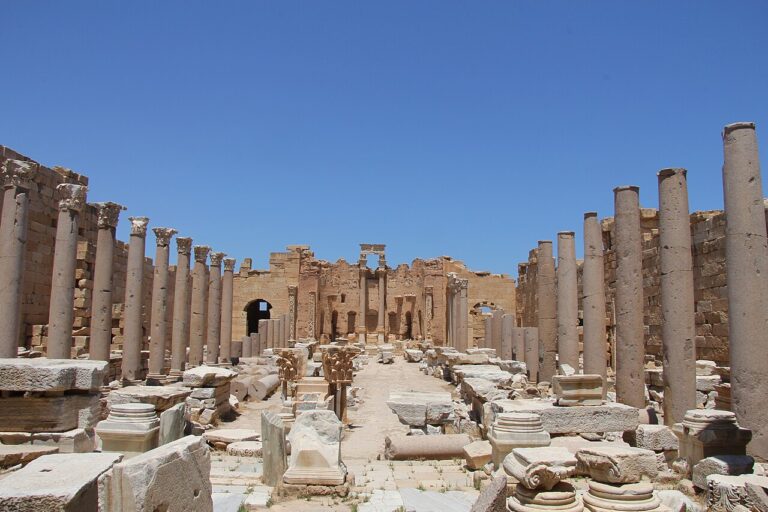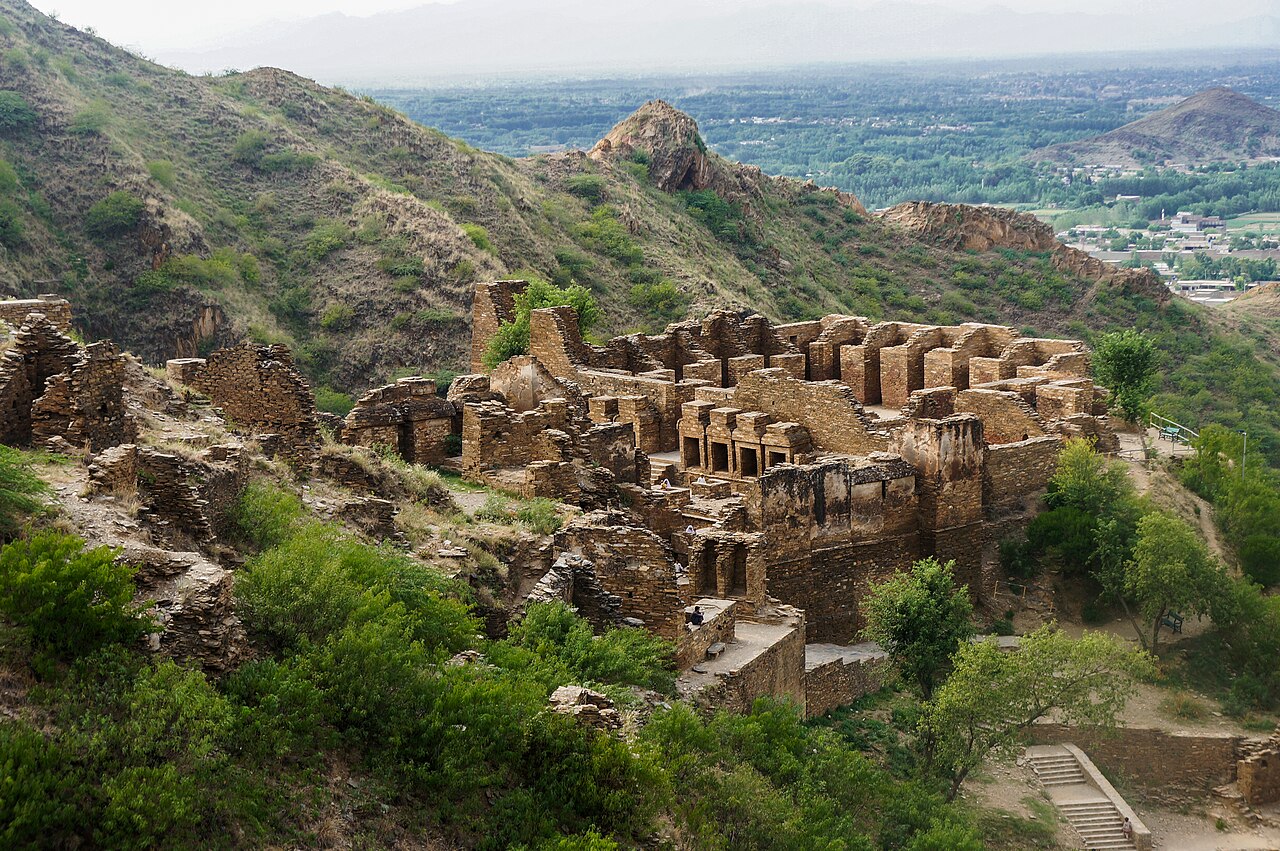
Takht-i-Bahi and Neighbouring City Remains at Sahr-i-Bahlol (Urdu/Pashto: “تخت بہائی” — literally “throne of the stream” or “platform by the water spring”, from “takht” = throne/platform + “bahi” = water spring/stream; alternatively interpreted as “throne of the flowing waters” — the site is indeed located above a spring-fed area in an otherwise arid landscape; the neighboring city “Sahr-i-Bahlol” = “city of Bahlol”, possibly named after a local ruler), inscribed by UNESCO in 1980, is a UNESCO World Heritage designation that recognises the Buddhist monastery complex of Takht-i-Bahi (one of the best-preserved and most important Buddhist monastery sites in the Gandharan civilisation — the distinctive Greco-Buddhist cultural and artistic tradition that flourished in the Peshawar Valley and the surrounding regions of modern Pakistan and eastern Afghanistan from approximately the 3rd century BCE to the 7th century CE, the region where the Greek artistic traditions of the Hellenistic world introduced by Alexander the Great’s campaign (327–325 BCE) combined with the Indian Buddhist religious tradition patronised by the Mauryan emperor Ashoka [reigning approximately 268–232 BCE] to produce a distinctive art style that created the first anthropomorphic images of the Buddha — images of the Buddha in human form that replaced the earlier aniconic tradition of representing the Buddha only through symbols [footprints, an empty throne, a parasol, the Bodhi tree]) and the adjacent ruins of the Parthian-period city of Sahr-i-Bahlol in the Mardan District of the Khyber Pakhtunkhwa Province of Pakistan (approximately 80 km northeast of Peshawar, approximately 15 km north of Mardan city).
The Gandharan Buddhist monastery and the Greco-Buddhist art tradition Monastery Courts · Main Stupa · Assembly Hall · Mardan 15 km · Peshawar 80 km · Taxila 90 km
The Takht-i-Bahi monastery complex occupies the summit and upper slopes of a rocky ridgeline approximately 150 m above the surrounding plain — a location chosen both for its commanding defensive position and for its suitability for the contemplative life of the Buddhist monastic community, separated from the populated valleys below but visible from a great distance as a symbol of the Buddhist presence in the Gandharan landscape. The complex as preserved today (the result of partial excavations beginning in the early 20th century CE under British India’s Archaeological Survey) comprises four main architectural groupings: (1) the Main Stupa Court (“stupa” — a Buddhist reliquary mound, originally an earthen mound encasing the relics of the historical Buddha or a Buddhist saint, later elaborated into the characteristic domed stone structure of the Gandharan tradition — the main stupa of Takht-i-Bahi is a large cylindrical drum supporting a hemispherical dome on a square base, consistent with the developed Gandharan stupa typology of approximately the 1st–3rd centuries CE, surrounded by a court of smaller votive stupas donated by individual worshippers); (2) the Monastery Court (a quadrangular court surrounded by a double row of individual monks’ cells — small rooms approximately 2 m × 2 m, each lit by a single window and opening onto the central courtyard through a doorway, the standard planning unit of the Gandharan Buddhist monastery that accommodates the individual meditation practice of the monastic community while providing visual connection to the communal stupa at the centre); (3) the Assembly Hall (a larger rectangular space used for communal teaching, recitation of the Vinaya [monastic code], and meditation instruction — the hall at Takht-i-Bahi retains the remnants of the carved stone decoration that was characteristic of Gandharan Buddhist monastery interiors, including relief panels depicting scenes from the Jataka tales [the stories of the Buddha’s previous lives] in the distinctive Gandharan style that combines Greek anatomical naturalism with Indian religious iconography); and (4) the Tantric Monastery (a smaller walled enclosure identified by its excavators as a later addition to the complex, possibly associated with the Vajrayana or tantric traditions of Buddhism that became prominent in the Gandharan region in the 4th–6th centuries CE). The Gandharan artistic tradition that Takht-i-Bahi embodies is of exceptional art-historical importance: the sculptures found at Takht-i-Bahi and at related Gandharan sites (particularly the great stupa complex at Taxila [UNESCO-inscribed 1980], approximately 90 km from Takht-i-Bahi) include the earliest known images of the Buddha in human form — images that show the Buddha sitting cross-legged in meditation (the “dhyana mudra” = meditation gesture — hands folded in the lap, eyes closed or partially closed, the expression conveying transcendence beyond ordinary consciousness) or standing with a right hand raised in the “abhaya mudra” (= gesture of fearlessness, the hand raised with palm outward), wearing the draped Greek himation robe rather than the Indian dhoti, with the wavy hair (the “usnisha” = cranial protuberance of the Buddha, rendered in the Gandharan tradition as the wavy Greek hair style of the Apollo or Helios type) parted at the centre and gathered into the distinctive topknot of the Buddha image.
Practical information
Takht-i-Bahi is approximately 80 km northeast of Peshawar (the capital of Khyber Pakhtunkhwa Province, with an international airport) and approximately 15 km north of Mardan (the nearest significant town). Access from Peshawar is by road via Mardan (approximately 1.5 hours). The monastery complex is managed by the Pakistan Department of Archaeology; admission charge applies. The site is on a hilltop — comfortable shoes and some climbing required. The combined UNESCO inscription also includes the Parthian city ruins of Sahr-i-Bahlol, approximately 3 km from Takht-i-Bahi at ground level. Security conditions in Khyber Pakhtunkhwa should be checked before visiting; the site is in a traditionally accessible tourist area but regional security varies. Best visiting season: October–March (the summer months June–August are extremely hot in the Peshawar Valley).
Frequently Asked Questions
What was the Gandharan civilisation and why did it produce the first images of the Buddha?
The Gandharan civilisation (named from “Gandhara” — the ancient name of the region corresponding approximately to the modern Peshawar Valley, Swat Valley, and adjacent areas of northwestern Pakistan and eastern Afghanistan — a name attested in the Rigveda [approximately 1500–1200 BCE] as a peripheral region of the Vedic world, in the Achaemenid Persian royal inscriptions as the easternmost satrapy of the Persian Empire [approximately 520 BCE], and in Alexander the Great’s campaign records [327–325 BCE] as a sophisticated urban region with established agricultural infrastructure and political organisation) was the cultural and artistic tradition that flourished in the Peshawar Valley and surrounding regions from approximately the 3rd century BCE to the 7th century CE — a tradition that is extraordinary in world art history for producing the first images of the Buddha in human form and for creating the distinctive Greco-Buddhist artistic style that subsequently influenced the entire Buddhist iconographic tradition across all of Asia (including the Chinese, Japanese, Korean, Southeast Asian, and Tibetan Buddhist art traditions that dominate modern perceptions of Buddhist imagery). The reason the Gandharan civilisation produced the first Buddha images is a matter of art-historical debate, but the most widely accepted explanation involves the specific cultural collision of three civilisational traditions in the Gandharan region: (1) the Indian Buddhist religious tradition (introduced to Gandhara by the Mauryan emperor Ashoka’s missionary campaigns approximately 260–250 BCE — Ashoka had converted to Buddhism after the bloody Kalinga War and committed his empire to spreading the Buddhist dharma [teaching] throughout his domains and beyond, sending missionaries to Sri Lanka, Greece, Syria, Egypt, and the Gandharan frontier regions); (2) the Greek figurative artistic tradition (introduced by the Macedonian-Greek colonists settled in the Gandharan region by Alexander and his successors, who established the Bactrian Greek kingdom [approximately 250–125 BCE] and the Indo-Greek kingdoms [approximately 180–10 BCE] that combined Greek political and cultural institutions with the existing Indian substrate culture); and (3) the Parthian (Iranian) artistic patronage tradition (the Parthian dynasty of Gondophares [approximately 19–46 CE] — the “Gondophares” who appears in early Christian tradition as one of the Magi and to whom the Acts of Thomas attributes the apostle Thomas’s missionary journey to India — was a major patron of Buddhist art and architecture in the Gandharan region). The combination of Greek figurative realism with Buddhist religious need — the Buddhist teacher tradition required images of the Buddha for veneration, instruction, and meditation focus — produced the first anthropomorphic Buddha image approximately the 1st–2nd century CE, displacing the earlier aniconic tradition in which the Buddha was represented only by symbols. The earliest Gandharan Buddha images (now in museums in Lahore, Peshawar, Berlin, Paris, London, and Tokyo) show the Buddha with distinctly Greek facial features — straight nose, deep-set eyes, wavy hair in the Greek Apollo style — wearing the Greek philosopher’s himation robe, and making hand gestures (mudras) derived from the Indian gesture language rather than the Greek pantomime tradition.
What happened to the Gandharan Buddhist civilisation and why did the monasteries fall into ruin?
The Gandharan Buddhist civilisation reached its apogee under the Kushan Empire (approximately 1st–3rd century CE — the Kushan rulers, of Central Asian Yuezhi origin, were enthusiastic patrons of Buddhist art and architecture, commissioning the great stupas and monasteries of Gandhara while also patronising the Greco-Roman artistic tradition, resulting in the extraordinary sculptural output of the Kushan period that fills the world’s great museums) and began its long decline through a combination of political disruption, religious change, and military invasion over the following centuries. The specific sequence of events that ended the Gandharan Buddhist tradition at Takht-i-Bahi was: (1) the weakening of Kushan political authority in the 3rd century CE following the Sassanid Persian invasion of the western Kushan territories (approximately 230–270 CE), which disrupted the trade routes — particularly the Silk Road — that had provided the wealth sustaining the Gandharan monastery economy; (2) the invasion of the Kidarites (a Central Asian nomadic people, possibly of Hunnic origin) approximately 350–380 CE, which further weakened the surviving Kushan political structure; (3) the devastating invasion of the White Huns (Hephthalites) approximately 450–560 CE, during which the Buddhist monasteries of the Gandharan region suffered severe destruction — the Chinese Buddhist pilgrim Xuanzang (who visited the Peshawar Valley approximately 630 CE, approximately 60 years after the Hephthalite period) described the monasteries of the region as largely in ruins with only small communities of monks remaining in some sites; and (4) the Islamic conquest of the region beginning approximately 660–670 CE under the Umayyad Caliphate’s campaigns into Central Asia and the Indus Valley, which ended the political and social conditions that had sustained Buddhist monastic life in Gandhara for approximately 900 years. The ruins of Takht-i-Bahi were covered by accumulated debris and the Buddhist stone sculptures were largely removed or destroyed — some images buried by the monks themselves during periods of danger are now among the best-preserved Gandharan sculptures in museum collections (including the Peshawar Museum’s outstanding collection of Gandharan Buddhist sculpture).
EXCERPT: Takht-i-Bahi, Mardan District, Pakistan, UNESCO-inscribed 1980 — the best-preserved Buddhist monastery complex in the Gandharan civilisation: 600 years of occupation (1st century BCE – 7th century CE), stupa courts, monks’ cells, and the artistic tradition that created the first anthropomorphic images of the Buddha in human form, combining Greek naturalism with Indian religious iconography.
META: UNESCO World Heritage Sites near Takht-i-Bahi Pakistan: Taxila Pakistan (UNESCO 1980), Mohenjo-daro Pakistan (UNESCO 1980), Lahore Fort Pakistan (UNESCO 1981) — Takht-i-Bahi Buddhist monastery Pakistan UNESCO 1980, Gandhara civilization Greco-Buddhist art, first Buddha images anthropomorphic, Kushan Empire stupa monastery, Mardan Khyber Pakhtunkhwa, Peshawar 80km Taxila 90km.
Sources
- S1 — UNESCO World Heritage Centre — Buddhist Ruins of Takht-i-Bahi and Neighbouring City Remains at Sahr-i-Bahlol (Ref. 140) — https://web.archive.org/web/20230601000000/https://whc.unesco.org/en/list/140/
- S2 — Directorate of Archaeology and Museums Khyber Pakhtunkhwa Pakistan — https://kparchaeology.gkp.pk/
Spotted an error? Write to [email protected] and we correct it the same day.