

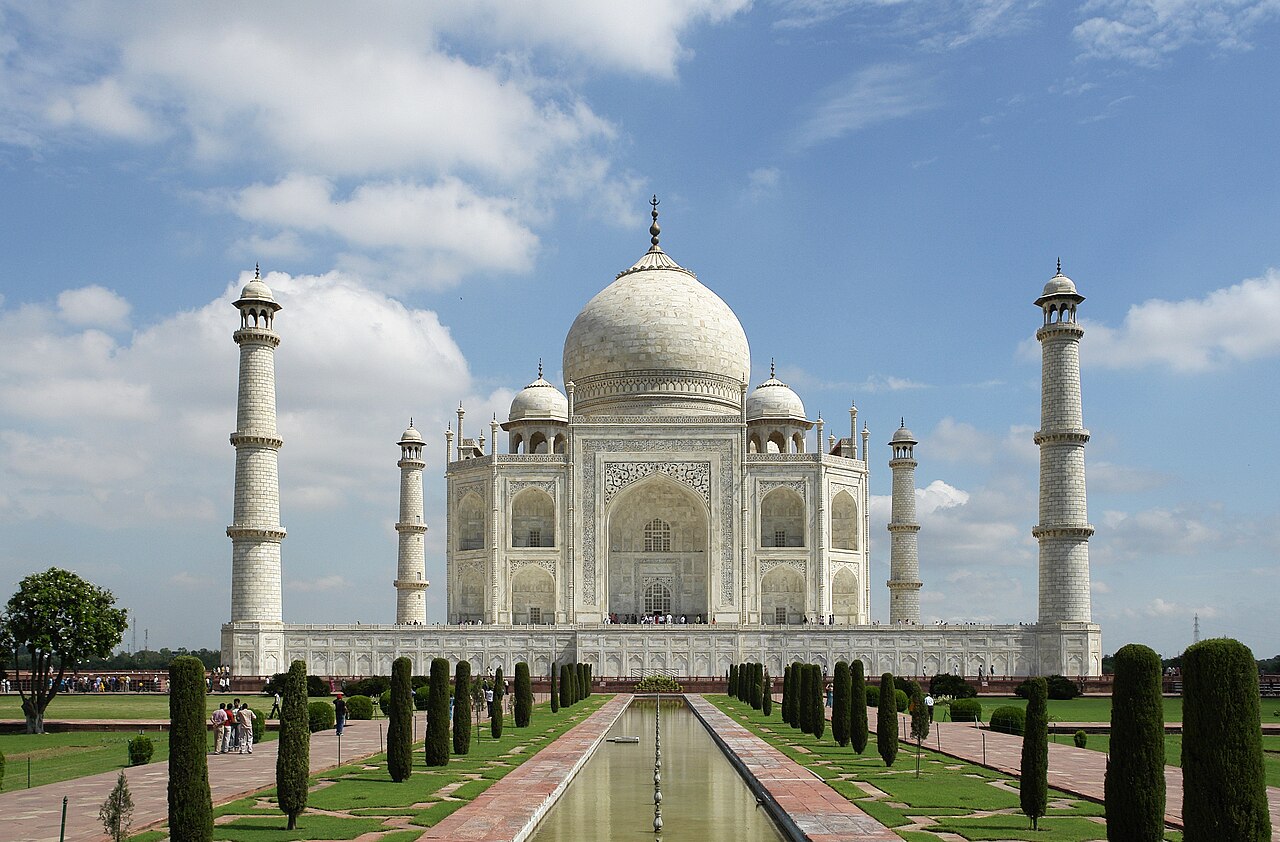
The Taj Mahal is a mausoleum complex on the southern bank of the Yamuna River in Agra, Uttar Pradesh, commissioned by Mughal Emperor Shah Jahan as the tomb of his third wife Mumtaz Mahal, who died in childbirth in 1631. Construction began in 1632, engaged approximately 20,000 workers and architects from across the Mughal Empire and Central Asia, and the main mausoleum was completed around 1643; the full complex, including the mosque and guest house, was finished by 1653. UNESCO inscribed the Taj Mahal as a World Heritage Site in 1983.
A Mausoleum Built in Grief: Construction, Materials and Architecture Agra, Uttar Pradesh
Mumtaz Mahal — born Arjumand Banu Begum in 1593 — was the daughter of a Persian nobleman and became Shah Jahan’s third and most favoured wife. She died on 17 June 1631 during the birth of their fourteenth child at Burhanpur. The emperor, who was on military campaign at the time, is reported by court chronicles to have gone into deep mourning. Within months he began planning the funerary complex that would become the most visited monument in India.
The chief architect is traditionally named as Ustad Ahmad Lahori, documented in contemporaneous Mughal sources. The construction workforce came from across the empire and from Central Asia — masons, calligraphers, inlay workers, carpenters and dome builders. The primary building material, white Makrana marble, was quarried approximately 300 km away in Rajasthan and transported to Agra on ox carts, with approximately 1,000 elephants used as draught animals for the heaviest components. The sheer logistical scale is staggering: the marble facing alone required hundreds of carts working in relay over a period of years across a route that crossed rivers and desert terrain.
The dome, the most immediately recognisable feature of the monument, rises 73 metres above the base. It is a double-shell construction: an outer visible dome of white marble and an inner dome that controls the proportions of the interior chamber. This double-shell technique was known in Persian and Central Asian architectural traditions and allowed builders to achieve a dramatic exterior silhouette without making the interior space overwhelmingly tall. The four minarets at the corners lean slightly outward — a deliberate structural choice so that in the event of earthquake they would fall away from the main mausoleum rather than onto it.
The decorative programme is extraordinary. The surfaces of the mausoleum are covered in pietra dura inlay — semi-precious stones including lapis lazuli, jasper, jade, crystal and turquoise set into white marble in floral and geometric patterns. The calligraphic inscriptions framing the main entrance arch and the interior cenotaph chamber are verses from the Quran executed by the court calligrapher Amanat Khan, who signed his name on the main gateway — one of the very few artisans of the complex to be documented by name. The total cost of construction has been estimated at approximately 32 million rupees in 1650s values, equivalent to roughly one billion US dollars by standard commodity-price conversions.
The octagonal interior chamber contains the cenotaphs of Mumtaz Mahal and, flanking her, Shah Jahan himself — the actual burials are in a crypt below, at garden level. Shah Jahan was not originally planned for burial here: the complex was built for Mumtaz Mahal alone. He was buried beside her after his death in 1666, his coffin displacing the geometric symmetry of a space designed for one.
The Charbagh Garden, the Water System and the Emperor’s Imprisonment Yamuna River bend, Agra
The garden that surrounds the mausoleum is a charbagh — a formal Persian garden divided into four equal quadrants by water channels, representing the four rivers of paradise described in Islamic tradition (water, milk, wine and honey). The garden covers approximately 300 metres by 300 metres and is divided first by the main north-south canal running from the main gateway to the mausoleum, then subdivided again into sixteen flower beds. The central reflecting pool sits at the midpoint of the main axis and provides the canonical view of the dome framed by the gateway arch.
The visual sequence was deliberate. Entering through the main red sandstone gateway (darwaza-i-rauza), a visitor sees the dome framed within the arch of the gateway before anything else. As one approaches along the central canal, the dome grows and resolves in detail. This approach — placing the mausoleum at the far northern end of the garden rather than at its centre — was an architectural departure from earlier Mughal garden tomb layouts, where the tomb was placed centrally. The effect of walking toward the dome across the full length of the garden is calculated: it was designed as a promenade of gradual revelation.
Water for the fountains and channels was raised from the Yamuna River below using an araghatta system — a chain-of-pots mechanism operated by bullocks — lifting water up to storage tanks and then distributing it under pressure through an underground copper pipe system. This infrastructure was essential: the garden required continuous water supply to maintain its fountains and the tree-lined pathways between the flower beds.
In 1658, Shah Jahan was deposed by his son Aurangzeb in a succession war. The emperor was imprisoned in Agra Fort, 2 km northwest of the Taj Mahal along the Yamuna River. The fort’s Musamman Burj — an octagonal tower projecting from the fort’s eastern wall — faces directly down the river bend toward the mausoleum. Contemporary sources record that Shah Jahan spent the remaining eight years of his life in the Musamman Burj, able to see the Taj Mahal from his window across the Yamuna. He died in the tower on 22 January 1666. His body was transported by boat down the Yamuna and buried in the crypt beside Mumtaz Mahal — the exact placement described in contemporaneous accounts.
The pairing of these two UNESCO World Heritage Sites — the Taj Mahal and Agra Fort — is not merely geographic. They are linked by one of the most documented personal stories in Mughal history: the emperor who built the most celebrated funerary monument in the world spent the last years of his life imprisoned within sight of it, in the fort where his son had usurped him.
Practical information
The Taj Mahal is open daily except Friday, from sunrise to sunset. The monument closes for Friday prayers and remains closed to casual visitors for most of the day; Friday visits are restricted to worshippers attending the mosque within the complex. Entry is charged; the ticket includes access to the main gateway, garden, and the mausoleum exterior. An additional fee applies for entry to the interior chamber. Photography is permitted in the garden and from the external terraces; interior photography is prohibited.
The nearest airports are Agra’s Kheria Airport (approximately 12 km) and Delhi’s Indira Gandhi International Airport (approximately 220 km by road or rail). The Agra Cantonment railway station, the city’s principal station, is approximately 5 km from the Taj Mahal and connects to Delhi, Jaipur, Varanasi and Mumbai. The Gatimaan Express from Delhi Hazrat Nizamuddin completes the journey in approximately 100 minutes. Within Agra, pre-paid taxis and autorickshaws operate to the monument. The road-restricted zone around the Taj Mahal prohibits combustion vehicles within 500 metres of the eastern gate; battery-operated vehicles, cycle rickshaws and walking are the permitted options for the final approach.
Both Agra Fort (2 km northwest) and Fatehpur Sikri (40 km west) are within practical day-visit range. Combined UNESCO tickets covering both Agra sites — the Taj Mahal and Agra Fort — are available.
Frequently Asked Questions
How long did it take to build the Taj Mahal, and how many people worked on it?
Construction of the Taj Mahal began in 1632, approximately one year after the death of Mumtaz Mahal in June 1631. The main mausoleum was substantially complete by around 1643 — an eleven-year construction period for the central structure. The full complex, including the red sandstone mosque to the west of the mausoleum, the identical guest house (mihman khana) to the east, the main gateway and the perimeter walls, was finished by approximately 1653. The total elapsed time from groundbreaking to completion of the entire complex was therefore approximately 21 years.
Contemporary Mughal sources indicate that approximately 20,000 workers were engaged at the peak of construction, drawn from across the Mughal Empire and from craftsman communities in Central Asia — specifically from Samarkand and Bukhara, cities with long traditions in the pietra dura inlay work that covers the mausoleum surfaces. Beyond the stonecutters and masons, the workforce included specialist calligraphers, metal casters for the railings, hydraulic engineers for the water supply system, and landscape workers for the charbagh garden. The chief architect is traditionally identified as Ustad Ahmad Lahori, referenced in two contemporaneous Persian-language biographical sources. The ornamental calligraphy programme was directed by Amanat Khan, who left his signature on the main entrance arch — a rare example of a craftsman identified by name in the monument itself.
Why is the Taj Mahal white, and does it change colour?
The mausoleum’s exterior surfaces are faced with Makrana marble, quarried from deposits near Makrana in Rajasthan, approximately 300 km southwest of Agra. Makrana marble is a high-purity white metamorphic limestone that has been used in Indian construction for centuries and is noted for its translucency — light penetrates slightly into the surface rather than reflecting from it opaquely, which gives the stone a luminous quality at different times of day. The same marble was used centuries later in the restoration of the Victoria Memorial in Kolkata.
The Taj Mahal does change apparent colour with light conditions, and this is not a modern tourist myth — it is a physical property of the stone and was presumably known to the architects. At dawn, the marble reflects a pale pink. Through the morning and midday, it appears white with cool undertones. In late afternoon light the surface takes on golden and amber tones. Under moonlight — the monument is open on the five nights surrounding each full moon — the marble appears a pale silver-blue. These colour shifts result from the stone’s interaction with the spectrum of natural light at different angles and times of day. The pietra dura inlay of semi-precious stones in the surface panels — lapis lazuli, jasper, jade and turquoise among others — also shifts in apparent colour with the light, so the decorative programme is in some sense designed for a changing viewing experience across the day.
What are the nearest UNESCO World Heritage Sites to the Taj Mahal?
The two closest UNESCO World Heritage Sites to the Taj Mahal are both within the city of Agra. Agra Fort, inscribed in 1983 the same year as the Taj Mahal, stands approximately 2 km northwest of the mausoleum along the Yamuna River. The fort was the Mughal imperial residence for Akbar, Jahangir and Shah Jahan, and the two sites are directly linked historically: Shah Jahan was imprisoned in the fort’s Musamman Burj tower after his deposition by Aurangzeb in 1658, and the tower faces the Taj Mahal across the Yamuna bend. Fatehpur Sikri, Akbar’s former imperial capital inscribed in 1986, is approximately 40 km west of Agra and reachable by road in under an hour. It preserves the only Mughal imperial city that was built from scratch and abandoned in a single generation, abandoned around 1585 after serving as capital for approximately 14 years. Farther afield, the Buddhist monuments at Sanchi in Madhya Pradesh — inscribed in 1989 — are approximately 380 km south of Agra, a day’s journey by road or rail via Bhopal, making them a reasonable addition to a longer itinerary through north-central India’s UNESCO sites.
Sources
- S1 — Archaeological Survey of India (ASI) — Agra Circle: Taj Mahal Conservation & World Heritage Site — https://asi.nic.in/
- S2 — Ebba Koch — The Complete Taj Mahal, Thames & Hudson, London, 2006, ISBN 978-0500342091
Spotted an error? Write to editorial@culturalheritageonline.com and we correct it the same day.

.jpeg)