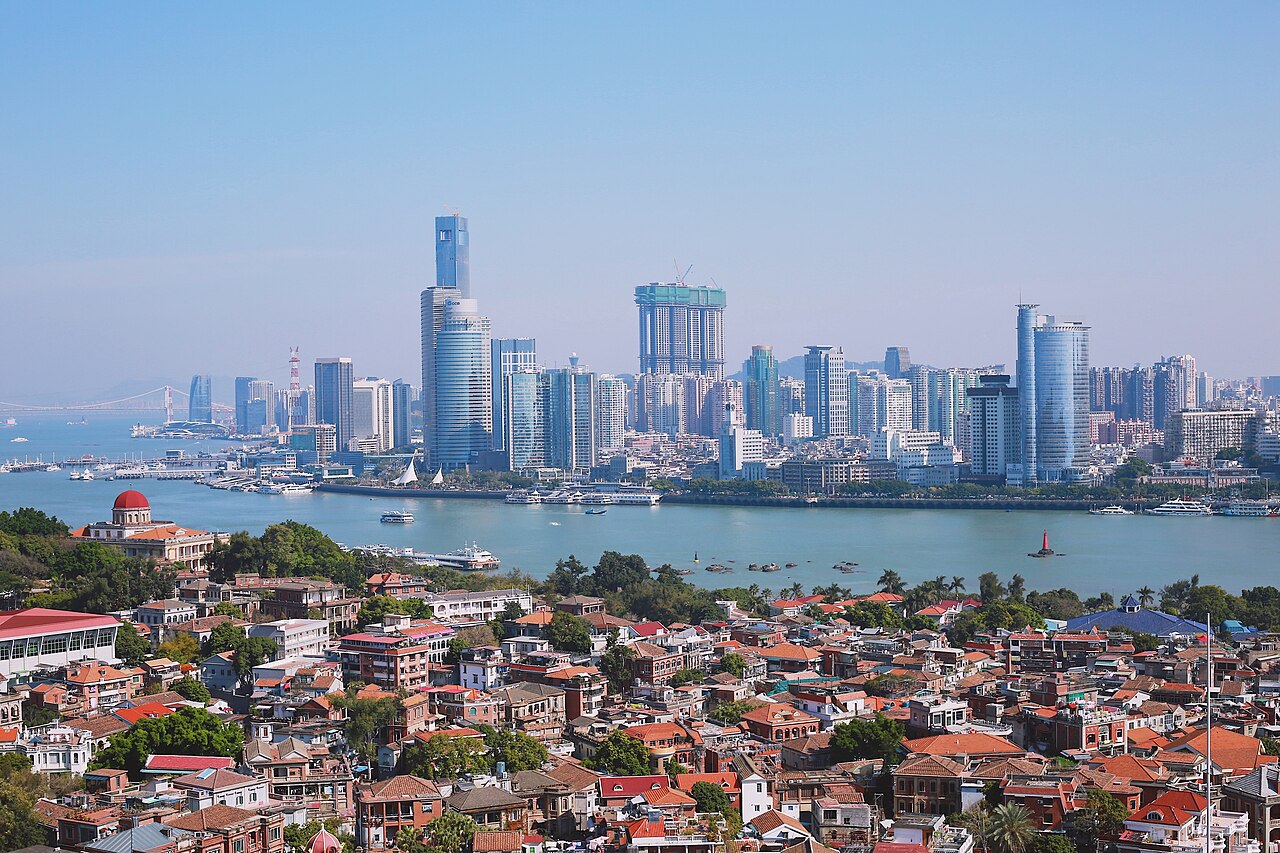
Kulangsu (鼓浪屿, Gǔlàng Yǔ, alternatively romanised as Gulangyu), inscribed by UNESCO in 2017 as a Historic International Settlement, is a small island of 1.88 km² located 600 metres offshore from Xiamen City in the Taiwan Strait, Fujian Province, China — the material evidence of an internationally administered concession settlement that operated from 1902 to 1942, during which period representatives of 13 national governments established consulates, churches, schools, sports clubs, hospitals, and residential compounds on an island that had previously been a minor Ming-dynasty defensive garrison, transforming Kulangsu into the most architecturally diverse collection of eclectic colonial and vernacular architecture in Chinese territory, and the settlement most frequently described by early 20th-century visitors as an idealised colonial garden city. The inscription’s Outstanding Universal Value rests on the surviving built fabric of the International Settlement period: 931 historical buildings constructed between 1840 and 1945, including Amoy Deco (厦门装饰艺术, the Xiamen-specific eclectic synthesis that combined European neoclassical facades with Southern Chinese shophouse spatial planning, traditional Fujian tile roofing, and locally manufactured ceramic ornament) buildings, consulate compounds, missionary hospitals, and the residential villas of the overseas Chinese (Nanyang Huaqiao, 南洋华侨) merchants who returned from Southeast Asia with commercial wealth and built on Kulangsu in a hybrid architectural language combining European Art Deco, Malay tropical, and Fujian vernacular construction traditions — producing an architecture without close parallel in either European or Chinese building history.
Kulangsu’s proximity heritage: Fujian coastal legacy and the Minnan cultural world Quanzhou Song-Yuan China · Wuyi Mountain Fujian · Fuzhou Yongquan Temple — 80 to 200 km
Eighty Kilometres north of Kulangsu by road and HSR (approximately 35 minutes from Xiamen North to Quanzhou Station on the Fuzhou-Xiamen HSR), Quanzhou City is the other UNESCO inscription in the Fujian coastal heritage circuit and the most historically significant companion site to Kulangsu. Quanzhou: Emporium of the World in Song-Yuan China (inscribed 2021) and Kulangsu are the two bookends of Fujian’s maritime heritage: Quanzhou representing the Song-Yuan (10th–14th centuries CE) phase when the Port of Quanzhou (Zayton, to Marco Polo) was one of the two greatest maritime trade hubs in the medieval world; and Kulangsu representing the 19th–20th century phase when Xiamen Bay was the primary gateway for the Fujian diaspora’s overseas Chinese trade networks. The cultural connection is direct — the Minnan (Southern Min, 闽南) language, cuisine, religious practice (Mazu worship, the Jade Emperor cult, and the Minnan opera tradition), and merchant social organisation are continuous from Quanzhou’s Song-dynasty trading community to Kulangsu’s 20th-century Nanyang Huaqiao merchant villa builders. From Xiamen, Quanzhou is the most practical HSR day trip (approximately 35 minutes from Xiamen North to Quanzhou Station); the Quanzhou heritage walking circuit (Old City waterfront → Qingjing Mosque → Kaiyuan Temple → Maritime Trade Museum → Maritime Silk Road Museum → Luoyang Bridge) requires approximately 6–8 hours to complete.
Two Hundred Kilometres northwest of Kulangsu by road (approximately 3 hours from Xiamen North to Wuyishan Station on the Hangzhou-Fuzhou-Shenzhen HSR, with connection from Xiamen North via the Fuzhou-Xiamen HSR to Fuzhou and then the coastal HSR north), the Wuyi Mountains (武夷山, inscribed UNESCO 1999 for both natural and cultural heritage) represent the inland counterpart to Kulangsu’s coastal heritage — the forested mountain landscape that has been the source of Fujian’s most commercially significant product (Wuyi Rock Oolong tea, specifically Dahongpao/Big Red Robe oolong, the most expensive tea variety in the world at its peak valuation, and Lapsang Souchong, the first black tea exported to Europe in the 17th century via the Dutch East India Company) and the refuge of the Neo-Confucian philosophical tradition (the 12th-century Zhu Xi’s Academy at Wuyi Mountain, where the philosopher Zhu Xi taught from 1183 to 1200 CE and produced the systematic Neo-Confucian synthesis that became the ideological framework for Chinese imperial governance and examination culture from the Song dynasty through the Republic). From Xiamen North, Wuyishan is reached by the Hangzhou-Fuzhou-Shenzhen HSR north to Fuzhou and then west to Wuyishan (approximately 3.5–4 hours total), or by flight from Xiamen Gaoqi Airport to Wuyishan Airport (approximately 1.5 hours). The Wuyi Mountain scenic area (the Jiuqu Xi nine-bend stream bamboo-raft float and the Dajin Lake scenic area) is the primary visitor circuit, with the Wuyi Mountain Tea Research Institute and the Wuyi Palace (the former headquarters of Zhu Xi’s academy, now a museum of Neo-Confucian philosophy) providing the cultural context for the tea-mountain heritage.
Practical information
Kulangsu (Gulangyu) is accessible only by ferry from Xiamen’s Lundu Ferry Terminal (the main international tourist terminal, approximately 15 minutes’ walk from Zhongshan Road pedestrian street in central Xiamen) or the Neicuo’ao Ferry Terminal (the local resident terminal, closer to Xiamen’s Huyuelu area). Tourist ferries run every 15–30 minutes, with journey time approximately 5–10 minutes. There are no motor vehicles on Kulangsu — the island is navigable only on foot (electric golf carts serve residents with mobility needs, but tourist access is pedestrian only). The primary visitor circuit on the island covers approximately 5–8 km of walking: Piano Museum (the most-visited single attraction, with approximately 70 historical pianos from the European and American concert piano tradition, established in the Guyue Villa by Chinese-American collector Hu Youyi) → Sunlight Rock (the island’s highest point at 92.68 metres, with panoramic views of Xiamen harbour and the Taiwan Strait) → Shuzhang Garden (a Qing-period garden of 1913 built by the Fujian provincial official Lin Erjia, incorporating the earliest examples of reinforced concrete construction in Chinese garden design) → the International Settlement Historic Zone (the concentrated area of eclectic consulate and residential architecture around Longtou Road and Neicuo’ao Bay). Best visiting season: October–April (mild coastal temperatures, 18–24°C, low typhoon risk); avoid the National Day holiday week (October 1–7) and Chinese New Year golden week when the island’s pedestrian visitor density becomes extreme (daily visitor counts exceeding 40,000 on the 1.88 km² island). The Piano Capital Festival (annual, March–April) is the recommended cultural event: Kulangsu produces a disproportionate number of China’s professional pianists (the island had over 500 pianos during the peak International Settlement period, one piano per 3.5 residents, giving it the highest piano density of any urban area in early 20th-century Asia), and the festival celebrates this legacy with outdoor concerts in the historic buildings and gardens.
Frequently Asked Questions
What was the International Settlement of Kulangsu and how did 13 foreign nations come to share a 1.88 km² island?
The International Settlement of Kulangsu emerged from the 1842 Treaty of Nanking (the treaty ending the First Opium War between Britain and China), which opened five treaty ports — Guangzhou, Fuzhou, Xiamen, Ningbo, and Shanghai — to foreign trade and residence. Xiamen (Amoy in the period English romanisation of the Minnan pronunciation) was among the five treaty ports, and Kulangsu — then a small island housing a Chinese garrison fort and a fishing community — was identified by foreign residents as a more healthful and secure residential site than the crowded Xiamen mainland waterfront. British and American merchants established the first foreign residences on Kulangsu in the 1840s; British, American, and German consulates followed in the 1850s–1860s; and the formal establishment of the International Settlement was codified by the International Settlement Convention of 1902, signed by China and representatives of Britain, the United States, Germany, the Netherlands, France, Spain, Denmark, Portugal, and other treaty port nations with interests in Xiamen Bay. Under the Convention, the island was governed by a joint Municipal Council of foreign representatives, which collected local taxes, maintained public infrastructure (roads, public gardens, street lighting, water supply), operated a police force (combining Chinese constables and foreign officers), and administered building regulations. The 13 national governments with a presence on the island at various points between 1902 and 1942 (when the Japanese occupation dissolved the International Settlement) included Britain, the United States, Germany, France, the Netherlands, Spain, Denmark, Portugal, Norway, Sweden, Japan, the Philippines, and Austria-Hungary — a roster that reflects the full range of 19th–early 20th century treaty port powers in East Asia. The Nanyang Huaqiao (overseas Chinese from Southeast Asia) who returned to build villas on Kulangsu in the early 20th century — particularly the Manila, Penang, and Singapore Fujian merchant communities — brought the design aesthetic and the financial capital that produced the island’s most architecturally distinctive buildings: the hybrid Amoy Deco style combines European architectural motifs (classical columns, Art Deco geometric ornament, balcony railings) with Southern Chinese construction materials (fired brick, local ceramic tile, timber framing) and tropical spatial organisation (deep verandas, cross-ventilation corridors, internal garden courtyards).
What is the Kulangsu piano tradition and why does the island produce so many professional pianists?
Kulangsu’s reputation as China’s “piano island” (琴岛, Qín Dǎo) originates in the confluence of several factors that made Western classical music unusually deeply embedded in the island’s culture during the International Settlement period: the presence of Christian missionary educational institutions (the Talmage College, founded 1898 by the American Reformed Church; the Anglo-Chinese College, founded by the London Missionary Society; and multiple mission schools operated by British, American, and Dutch Protestant denominations) that taught Western music as a component of the mission school curriculum, exposing Kulangsu children of Christian Fujian families to piano instruction from an early age; the presence of foreign resident families who brought concert pianos and gave private lessons; and the social prestige among the Nanyang Huaqiao merchant class of piano proficiency as a marker of Western-educated cosmopolitan status (the Huaqiao villa builders who constructed Kulangsu’s most architecturally distinguished houses also furnished them with Steinway, Blüthner, and Bösendorfer concert grands, which they imported through Shanghai and Hong Kong). By the 1920s–1930s, Kulangsu had established a self-reinforcing musical culture in which piano performance was a social expectation for the children of the island’s elite families, professional piano teachers were resident on the island, and Kulangsu-born pianists went on to study at the Shanghai Conservatory (founded 1927) and eventually at European conservatories. The trajectory produced a disproportionate concentration of Chinese concert pianists with Kulangsu origins: among the most celebrated is Liu Shikun (刘诗昆, born 1939, Kulangsu), who won second prize at the 1958 Tchaikovsky International Piano Competition in Moscow (the first Chinese pianist to achieve international competition recognition), and Yin Chengzong (殷承宗, born 1941, Kulangsu), who performed Beethoven’s Piano Concerto No. 5 for President Nixon during the historic 1972 visit to China. The Piano Museum in the Guyue Villa on Kulangsu’s northern slope holds approximately 70 historical instruments, including a rare 1903 Grotrian-Steinweg concert grand and a 19th-century English chamber organ, donated from collections in Kulangsu, Shanghai, and overseas Chinese communities in Singapore and Malaysia.
How does Kulangsu’s architecture represent a unique synthesis of Chinese and Western building traditions?
The 931 historical buildings that constitute Kulangsu’s UNESCO inscription material comprise three principal architectural typologies that developed on the island between 1840 and 1945: the European colonial consulate and institutional building type (symmetrical neoclassical facades, load-bearing masonry construction, basement service floors, formal entrance sequences — represented by the former British Consulate, 1870, the former US Consulate, 1880s, and the Kulangsu International School building, 1920s); the overseas Chinese villa type (the Nanyang Huaqiao merchant residential building, combining European ornamental facades with Chinese spatial organisation — represented by the Huang Rongyuan Villa, the Lin Wenqing Manor, and the Chen Jiageng family compound); and the vernacular Minnan shophouse-villa type (the Fujian coastal commercial building type with ground-floor commercial arcade, residential upper floors, and internal courtyard — adapted to Kulangsu’s exclusively residential function by replacing the commercial arcade with a piano nobile reception room and a formal garden entrance court). The Amoy Deco synthesis — the most distinctive and internationally recognised of Kulangsu’s architectural styles — combines elements of all three types: it uses the European Baroque or Art Deco ornamental vocabulary (pilasters, entablatures, arched arcade windows, geometric Art Deco surface patterns) as the exterior decorative layer, but organises the building plan around Chinese courtyard space hierarchies (reception hall at the garden axis, residential wings flanking the central ceremonial space, servants’ and kitchen wings at the rear), uses local Fujian handmade ceramic tile for roof surfaces and decorative panels (the polychrome glazed tile from Quanzhou kilns that is the most immediately recognisable material of Fujian vernacular architecture), and employs the tropical veranda (deep canopied balconies on all inhabited floors, providing shade while maintaining natural ventilation in the Taiwan Strait’s subtropical climate) as the primary mediating element between interior and exterior. The resulting buildings are identifiable as neither purely European nor purely Chinese — they are a hybrid architectural form that existed only on this island, at this historical moment, produced by a specific combination of cultural cosmopolitanism, commercial wealth, and eclectic design ambition that was extinguished by the Japanese occupation in 1942 and never fully resumed.
Sources
- S1 — UNESCO World Heritage Centre — Kulangsu, a Historic International Settlement (Ref. 1541) — https://web.archive.org/web/20230601000000/https://whc.unesco.org/en/list/1541/
- S2 — UNESCO World Heritage Centre — Statement of Outstanding Universal Value (Ref. 1541) — https://whc.unesco.org/en/list/1541/
Spotted an error? Write to editorial@culturalheritageonline.com and we correct it the same day.