Taxila, inscribed on the UNESCO World Heritage List in 1980, encompasses three distinct urban settlements built successively over roughly 800 years: Bhir Mound (600–200 BCE), Sirkap (200 BCE–100 CE), and Sirsukh (from approximately 100 CE), together covering several hundred hectares on the Potohar Plateau in Punjab province. Alexander the Great arrived at the site in 326 BCE, welcomed by King Ambhi as an ally — one of the few encounters on his eastern campaign that required no battle. Between the 1st and 5th centuries CE, Gandharan sculptors at Taxila produced the first figurative images of the Buddha in human form, blending Hellenistic drapery and facial conventions with Indian iconographic traditions in a synthesis that subsequently spread across all of Asia.
Three Cities, Eight Centuries: The Archaeology of Taxila 40 km east of Lahore; 35 km northwest of Islamabad
The three settlements that make up the Taxila UNESCO site were not built on top of one another in a simple stratigraphic sequence but were established at different locations on the plateau as political control of the region shifted. Bhir Mound, the earliest city, dates from the Achaemenid Persian period when Taxila was a provincial capital of the Persian Empire and through the transition into Mauryan Indian rule. Its street plan was irregular, with lanes following the natural contours of the land. Alexander passed through when Bhir Mound was still the active city. Under the Indo-Greek kings who ruled the region after the breakup of Alexander’s empire, a new city called Sirkap was laid out on a grid plan following Hellenistic urban conventions: straight streets crossing at right angles, with residential and commercial blocks of relatively uniform size. Sirkap’s remains include the Apsidal Temple, which uniquely combines a Greek temple plan with a Buddhist stupa at its east end — physical evidence of the religious pluralism that characterised the Taxila region in the early centuries of the Common Era.
Sirsukh, the third city, was established by the Kushan dynasty, the Central Asian rulers who controlled the region from approximately 100 CE and became major patrons of Buddhism. The Kushans’ most enduring contribution at Taxila was not the city itself — Sirsukh is relatively unexcavated — but their role in the patronage of Gandharan sculpture, which reached its most refined phase under Kushan rule. The total archaeological zone covers a perimeter of several kilometres and contains, in addition to the three cities, dozens of stupas and monasteries scattered across the surrounding landscape, including Jaulian (a 2nd–5th century monastic complex with well-preserved stucco sculptures) and Mohra Moradu (a monastery with an active spring that supplied it with water throughout its occupation).
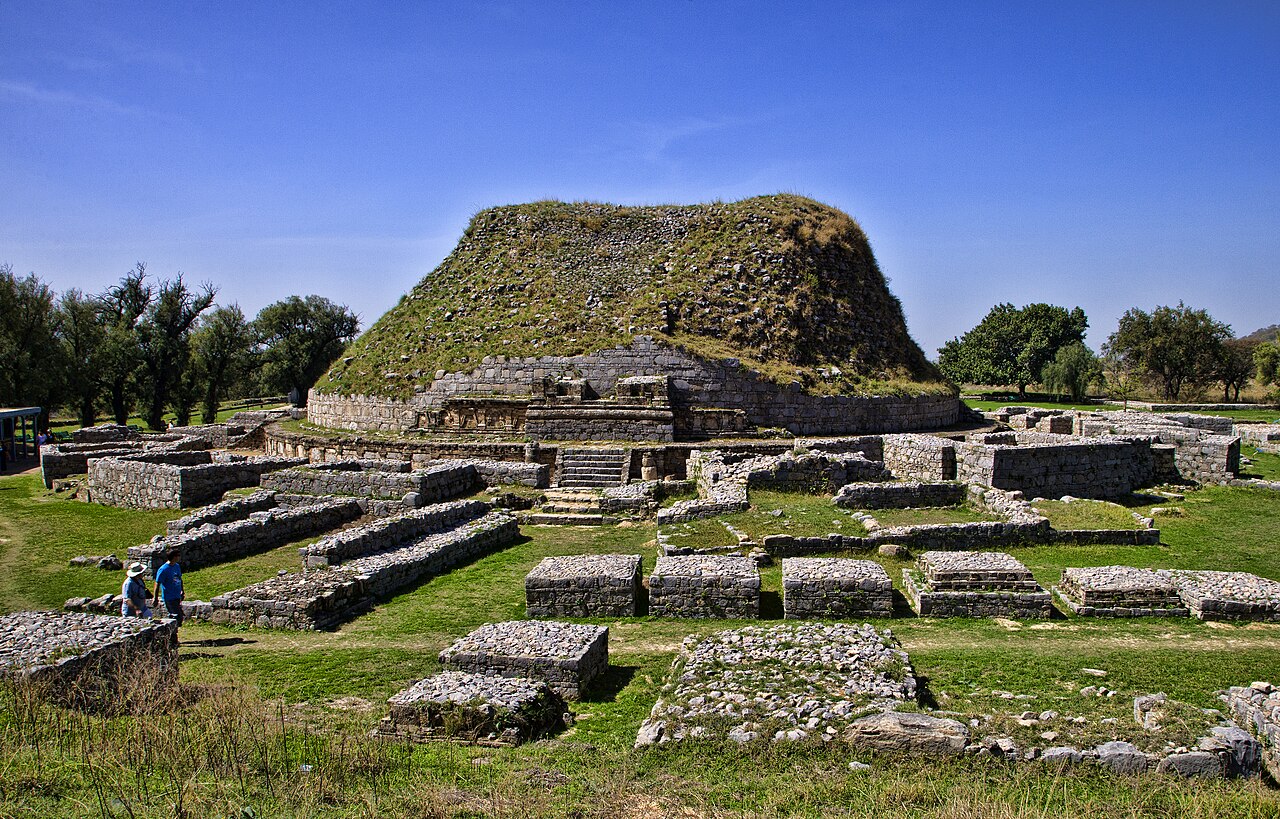
The Dharmarajika stupa is the largest Buddhist monument at Taxila. Emperor Ashoka of the Maurya dynasty is credited with its original construction in the 3rd century BCE, intended to enshrine relics of the Buddha. The stupa was rebuilt and enlarged at least three times by successive dynasties. In its present form it stands as a broad circular drum of dressed stone, surrounded by a series of smaller votive stupas and the ruins of monasteries that once housed hundreds of monks. The name “Dharmarajika” translates roughly as “the stupa of the king of the dharma,” a title applied to Ashoka in Buddhist tradition for his role in spreading the faith after his conversion following the Battle of Kalinga in 261 BCE. The stupa became a major pilgrimage destination for Buddhist travellers from China, Central Asia, and the Mediterranean world during the Kushan period.
The Taxila Museum, established in 1918 near the Dharmarajika stupa, holds one of the world’s most significant collections of Gandharan sculpture. The collection includes Buddhist sculptures in schist stone and stucco, Hellenistic-influenced architectural fragments, coins from Persian, Greek, Mauryan, Indo-Greek, Saka, Parthian, and Kushan mints — each set representing a different period of Taxila’s political history — and everyday objects from the residential zones of all three cities. The museum is closed on Mondays. Photography inside the museum galleries requires a separate permit.
Taxila is also identified in ancient texts as the location of one of the earliest known universities in the world. The institution, referred to in Sanskrit as Takshashila, attracted students from Babylon, Greece, Syria, and various parts of the Indian subcontinent, who came to study subjects ranging from Vedic literature and the Arthashastra (statecraft) to medicine, military science, and law. The philosopher and economist Chanakya, author of the Arthashastra — the foundational ancient Indian text on governance and economics — is said to have studied at Taxila in the 4th century BCE. The physician Jivaka, personal doctor to the Buddha according to Buddhist tradition, is also associated with the university. No single permanent institution building has been identified archaeologically; the “university” was likely a dispersed network of individual teachers with their household students, as was common in the gurukula tradition of South Asia.
Gandharan Art: The First Images of the Buddha in Human Form Gandhara region spans 200 km from Taxila to Peshawar
The most influential artistic development associated with Taxila is the Gandharan tradition of Buddhist sculpture, which produced what are now understood to be the earliest surviving representations of the Buddha as a human figure rather than a symbol. This development, which occurred approximately between the 1st and 3rd centuries CE, had lasting consequences for Buddhist art throughout Asia. Every subsequent tradition of depicting the Buddha — whether in Tibet, China, Japan, Thailand, or Indonesia — ultimately traces its iconographic conventions to Gandharan prototypes.
Before Gandhara, Buddhist relief sculptures in central India (at Sanchi, Bharhut, and Amaravati) depicted scenes from the Buddha’s life without showing his physical form. The Buddha was present in the composition through surrogates: his footprints on the ground, the empty seat under the Bodhi tree, an ornamental parasol floating above a crowd. Scholars debate why figurative depiction began in Gandhara specifically. The most common explanation emphasises the presence of Greek artistic traditions in the region after Alexander’s successors established kingdoms there — sculptors trained in the Hellenistic workshop tradition, accustomed to representing gods and heroes in anthropomorphic form, brought those conventions to Buddhist patronage contexts. Kushan royal commissions accelerated the output.
The distinctive features of Gandharan sculpture include: flowing robes rendered with the parallel fold lines of Greek marble carving; a topknot (ushnisha) on the Buddha’s head interpreted through the convention of the Greek knotted hair of Apollo; frontal composition in relief panels; narrative cycles drawn from Buddhist scriptures. The schist stone used in much Gandharan carving comes from local quarries; stucco (lime plaster) was used for sculptural decoration of monastery interiors. The Taxila Museum’s collection of these works spans the full chronological and material range of the tradition. Jaulian monastery, 6 kilometres from the main museum and accessible by a short drive, retains in-situ stucco figures in the courtyard of its main stupa — the only major Gandharan sculptural ensemble that remains at its original location rather than in a museum.
Lahore Fort and Rohtas Fort: The Mughal and Suri Heritage Within 100 Kilometres Lahore 40 km west; Rohtas Fort 80 km southeast
Lahore Fort, 40 kilometres west of Taxila and UNESCO-listed since 1981, represents a historical period approximately 1,500 years after Taxila’s most active Buddhist phase. The Mughal emperors from Akbar (1556–1605) to Aurangzeb (1658–1707) each added a major structure to the Lahore Fort complex, which now contains 21 distinct monuments including the Shish Mahal (Palace of Mirrors, built by Shah Jahan with approximately 50,000 mirror fragments set into its ceiling and walls) and the Naulakha Pavilion, named for the 900,000 rupees spent on its construction. The Shalimar Gardens, also listed in 1981 alongside the fort, were built by Shah Jahan in 1641 as a formal garden on three terraced levels with 410 fountains fed by 12 water channels. Both are accessible from Taxila as part of a two-day itinerary centred on Lahore.
Rohtas Fort, 80 kilometres southeast of Taxila and inscribed in 1997, dates to the brief interregnum between the first and second Mughal periods. Sher Shah Suri, the Afghan ruler who expelled the Mughal emperor Humayun in 1540, ordered the fort’s construction at Rohtas between 1541 and 1543, building it in just three years using paid local labour. The fort’s 4-kilometre perimeter wall, 12 gates (each architecturally distinct), and 68 bastions represent Afghan Pashtun military architecture adapted to the local Punjab building tradition. Despite being constructed specifically to defend against Humayun’s return, the fort never sustained a siege — Humayun reclaimed Lahore in 1555 by negotiation and the fort surrendered without combat. The Kabuli Gate, the largest of the 12, faces northwest toward Kabul and features a 15-metre arch with carved Quranic inscriptions.
Practical information
Taxila is best visited between October and March, when daytime temperatures on the Potohar Plateau range from 10°C to 22°C. Summer heat (May–September) regularly exceeds 38°C, and the monsoon (July–September) makes unexcavated earthworks and dirt paths at the archaeological sites difficult to navigate. Taxila is approximately 40 kilometres from Lahore and 35 kilometres from Islamabad; the Grand Trunk Road (N-5) connects both cities to the site. From Islamabad/Rawalpindi, local buses run frequently to Taxila Bazaar, from which cycle rickshaws and auto-rickshaws connect to the museum and stupa. From Lahore, hiring a driver for the day is the most practical option. Pakistan e-visa is available for citizens of most Western, Southeast Asian, and Gulf countries; processing typically takes three to five working days. The currency is the Pakistani rupee (PKR). The Taxila Museum entrance fee is modest, with a separate rate for foreign nationals; Jaulian monastery has its own ticket. Both the museum and the main stupa are within 3 kilometres of each other and can be covered on foot or by rickshaw. Plan a minimum of four hours for the museum, Dharmarajika stupa, and either Sirkap or Jaulian. The site has no significant food facilities inside the archaeological zone; the bazaar area near the museum has basic restaurants and tea stalls.
Frequently Asked Questions
What is the significance of Taxila’s Gandharan art to the global history of Buddhism?
The Gandharan sculpture produced in and around Taxila between the 1st and 5th centuries CE represents a pivotal turning point in the history of Buddhist visual culture. Before Gandhara, Buddhist art in the Indian subcontinent avoided depicting the Buddha in human form. Sculptors working at sites such as Sanchi (2nd–1st century BCE) created elaborate narrative reliefs in which the Buddha’s presence was indicated only by symbolic substitutes: his footprints, an ornate throne left empty, the Bodhi tree under which he attained enlightenment. The introduction of anthropomorphic Buddha figures in Gandhara — with robes rendered in the flowing draped style of Greek sculpture, a round face with large eyes, and the distinctive topknot (ushnisha) interpreted through Hellenistic hair conventions — gave Buddhism a portable, replicable image that could travel with missionaries along the Silk Road. Buddhist pilgrims and monks carrying Gandharan figures or images derived from them introduced the anthropomorphic Buddha to Central Asia, China, Korea, Japan, and Southeast Asia. Every regional tradition of Buddhist sculpture from Nara to Nalanda can ultimately trace its iconographic grammar back to Gandhara. The Taxila Museum holds the most comprehensive single collection of these works at the site where many were originally produced, making it uniquely important for understanding the stylistic origins of what became a pan-Asian religious art tradition.
How did Taxila function as an ancient university, and what subjects were taught there?
The ancient texts that describe Taxila as a centre of learning — primarily the Jataka tales, the Arthashastra, and various Buddhist biographical accounts — portray it not as a single institution with a campus and administration but as a city where scholars of high reputation attracted students who paid fees and lodged in their households. This was the gurukula model: the teacher (guru) as the institutional centre, with students (shishya) living in proximity and learning through direct instruction and oral transmission. The subjects covered were broad by any standard. Students came from across the subcontinent and from Mesopotamia, Greece, and the Levant to study Vedic literature, Sanskrit grammar, philosophy, law, statecraft (Arthashastra as a genre predates Chanakya’s specific text), medicine, surgery, archery, astronomy, and commerce. Chanakya, the 4th-century BCE political economist whose Arthashastra remains an influential text in political science, is said to have both studied and taught at Taxila. The physician Jivaka, who treated the Buddha according to Pali canon texts, studied medicine here for seven years. There is no archaeological evidence of permanent teaching buildings identified as university structures; the function was dispersed through the city’s residential fabric. Taxila’s role as a university city should therefore be understood as a function of its urban density of scholars rather than the presence of a single organised institution comparable to medieval European universities.
How is the archaeological site divided, and which areas are most accessible to first-time visitors?
The Taxila archaeological zone is spread across a roughly 30-square-kilometre area of the Potohar Plateau and contains dozens of distinct sites, most of which require a vehicle to visit. For a first visit of four to six hours, the priorities are: the Taxila Museum (essential starting point; collection covers all periods and provides orientation for the outdoor sites), the Dharmarajika stupa and monastery complex (3 km from the museum; the largest and most immediately legible monument on the site), and either Sirkap (the Hellenistic-era city with grid-plan streets, 4 km from the museum) or Jaulian monastery (6 km from the museum; the site with the best-preserved in-situ sculptural decoration). Bhir Mound, the oldest settlement, is visible but has limited standing remains accessible without specialist guidance. Sirsukh is largely unexcavated and not accessible to general visitors. The site museum closes on Mondays; the outdoor sites are accessible on all days but should be avoided during midday heat in summer. A site guide hired at the museum entrance costs a modest fee and significantly improves comprehension of the uninterpreted earthworks. The Grand Trunk Road runs close to the museum and the main stupa, and auto-rickshaws from Taxila Bazaar can navigate between most sites.