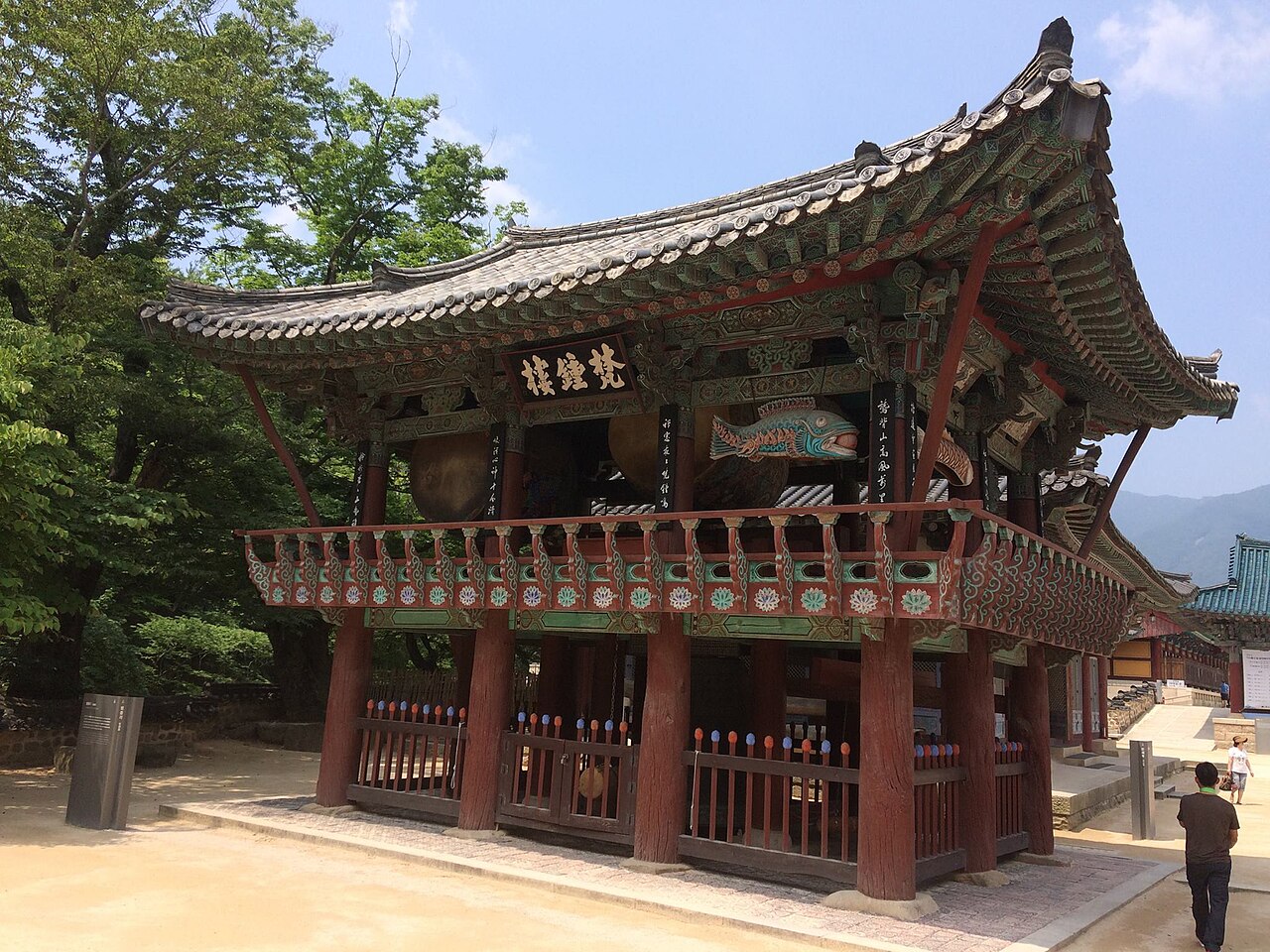
The Sansa, Buddhist Mountain Monasteries were inscribed by UNESCO in 2018 as a serial property of seven monasteries distributed across the mountain ranges of central and southern South Korea: Tongdosa (South Gyeongsang), Beopjusa (North Chungcheong), Magoksa (South Chungcheong), Seonamsa (South Jeolla), Daeheungsa (South Jeolla), Bongjeongsa (North Gyeongsang) and Seonamsa being the southernmost. The oldest surviving structure across the seven monasteries dates to the 9th century CE, and each monastery has been continuously active—meaning monks live and practise there year-round—for between 1,200 and 1,400 years. Tongdosa, the largest of the seven by landholding, covers approximately 1,750 hectares of mountain terrain in the Yeongchuk range and is the only major Korean monastery with no main Buddha statue in its principal hall: the founder, Jajang (590–658 CE), designated the mountain itself as the Buddha’s body.
The seven monasteries: locations, distances and what distinguishes each Tongdosa to Beopjusa 220 km; Daeheungsa to Seonamsa 100 km
Tongdosa, in the Yeongchuk mountains near Yangsan city in South Gyeongsang Province, is the monastery most accessible from Busan (approximately 50 kilometres northwest, 1 hour by intercity bus). It was founded by the monk Jajang, who returned from Tang China in 643 CE carrying relics of the historical Buddha, including fragments of the robe and a bowl. Jajang placed the relics in a sari stupa behind the main hall, the Daeungjeon, and declared this structure—enshrining the physical remains of the Buddha himself—sufficient as a place of worship without a statue. This theological position has been maintained for over 1,350 years: the Daeungjeon at Tongdosa remains one of only a handful of Buddhist sanctuaries anywhere in East Asia where the primary worship space contains no representational image. The monastery’s current buildings date mainly to the 17th century rebuild after Japanese invasions of the 1590s, but the foundation stones and sari stupa are original. The entrance path, a 1.2-kilometre pine-lined walkway along a stream, is one of the most photographed approaches to any Korean monastery.
Beopjusa, in the Songnisan mountains of North Chungcheong Province, sits near the centre of the Korean peninsula, approximately 100 kilometres south of Seoul by expressway (2 hours by intercity bus from Seoul’s Express Bus Terminal). It holds the largest wooden building among the seven inscribed monasteries: the Palsangjeon, a six-storey wooden pagoda structure built in 1626 CE, rising 22.4 metres, which survived the widespread destruction of Korean monasteries during the Joseon period’s suppression of Buddhism (1392–1895). Beopjusa was among the monasteries that retained royal patronage through the worst of the Joseon suppression, partly because its mountain location placed it within the forested corridor used for royal pilgrimages. The approach from the bus stop at Songnisan National Park entrance is 3 kilometres through the park, most of it on a shaded valley trail.
Magoksa, in South Chungcheong Province (40 kilometres south of Gongju by local bus, approximately 1 hour), was founded in 640 CE and is the monastery most directly linked to the Baekje kingdom’s Buddhist tradition. Its five-storey stone pagoda in the courtyard is a distinctive Yuan dynasty Lamaist form, unusual in a Korean context, dating to the 14th century Goryeo period. Bongjeongsa in North Gyeongsang Province (30 kilometres northwest of Andong by local bus, 50 minutes) holds the oldest surviving wooden building in Korea: the Geuknakjeon main hall, constructed in 1363 CE, predating most surviving wooden architecture on the peninsula. Seonamsa (South Jeolla, in the Jogye mountains near Suncheon, 300 kilometres south of Seoul) and Daeheungsa (South Jeolla, in the Duryun mountains near Haenam, the southernmost point of the mainland, 350 kilometres south of Seoul) are the most remote of the seven from major cities but the most scenically striking: Seonamsa is reached via a 3-kilometre stone-paved trail over a curved bridge, the Seungseongyo, where a visiting monk reputedly threw away his walking staff on arrival; Daeheungsa occupies a valley enclosed by peaks on three sides and contains 17 separate shrine buildings and a separate hermitage complex.
Nearby Korean UNESCO sites reachable from the Sansa monasteries 15 km–200 km by rail and bus from Tongdosa and Seonamsa
The Tripitaka Koreana and Depositories at Haeinsa Temple (UNESCO 1995) is the UNESCO inscription most directly connected to the Sansa in theme and geography. Haeinsa itself is one of Korea’s three “jewel monasteries” (alongside Tongdosa and Songgwangsa), representing the Buddhist dharma; Tongdosa represents the Buddha; Songgwangsa represents the sangha (community of monks). Haeinsa is approximately 80 kilometres northwest of Tongdosa by road (1.5 hours by bus via Miryang and Daegu), or about 100 kilometres from central Busan. The 81,258 wooden printing blocks of the Tripitaka Koreana, carved between 1237 and 1248 CE, are stored in the Janggyeong Panjeon depositories—four halls built in the 15th century, whose orientation and passive ventilation system has kept the blocks free from rot, insect damage and warping for over 750 years. The connection to the Sansa inscription is not merely thematic: the blocks were carved after the Mongol invasion destroyed the previous Tripitaka edition, which had been housed at Ganghwa Island; monks from several of the Sansa monasteries participated in the carving effort. From Tongdosa, the most efficient routing is by bus to Miryang (30 minutes), then intercity bus or KTX to Daegu (40 minutes), then bus to Haeinsa (1 hour).
The Gyeongju Historic Areas (UNESCO 2000) lie approximately 50 kilometres north of Tongdosa, making them the closest major UNESCO inscription to any single Sansa monastery. Gyeongju is reachable from the Tongdosa bus stop in about 1 hour by intercity bus (via Ulsan or direct). The Silla kingdom that built Gyeongju was both a rival and, eventually, a patron of the Buddhist monasteries: after unifying the peninsula in 668 CE, Silla actively supported Buddhism as a state religion, and many of the monasteries now inscribed as Sansa received significant Silla royal patronage during the 7th and 8th centuries. The Cheomseongdae observatory (circa 634 CE), the Daereungwon burial tumuli containing gold crowns and ornaments from the 4th–6th centuries, and the reconstructed Donggung and Wolji palace pond complex are the main historic Gyeongju sites. Bulguksa Temple and the Seokguram Grotto (UNESCO 1995), 15 kilometres east of Gyeongju centre, are a logical half-day addition: Bulguksa was constructed in 751 CE under the patronage of Prime Minister Kim Daeseong, and Seokguram’s granite rotunda and carved Buddha figure, completed circa 774 CE, represent the summit of Silla Buddhist sculpture.
The Gochang Dolmen Sites—component of the UNESCO 2000 serial inscription covering Gochang, Hwasun and Ganghwa—are approximately 80 kilometres west of Seonamsa, the southernmost Sansa monastery (bus from Suncheon to Gochang, 1 hour 30 minutes with a change at Gwangju or Jeonju). The Gochang cluster, with approximately 1,665 megalithic tombs dating to the Korean Bronze Age (circa 1000–300 BCE), represents a period roughly 1,500 years before any of the Sansa monasteries were founded. The contrast in site character is pronounced: where the Sansa monasteries are environments of ongoing religious practice—with monks, bells, incense and seasonal ceremonies—the dolmen sites are entirely archaeological, explaining a culture that left no written records. The Hwasun cluster, 55 kilometres southeast of Gochang, adds quarry evidence. From Seonamsa or Suncheon, a day trip to Gochang and back is feasible by bus, though a night in Gochang simplifies the Hwasun addition.
The Baekje Historic Areas (UNESCO 2015), covering eight sites in Gongju, Buyeo and Iksan, are most conveniently combined with a visit to Magoksa—which lies 40 kilometres south of Gongju—making the two inscriptions naturally paired in a South Chungcheong itinerary. From Magoksa, the bus back to Gongju (40 minutes) connects to Buyeo in 50 minutes further; Iksan is another 30 kilometres south of Buyeo. Daeheungsa and Seonamsa in the far south can be paired with the Jeju Volcanic Island and Lava Tubes (UNESCO 2007): ferries from Mokpo, 50 kilometres from Haenam (where Daeheungsa is located), cross to Jeju Island in 2 hours 30 minutes by fast ferry or 4 hours 30 minutes by standard ferry.
Practical information
No single base connects all seven Sansa monasteries efficiently—they span 400 kilometres of the Korean peninsula. For visits combining two or three monasteries with nearby UNESCO sites, the most productive regional bases are: Busan for Tongdosa plus Gyeongju and Haeinsa; Andong for Bongjeongsa plus the Seowon (Korean Neo-Confucian Academies, UNESCO 2019) and the Historic Villages of Hahoe and Yangdong (UNESCO 2010); and Suncheon or Gwangju for Seonamsa and Daeheungsa with access to the Gochang dolmens and the Getbol tidal flats (UNESCO 2021) along South Korea’s southwestern coast.
All seven monasteries charge a small admission fee (typically 3,000–4,000 KRW per adult) used to maintain the site and support the resident monastic community. Photography is permitted in the grounds but restricted inside individual shrine halls; check signage at each building. The monasteries are active religious communities: during morning and evening ceremonies (usually 4:00 AM and 6:00 PM, times vary), visitors are welcome to observe from a respectful distance but should enter shrines quietly. The templestay programme, administered by the Korean Buddhist Cultural Service, operates at Tongdosa, Beopjusa and several of the other Sansa monasteries, offering overnight meditation, chanting participation and instruction in tea ceremony; advance booking through the templestay.com portal is required.
Frequently Asked Questions
Why does Tongdosa have no main Buddha statue, and how has this practice been maintained for 1,350 years?
The absence of a central Buddha statue at Tongdosa’s Daeungjeon (Great Hero Hall) rests on a theological position established by the founder Jajang (590–658 CE). Jajang had studied in Tang China, where he received—according to the Samguk Yusa account of his life—relics of the historical Buddha from the bodhisattva Mañjuśrī at Mount Wutai, the most important Chinese pilgrimage centre for Mañjuśrī devotion. On returning to Korea in 643 CE, Jajang placed these relics, along with a Buddhist robe fragment, in a sari stupa (Geumganggyedan) in the grounds at Tongdosa. His position: with actual relics of Śākyamuni present in the compound, the main hall is itself in the presence of the Buddha and requires no representational substitute. The Daeungjeon therefore houses the altar, offerings and ritual implements but no statue; worshippers face the direction of the Geumganggyedan outside through the hall’s rear window during ceremony. This is not unique to Korea—a handful of other East Asian monasteries holding authenticated relics maintain similar practices—but it is rare enough that Tongdosa is the only one of the seven Sansa monasteries with this characteristic. The practice has survived the 1590s Japanese invasion (which destroyed much of the compound), the 20th-century Korean War damage to surrounding Yangsan, and the general reconstruction of the post-war period, because the Geumganggyedan sari stupa, which is the theological rationale, survived intact.
What is the Templestay programme, and which Sansa monasteries offer it?
The Templestay programme was established in 2002 as a structured way for non-Buddhist visitors to experience monastic life at Korean Buddhist monasteries, initially set up to accommodate international visitors during the FIFA World Cup held in Korea and Japan that year. It is now administered by the Korean Buddhist Cultural Service (a body of the Jogye Order of Korean Buddhism, which oversees most of the Sansa monasteries) and operates at over 130 monasteries, including all seven Sansa inscribed sites. A typical templestay programme runs from one to three days and includes participation in the 108-prostration morning ceremony, a tea ceremony session, meditation instruction (usually sitting meditation, or seonsim), the donning of temple workwear (samubok), and communal meals in silence following the monastic schedule. Meals are vegetarian: Korean Buddhist cuisine (sachal eumsik) excludes the five pungent vegetables (garlic, onions, green onions, chives and leeks) in addition to meat and fish. Tongdosa, Beopjusa and Seonamsa have the most developed templestay infrastructure and offer English-language guidance. Daeheungsa in the Duryun mountains offers a particularly well-regarded winter programme due to the monastery’s relative isolation in the off-season. Booking is made through the national templestay.com portal; costs range from approximately 60,000 to 100,000 KRW per person per night, depending on monastery and programme type. No prior knowledge of Buddhism is assumed or required.
How did the Sansa monasteries survive repeated historical destructions while maintaining continuity?
The Sansa monasteries faced three major periods of severe threat: the Joseon dynasty’s suppression of Buddhism (1392–1895), the Japanese invasions of 1592–1598 (Imjin Waeran), and the 1950–1953 Korean War. The Joseon strategy of removing Buddhism from state sponsorship and restricting monasteries to mountain zones—literally prohibiting monks from entering walled cities—had the paradoxical effect of concentrating monastic life in precisely the remote terrain that made the monasteries difficult to destroy completely. All seven of the current Sansa monasteries are in mountain locations requiring at least 30 minutes to 2 hours of travel from the nearest city, a positioning that predated Joseon but was reinforced by it. During the Japanese invasions, monks at several Sansa monasteries organised euibyeong (righteous armies) to resist the Japanese forces—Tongdosa and Daeheungsa both have documented connections to monastic fighting units of this period—and many of the current 17th-century buildings at Tongdosa, Beopjusa and other sites are explicitly post-invasion reconstructions, funded by royal grants to monasteries that had contributed to the defence. The Korean War caused significant localised damage, particularly in South Gyeongsang and South Jeolla provinces, but the mountain locations again limited total destruction. The continuity of the Sansa monasteries is therefore partly a product of their geographic marginality: built where the state sent them, they survived where armies could not easily follow.
Sources
- S1 — UNESCO World Heritage Centre — Sansa, Buddhist Mountain Monasteries in Korea (Ref. 1562) — https://web.archive.org/web/20230601000000/https://whc.unesco.org/en/list/1562/
- S2 — Korea Heritage Service Official Portal — https://whc.unesco.org/en/list/1562/
- S3 — Seth, Michael J. <em>A History of Korea: From Antiquity to the Present</em>. Rowman & Littlefield, 2010. ISBN: 978-0-8248-3563-7.
Spotted an error? Write to editorial@culturalheritageonline.com and we correct it the same day.