
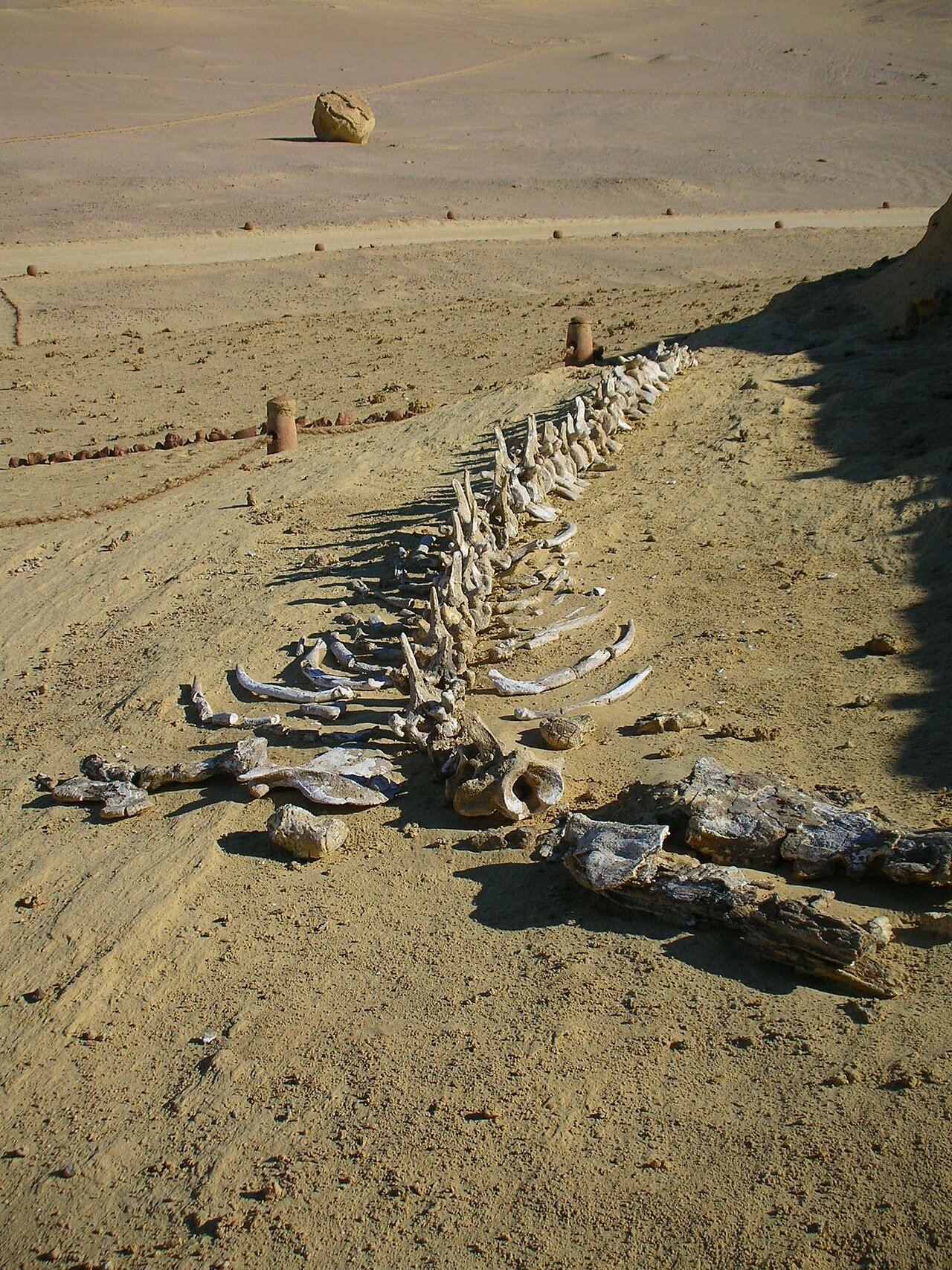
Wadi Al-Hitan — “Whale Valley” — is a paleontological site in the Western Desert of Egypt, 150 kilometres southwest of Cairo, inscribed as a UNESCO Natural World Heritage Site in 2005. It contains the world’s most important concentration of fossils of archaeocetes: ancient whales dating from 40 to 34 million years ago, preserved in the Eocene rock layers of the Faiyum Depression. The site documents one of the most consequential evolutionary transitions in the history of mammals — the return of a four-legged land animal to the sea — at the precise moment before that transformation was complete.
Where Land Animals Became Whales Western Desert, Faiyum Governorate, Egypt
The fossils at Wadi Al-Hitan belong primarily to two species of archaeocetes — the ancient whale family now entirely extinct — whose remains are exposed on the desert surface by wind erosion of the enclosing chalk and limestone. Basilosaurus isis is the larger of the two: a serpentine animal reaching up to 18 metres in length, with an elongated body quite unlike any modern whale. It would have moved through the water with lateral undulation of its rear section, more like a sea snake than a modern cetacean. Dorudon atrox was considerably smaller — approximately 5 metres — and anatomically closer to the body plan of modern dolphins and whales, with a shorter trunk and proportionally larger head.
What makes both species scientifically irreplaceable is what the Wadi Al-Hitan specimens preserve: tiny but fully formed hind legs. In the fossilized skeletons visible at the site, the remnant hind limbs of Basilosaurus are clearly articulated — femur, tibia, even small foot bones — despite being far too small to support the animal’s weight or to function in locomotion. They are vestigial structures, retained from the quadrupedal land ancestor from which the whole cetacean lineage descended. The whale family (order Cetacea) shares a common ancestor with even-toed ungulates — the artiodactyls, the same branch that includes hippos, deer, and cattle — that returned to an aquatic life approximately 50 to 55 million years ago. By the time of Basilosaurus and Dorudon, roughly 40 million years ago, the transition to a fully marine existence was nearly complete. The hind legs were about to disappear entirely. Wadi Al-Hitan catches this moment in stone.
UNESCO’s statement about the site is unusually direct in its assessment of significance: it describes Wadi Al-Hitan as “the most outstanding of any site in the world in illustrating this phase of the history of life.” The claim holds because the fossils here are not fragmentary. Many specimens are nearly complete, articulated skeletons exposed in three dimensions on the desert floor, including stomach contents in several cases that reveal what archaeocetes were eating in the Eocene Tethys Sea. The quality of preservation results from the rapid burial of carcasses in the shallow, warm seafloor sediments of the proto-Mediterranean — the Tethys Sea — which covered this part of North Africa during the Eocene epoch.
A Chalk Desert That Was Once a Shallow Sea 40 km from Faiyum city, 150 km from Cairo
The landscape of Wadi Al-Hitan is itself a product of the same geological story the fossils tell. The desert floor is composed of pale Eocene chalk and limestone — the compressed remains of marine organisms that accumulated on the seafloor of the Tethys Sea over millions of years. Wind erosion has carved these soft rocks into rounded white formations: mushroom-shaped inselbergs, low ridges, and flat expanses of eroded chalk pavement studded with fossils and shark teeth. The exposed geological layers are clearly visible in the valley walls, allowing visitors to read the sequence of Eocene sediments like pages in a book.
The open-air museum trail established through the site allows visitors to walk among skeletons displayed in situ — that is, precisely where they were found in the rock, protected from further erosion by steel-and-glass shelters that cover the most important specimens while leaving them visible from above. The largest Basilosaurus skeleton on display measures 18 metres from snout to tail tip; the bones are stained dark brown by mineral replacement over 40 million years, contrasting sharply with the white chalk around them. Signage at each shelter explains the species, the age of the specimen, and the anatomical details that are significant — including photographs highlighting the vestigial hind limb bones for visitors unfamiliar with cetacean anatomy.
Beyond the whale fossils, the site yields abundant Eocene marine fauna: sharks, sawfish, sea turtles, and numerous fish species, all inhabitants of the same warm, shallow Tethys Sea. The presence of mangrove root casts in some layers suggests that the ancient coastline was lined with tropical vegetation. The full ecological picture that emerges is of a productive tropical sea margin that supported a diverse food web — including the large, apex-predator archaeocetes that fed on fish and smaller marine mammals.
Access to the site is via the Faiyum Depression, approximately 40 kilometres of paved and unpaved road from Faiyum city, or 150 kilometres from Cairo with a four-wheel-drive vehicle strongly recommended for the final approach. The Faiyum Oasis itself — one of Egypt’s largest oases, sustained by a channel of the Nile called Bahr Yusuf — is worth including in any visit: the nearby Lake Qarun is a remnant of the ancient Lake Moeris, and Faiyum city has significant archaeological resources of its own from the Ptolemaic and Roman periods. A fossil museum at the site entrance provides context before the outdoor trail.
Practical information
Getting there: From Cairo, the most practical approach is to hire a taxi or private car for the day (approximately 3 hours each way with stops). Public transport reaches Faiyum city, from which the site is 40 km by road; a local taxi from Faiyum is the standard last leg. Four-wheel drive is not mandatory but recommended for the final approach road, which can be rough after rain.
Entry: An entry fee applies; confirm current rates with the Egyptian Antiquities authorities or your Cairo hotel, as fees are periodically revised. The open-air museum trail with fossil shelters is included in the entry ticket.
On-site facilities: A fossil museum at the site entrance provides interpretive context, including mounted skeletons and explanatory panels in Arabic and English. Basic refreshments may be available but carry water and food; facilities are limited. There are no hotels at the site itself.
Best season: October to April, when temperatures are manageable. The desert sun is intense even in winter; bring sun protection, a hat, and plenty of water.
Duration: Allow 3–4 hours for the full outdoor trail plus the museum. Combine with a half-day at Faiyum Oasis and Lake Qarun for a full-day excursion from Cairo.
Guided tours: Cairo-based tour operators run day trips to Wadi Al-Hitan, often combined with Faiyum sites. Independent visits are feasible with a rented vehicle and GPS coordinates.
Frequently Asked Questions
Why is Wadi Al-Hitan considered more important than other whale fossil sites?
Several other Eocene deposits around the world yield archaeocete fossils — notably the Kuldana Formation in Pakistan, where some of the earliest known whale ancestors (pakicetids and ambulocetids) have been found in older Eocene layers. What distinguishes Wadi Al-Hitan is the combination of quality, quantity, and the specific evolutionary moment the fossils document. The site contains hundreds of specimens, many nearly complete and still articulated, at a stratigraphic horizon that represents the critical transition point: the creatures preserved here are unmistakably marine in their overall body plan, yet they still retain visible evidence of their terrestrial ancestry in the form of functional — if vestigial — hind limbs. The earlier whale ancestors found in Pakistan are fascinating precisely because they are transitional in the other direction: still largely land-capable animals acquiring aquatic adaptations. Wadi Al-Hitan documents the opposite end of the same story — animals that had fully committed to the sea but had not yet shed every trace of life on land. UNESCO’s description of it as the outstanding site for illustrating this phase refers specifically to this combination: a late-stage transitional fauna, preserved in exceptional completeness, in numbers sufficient to support statistical analysis of the population. No other site offers all three together.
How were the fossils discovered, and why are they exposed on the surface?
The fossils were first scientifically described by German palaeontologist Ernst Stromer von Reichenbach during expeditions between 1902 and 1914. Stromer recognised the evolutionary significance of the finds immediately, though the world-changing implications of archaeocete anatomy were not fully appreciated until much later in the 20th century, when molecular phylogenetics confirmed the close relationship of cetaceans and artiodactyls and reanalysis of the fossil record mapped the transition in detail. The surface exposure of the fossils is a direct result of the Western Desert’s extremely low rainfall — less than 5 mm per year in some years — combined with persistent winds that remove the soft chalk matrix grain by grain without the sudden erosive episodes that would damage the fossils themselves. The process is ongoing: new specimens are exposed each year as the chalk surface is lowered by deflation. This is both an opportunity and a management challenge. The Egyptian Antiquities Authority and UNESCO-affiliated researchers conduct regular surveys of newly exposed material, and the most significant finds are either left in situ under protective shelters or transferred to the on-site museum for conservation before deterioration accelerates once exposure to the air begins.
What can visitors actually see on the fossil trail, and do you need a scientific background to appreciate it?
The trail is well-designed for visitors without a scientific background. Each sheltered specimen is accompanied by panels explaining in plain language what the animal was, how it lived, and why the specific features visible in the skeleton matter — including annotated photographs pointing to the vestigial hind limb bones, which are small and easy to miss without guidance. The sheer scale of the largest Basilosaurus skeletons is immediately impressive regardless of prior knowledge; the bones are fully visible, brown against white chalk, stretched across the desert floor under a glass shelter. The landscape context is as striking as the fossils themselves — the white chalk formations, the silence, and the cognitive dissonance of looking at a whale skeleton in the middle of a desert are genuinely arresting. Children respond particularly well to the site; the narrative of “these are the ancestors of whales and dolphins, and they used to have legs” is one of the most effective entry points into evolutionary biology for young visitors. Adults with no scientific training consistently describe the site as one of the most intellectually affecting heritage experiences in Egypt — more memorable, many report, than sites they expected to find more impressive. The combination of the evolutionary story, the quality of preservation, and the spare desert landscape makes it exceptional.
Sources
- S1 — Gingerich, Philip D. Early Eocene Whales from the Fayum: Evolution and Paleobiology. University of Michigan, 1992. ISBN 978-0-910788-28-1.
- S2 — Thewissen, J. G. M. The Walking Whales: From Land to Water in Eight Million Years. University of California Press, 2014. ISBN 978-0-520-27706-9.
Spotted an error? Write to editorial@culturalheritageonline.com and we correct it the same day.

-113628.jpg)