

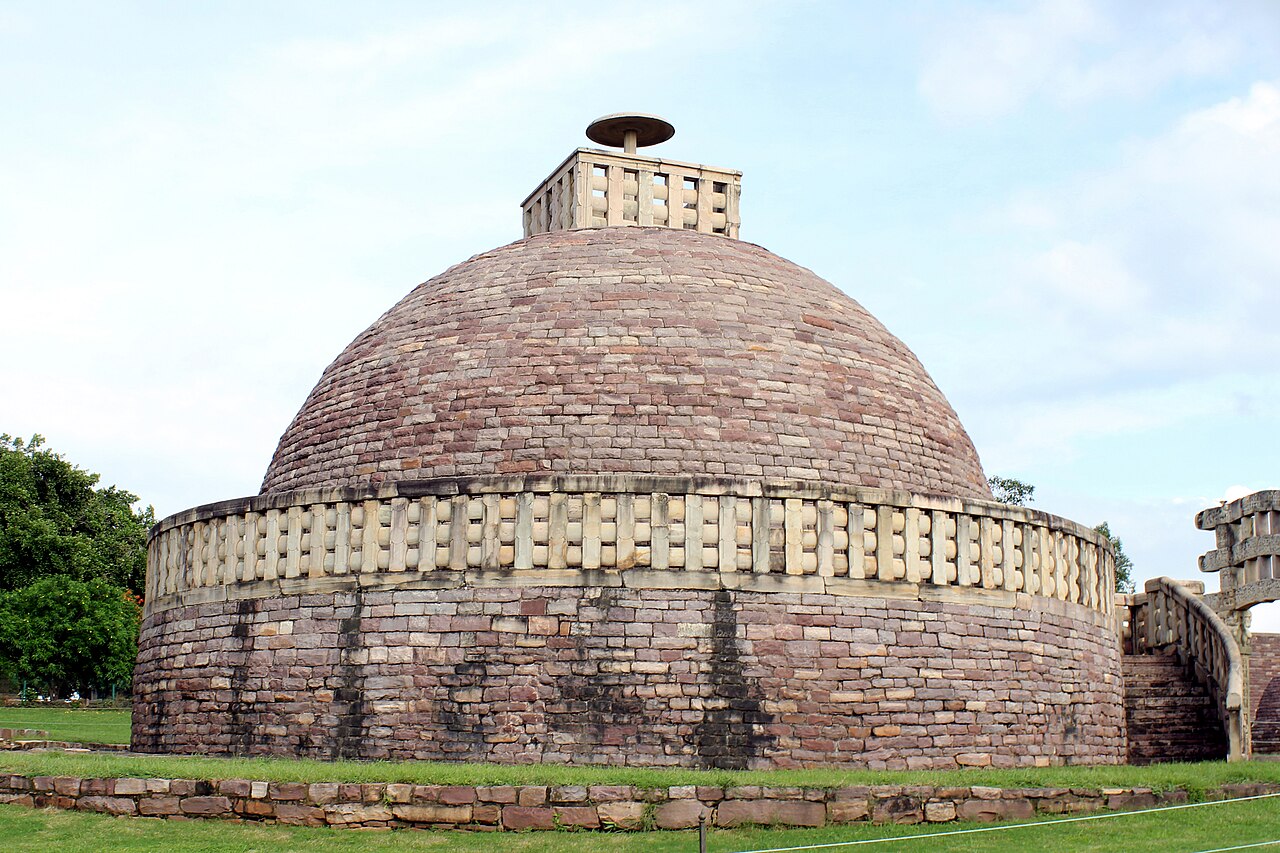
Sanchi is a hilltop Buddhist complex in Madhya Pradesh, 46 km northeast of Bhopal, preserving fifty structures spanning approximately 1,300 years of Buddhist construction from the 3rd century BCE to the 12th century CE. The principal monument, the Great Stupa (Stupa 1), was originally built by Emperor Ashoka over relics of the Buddha and carries four carved stone gateways added in the 1st century BCE that represent the most extensive narrative stone carving programme surviving from ancient India. UNESCO inscribed the Buddhist Monuments at Sanchi as a World Heritage Site in 1989.
Ashoka’s Stupa and the Cosmos in Stone: Architecture and Symbolism of the Great Stupa Sanchi Hill, 46 km northeast of Bhopal, Madhya Pradesh
Emperor Ashoka (r. 268–232 BCE) ruled the Maurya Empire at its greatest extent — a territory covering most of the Indian subcontinent — and is remembered in Buddhist tradition as the ruler who underwent conversion to Buddhism following the catastrophic Battle of Kalinga in 261 BCE, in which his armies killed approximately 100,000 people. Repudiating further conquest, Ashoka promoted Buddhist values through a programme of edicts inscribed on pillars and rock faces across the empire and built stupas over Buddhist relics at sites across his territory. The Ashokan stupa at Sanchi was one of several built during his reign; it covered relics of the Buddha in a simple brick hemispherical mound.
The Great Stupa as it stands today is substantially larger than Ashoka’s original construction. In the 1st century BCE, under the patronage of the Satavahana dynasty, the original brick stupa was encased in a stone facing that nearly doubled its diameter to 36.6 metres and increased its height to 16.5 metres. The Satavahana patronage is documented in donor inscriptions on the four gateways added at the same time. The result is a structure that appears monolithic from the exterior — a smooth stone dome rising from a circular drum — but that contains the original Ashokan brick construction at its core.
The symbolism of the stupa form is explicit in Buddhist doctrinal sources. The hemispherical dome (anda, literally “egg”) represents the dome of heaven — the universe. The square terrace (medhi) at the base of the dome represents the earth. The harmika, a square railing at the summit of the dome, marks the axis mundi — the cosmic axis connecting the earthly and divine realms. Rising from the harmika is the yashti, a vertical pole, surmounted by the chattra, a triple umbrella representing the Three Jewels of Buddhism: the Buddha, the Dharma (teaching) and the Sangha (community of practitioners). The entire structure is therefore a three-dimensional cosmological diagram, and circumambulating it clockwise (pradakshina) — following the walkway on the medhi above and the ground-level path below — is an act of aligning oneself with the cosmic order.
The Great Stupa has a double circumambulatory path: one at ground level outside the outer railing, and one elevated on the medhi platform accessed by staircases on the north and south. Both paths were used for pradakshina in antiquity. The outer stone railing enclosing the ground-level path is itself a significant sculptural monument, carved with medallions depicting lotus flowers, elephants, yakshis (female nature spirits) and other auspicious symbols. The railing system and its relationship to the gateways — the four toranas open outward to the cardinal directions — creates a carefully choreographed spatial sequence for ritual movement around the stupa.
Two smaller stupas on the same hill — Stupa 2 and Stupa 3 — contain relics of early Buddhist disciples and teachers. Stupa 3, compact and well-preserved, was found by Alexander Cunningham in 1851 to contain relics of Sariputra and Mahamoggallana, two of the Buddha’s principal disciples. These relics were removed during the 19th-century excavations, sent to London, and returned to India in 1952; they are now enshrined in a modern vihara (monastery) built below the hill at Sanchi.
The Four Toranas: 547 Previous Lives Carved in Stone Sanchi Hill, Madhya Pradesh
The four gateways (toranas) of the Great Stupa were added in the 1st century BCE, each approximately 10 metres high, and each oriented to one of the cardinal directions. The structural form is consistent across all four: two square pillars supporting three horizontal architraves (crossbeams), with the ends of the architraves curving upward and outward. The surfaces of the pillars and all three architraves — top, bottom and sides — are covered in narrative relief carvings. The carving programme across the four gateways constitutes the most extensive surviving example of narrative stone sculpture from ancient India.
The subjects depicted are drawn from two sources: the Jataka tales — the 547 previous lives of the Bodhisattva (the being who would become the historical Buddha), in which the Bodhisattva is born as animals, humans and divine beings in a sequence of lives building toward enlightenment — and scenes from the life of the historical Buddha Shakyamuni. The two bodies of content are intermixed across the four gateways without strict organisational separation; the carvings were presumably read by educated monks and by lay pilgrims who knew the stories, rather than following a fixed didactic sequence.
One of the most significant aspects of the gateway carvings is what they do not show. In the period of the early Buddhist sculptural programme — roughly from the 3rd to the 1st century BCE — the historical Buddha is not depicted in human form. This is not an accident or limitation: it was a conscious doctrinal position. The Buddha who achieved enlightenment and died at Kushinagar had entered parinirvana (complete liberation from rebirth), and to depict him in human form would be to suggest he remained in the cycle of embodiment. Instead, the Sanchi carvers represent the Buddha’s presence through a set of conventional symbols: the Bodhi tree (under which he attained enlightenment), the Wheel of Dharma (his first teaching), the empty throne (the seat of enlightened teaching), footprints (his passage), and the parasol (sovereignty). In the narrative scenes at Sanchi, the viewer must locate these symbols within the composition to follow the action — a demanding visual experience that rewards repeated engagement.
The north gateway is generally considered the most elaborate of the four, with all three architraves and the pillar surfaces covered in a dense programme of carvings. The bottom architrave of the north gateway shows the Great Departure — the moment when Prince Siddhartha (who would become the Buddha) left his father’s palace in the night. The horse Kanthaka on which he rode is shown, but the prince himself is absent from the saddle; only a parasol above the empty seat marks his presence. At the right end of the same beam, the gods descend from heaven to receive him. The absent figure in the saddle is one of the most powerful images in early Buddhist art — absence as sacred presence.
The discovery and restoration of Sanchi extended across more than a century. British officer H.H. Taylor first noted the site in 1818; James Prinsep, who deciphered the Brahmi script in 1837, documented the inscriptions. Major Alexander Cunningham began excavation in 1851 and found that treasure hunters had partially dismantled the Great Stupa, toppling the north gateway in the process. The Archaeological Survey of India undertook systematic restoration between 1912 and 1919 under John Marshall, who re-erected the north gateway and stabilised the structure. The toppled gateway had actually helped preserve the carvings by burying them in debris; the north gateway carvings are among the sharpest-detailed of the four.
Practical information
Sanchi is 46 km northeast of Bhopal and is accessible by rail and road. The nearest railway station is Sanchi station on the Bhopal–Vidisha–Saugor line, approximately 1 km from the monument hill; several trains connect Bhopal to Sanchi daily, with journey times of approximately 45 minutes. Bhopal’s Raja Bhoj Airport has connections to Delhi, Mumbai and other Indian cities. By road from Bhopal, the journey takes approximately one hour.
The Sanchi complex is open from sunrise to sunset, seven days a week. Entry is charged; the Archaeological Survey of India administers the site. The ASI Museum at Sanchi, located at the foot of the hill near the entrance, houses sculptures, donor inscriptions and relics found during excavation and is included in the general site ticket. Allow two to three hours for the hilltop monuments and a further hour for the museum. The modern Chetiyagiri Vihara at the base of the hill, which houses the returned relics of Sariputra and Mahamoggallana, is open to visitors and remains an active place of Buddhist worship.
The Bhimbetka Rock Shelters — a UNESCO World Heritage Site inscribed in 2003, preserving prehistoric cave paintings dating from approximately 30,000 BCE — are 46 km south of Bhopal, making a combined Sanchi–Bhimbetka itinerary feasible with an overnight in Bhopal.
Frequently Asked Questions
Why is the Buddha never shown as a human figure in the Sanchi carvings?
The absence of the human Buddha from the 1st-century BCE carvings at Sanchi reflects a deliberate doctrinal position rather than a technical limitation. Buddhist doctrine holds that the historical Buddha Shakyamuni, at the moment of his death at Kushinagar, entered parinirvana — a state of complete liberation from the cycle of birth and death (samsara). To depict him in human form would be to suggest that he persists in embodied existence, which contradicts the core teaching that the Buddha has moved entirely beyond the conditioned world. The sculptors at Sanchi and at the roughly contemporary Buddhist carving sites of Bharhut and Amaravati represented the Buddha’s presence through symbols: the Bodhi tree under which he attained enlightenment, the Wheel of Dharma he set in motion with his first teaching, the empty throne of enlightened teaching, his footprints, and the parasol marking royal and divine sovereignty.
This aniconic convention was gradually abandoned. Beginning in the 1st century CE, at workshops in Gandhara (present-day northwest Pakistan and Afghanistan, where Hellenistic artistic influence from the campaigns of Alexander the Great remained strong) and in Mathura in central India, human representations of the Buddha began to appear. These early Buddha images established the physical characteristics — the ushnisha (cranial protuberance), the urna (mark between the eyebrows), the elongated earlobes — that became canonical in Buddhist art across Asia. The Sanchi carvings therefore represent a specific phase of Buddhist art history before this transition, making them essential documents for understanding how early Buddhists conceptualised and represented the founder of their tradition.
Who built the four gateways at Sanchi and what do the donor inscriptions say?
The four toranas (gateways) of the Great Stupa at Sanchi were built in the 1st century BCE, several generations after the original Ashokan stupa was completed. The funding came not from royal patronage but from merchant communities, guilds and individual donors, many of them involved in the trade networks of the Satavahana kingdom that controlled much of central India at the time. The Satavahana dynasty provided political stability and some institutional support, but the inscriptions on the gateways — more than 600 individual donor inscriptions have been identified across the Sanchi complex — record contributions from ivory carvers, merchants, monks, nuns and lay devotees from a wide geographic area.
James Prinsep’s decipherment of the Brahmi script in 1837 — one of the foundational events in the recovery of ancient Indian history — was made possible partly by the Sanchi inscriptions, which provided a large corpus of relatively legible early Brahmi text. The Brahmi script, used across Ashoka’s empire in his edicts, had been unreadable for centuries by the time European scholars began working on it; Prinsep cracked the code by identifying short repeated words and working outward. The Sanchi donor inscriptions record professions (ivory carvers of Vidisha, for example, are mentioned as a contributing guild), places of origin, and religious affiliation. Together they give a detailed picture of the lay Buddhist community that funded the carving programme — not an imperial commission but a collective project sustained by ordinary devotional giving over a period of decades.
What happened to the Buddhist community at Sanchi and when was the site rediscovered?
Buddhism in India declined gradually over many centuries following the collapse of Ashoka’s Maurya Empire. The causes were multiple: the rise of devotional Hinduism (bhakti movements), reduced royal and merchant patronage for Buddhist institutions, and — most decisively in northern India — the destruction of monasteries and libraries by Turkic military raids in the 12th century CE, which killed or displaced the monastic communities that were the institutional backbone of Indian Buddhism. Sanchi continued to receive some patronage and additions through the Gupta period (4th–6th century CE) and into the early medieval period, but by approximately the 12th century CE the complex was no longer actively maintained and the monastic community had departed.
The site was not destroyed — it was simply abandoned and forgotten by the wider world, its location known to local communities but no longer connected to any functioning Buddhist institution. The forest grew up around the structures. British officer H.H. Taylor encountered the site in 1818 while stationed in the region and noted the gateways; the account reached Calcutta and attracted scholarly attention. Alexander Cunningham, later the first Director-General of the Archaeological Survey of India, excavated at Sanchi beginning in 1851 and found the Great Stupa partially demolished by 19th-century treasure hunters and the north gateway fallen. The ASI’s restoration programme between 1912 and 1919, directed by John Marshall, consolidated the structures and re-erected the north gateway. In 1952, in a ceremony attended by representatives from across the Buddhist world, the relics of Sariputra and Mahamoggallana — removed by Cunningham in 1851 and held in London — were returned and enshrined in the modern vihara at the foot of the hill, restoring Sanchi’s status as an active place of Buddhist pilgrimage for the first time in approximately eight hundred years.
Sources
- S1 — Archaeological Survey of India (ASI) — Bhopal Circle: Sanchi Stupas & Monasteries — https://asi.nic.in/
- S2 — Sir John Marshall — The Monuments of Sanchi, Archaeological Survey of India, Delhi, 1982 reprint, ISBN 978-8120610330
Spotted an error? Write to editorial@culturalheritageonline.com and we correct it the same day.

.jpg)