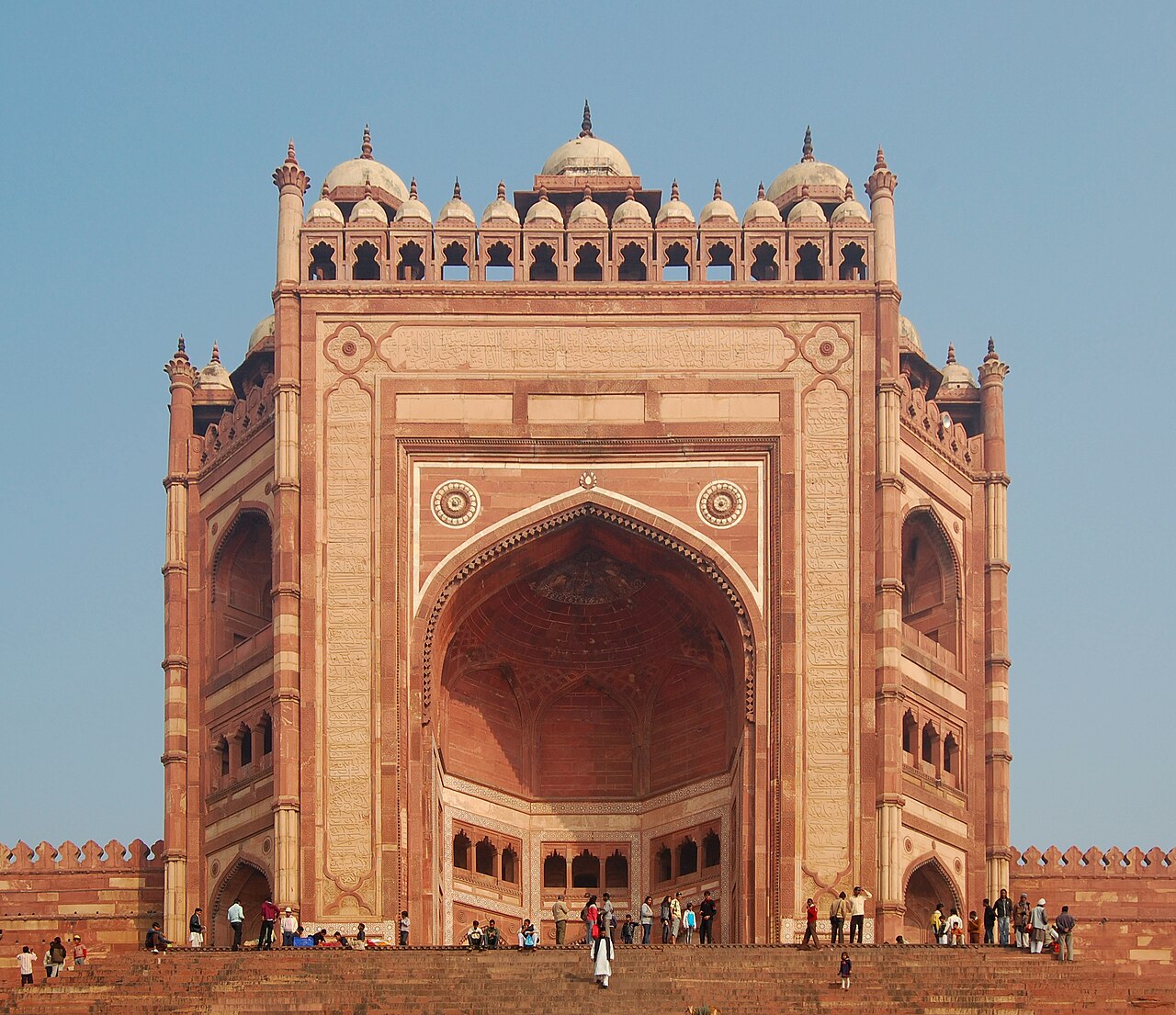
Fatehpur Sikri is a former Mughal imperial capital 37 km west of Agra in Uttar Pradesh, built by Emperor Akbar beginning in 1569 and serving as the seat of the Mughal Empire from approximately 1571 to 1585 — a period of roughly fourteen years — before being abandoned and never re-inhabited. The palatial complex, mosque and ceremonial gateways are preserved almost entirely intact, frozen at the moment of Akbar’s departure. UNESCO inscribed Fatehpur Sikri as a World Heritage Site in 1986.
Akbar’s City and the Sufi Saint: Why an Emperor Built a Capital on a Hill 37 km west of Agra, Uttar Pradesh
The Mughal court historian Abul Fazl, in his Akbarnama, records that Emperor Akbar began making pilgrimages to the village of Sikri in the late 1560s to visit the Sufi saint Sheikh Salim Chishti (1478–1572), a revered teacher of the Chishti order who lived at the site. Akbar, despite ruling an empire of tens of millions, had no surviving male heir by the mid-1560s. He sought the saint’s blessing and, according to the account, Sheikh Salim predicted the birth of a prince. In 1569, a son was born at Sikri — named Salim in the saint’s honour, he later became Emperor Jahangir.
Akbar responded by building a capital at the site. The scale of the project was unprecedented even by Mughal standards. Within a few years, a fully functioning imperial capital with palaces, administrative halls, a mosque, a market complex and residential quarters for the court had been constructed on and around a rocky ridge above the plains of Uttar Pradesh. The complex covers approximately 6 km² of planned construction; the walled royal enclosure alone — the part now accessible to visitors — covers approximately 1.2 km².
The architecture of Fatehpur Sikri is a synthesis unlike anything else in the Mughal canon. Akbar was a religiously syncretic emperor — Muslim by birth, deeply interested in Hinduism and Zoroastrianism, and the founder of his own short-lived religious movement, the Din-i-Ilahi. This intellectual eclecticism is visible in the buildings. The Panch Mahal, a five-storey open colonnade of 176 pillars, uses carved stone columns in the Hindu trabeate style — post-and-lintel rather than the arch — while its upper storeys create a cascading stepped silhouette derived from Indian palatial traditions. The Diwan-i-Khas (Hall of Private Audience) has at its centre a single massive pillar that spreads into a circular capital connected by four footbridges to a raised walkway around the hall’s interior — an arrangement with no direct precedent in Islamic or Hindu architecture and the subject of scholarly debate about its precise function.
The Jama Masjid at Fatehpur Sikri is one of the largest mosques in India, designed to hold the entire imperial court at Friday prayers. Its courtyard measures 166 metres by 130 metres. The mosque was begun in 1571 and the complex was substantially complete by 1575. The tomb of Sheikh Salim Chishti — housed in a white marble pavilion at the northern end of the mosque courtyard, built by Akbar after the saint’s death in 1572 and later rebuilt in marble under Jahangir — remains an active pilgrimage site to the present day. Visitors tie threads to the marble lattice screens of the tomb, a petition practice at Chishti shrines across India.
The name Fatehpur Sikri contains a historical record within it. “Fatehpur” means “city of victory” in Urdu and Persian; the name was given in 1573 after Akbar’s conquest of Gujarat. The Buland Darwaza, the monumental southern gateway, was added in 1601 specifically to commemorate that Gujarat campaign — it was built twenty-eight years after the victory it commemorates, suggesting that the gateway was a retrospective memorial rather than a contemporary celebration.
The 54-Metre Gateway and the Question of Abandonment Sikri ridge, 37 km west of Agra
The Buland Darwaza — the Gate of Magnificence — is the tallest ceremonial gateway in India and among the tallest in the world. It rises 54 metres above the exterior courtyard on the south side of the Jama Masjid; approached from below by a wide flight of steps, the gate appears to grow from the ground as you climb, the full scale of its red sandstone and white marble tympanum arch visible only as you near the top of the staircase. The arch’s pointed profile follows the tall lancet form associated with Central Asian Timurid architecture, and the inscription carved into the tympanum is a verse from the Quran beginning: “Said Jesus, Son of Mary (Peace be upon him): The world is a bridge. Pass over it but build no houses upon it.”
The attribution of this inscription to Jesus — integrated into a Quranic verse on a Mughal imperial mosque — is a direct expression of Akbar’s religious syncretism. The gate was not merely a monument to military victory; it was a statement of the emperor’s conception of divine sovereignty as transcending any single religious tradition. The proportions of the Buland Darwaza are carefully calibrated: the main arch is flanked by smaller blind arches in the same pointed form, creating a tripartite facade that reads as a single composition from a distance.
Fatehpur Sikri was abandoned in approximately 1585, around fourteen years after it became the imperial capital. The reason is debated. The traditional explanation, repeated in most popular accounts, is water scarcity: the ridge on which the city was built has limited natural water sources, and supporting an imperial population of approximately 200,000 people — court, army, merchants, servants, artisans — would have required water on a scale the local resources could not sustain. There is archaeological evidence of elaborate water management systems at the site, including a large reservoir (Anup Talao), but whether these were adequate for the full scale of the city’s population is unresolved.
The Mughal court historian Abul Fazl does not provide a clear explanation for the abandonment. He describes Akbar departing for military campaigns in the northwest, first to deal with threats on the Afghan frontier and then to address ongoing instability in the Punjab. Some historians argue that military necessity — requiring the emperor’s physical presence near the northwestern frontier — was the primary reason, and that the capital’s location in the interior of the Gangetic plain made it strategically inconvenient. The weight of current historical opinion accepts a combination: real water management challenges combined with the practical military argument that the emperor and court needed to operate from a location closer to the active northwest frontier.
What is certain is that after approximately 1585 the imperial court did not return. The site was not destroyed, sacked or built over. It was simply vacated. The buildings remain in a state of preservation that reflects this: unlike most medieval urban sites, Fatehpur Sikri was not quarried for building materials by later construction, because no substantial later construction occurred in the vicinity. The combination of imperial construction quality and complete post-abandonment inactivity has left the complex more intact than almost any comparable Mughal site.
Practical information
Fatehpur Sikri is located 37 km west of Agra along National Highway 19 (the Agra–Jaipur road). Journey time by road is approximately 45 minutes to one hour depending on traffic. Buses run regularly from Agra’s Idgah Bus Stand to Fatehpur Sikri and take approximately 60 to 75 minutes. Hired taxis and auto-rickshaws from Agra can complete the journey and wait while you visit; drivers regularly cover Agra Fort, the Taj Mahal and Fatehpur Sikri as a combined day route.
The site consists of two main areas: the royal palace complex (ticketed entry, administered by the Archaeological Survey of India) and the Jama Masjid with the dargah of Sheikh Salim Chishti (free entry, active religious site). The two areas are adjacent and are typically visited together; allow two to three hours for a thorough visit of both. The palace complex is open from sunrise to sunset.
Agra Fort is 38 km east, and the Taj Mahal 40 km east. Both are practical additions to a Fatehpur Sikri visit and the three UNESCO sites can be covered in a single long day from a base in Agra. There is no accommodation at Fatehpur Sikri itself.
Frequently Asked Questions
Why was Fatehpur Sikri abandoned so quickly, and can it be visited today?
Fatehpur Sikri functioned as the Mughal imperial capital for approximately fourteen years, from around 1571 to 1585, before Emperor Akbar and the court departed. The site was never re-inhabited as a functioning city. The question of why has no definitive single answer in the historical record. Abul Fazl’s court history — the primary Mughal source — does not provide an explicit explanation. The two most widely cited reasons are water scarcity, given the limited natural water sources on the ridge, and military necessity, since Akbar’s campaigns in the northwest required his presence far from the Gangetic plain interior.
What makes the site unusual is precisely the absence of subsequent occupation. Most historical urban sites are subject to continuous reuse: buildings are demolished for materials, new structures are built over old ones, and the original layout becomes fragmentary. At Fatehpur Sikri, the departure of the court was total and no significant later construction occurred on the site. The buildings have stood essentially as Akbar left them for over four hundred years, with restoration work by the Archaeological Survey of India beginning in the late 19th century. The site is fully accessible today. The palace complex is a ticketed Archaeological Survey of India site; the Jama Masjid and the dargah of Sheikh Salim Chishti are open to all visitors without charge as an active pilgrimage destination. The combination of royal secular and sacred religious architecture within a single planned complex makes Fatehpur Sikri among the most coherent surviving examples of Mughal urban planning.
What is the Buland Darwaza and why was it built?
The Buland Darwaza — the Gate of Magnificence — is a triumphal gateway built by Emperor Akbar in 1601 on the southern side of the Jama Masjid at Fatehpur Sikri, to commemorate his conquest of the Sultanate of Gujarat, which had been completed in 1573. The gateway is 54 metres tall measured from the exterior courtyard at the base of its approach staircase, making it the tallest ceremonial gateway in India. The approach is designed for maximum visual impact: a wide flight of steps leads upward to the gate, so the full height of the structure is revealed gradually as you climb.
The Buland Darwaza was built twenty-eight years after the Gujarat victory it commemorates, which means it was not a contemporary celebration but a retrospective memorial — possibly motivated by Akbar’s desire to mark his Gujarat campaign at a time when he was engaged in further military and political consolidation in the northwest. The gateway combines red Rajasthani sandstone with white marble detailing in the voussoirs of the main arch and the decorative panels flanking it. The tympanum inscription, a verse that includes the words attributed to Jesus: “The world is a bridge — pass over it but build no houses upon it,” reflects the religious syncretism that marked Akbar’s reign. The Buland Darwaza is structurally integrated into the mosque complex and functions as the main entrance to the Jama Masjid’s courtyard from the south.
Who was Sheikh Salim Chishti and why does his tomb still attract pilgrims?
Sheikh Salim Chishti (1478–1572) was a Sufi teacher of the Chishti order, one of the principal Sufi lineages of South Asia. The Chishti order — founded in the town of Chisht in present-day Afghanistan, introduced to the Indian subcontinent by Moinuddin Chishti in the 12th century — places particular emphasis on music, poetry and the accessibility of divine experience across social boundaries. Chishti dargahs (shrines of deceased saints) have historically attracted pilgrims from Hindu and Muslim communities alike.
Sheikh Salim’s tomb is housed in a white marble pavilion at the northern end of the Jama Masjid courtyard at Fatehpur Sikri. The pavilion was originally built in red sandstone by Akbar immediately after the saint’s death in 1572; it was rebuilt in white marble under Emperor Jahangir — Akbar’s son, who was named Salim in the saint’s honour — in the early 17th century. The interior screen walls of the pavilion are pierced marble lattices (jali) of exceptional delicacy, among the finest examples of Mughal marble carving. The tradition of tying threads to the jali screens as petition offerings is a practice common at Chishti shrines across India and Pakistan; it continues at Sheikh Salim’s tomb today. The combination of an active pilgrimage destination set within a UNESCO World Heritage complex accessible to all visitors makes Fatehpur Sikri unusual among Indian heritage sites: the religious and historical dimensions of the place remain continuously alive rather than being purely archaeological.
Sources
- S1 — Archaeological Survey of India (ASI) — Agra Circle: Fatehpur Sikri Monuments — https://asi.nic.in/
- S2 — Attilio Petruccioli — Fatehpur Sikri: La città del sole e del sole nascente, Carucci, Roma, 1988, ISBN 978-8884020147
Spotted an error? Write to editorial@culturalheritageonline.com and we correct it the same day.