
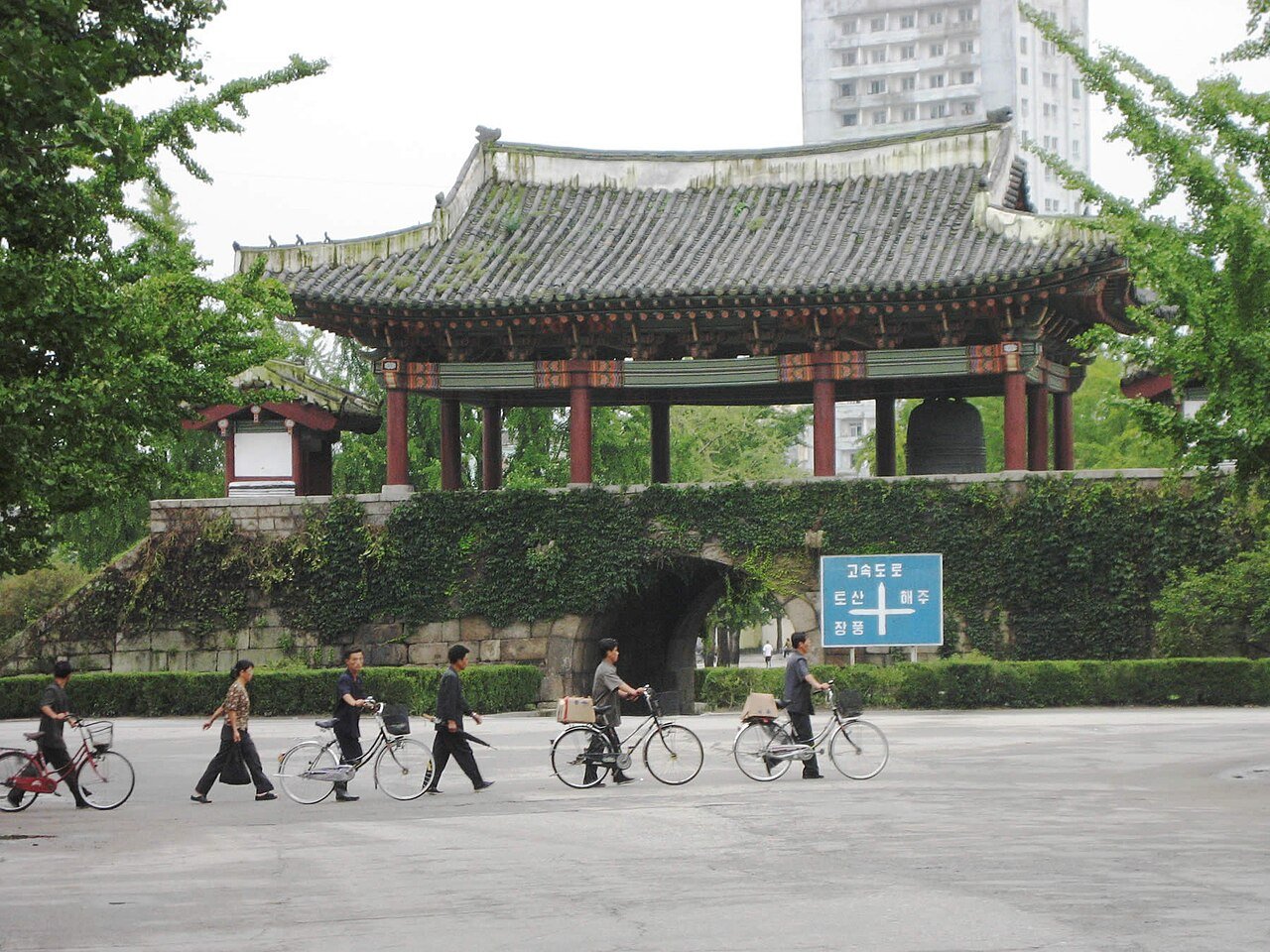
North Korea has two UNESCO World Heritage Sites. The Complex of Koguryo Tombs (inscribed 2004) — a group of decorated ancient tombs near the capital Pyongyang — was the first North Korean UNESCO site. The Historic Monuments and Sites in Kaesong (inscribed 2013) preserve the capital city of the Goryeo Kingdom (918–1392 CE), 170 km south of Pyongyang. Both sites are accessible only within the context of officially approved and supervised visits to North Korea. From Cultural Heritage Online.
Complex of Koguryo Tombs Distributed around Pyongyang — 30 min to 2 hr by road
The Complex of Koguryo Tombs is a group of approximately 30 individual and clustered tombs, from a total of approximately 10,000 Goguryo-period tombs that survive in the Pyongyang region, dated to between the fourth and seventh centuries CE. The tombs were the burial sites of Goguryo (Goguryeo) royal family members and aristocrats; Goguryo was one of the Three Kingdoms of Korea (along with Baekje and Silla), and at its maximum extent in the fifth century CE was the largest of the three kingdoms, controlling territory from the Korean Peninsula into Manchuria and eastern Russia.
The tombs are remarkable for their interior murals — painted directly onto the stone walls of the burial chambers with mineral pigments that have survived approximately 1,500 years of the underground environment. The murals depict scenes from the daily life of the Goguryo aristocracy (hunting, feasting, wrestling, dancing), portraits of the deceased and attendants, and elaborate cosmological and guardian imagery (the Four Directional Deities: the Blue Dragon of the East, the White Tiger of the West, the Red Phoenix of the South, and the Black Tortoise of the North). The Anak Tomb No. 3 (circa 357 CE) contains the most complex mural programme and the largest known single mural from East Asian antiquity — a procession of approximately 250 figures extending across multiple chambers. UNESCO inscribed the site in 2004; it was the first North Korean site on the World Heritage List.
Historic Monuments and Sites in Kaesong 170 km south of Pyongyang — approximately 2 hr by train
Kaesong was the capital of the Goryeo Kingdom (918–1392 CE), the dynasty that gave its name to the modern word “Korea.” The UNESCO-inscribed site encompasses twelve component monuments including the Manwoldae Palace Site (the ruined foundations of the Goryeo royal palace, covering approximately 25 hectares), the Namdaemun South Gate (a surviving original gate in the old city wall), the Koryo Museum (in the former National Confucian Academy, Sungkyunkwan, established 992 CE), several royal and aristocratic mausoleums in the surrounding hills, and the tomb of King Wanggeon (918–943 CE), founder of the Goryeo dynasty. UNESCO inscribed the site in 2013.
Kaesong is approximately 170 km south of Pyongyang and approximately 6 km north of the Korean Demilitarized Zone that separates North and South Korea. The Kaesong Industrial Complex, a joint North-South Korean economic zone on the outskirts of Kaesong, operated from 2004 to 2016 and employed approximately 55,000 North Korean workers; it has been suspended since 2016 due to nuclear testing sanctions.
Access: Foreign visitors to North Korea require a visa obtainable only through a state-authorised North Korean tour agency; independent travel is not permitted. Tours are typically group-based and follow pre-approved itineraries. The Koguryo Tombs near Pyongyang and the Kaesong sites are both included in some standard tour itineraries. Western nationals (particularly US, UK, Australian) face significant restrictions; check current advisories. Best for: Korean antiquity specialists; Cold War heritage context.
Frequently Asked Questions
How many UNESCO World Heritage Sites does North Korea have?
Two: the Complex of Koguryo Tombs (inscribed 2004, natural and cultural) and the Historic Monuments and Sites in Kaesong (inscribed 2013, cultural). North Korea submitted its first Tentative List to UNESCO in 1994, and Kaesong’s nomination was a joint submission with the government of South Korea — one of the rare areas of cultural cooperation between the two Koreas. North Korea also has several sites on the Tentative List including the Ryongmyon-Ri Dinosaur Footprint Site and various revolutionary historic sites.
What was the Goryeo Kingdom and why is it historically important?
The Goryeo Kingdom (918–1392 CE) was the first Korean state to unify the entire Korean Peninsula under a single ruling dynasty (the earlier unified Silla kingdom unified most but not all of the peninsula). Goryeo gave the Western world the name “Korea” (via the Mongol pronunciation “Gaoli” transmitted through Marco Polo and Arab traders). The Goryeo period was Korea’s most significant cultural golden age: it produced the Goryeo celadon ceramics (regarded as the finest in East Asian ceramic history), the first complete Buddhist canon carved onto 80,000 wooden blocks (the Tripitaka Koreana, now at Haeinsa Temple in South Korea and separately inscribed as a UNESCO World Heritage Site), and major advances in printing technology, including the development of moveable metal type approximately 200 years before Gutenberg’s press in Europe.
What is the significance of the Goguryo tomb murals?
The Goguryo tomb murals are among the most important surviving examples of East Asian painting from the period between approximately 300 and 700 CE — a period for which relatively little painting survives in China, Japan, or Korea on other surfaces. The murals provide the most detailed visual record available of the material culture, dress, social organisation, cosmology, and artistic conventions of the Goguryo aristocracy and, by extension, of northern Korean culture in the first millennium CE. The cosmological guardian figures (Blue Dragon, White Tiger, Red Phoenix, Black Tortoise) depicted in the tombs appear in essentially identical form in Japanese Asuka-period tombs (notably Takamatsuzuka in Nara) and in Chinese Tang-dynasty decoration, demonstrating the cultural transmission routes across Northeast Asia during this period.
Can foreign tourists visit North Korea?
Foreign tourists, other than Chinese nationals (who have historically had easier access), typically access North Korea through a small number of authorised tour operators based in Beijing or other third countries. Tourism has been heavily restricted since the outbreak of COVID-19: North Korea closed its borders in January 2020 and did not reopen to foreign tourists until 2024. The conditions under which tourists can visit, what they can see, and the degree of supervised versus unsupervised access have varied over time. US citizens have been prohibited from travelling to North Korea by the US State Department since 2017 (with exceptions for humanitarian and journalistic purposes), following the death of American student Otto Warmbier, who died shortly after being released from North Korean custody in 2017.
Sources
- S1 — Nelson, Sarah Milledge. The Archaeology of Korea. Cambridge University Press, 1993. ISBN 978-0-521-40783-0.
- S2 — Portal, Jane. Korea: Art and Archaeology. Thames & Hudson, 2000. ISBN 978-0-500-28202-1.
Spotted an error? Write to editorial@culturalheritageonline.com and we correct it the same day.

.jpg)