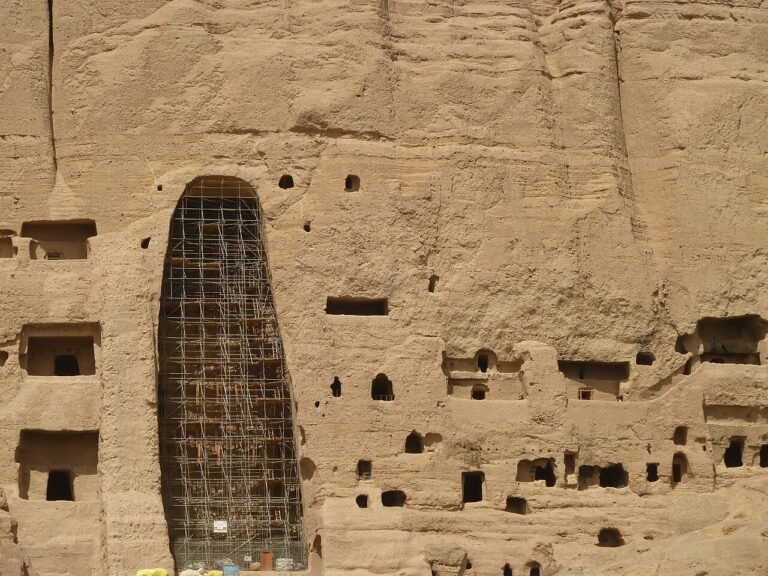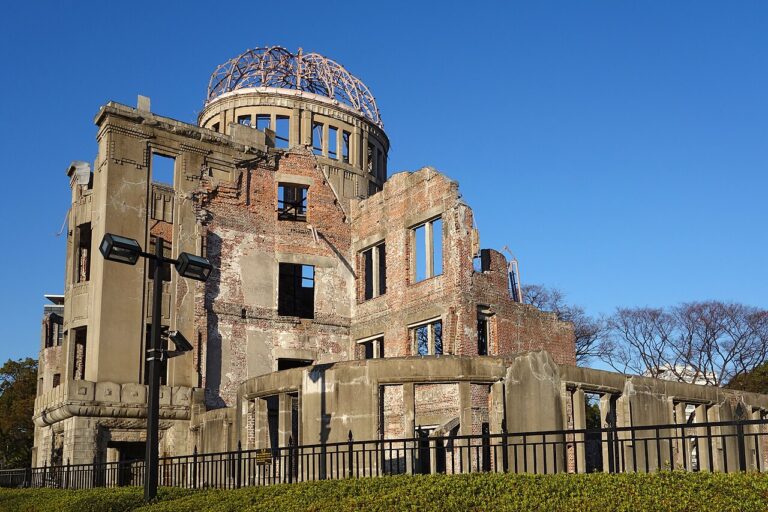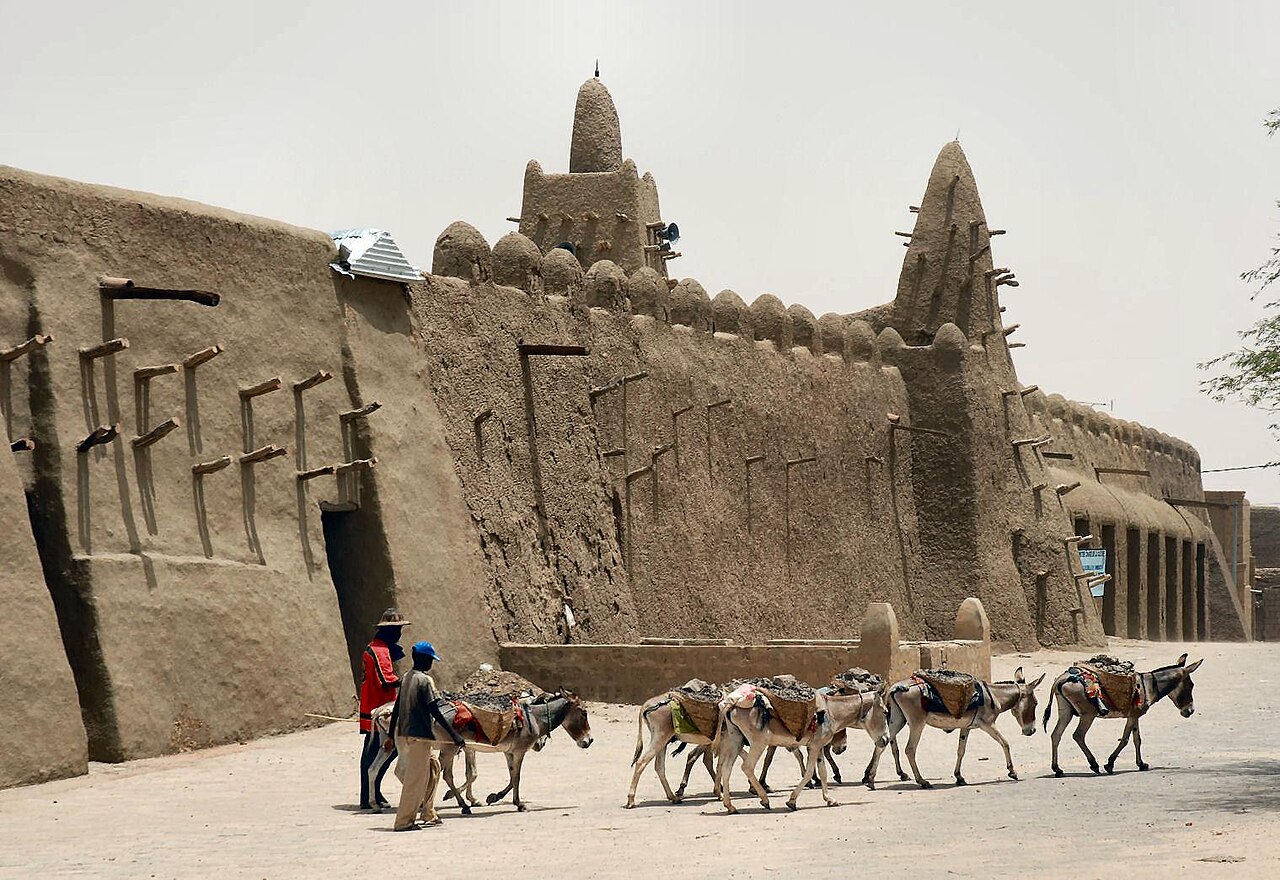
Timbuktu, in central Mali at the southern edge of the Sahara on the Niger Bend, was one of the principal intellectual and commercial centres of the medieval Islamic world between the 13th and 16th centuries. Its three great mud-brick mosques — Djinguereber, Sankore, and Sidi Yahia — and a collection of up to 300,000 medieval manuscripts in Arabic and local languages represent an extraordinary concentration of knowledge production and preservation. UNESCO inscribed Timbuktu in 1988; the site was placed on the List of World Heritage in Danger in 2012 during a jihadist occupation, and removed in 2019 after restoration.
Gold, salt and scholarship: Timbuktu at the height of the Mali and Songhai empires Central Mali, Niger Bend, edge of the Sahara
Timbuktu’s position at the crossing of two great trade axes made it one of the wealthiest cities in the medieval world. The north-south Saharan axis carried salt slabs — cut at the mines of Taoudenni, 700 kilometres north — down to the agricultural communities of the Sahel and the savannah. The east-west Niger River axis carried gold, kola nuts, and enslaved people westward toward the Atlantic, and connected Timbuktu to the trading networks of the Mali Empire and later the Songhai Empire. The city functioned as the point where these two systems met, and the merchants who facilitated that meeting accumulated vast wealth across several centuries.
The physical embodiment of that wealth is the Djinguereber Mosque, begun in 1327 CE. Mansa Musa, emperor of the Mali Empire, had returned the previous year from his pilgrimage to Mecca — a journey that brought him and his enormous retinue through Cairo, where his spending of gold caused price inflation that, by some accounts, disrupted the Egyptian economy for a decade. In Mecca he met Abu Ishaq al-Sahili, an architect and poet originally from Granada in Andalusia. He brought al-Sahili back to Mali with him and commissioned the Djinguereber Mosque in Timbuktu. The result was a building that adapted the Andalusian tradition to the materials and climate of the Sahel: mud brick and banco (a mixture of mud, straw, and organic material) in place of stone, flat roofs with drainage channels, massive buttressing walls, and the distinctive projecting wooden rods — torons — that serve as permanent scaffolding anchors for annual replastering. The mosque, rebuilt and extended at various points, still functions as a place of worship.
The Sankore Mosque, built in the 14th and 15th centuries on the site of an earlier structure, became the centre of Sankore University — one of the world’s earliest universities, and the intellectual heart of Timbuktu at the height of the Songhai Empire in the late 15th and early 16th centuries. At its peak, Sankore is estimated to have had up to 25,000 students studying Islamic law, theology, mathematics, astronomy, history, and medicine. Scholars came from across the Islamic world. The library collections assembled by Timbuktu’s scholarly families during this period are what we now call the Timbuktu manuscripts. The Sidi Yahia Mosque, the third of the inscribed monuments, dates to the 15th century and is associated with a revered local saint.
The city’s population at its height in the 16th century under the Songhai Empire is estimated at possibly 100,000, making it one of the largest cities in the world at the time. The Songhai Empire was destroyed by a Moroccan invasion in 1591, and Timbuktu never fully recovered its position as an imperial capital, though it remained a centre of Islamic scholarship and trans-Saharan trade at a reduced scale for centuries afterward.
The manuscripts crisis of 2012 and the covert rescue operation UNESCO Danger List 2012–2019
In April 2012, a jihadist coalition dominated by Ansar Dine, affiliated with Al-Qaeda in the Islamic Maghreb, seized control of northern Mali including Timbuktu. The occupation lasted until January 2013, when French military intervention under Operation Serval drove the jihadist groups from the city. During the occupation, the militant forces enforced an extreme interpretation of Islamic law, banning music, sport, and mixed-gender interaction. They also began systematically destroying the mausolea of Sufi saints that are part of the Timbuktu World Heritage Site, viewing the veneration of saints as idolatry. Sixteen of the seventeen inscribed mausolea were damaged or destroyed. The destruction of the mausolea was subsequently prosecuted as a war crime before the International Criminal Court; Ahmad al-Faqi al-Mahdi, one of the commanders responsible, pleaded guilty in 2016 and was sentenced to nine years in prison — the first ICC conviction specifically for the deliberate destruction of cultural heritage.
The fate of the manuscripts was more complex. Abdel Kader Haidara, a Malian librarian and manuscript collector, organised one of the most remarkable cultural rescue operations of the 21st century. Over months before and during the occupation, he and a network of associates quietly moved an estimated 300,000 manuscripts — the collections of dozens of private family libraries as well as the public Ahmed Baba Institute — out of Timbuktu. The books were hidden in trunks, transported by donkey and river boat, and eventually brought to the relative safety of Bamako, the Malian capital, 1,000 kilometres to the south. When the jihadist forces discovered that the manuscripts were being removed and began to target the effort, the operation had already largely succeeded. The manuscripts that remained in the Ahmed Baba Institute were burned during the French military advance, but these were a small fraction of the total.
The restoration work that followed — rebuilding the mausolea with traditional banco techniques, using craftsmen trained in the methods that built the original structures — was coordinated by UNESCO and the Malian government and largely completed by 2015. The recognition of this work, and improved security conditions, led to the site’s removal from the Danger List in 2019. The nearest UNESCO World Heritage Site is the Cliff of Bandiagara (Land of the Dogons), approximately 300 kilometres south of Timbuktu.
Practical information
Timbuktu is accessible by a 90-minute domestic flight from Bamako (Air Mali and charter operators serve the route), by river boat from Mopti during high-water season (July to November, approximately 3 to 5 days), or by road from Mopti in the dry season (roughly 12 hours on unpaved tracks in a 4×4 vehicle). Security in northern Mali remains volatile; travellers are strongly advised to check current government travel advisories from their home country before planning a visit, and to travel with an established local guide agency with current knowledge of conditions. The mosques are active places of worship; the Djinguereber Mosque is generally accessible to visitors outside prayer times, but access rules for non-Muslims vary and should be confirmed locally. The Ahmed Baba Institute, which preserves and digitises the manuscript collection (most manuscripts were returned to Timbuktu after 2013, though the digitisation programme means copies are now held in multiple locations), can be visited with advance arrangement. The town itself, with a current population of approximately 55,000, has a small number of guesthouses.
Frequently Asked Questions
What exactly are the Timbuktu manuscripts, and what subjects do they cover?
The Timbuktu manuscripts are a collection of handwritten documents produced in Timbuktu and other West African scholarly centres primarily between the 13th and 17th centuries, with some dating as late as the 19th century. They are written mainly in Arabic, with some texts in Ajami — African languages (including Songhai, Fulani, and Bambara) transcribed using the Arabic script. The subject range is extraordinary: Islamic theology and jurisprudence are the most numerous categories, but the collections also include treatises on mathematics, algebra, geometry, and astronomy; medical texts covering diagnosis, pharmacology, and surgery; histories of the Mali and Songhai empires; poetry and literature; diplomatic correspondence; and commercial records. Some manuscripts contain marginalia that reveal they were actively used as textbooks, with students and teachers annotating the text across generations. The total number of surviving manuscripts is uncertain; estimates range from 100,000 to 700,000 depending on how “manuscript” is defined and how many private family collections exist that have not yet been catalogued. The Ahmed Baba Institute in Timbuktu holds the largest single public collection; dozens of private family libraries hold additional thousands. Digitisation efforts by the institute and international partners have made a portion of the collection searchable online.
Who was Mansa Musa, and why is his 1324 pilgrimage still historically significant?
Mansa Musa (reigned approximately 1312–1337) was the ninth emperor of the Mali Empire, which at its peak controlled most of West Africa from the Atlantic coast to the bend of the Niger River, including the gold-producing regions of Bambuk and Bure. His pilgrimage to Mecca in 1324–1325 was one of the most consequential journeys in medieval world history, and not primarily for religious reasons. Mansa Musa travelled with a reported entourage of 60,000 to 80,000 people — court officials, soldiers, merchants, enslaved servants, and wives — and 80 to 100 camels each carrying gold dust. In Cairo, where he stopped for three months, his entourage spent and gave away so much gold that the metal’s value in Egypt fell dramatically; some contemporary accounts suggest it took the Egyptian gold market a decade to recover. In Mecca, Musa established diplomatic contacts and purchased property. On his return, he brought craftsmen and scholars to Mali; the architect Abu Ishaq al-Sahili was the most consequential of these, responsible for the Djinguereber Mosque in Timbuktu and other structures. The pilgrimage put Mali on European maps for the first time; the 1375 Catalan Atlas depicts Mansa Musa seated on a throne in West Africa, holding a golden orb, labelled “Rex Meli” — King of Mali.
What is the current status of security in Timbuktu, and can tourists visit safely?
The security situation in northern Mali, including Timbuktu, has remained unstable since the 2012 crisis. Although French military operations drove jihadist groups from the main urban centres in early 2013, armed groups affiliated with Al-Qaeda and, later, the Islamic State in the Greater Sahara have continued to operate in the region. The UN peacekeeping mission MINUSMA, which provided some security presence, was withdrawn in 2023 following a deterioration in relations between the Malian military government and international partners. Western governments, including France, Germany, the United States, and the United Kingdom, advise against all travel to northern Mali. The situation is fluid, and travellers should consult their government’s current travel advisory immediately before making any plans. Visits to Timbuktu are not impossible in practice — Malian tour operators continue to bring visitors — but they carry real and documented risks. Those who do visit typically do so as part of organised groups with local security arrangements. Remote and digital exploration of the manuscripts and monuments through the Ahmed Baba Institute’s online resources is a meaningful alternative for those unable to travel safely.
Sources
- S1 — Hunwick, John O., and Alida Jay Boye. The Hidden Treasures of Timbuktu. Thames & Hudson, 2008. ISBN 978-0-500-51421-4.
- S2 — Saad, Elias N. Social History of Timbuctu: The Role of Muslim Scholars and Notables 1400-1900. Cambridge University Press, 1983. ISBN 978-0-521-24603-3.
Spotted an error? Write to editorial@culturalheritageonline.com and we correct it the same day.