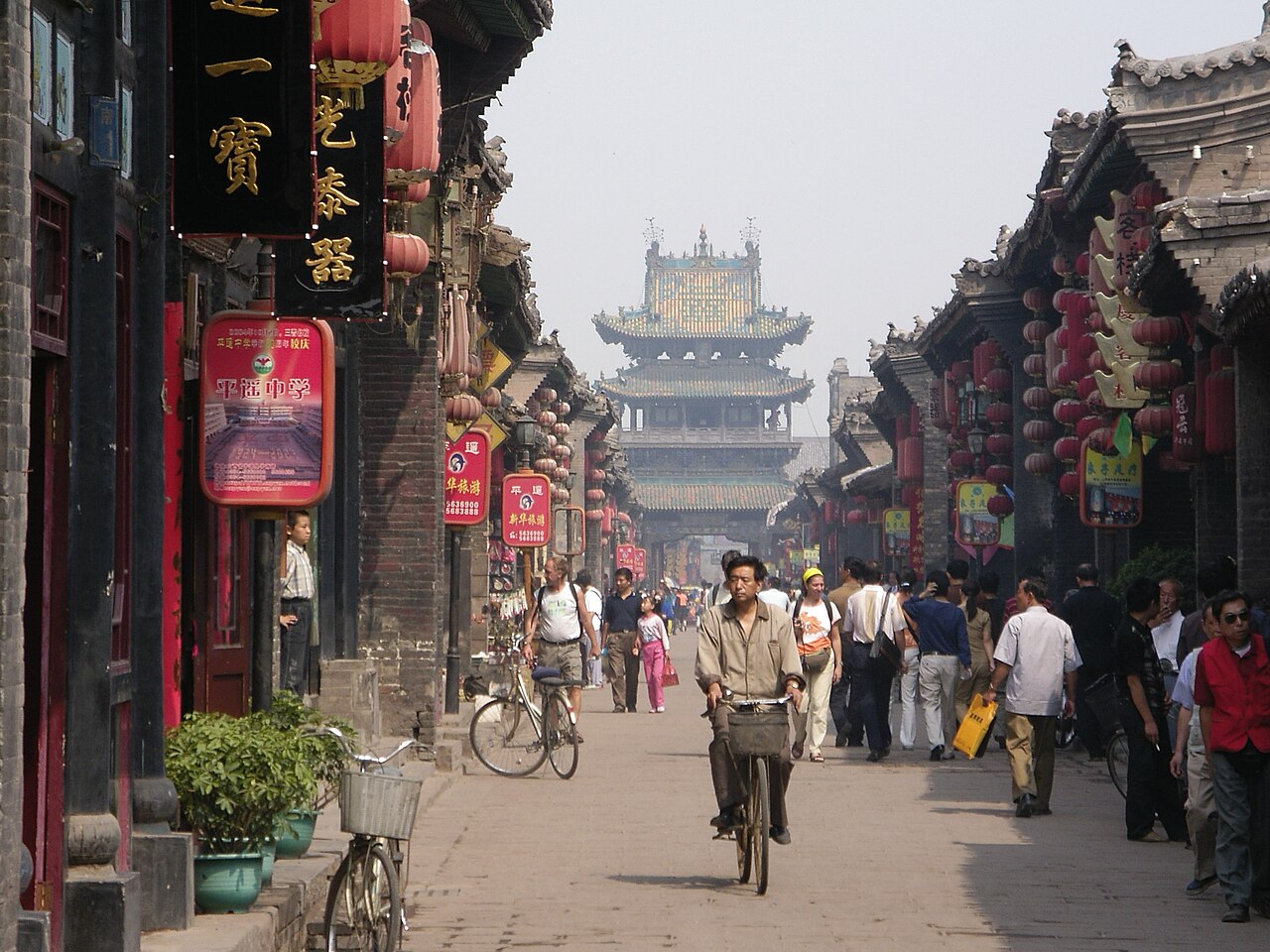
The Ancient City of Ping Yao, inscribed in 1997, is the best-preserved example of a walled Chinese city from the Ming dynasty — the only major Chinese city where the complete urban fabric, including town walls, streets, shops, temples, residences, and government offices, survives in its fourteenth-century configuration. The world’s first draft bank, founded here in 1823, makes Pingyao the birthplace of modern Chinese banking. Mount Wutai’s Buddhist monastery complex is 3 hours north.
Ancient City of Ping Yao: Ming Dynasty Urban Time Capsule Walled old city, Shanxi Province
The Ancient City of Ping Yao, inscribed in 1997 under criteria (ii), (iii), and (iv), is the only Chinese city where the complete urban fabric of the Ming dynasty (1368–1644) survives intact within its walls — undemolished, unrenovated to modern standards, and still inhabited by Chinese families in courtyard houses that were built 300–500 years ago. The city walls (6,163 metres of perimeter, built 1370 CE on earlier fortifications, 12 metres high, 3–6 metres wide at the top) have 72 watchtowers (corresponding to the 72 disciples of Confucius) and 6 city gates. The Yamen (County Magistrate’s Office, the government building of the Ming and Qing administrations), the City God Temple, the Confucian Temple, and two Buddhist temples survive in their original form inside the walls; over 3,700 traditional courtyard residences (siheyuan) document the private architecture of a mid-level Chinese market city from the Ming to the Republican period (1912–1949). The city was not demolished in the 1950s–1970s because it was too poor to attract investment; its backwardness proved its salvation.
Rishengchang: The World’s First Draft Bank Ming Qing Street, Pingyao old city
The Rishengchang Exchange Shop (日升昌票号), opened in 1823 by the dye merchant Lei Lutai at 38 Ming Qing Street in Pingyao, was the first institution in world financial history to develop the draft banking system — a method of transferring value between distant cities without physically transporting silver. A merchant in Beijing could deposit silver at a Rishengchang branch, receive a coded draft, travel to Shanghai, and withdraw silver against the draft — the difference in silver quantities accounted for the interest and commission. The system spread across China through the other Shanxi banking houses (piaohao or Shanxi banks) that followed Rishengchang’s model; at the peak of Shanxi banking (1850–1900), 22 banking houses with branches across China and in Japan, Russia, and Southeast Asia controlled the flow of capital in the Qing Empire, making Pingyao the financial capital of China. The Rishengchang building survives intact with its original strong rooms, iron cash boxes, and encoded ledgers; it now functions as a museum documenting the first 80 years of modern Chinese banking.
Mount Wutai: Sacred Buddhist Mountain with 47 Monasteries 🚗 ~3 hrs northeast
Mount Wutai (Wutai Shan) Cultural Landscape, inscribed in 2009 under criteria (ii), (iii), (iv), and (vi), is the most sacred Buddhist mountain in China — a plateau at 3,058 metres (the highest point in northern China) that is the legendary earthly home of Manjushri (Wenshu Pusa, bodhisattva of wisdom) and has been a centre of Buddhist pilgrimage since the fifth century CE. The site comprises 47 monasteries built between the fourth and twentieth centuries in a landscape that combines the natural peaks and valleys of the mountain with a continuous built heritage of temples, pagodas, scripture halls, and monks’ quarters. The Foguang Temple (857 CE, East Main Hall) is the oldest surviving timber-framed building in China — the only Tang-dynasty wooden architecture remaining above ground. The Xiantong Monastery (founded 68 CE, the oldest Buddhist temple in China after the White Horse Temple at Luoyang) is the largest temple complex on the mountain. The Tayuan Monastery’s Tibetan-style white dagoba pagoda (built 1301 CE) is the iconic image of Mount Wutai.
Yungang Grottoes: Fifth-Century Buddhist Cave Art 🚗 ~3.5 hrs north via Datong
The Yungang Grottoes near Datong, inscribed in 2001 under criteria (i), (ii), (iii), and (iv), are the most important fifth-century Buddhist rock-cut cave complex in China — 252 caves carved between 460 and 525 CE under Northern Wei dynasty patronage into the Wuzhou Mountain sandstone, containing approximately 51,000 Buddhist statues. The caves represent the introduction of Central Asian and Indian Buddhist iconography into northern China: the early (460–494 CE) caves directly commissioned by Emperor Wen Cheng show the Buddha’s face modelled on the emperor’s own features (a uniquely Chinese innovation — the five imperial donor caves, Cave 20’s outdoor great Buddha at 13.7 metres being the most famous), while the later caves show the progressive Sinification of the iconographic programme as the Wei court moved south and Chinese aesthetic sensibilities displaced the Central Asian models.
Practical information
Pingyao is 90 km south of Taiyuan; trains from Taiyuan to Pingyao take 1 hour (high-speed). From Beijing, the journey is 3–4 hours by high-speed train via Taiyuan. The walled old city is compact and walkable (the main streets are car-free) but the number of tourist shops has increased dramatically since UNESCO inscription. Rishengchang and the Yamen are the primary ticketed attractions (combined ticket recommended). Mount Wutai is 150 km northeast by road (3 hours); accommodation on the mountain in monastery guesthouses is available. The best season for Pingyao is May–October; the Pingyao International Photography Festival (September) fills the city. Mount Wutai’s highest point (3,058 m) can receive snow from October to May; the summer pilgrimage season (June–September) is the most active.
Frequently Asked Questions
Is Pingyao a UNESCO World Heritage Site?
Yes. The Ancient City of Ping Yao was inscribed in 1997 under criteria (ii), (iii), and (iv). The inscription covers the entire walled city including the city walls (1370 CE), the street plan, the Yamen, temples, and over 3,700 courtyard residences — an unprecedented survival of a complete Ming-dynasty Chinese urban environment.
What is a Shanxi bank (piaohao) and how did it work?
A piaohao (ticket shop, draft bank) was the Chinese equivalent of a bank of exchange — an institution that transferred money by paper draft rather than physical silver movement. A merchant would deposit a sum of silver at a branch, receive a coded draft paper (the code changed periodically to prevent forgery), travel to a distant city, present the draft at a local branch, and receive the silver equivalent minus commission and interest. The system was more secure and faster than transporting silver by land caravan; by 1850 the Shanxi piaohao handled an estimated 30–50 million taels of silver annually — approximately half the government’s revenue passing through their networks.
How old is the Foguang Temple at Mount Wutai?
The East Main Hall of the Foguang Temple dates from 857 CE (Tang dynasty) — confirmed by an inscription on the central beam discovered by the architectural historian Liang Sicheng during his 1937 survey expedition. It is the oldest surviving timber-framed building in China. The building was unknown to researchers until 1937 because the Japanese travel writer Ōgawa Kazumasa had documented it in 1922 without identifying its age; Liang Sicheng and his wife Lin Huiyin rediscovered it independently using references in a Dunhuang cave painting that showed the temple’s silhouette.