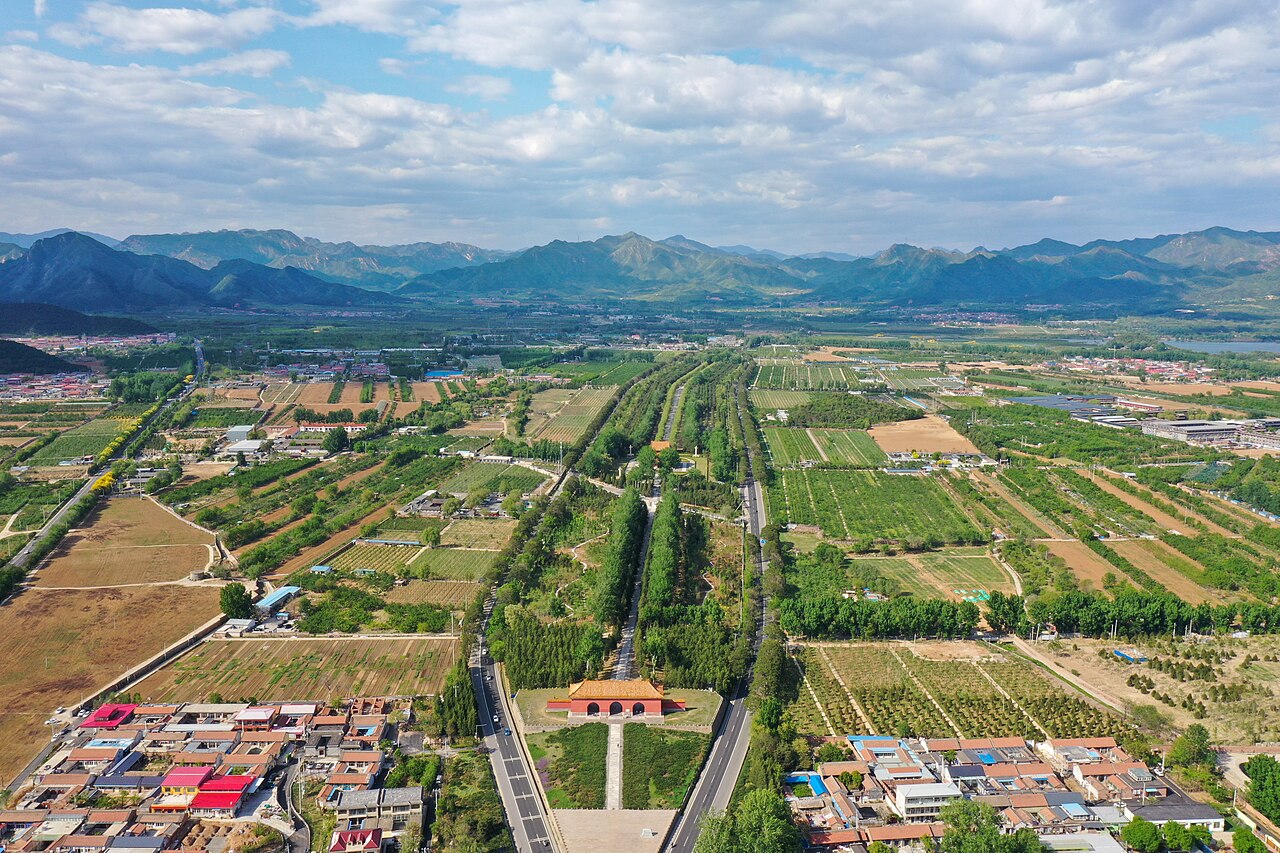
The Imperial Tombs of the Ming and Qing Dynasties were inscribed as a serial UNESCO World Heritage Site in 2000, with extensions in 2003 and 2004, and currently encompass six groups of imperial burial complexes built between 1368 and 1911 CE. The Ming Tombs (Shisanling, “Thirteen Mausoleums”) near Beijing contain the burials of 13 of the 16 Ming emperors; the Spirit Way approaching Changling, the tomb of the Yongle Emperor (r. 1402–1424), is 7.3 kilometres long and is lined with 36 stone figures of animals and officials. The only Ming Tomb whose underground chambers have been excavated is Dingling, burial of the Wanli Emperor (r. 1572–1620), opened in 1956–1958.
The living counterpart and the wall: the Forbidden City and the Great Wall at Badaling Forbidden City 50 km south 1 hour; Great Wall Badaling 70 km northwest 1 hour
The Imperial Palace (Forbidden City) in central Beijing, inscribed as UNESCO World Heritage in 1987, is approximately 50 kilometres south of the Ming Tombs, reachable by Metro Line 4 from Changping (Tiancun station) to Xidan in approximately 45 minutes, or by car on the G7 expressway in approximately one hour. The formal relationship between the Ming Tombs and the Forbidden City is architecturally direct: the Yongle Emperor, who built the Forbidden City between 1406 and 1420 CE and simultaneously selected the Changling site at Shisanling, applied the same axial planning principles to both complexes. The Forbidden City is oriented due south on a north–south axis; Changling is also oriented due south with the Tianshou Mountains closing the northern end of the valley in the role that would be played by a city wall or mountain fortification in defensive planning. Both complexes use the same tripartite hierarchical sequence of gateways through which the visitor moves from outer public space to inner sacred space: the Forbidden City progresses from Tiananmen Gate through Wumen Gate to the Three Great Halls; Changling progresses from the Great Red Gate through the Ling’en Gate to the Ling’en Hall and the burial mound. The Ling’en Hall at Changling, built in 1427 CE, is the largest surviving Ming-dynasty timber hall in China at 66.75 metres by 29.31 metres; its 60 columns of solid nanmu (Phoebe zhennan) wood, each approximately 14 metres high and 1.17 metres in diameter, were harvested from forests in Sichuan and Yunnan and transported to Beijing by river; the nanmu is a subtropical slow-growing timber, and the columns at Changling are the largest collection of original Ming nanmu columns in existence. Visitors who understand the Ling’en Hall’s construction are then equipped to read the Forbidden City’s halls comparatively: the Hall of Supreme Harmony (Taihe Dian), rebuilt after a 1695 fire in the Qing period, uses smaller and mixed-species timbers patched with composite sections, a visible record of the depletion of primary forest in southern China between the early Ming and late Qing periods. The Forbidden City contains 980 buildings covering 720,000 square metres within its 3.4-kilometre perimeter wall; it was completed in 1420 CE and served as the imperial residence through 1924 when the last emperor Puyi was expelled. The Palace Museum, which administers the complex since 1925, holds approximately 1.86 million objects; the collection includes the most significant corpus of imperial Chinese paintings, bronzes, ceramics and documents in mainland China.
The Great Wall at Badaling, which is part of the UNESCO World Heritage serial inscription of the Great Wall (inscribed 1987), is approximately 70 kilometres northwest of Beijing and 50 kilometres from the Ming Tombs, reachable by car from the Tombs in approximately one hour via the G7 expressway, or from Beijing by the S2 suburban railway from Beijing North station in approximately one hour 10 minutes. Badaling is the most visited section of the wall; the site receives approximately 10 million visitors annually and is the section shown on most photographs of the wall. The current structure at Badaling was restored between 1952 and 1957 and again in the 1980s; it is substantially rebuilt relative to the Ming-period original. The wall at Badaling dates from the later Ming period, primarily the Wanli reign (1572–1620), the same emperor whose tomb at Dingling is the only excavated Ming Tomb. A less visited and substantially more intact section of Ming wall is at Mutianyu, 75 kilometres northeast of Beijing; Mutianyu’s wall follows a ridge at higher elevation and retains more original brickwork and watchtower fabric, with a modern cable car providing access to the ridge without requiring significant climbing. The Great Wall’s UNESCO inscription (1987) is one of the earliest Chinese World Heritage inscriptions and covers the wall as a total entity across all dynasties and provinces; the inscribed property includes Han-dynasty (206 BCE–220 CE) earthen walls in Gansu as well as the Ming-dynasty brick-faced walls near Beijing. The combinable day itinerary from Beijing of Ming Tombs in the morning (Spirit Way, Changling Ling’en Hall, Dingling underground chambers) and Great Wall at Mutianyu in the afternoon (approximately one hour from Shisanling by car) is one of the most efficient ways to see two of the Beijing-area UNESCO inscriptions in a single day without returning to the city centre between sites.
Northeast and southwest circuits: Chengde, the Western Qing Tombs and the Eastern Qing Tombs Chengde 200 km northeast 2.5h HSR; Western Qing Tombs 120 km southwest 2h; Eastern Qing Tombs 125 km east 2.5h
The Eastern Qing Tombs (Dongling) at Zunhua in Hebei Province, part of the same UNESCO serial inscription as the Ming Tombs, are approximately 125 kilometres east of Beijing and reachable in approximately 2 hours 30 minutes by car or hired transport; there is no direct rail connection, and the journey requires a bus from Beijing’s Sihui East bus station or a hired vehicle. The Eastern Qing Tombs complex contains the burials of five Qing emperors—Shunzhi (r. 1644–1661), Kangxi (r. 1661–1722), Qianlong (r. 1736–1796), Xianfeng (r. 1850–1861) and Tongzhi (r. 1861–1875)—as well as 14 empresses and 136 imperial consorts. The complex at Zunhua covers 2,500 square kilometres of mountainous terrain; the burial mounds and their underground chambers are distributed across the valley according to a system of fengshui alignment that placed the Shunzhi Emperor’s Xiaoling mausoleum at the prime central position, with subsequent burials filling the valley according to seniority rules. The Qianlong Emperor’s Yuling mausoleum, completed in 1762 CE, contains an underground chamber system with 4 vaulted antechambers and 3 burial chambers, the walls and ceilings of which are entirely covered in Tibetan Buddhist carved reliefs and texts—the Dharanīs, Amitabha sutras and mandala diagrams that the emperor required as a practising Tibetan Buddhist initiate. This is the most elaborate internal programme in any Chinese imperial tomb and is open to visitors. The Empress Dowager Cixi’s Dingdongling mausoleum at Zunhua, rebuilt in 1895 after the original was demolished, is known for the relief carvings of phoenixes ranked above dragons on the approach ramps—a reversal of the standard imperial hierarchy that Cixi implemented to assert her authority over the nominal emperor Guangxu.
The Western Qing Tombs (Xiling) at Baoding in Hebei Province, the second Qing component of the serial UNESCO inscription, are approximately 120 kilometres southwest of Beijing, reachable by high-speed rail from Beijing West station to Gaobeidian South in approximately 45 minutes, followed by a taxi to the tomb complex (approximately 15 kilometres). The Western Qing Tombs contain the burials of the Yongzheng Emperor (r. 1722–1735), the Jiaqing Emperor (r. 1796–1820), the Daoguang Emperor (r. 1820–1850) and the Guangxu Emperor (r. 1875–1908). The decision by Yongzheng to establish a second Qing tomb precinct at Baoding rather than continuing the Eastern Tombs at Zunhua reflected both a fengshui assessment of the Baoding terrain and a political strategy of distinguishing his regime from that of his predecessor Kangxi, whose tomb was at Zunhua. The result was an alternating pattern: Qianlong returned to Zunhua, Jiaqing went to Baoding, and so on, creating a geographical alternation between the two precincts that continued for six emperors. The Guangxu Emperor’s Chongling mausoleum at Baoding, completed posthumously in 1915, is the last imperial tomb built in China; the Xuantong Emperor Puyi, who abdicated in 1912, was buried in a commercial cemetery at Yi County in 1995 after a series of post-death relocations. The Western Qing Tombs cover 800 square kilometres; the terrain is less dramatic than Zunhua and the visitor facilities less developed, but the Tailing (Yongzheng’s tomb) is one of the most formally complete of the Qing mausoleums, with its full sequence of gateways, ritual halls and subsidiary structures intact.
The Mountain Resort and Outlying Temples at Chengde, inscribed as UNESCO World Heritage in 1994, is approximately 200 kilometres northeast of Beijing and 250 kilometres north of the Ming Tombs, reachable by high-speed rail from Beijing Chaoyang station to Chengde South station in approximately 2 hours. Chengde functioned as the Qing summer capital and the primary venue for receiving Mongolian, Tibetan and Central Asian tributary missions between 1703 and the mid-nineteenth century; the resort’s role was inseparable from the Ming Tombs’ context because it was Kangxi’s choice of Chengde, rather than the Beijing palaces, as the site for conducting the Qing empire’s most consequential diplomatic relationships that defined the political geography of the Qing state as distinct from the preceding Ming state. The Imperial Mountain Resort is the largest surviving Chinese imperial garden at 5.64 square kilometres; the Eight Outer Temples on the surrounding mountains include the Putuo Zongcheng Temple (1771, modelled on the Potala) and the Pule Temple (1766, with a circular Tibetan-rite inner sanctum). A four-day circuit Beijing–Eastern Qing Tombs–Chengde–Beijing covers the principal Qing imperial heritage sites in the northeast; a separate day for the Ming Tombs and the Great Wall covers the Ming heritage within the Beijing metropolitan area.
Practical information
The Ming Tombs are 50 kilometres northwest of central Beijing, reachable by Metro Line 4 to Changping North station and then by taxi (approximately 20 minutes, 40–60 CNY) or by the dedicated tourist bus from Deshengmen Archway in central Beijing (Bus 872, approximately 1 hour 30 minutes). The Shisanling scenic area encompasses all 13 mausoleums; the three principal sites open to visitors are Changling (the largest, with the Ling’en Hall), Dingling (the only excavated underground chamber) and Zhaoling. A combined ticket covers the three principal sites; visitors with limited time should prioritise the Spirit Way approach and Changling for the above-ground architecture, and Dingling for the underground chamber. The Spirit Way’s 36 stone figures are accessible separately without entering the mausoleum compounds; walking the Spirit Way from the Great Red Gate to the end of the stone-figure avenue requires approximately 40 minutes at a comfortable pace. The Beijing Summer Palace, inscribed in 1998, is approximately 30 kilometres south of the Ming Tombs and can be combined with them in a single day’s itinerary by car. Avoid the Ming Tombs on national holidays (particularly National Day, 1–7 October, and Spring Festival) when the Spirit Way and Changling are extremely crowded; April to June and September to early October are the best months for combining the tombs with the Great Wall visits.
Frequently Asked Questions
Why did the Wanli Emperor reign for 48 years but reportedly open only 2 doors of his palace, and what does the excavation of his tomb reveal about the late Ming period?
The Wanli Emperor (Zhu Yijun, r. 1572–1620) is the longest-reigning Ming emperor and one of the most extensively documented cases of imperial non-governance in Chinese dynastic history. His withdrawal from active court participation, which began around 1587 and became almost total by 1600, was documented in detail by Ming official historians and has been the subject of the historian Ray Huang’s study “1587: A Year of No Significance.” The emperor reportedly refused to conduct audience sessions, sign official documents or appear at state rituals for extended periods; officials communicated with him through written memorials that were frequently unanswered. The immediate cause of the withdrawal was a succession dispute: Wanli wished to designate his third son (by a favoured consort) as crown prince in place of the first son (by the empress), which would have violated the legal principle of primogeniture. The court refused to accept the irregular designation for nearly 15 years; the emperor, unable to enforce his preference, responded by disengaging. The Dingling underground chambers, excavated between 1956 and 1958 by the archaeologist Wu Han and others, were the first and only Ming imperial tomb to be opened systematically by the People’s Republic. The excavation revealed three burial chambers totalling approximately 1,195 square metres with a ceiling height of approximately 9 metres, containing the Wanli Emperor, his empress and his favoured consort in three marble thrones, surrounded by 3,000 grave goods including gold crowns, porcelain vessels, silk textiles and the emperor’s personal weapons. The silk textiles preserved in the airless stone chambers are among the best-documented examples of late Ming weaving in existence. Forensic examination of the Wanli Emperor’s bones indicated that he suffered from severe scoliosis, with a 26-degree spinal curvature that would have caused chronic pain; this physical condition may have contributed to his reclusiveness. The grave goods were displayed in the Dingling Museum on-site but suffered significant damage during the Cultural Revolution (1966–1976), when Red Guards removed and destroyed some items; the current display includes both original material and restored pieces.
How were the locations of the Eastern and Western Qing Tombs selected, and what does the 125-kilometre alignment between them signify?
The selection of both Qing tomb precincts followed the Chinese practice of fengshui (geomancy) site selection, in which the topographic configuration of mountains, water courses and orientation was assessed for its capacity to accumulate and concentrate vital energy (qi) favourable to the deceased and to their living descendants. The Zunhua site for the Eastern Tombs was selected by the Shunzhi Emperor (r. 1644–1661) and his advisors in the mid-1650s; the Fengshan Mountains to the north of the Zunhua valley were judged to provide the ideal combination of a protective northern mountain mass, flanking ridges on east and west, and a south-facing open valley through which the burial axis could extend. The Baoding site for the Western Tombs was selected by the Yongzheng Emperor around 1730 after his decision not to continue at Zunhua; the Yixian valley site met the same topographic criteria with the Yishan mountain to the north. The apparent 125-kilometre alignment between the two precincts is not an intentional design feature but a consequence of both sites being selected on similar fengshui criteria within the topographic zone southwest of the Yanshan Mountains, which produces broadly comparable valley configurations at regular intervals. The alternating pattern of emperors between the two precincts (Shunzhi and Kangxi and Qianlong at Zunhua; Yongzheng and Jiaqing and Daoguang at Baoding) was maintained as a deliberate policy from the Yongzheng period onward, with each emperor instructed in succession law that he should be buried at whichever precinct his predecessor had not used. The Guangxu Emperor (d. 1908) broke the pattern by being buried at Baoding rather than Zunhua; his successor the Xuantong Emperor Puyi never received an imperial tomb within the traditional framework because the dynasty ended before one could be built.
What happened to the Spirit Way stone figures during the Cultural Revolution, and what is their current conservation status?
The Spirit Way (Shendao) approaching the Changling mausoleum at the Ming Tombs was not significantly damaged during the Cultural Revolution (1966–1976), which is notable given the systematic destruction of monuments classified as “feudal” by Red Guard factions in other sites during the same period. The relative preservation of the Ming Tombs is attributed to a combination of factors: the site’s remote location 50 kilometres from Beijing limited spontaneous Red Guard access; the Changling precinct was a functioning tourist site with some level of official oversight even during the chaos of the Cultural Revolution; and Zhou Enlai is reported in Chinese sources to have issued directives protecting certain major cultural sites, though the documentary evidence for specific directives covering the Ming Tombs is incomplete. The stone figures of the Spirit Way, 36 in total (12 animals in 6 pairs, 24 officials in 6 groups), were carved during the Xuande period (1425–1435 CE) and installed over approximately a decade. The animals include lions, xiezhi (a mythical single-horned equine), camels, elephants, qilin (the Chinese chimeric animal) and horses; each species appears in two pairs, one standing and one recumbent, for a total of four figures per species. The officials represent civilian officials (wenchen) and military officials (wuchen) in three ranks each, distinguished by rank badges on their robes. The figures have been cleaned and stabilised since 1980 but have not been substantially restored; original surface finish (paint and gilding) is entirely lost to weathering. The current conservation programme, managed by the Shisanling Special Administrative Zone, focuses on drainage improvement around the figure bases to reduce frost-heave damage and groundwater penetration into the stone. The stone is granite and relatively resistant to acid rain compared to sandstone or limestone; the primary conservation challenge is mechanical damage from foot traffic on the paved path that runs between the figures and periodic vehicle damage from maintenance vehicles using the Spirit Way access road.
Sources
- S1 — UNESCO World Heritage Centre — Imperial Tombs of the Ming and Qing Dynasties (Ref. 1004) — https://web.archive.org/web/20230601000000/https://whc.unesco.org/en/list/1004/
- S2 — Ming Tombs Administration Beijing — https://whc.unesco.org/en/list/1004/
- S3 — Kuhn, Dieter. <em>The Age of Confucian Rule: The Song Transformation of China</em>. Harvard University Press, 2009. ISBN: 978-0-674-03661-1.
Spotted an error? Write to editorial@culturalheritageonline.com and we correct it the same day.