Manama is the only Gulf Arab capital that can claim UNESCO World Heritage Sites within its own territory. Qal’at al-Bahrain, the Pearling Path, and the Dilmun Burial Mounds sit minutes from the city, while Saudi Arabia’s ancient trading routes are accessible via the King Fahd Causeway.
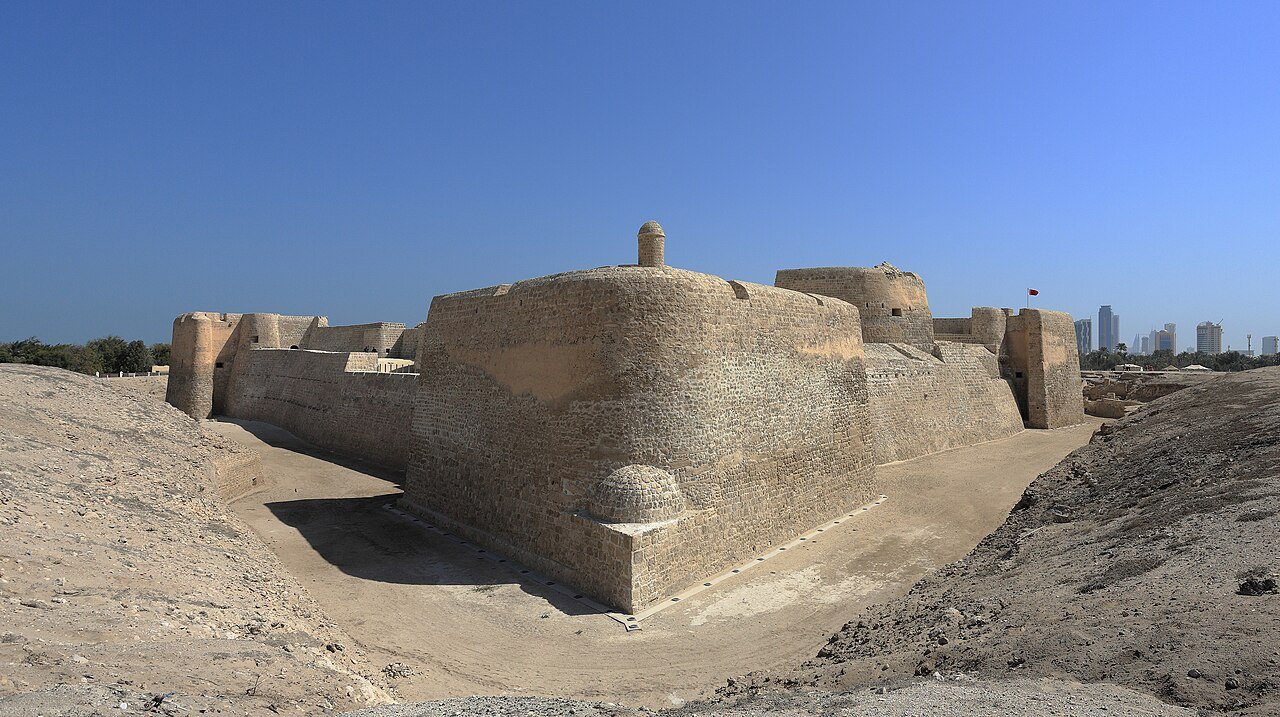
Qal’at al-Bahrain: Ancient Harbour and Capital of Dilmun 20 mins from central Manama
Qal’at al-Bahrain, inscribed in 2005 under criteria (ii), (iii), and (iv), is an archaeological site of exceptional depth — it layers Dilmun, Kassite, Assyrian, Greek, and Portuguese remains across seven millennia of continuous occupation. The Dilmun civilisation, centred here between roughly 2200 and 1600 BCE, appears in ancient Mesopotamian texts as a sacred land. The Portuguese fort that gives the site its modern name (Qal’at means fort in Arabic) was built in 1521 atop this accumulated history. From the ramparts, the view encompasses the sea that made Bahrain’s ancient wealth: pearling, maritime trade, and the freshwater springs that once bubbled from the seabed.
Pearling Path: Testimony of an Island Economy 10 mins from central Manama
The Pearling Path in Muharraq, inscribed in 2012 under criteria (iii) and (v), documents the pearl diving economy that underpinned Gulf society from antiquity until the Japanese cultured pearl industry ended it abruptly in the 1930s. The serial property includes three oyster beds in the sea, seventeen restored houses of pearl merchants, a fort, and a mosque — all linked by a walking path through Muharraq’s old town. The architecture of the merchants’ houses is unexpectedly refined, with carved stucco, wind towers, and inner courtyards that manage the Gulf heat with passive ventilation. Walking this path gives a precise account of how a single commodity shaped an entire civilisation for three thousand years.
Dilmun Burial Mounds: Bahrain’s Ancient Necropolis 20–40 mins from Manama
The Dilmun Burial Mounds, inscribed in 2019, are among the world’s largest prehistoric cemeteries — roughly 350,000 mounds concentrated at five sites across Bahrain, with the largest cluster at A’ali. The Dilmun civilisation buried its dead in corbelled stone chambers covered by earthen mounds between 2200 and 1700 BCE, and the extraordinary density of burials suggests Bahrain was regarded by neighbouring civilisations as a sacred island of the dead. The site is inscribed under criteria (iii) and (iv). The A’ali mounds, some rising to fifteen metres, remain dramatically visible amid Bahrain’s suburban landscape.
Al-Ahsa Oasis: Saudi Arabia’s Ancient Agricultural Landscape 🚗 ~1.5 hrs via King Fahd Causeway
Al-Ahsa Oasis in eastern Saudi Arabia, inscribed in 2018 under criteria (iii), (iv), and (v), is the largest natural oasis in the world — a complex of gardens, canals, springs, and traditional buildings that has sustained human settlement for at least five thousand years. The site includes Al-Qarah Mountain, Al-Jawatha Mosque (one of the oldest in eastern Arabia), and the historic town of Al-Hofuf with its Ottoman-era market. Driving from Manama across the King Fahd Causeway and through Dammam takes roughly ninety minutes. Al-Ahsa represents the agricultural counterpoint to Bahrain’s maritime heritage — where Dilmun farmed the sea, Al-Ahsa farmed the desert.
Practical information
Bahrain International Airport is 10 kilometres from central Manama, with connections across the Gulf, to Europe, and to South and Southeast Asia. Qal’at al-Bahrain, Muharraq’s Pearling Path, and the Dilmun Burial Mounds can all be visited in a single full day using a rental car or taxi. Saudi Arabia’s Al-Ahsa requires a Saudi visa; visa-on-arrival or e-visa is available for most nationalities. The King Fahd Causeway entry point handles traffic efficiently; a morning departure from Manama allows a comfortable return in the evening. Bahrain’s November-to-April period offers the most comfortable temperatures for outdoor heritage visits.
Frequently Asked Questions
How many UNESCO World Heritage Sites does Bahrain have?
Bahrain has three inscribed UNESCO World Heritage Sites: Qal’at al-Bahrain (2005), the Pearling Path in Muharraq (2012), and the Dilmun Burial Mounds (2019).
Can you visit all Bahrain’s UNESCO sites in one day from Manama?
Yes. Qal’at al-Bahrain, the Pearling Path in Muharraq, and the A’ali burial mounds are all within 40 minutes of central Manama. A full day is comfortable; a very efficient half-day is possible.
Is Saudi Arabia’s Al-Ahsa Oasis accessible from Manama?
Yes. The King Fahd Causeway links Bahrain to eastern Saudi Arabia. Al-Ahsa (Al-Hofuf) is roughly 90 minutes’ drive from Manama. A Saudi visa is required; most nationalities can obtain an e-visa before travel.
Sources
- S1 — Lombard, Pierre, and Félicien Kervran. Bahrain: The Civilization of the Two Seas. Institut du Monde Arabe, 1999. ISBN 978-2-84306-030-4.
- S2 — Rice, Michael. The Archaeology of the Arabian Gulf: c. 5000-323 BC. Routledge, 1994. ISBN 978-0-415-03268-1.
Spotted an error? Write to editorial@culturalheritageonline.com and we correct it the same day.