A tourism marketing plan is not a list of channels. It is a decision about where the visitor will find you, taken before the season starts. Most plans fail in the same place: they buy channels, and they do not build the page those channels point to.
1. The four questions
Every plan answers four questions, in this order:
- Who is the visitor, and what are they planning? A weekend, a route, a conference, a family visit.
- Where do they look when they plan? Search, maps, a local site, a guidebook, a friend, an assistant.
- What do they find when they arrive? A page with a date, a place, a price and a way to book.
- How do we know it worked? Visits, bookings, people at the door.
The answers change the channels. The order does not.
2. Owned: the page that stays
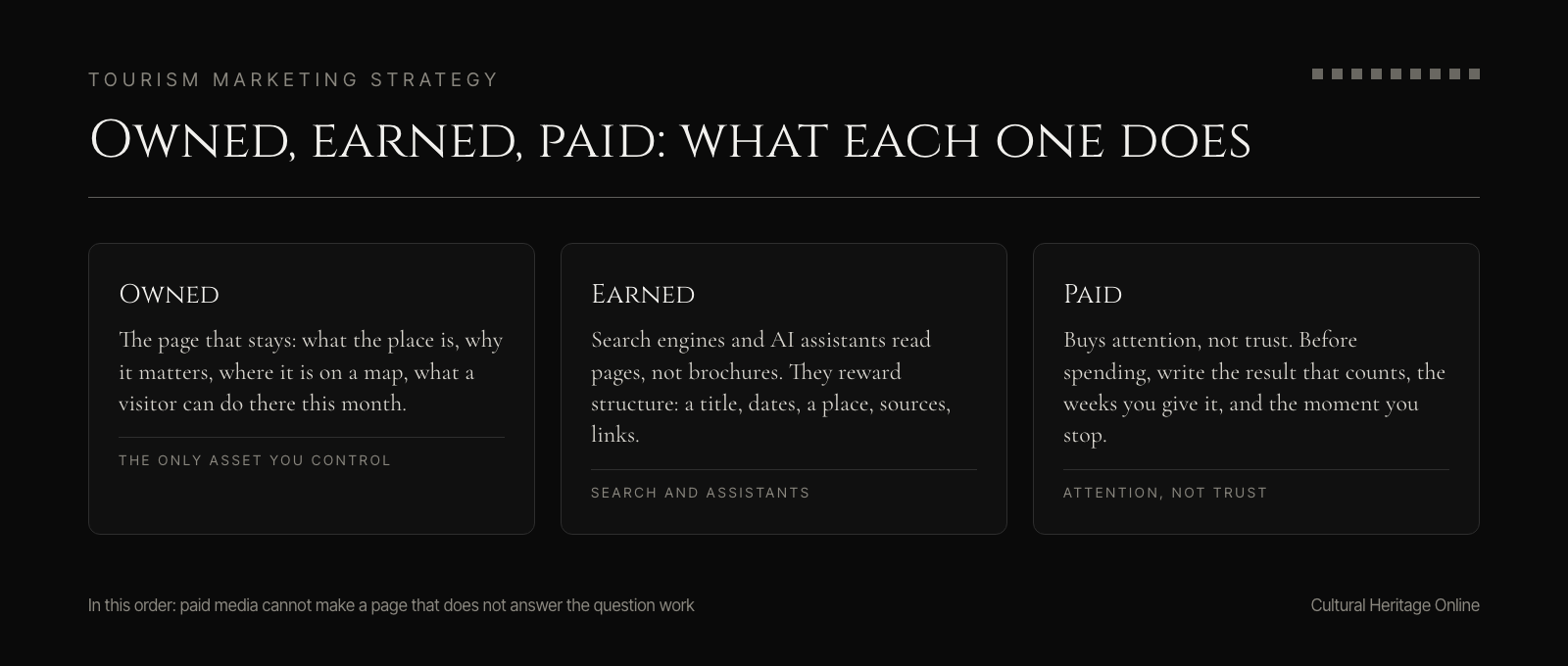
The only asset a venue controls is its own page. Not the social profile, not the listing on a platform that changes its rules, not the ad that stops when the budget stops: the page on a site that answers the question and stays online.
A good page for a heritage venue has four elements: what the place is, why it matters, where it is on a map, and what a visitor can do there this month. A page with those four elements can be linked, indexed, cited and remembered.
3. Earned: search, and the assistants
Search engines and AI assistants both read pages. They do not read brochures. They reward structure: a title that says what the page is, dates, a place, sources, links to related pages.
The practical consequence is unglamorous: a venue that publishes a documented page with a route around it is more likely to be cited than one that publishes the same paragraph on five social channels.
4. Paid: what it can and cannot do
Paid media buys attention, not trust. It can put a page in front of people who are already searching for something similar; it cannot make a page that does not answer the question work.
Before spending, write three things: the result that counts (a booking, a request, a visit to the page), the number of weeks you give it, and the moment you stop. A campaign without a written criterion is a subscription to clicks. A written criterion also protects you from the dashboard: it says what was promised and what was delivered, and it decides the renewal before the invoice arrives.
5. The calendar
Tourism is planned in the low season and sold in the high one. The page, the route and the programme should be ready when people are planning — typically in the months before the trip, not during it.
A simple calendar: write the page in the quiet month, publish it, link it from the site and the listings, and only then consider paid media for the weeks before the season.
6. What the partner programme adds
For a historic venue, the missing piece is usually context: the place around the building, the route that connects it, the story that makes it worth a detour. The partner programme builds that: a place-card, a route, an editorial feature, and the links between them, inside an archive of 16,968 places and 6,341 cities (figures measured on 22 October 2026).
See what the partner programme builds around a historic venue: /founding-partner/