The Major Mining Sites of Wallonia are four 19th-century coal mining complexes in southern Belgium — Grand-Hornu, Bois-du-Luc, Bois du Cazier, and Blegny-Mine — inscribed as a UNESCO World Heritage Site in 2012 for their significance as documents of the first industrial revolution on the European continent. The Bois du Cazier in Marcinelle, Charleroi, is also the site of the worst mining disaster in Belgian history: a fire on 8 August 1956 that killed 262 men from thirteen countries, 136 of them Italian.
The Model City That Preceded the Welfare State Grand-Hornu, 15 km west of Charleroi
Belgium was the first country on the European continent to industrialise after Britain, and the Sambre-Meuse valley in Wallonia was the site of that transformation. The coal seams running beneath the valley had been exploited since the Middle Ages using shallow bell-pit methods, but it was the application of James Watt’s steam engine to mine drainage — beginning in the 1810s — that allowed the systematic exploitation of deep seams and the creation of industrial-scale collieries. The four sites designated as UNESCO World Heritage in 2012 document four distinct phases of this process, from its inception at Grand-Hornu in 1810 to its conclusion at Blegny-Mine in 1980.
Grand-Hornu, located near Saint-Ghislain in Hainaut province, was built between 1810 and 1832 by the French entrepreneur Henri de Gorge, who had purchased the coal concession in 1810 and proceeded to develop it according to a vision that was simultaneously industrial and social. De Gorge designed not simply a mine but an entire planned settlement: 450 workers’ dwellings arranged in curved terraces around an elliptical central square, accompanied by a school, a hospital, baths, and a meeting hall. The colliery buildings — engine houses, workshops, administration — were designed in a coherent neo-classical idiom, with rounded arches, pilasters, and pediments applied to industrial structures in brick and stone. The ensemble was one of the first examples in Europe of what the 20th century would call a “company town”: a self-contained settlement in which an industrial employer provided housing, education, healthcare, and social infrastructure as components of the same investment as the mine itself.
De Gorge’s motivations were not purely philanthropic. A stable, housed, and physically maintained workforce was more productive and less likely to strike or migrate than a workforce dependent on existing village housing and public amenities. The model was rational as well as paternalistic. Nevertheless, Grand-Hornu anticipated many of the provisions that would not become statutory across European nations until the early 20th century — workers’ compensation, employer-provided healthcare, children’s education. The garden city movement of the 1890s and early 1900s, which produced planned settlements including Bourneville in England and the Cité Jardin in Brussels, drew explicitly on earlier industrial company towns of which Grand-Hornu was an early example.
Grand-Hornu ceased coal extraction in 1954 and fell into dereliction before restoration began in the 1970s. Today the complex houses the MAC’s (Musée des Arts contemporains de la Fédération Wallonie-Bruxelles), a museum of contemporary art installed within the original colliery buildings. The workers’ housing terraces are still occupied as private residences. The neo-classical elliptical square at the centre of the ensemble is the best-preserved example of 19th-century industrial urbanism in Belgium and one of the most coherent surviving examples in Europe.
Bois-du-Luc, located near La Louvière, has origins as a coal extraction concession dating to the 17th century, predating the Industrial Revolution. Its 19th-century development produced a workers’ housing colony — a cité ouvrière — that survives substantially intact, with approximately 300 dwellings arranged in a grid plan with a central church, school, and cooperative store. It is the oldest surviving mining site of the four UNESCO complexes in terms of continuous extraction history, and its housing colony documents the evolution of worker housing from pre-industrial conditions through 19th-century industrial paternalism.
Marcinelle, 1956: The Disaster That Changed European Immigration Bois du Cazier, Marcinelle, Charleroi
At 8:10 in the morning of 8 August 1956, a cage carrying miners from the surface of the Bois du Cazier colliery in Marcinelle, a suburb of Charleroi, snagged a projecting iron beam at shaft level. The impact ruptured oil and electrical lines. The oil ignited. The fire spread into the ventilation shafts that supplied air to the underground workings, and within minutes the smoke and carbon monoxide reached the working levels 975 metres below the surface. Of the 274 miners underground at the moment of the fire, 262 died. The last survivor was brought to the surface alive on 8 August. The last bodies were recovered on 23 August, sixteen days after the fire began.
The nationality breakdown of the dead defined the disaster’s political significance. One hundred and thirty-six of the 262 were Italian nationals — migrant workers who had come to Belgium under a 1946 bilateral agreement between the Belgian and Italian governments. Under that agreement, Italy supplied workers to the Belgian coal industry in exchange for coal delivered to Italy at preferential prices. The Italian workers, many of them from the impoverished villages of the Abruzzi, Calabria, and Veneto, were assigned to the most difficult and dangerous underground work. When the news of the Marcinelle disaster reached Italy, the Italian government suspended the 1946 agreement and refused to send further workers until Belgian mine safety standards were audited and overhauled.
The disaster had direct consequences for European labour law and safety regulation. A Belgian parliamentary inquiry identified multiple systemic failures: the cage guidance system that caused the initial impact, the absence of fireproof lining in the shaft’s electrical conduit, and the inadequacy of carbon monoxide detection equipment at working levels. Belgium revised its mining safety legislation within two years. The European Coal and Steel Community (ECSC) — the institution that would become, by stages, the European Union — convened an emergency conference on mine safety in 1957. The resulting Luxembourg Declaration on Mine Safety established common minimum standards across ECSC member states: Belgium, France, West Germany, Italy, Luxembourg, and the Netherlands.
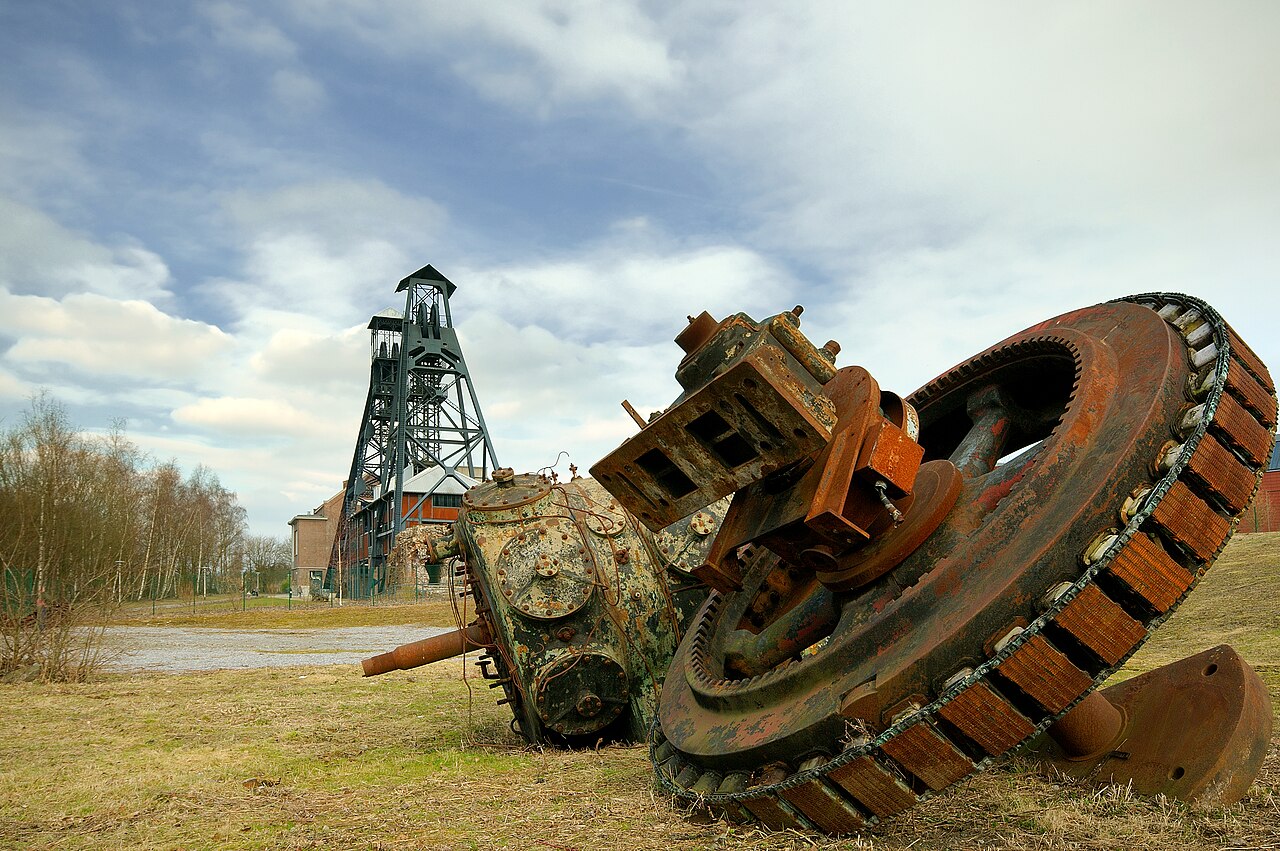
The Bois du Cazier ceased extraction in 1967 and is now a memorial museum and industrial heritage site. The mine headframes — the steel lattice towers that carried the cage winding mechanism — survive intact above both shafts. The surface machinery, including the steam winding engines and the lamp room where miners collected their safety lamps before each shift, is preserved in working condition. The memorial room, opened on the 50th anniversary of the disaster in 2006, documents each of the 262 victims by name, nationality, age, and family status. The youngest victim was 17 years old.
Blegny-Mine, the fourth site, near Liège, closed in 1980 as the last operating colliery in the Walloon coalfield. It now operates as a mine tourism attraction with underground visits by tourist train to working levels 60 and 30 metres below the surface — a different experience from Spiennes (where the shaft descent is brief) in that visitors travel through active mining galleries and see working equipment in its original operational context.
Practical information
The four sites of the Major Mining Sites of Wallonia are spread across a 60-kilometre east-west corridor in Hainaut and Liège provinces. All four are open to visitors; opening hours and admission prices vary by site and season.
Bois du Cazier (Marcinelle, Charleroi): open Tuesday to Sunday, 10:00 to 17:00. Adult admission €10; children €5. Underground visits are not available; the visit covers the surface installations and memorial museum. By public transport: train to Charleroi-Sud, then bus 71 towards Marcinelle; the colliery is clearly signposted at Rue du Cazier 80, 6001 Marcinelle.
Grand-Hornu (MAC’s museum): open Tuesday to Sunday, 10:00 to 18:00. Adult admission €8 for the site; additional admission for MAC’s exhibitions. By public transport: train to Mons or Saint-Ghislain, then bus towards Hornu; the site is at Rue Saint-Louise 82, 7301 Hornu, approximately 8 kilometres northwest of Mons.
Blegny-Mine: open daily April to October for underground tours; weekends only November to March. Tours depart at set times and last approximately 1.5 hours. Adult admission €15; children €10. By public transport: bus from Liège-Guillemins station towards Blegny. Address: Rue Lambert Marlet 23, 4671 Blegny.
Bois-du-Luc (Houdeng-Aimeries, La Louvière): the workers’ housing colony and colliery buildings are accessible for self-guided exterior visits at all times; interior visits by guided tour, bookable in advance at the Ecomusée régional du Centre. The Neolithic Flint Mines at Spiennes are 15 kilometres southwest of Charleroi by car.
Frequently Asked Questions
Why did so many Italian workers come to Belgium’s coal mines after World War II?
The 1946 agreement between Belgium and Italy was a direct response to the postwar economic situation in both countries. Belgium had extensive coal reserves in the Sambre-Meuse and Campine coalfields but lacked sufficient mine workers — many Belgian miners had died in the war, and the postwar generation was reluctant to enter mining. Italy had a large pool of unemployed workers, particularly in the rural south and northeast, and urgently needed the coal that Belgium could supply: Italy was rebuilding its industry with almost no domestic coal production. The terms of the agreement were transactional: Italy supplied 50,000 workers to the Belgian coal industry, and Belgium delivered 200 kilograms of coal per worker per day to Italy at favourable prices. Belgian mines provided accommodation in dormitories adjacent to the collieries. Italian workers were typically assigned to underground work because they were willing to accept conditions that Belgian workers had negotiated away through union action. The Marcinelle disaster of 1956 exposed the vulnerability of this arrangement: Italian migrant workers, housed in company accommodation with no independent social support, bore a disproportionate share of the industry’s most dangerous work and were the majority of the casualties when the worst accident in Belgian mining history occurred. The subsequent suspension of the agreement by Italy forced Belgium to improve safety standards that had remained inadequate as long as the supply of replacement workers was guaranteed.
What is the European significance of the Belgian Industrial Revolution?
Belgium industrialised before France, Germany, or any other continental European nation, and did so in the decade between 1815 and 1825, immediately after the Napoleonic Wars. The primary reason was access to British technology. Belgium had been part of the Austrian Netherlands and then, briefly, of Napoleonic France — but its proximity to Britain and its tradition of textile and glass manufacturing meant that Belgian entrepreneurs and engineers were among the first on the continent to acquire Watt steam engines, to hire British mechanics who knew how to operate them, and to apply them to both pumping water from deep coal mines and powering textile machinery. The Cockerill family, British industrialists who established a machine works at Liège in 1817, were the principal conduit for British technology transfer to the continent. By 1830 — the year Belgian independence was established — the Walloon coalfield was producing coal at an industrial scale that France would not match until the 1840s and that Germany would not exceed until after unification in 1871. The Belgian Industrial Revolution supplied coal to France and iron to the Netherlands and northern Germany during the critical decades of the 1820s and 1830s, making Belgian industrial production a precondition for northern European industrialisation as a whole. The UNESCO inscription of 2012 specifically cites this priority as the principal criterion for designation.
Can visitors go underground at the Major Mining Sites of Wallonia?
Underground visits are available at one of the four UNESCO sites: Blegny-Mine, near Liège. At Blegny, visitors travel by tourist train through former working galleries at depths of 30 and 60 metres, accompanied by a guide. The visit lasts approximately 90 minutes and covers the extraction galleries, the underground locomotive sheds, and the pump stations. Advance booking is strongly recommended, particularly in summer. The minimum age for underground visits is typically 5 years; children under 12 must be accompanied by an adult. At the Bois du Cazier, Grand-Hornu, and Bois-du-Luc, visits are surface-only. The Bois du Cazier’s surface visit is the most emotionally significant of the four: the winding headframes, the lamp room, the cage mechanism that failed on 8 August 1956, and the memorial museum documenting the 262 victims are all accessible. For a genuine underground experience in the Wallonia region, the Spiennes ArchéoSite — 15 kilometres southwest of Charleroi — offers a descent into one of the Neolithic flint mine shafts, dating to approximately 4,000 BCE: a very different kind of underground visit, but one that places the 19th-century coal industry in a 6,000-year geological and human context.
Sources
- S1 — Forti, Alain, and Christian Joosten. Celles du Bois du Cazier. Luc Pire, 2006. ISBN 978-2-87415-608-3.
- S2 — Puissant, Jean. L'évolution du mouvement ouvrier dans le bassin d'un charbonnage borain. Éditions de l'Université de Bruxelles, 1982. ISBN 978-2-8004-0774-6.
Spotted an error? Write to editorial@culturalheritageonline.com and we correct it the same day.