
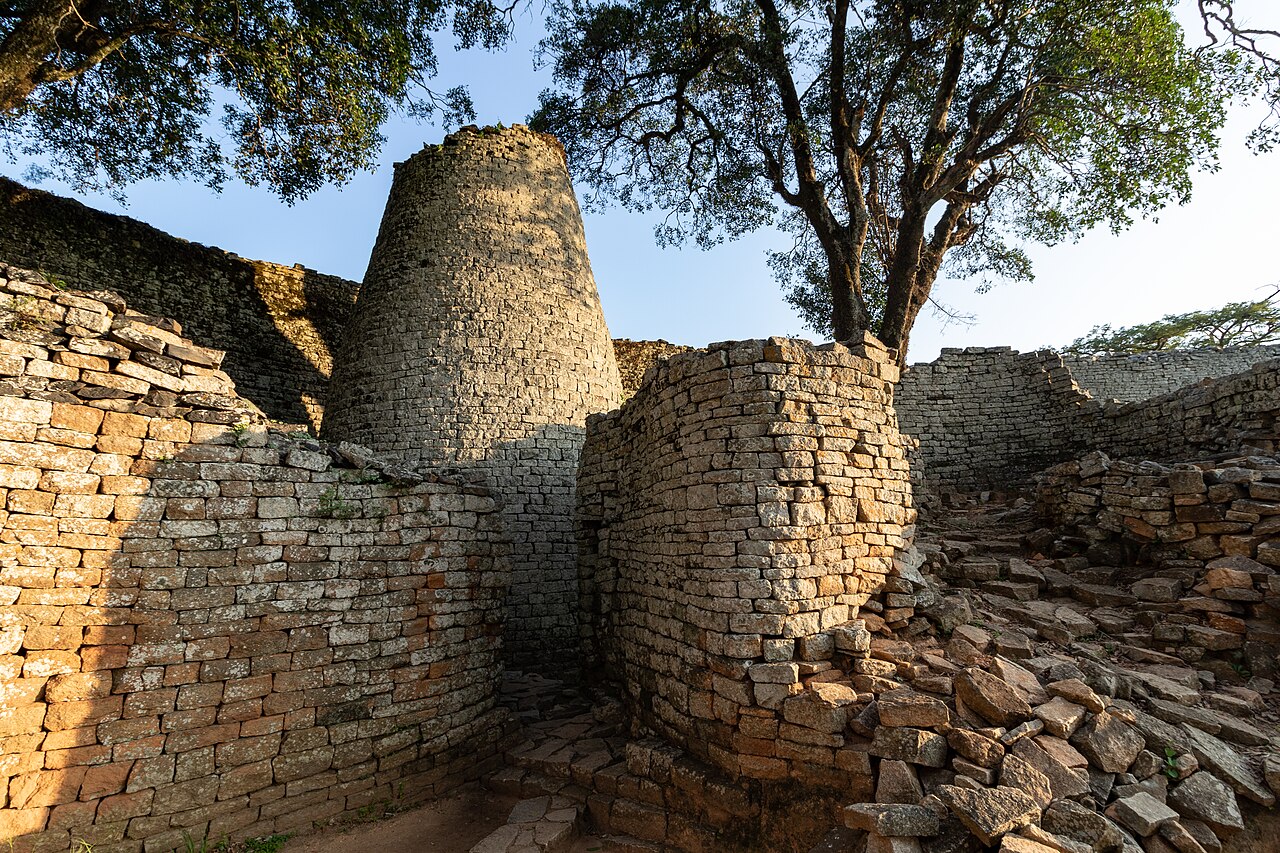
Great Zimbabwe, in Masvingo Province in southern Zimbabwe, is the largest ancient stone ruin in sub-Saharan Africa and the remains of a city that held between 10,000 and 18,000 people at its peak occupation between 1100 and 1450 CE. Built by the ancestors of the Shona people using a dry-stone technique requiring no mortar and no iron tools on the stonework itself, it has been a UNESCO World Heritage Site since 1986. Colonial authorities spent the better part of a century denying its African origins — a suppression that continued until Zimbabwe’s independence in 1980.
A city of granite: construction, trade and the Conical Tower Masvingo Province, Zimbabwe
The name Zimbabwe derives from the Shona phrase dzimba dza mabwe, meaning “houses of stone,” and nothing at the site is more immediately striking than the walls. The builders did not import material: the entire complex is constructed from granite split from the kopje — the rocky granite hill — on which the oldest section of the city sits. The technique, sometimes called dhaka in Shona, exploited the natural tendency of granite to crack along horizontal planes when fires were lit against the rock face and then rapidly cooled with water. The resulting slabs were shaped and laid in regular, interlocking courses with a precision that has kept many sections standing for six centuries without a gram of mortar between them.
The site divides into three main areas. The Hill Complex is the oldest, with occupation evidence from around 900 CE; it sits on a granite outcrop some 80 metres above the valley floor and served a ceremonial function, housing the religious and political leadership of the kingdom. The Valley Ruins form a more dispersed residential and working zone where the broader population lived. The Great Enclosure, built and extended primarily between the 13th and 14th centuries, is the structure that commands most attention: its outer wall runs 250 metres in circumference, stands up to 11 metres high, and is in places 5 metres thick. It is the largest single prehistoric structure in sub-Saharan Africa.
Inside the Great Enclosure stands the Conical Tower, one of the more tantalising puzzles in African archaeology. It is 9 metres high, 5 metres in diameter at the base, and entirely solid — no interior chamber, no doorway, no staircase. Built around 1350 CE, its purpose remains unknown. Theories range from a phallic fertility symbol to a representation of a royal grain store — embodying the ruler’s obligation to provision his people — to an astronomical marker aligned with the rising of the Pleiades, which in Shona agricultural tradition signals the planting season. No single theory has been conclusively established by the material evidence recovered so far.
What the archaeological record does establish clearly is that Great Zimbabwe was an economic centre of the first order. The kingdom controlled the gold trade between the Zimbabwe Plateau and the Indian Ocean coast. Gold moved eastward to the Swahili coastal port of Sofala in what is now central Mozambique, and from Sofala it was shipped by Arab and Swahili merchants onward to Arabia, India, and China. The site has yielded Chinese porcelain, Arabian glass beads, and Persian faience — goods that arrived as payment or exchange along the same networks that carried the gold outward. The associated Zhizo and Leopard’s Kopje cultural phases mark earlier stages of the region’s development before the Zimbabwe Culture reached its peak. Much of the material recovered is now displayed in the Great Zimbabwe Museum on site, making the museum an essential companion to the monument itself.
Colonial denial and the archaeology that reclaimed an African achievement Independence, 1980; UNESCO, 1986
When European explorers and prospectors reached Great Zimbabwe in the 1870s and 1880s, the site presented an immediate ideological problem for white Rhodesian colonial society. The scale and sophistication of the stonework contradicted the assumption, central to colonial ideology, that sub-Saharan Africans had not built complex urban civilisations. The response adopted by the colonial administration and a number of amateur archaeologists was to attribute the ruins to outside builders: the Phoenicians, the ancient Arabs, the Queen of Sheba, or the biblical land of Ophir. Theodore Bent, who excavated the site in 1891, concluded without credible evidence that the builders were Arabian or Semitic. The Rhodesian administration institutionalised this position, and official guides told visitors that Africans had not built what they were looking at.
The professional case for African authorship was made definitively by the archaeologist Gertrude Caton-Thompson, who conducted a rigorous excavation in 1929. She examined the stratigraphy, the pottery sequences, and the building techniques, and published a clear conclusion: Great Zimbabwe was built by Bantu-speaking Africans, the ancestors of the Shona, with no involvement from outside civilisations. The political consequences were immediate. The Rhodesian establishment attacked and marginalised her findings; the report was effectively suppressed in official discourse for decades. Into the 1970s, the museum at the site still presented the non-African origin theories as credible alternatives.
Zimbabwe’s independence in 1980 changed the situation entirely. The new government renamed the country after the site — a deliberate act of historical reclamation — and reoriented the museum to present the correct African authorship of the monument. The UNESCO inscription in 1986 followed in the context of this reassertion. Today Great Zimbabwe is understood as it should be: as evidence of a sophisticated, economically connected, architecturally innovative urban civilisation that developed on the Zimbabwe Plateau in the medieval period, built by people whose descendants still inhabit the region.
The nearest UNESCO World Heritage Site is Matobo Hills, approximately 300 kilometres southwest of Great Zimbabwe. The Matobo Hills are a landscape of granite kopjes and caves containing some of the finest San rock art in southern Africa, alongside the grave of Cecil Rhodes — a juxtaposition that captures something of the region’s layered and contested history.
Practical information
Great Zimbabwe National Monument is located 26 kilometres south of Masvingo, Zimbabwe’s fifth-largest city, on a tarred road. The site is open daily; the museum opens at 08:00 and closes at 17:00. Admission fees for international visitors are payable in USD at the gate. The site covers roughly 7 square kilometres and takes three to four hours to explore thoroughly on foot. Flat-soled shoes with good grip are advisable, as many paths cross granite surfaces. The Hill Complex requires a climb that is manageable for most visitors but can be extremely hot between October and March; early morning visits are strongly recommended in summer. A site guide can be hired at the main entrance and adds considerably to the experience, particularly for the Hill Complex where the spatial organisation of ceremonial areas is not self-evident. The Great Zimbabwe Hotel sits within the monument boundary and is the most convenient accommodation option. Masvingo itself offers guesthouses and lodges at various price points. The standard approach from outside Zimbabwe is to fly to Harare (5 hours by road) or Bulawayo (2.5 hours by road), then connect by bus or hired vehicle to Masvingo.
Frequently Asked Questions
How long did it take to build Great Zimbabwe, and who organised the construction?
Construction at Great Zimbabwe was not a single project but an accumulation of building across several centuries. The Hill Complex shows evidence of use from around 900 CE, making it the oldest part of the site. The Great Enclosure, the most ambitious single structure, was built and extended primarily across the 13th and 14th centuries, with the Conical Tower constructed around 1350 CE. The Valley Ruins were occupied and built up across the entire period of the city’s flourishing, roughly 1100 to 1450 CE. Labour was organised by the ruling elite of the Zimbabwe Culture kingdom — the same political authority that controlled and taxed the gold trade. There is no evidence in the archaeological record of slave or coerced labour in the modern sense; the building is understood as the product of a hierarchical but internally cohesive society capable of mobilising large numbers of skilled workers over long periods. The kingdom declined from the mid-15th century onward, most likely due to a combination of environmental pressure from overgrazing and deforestation around the dense settlement, shifts in the gold trade routes, and the rise of competing political centres such as Khami and the Mutapa kingdom further north. The city was largely abandoned by 1450 CE, though Shona communities continued to inhabit the surrounding region.
What are the Zimbabwe Birds and where can they be seen today?
The most celebrated artefacts associated with Great Zimbabwe are the eight soapstone Zimbabwe Birds — carved figures of birds mounted on columns, found at the site during late-19th-century excavations. They are generally believed to represent the bateleur eagle, a bird of spiritual significance in Shona culture, and served as royal symbols linking the ruler to ancestral spirits and political legitimacy. Several were removed from the site during the colonial period; Cecil Rhodes acquired at least one, and others ended up in museums in South Africa and Germany. After independence, Zimbabwe pursued the return of these objects with varying success. One bird was returned from Germany in 2003; several others remain abroad. Representations or originals of the birds are now displayed in the Great Zimbabwe Museum on site, which also holds the Chinese porcelain, Arabian glass beads, and Persian faience recovered from the ruins — material that attests directly to the city’s role in the medieval Indian Ocean trade network. The museum was renovated in the 1990s and 2000s and provides essential contextual material for understanding what the stonework alone cannot show.
Is Great Zimbabwe safe to visit, and what is its current conservation status?
Great Zimbabwe is not on the UNESCO List of World Heritage in Danger and has not been placed on that list since its inscription in 1986. Zimbabwe overall requires standard travel precautions, and Masvingo is a functioning provincial city. The main conservation challenges at the monument are physical rather than security-related: the dry-stone walls are vulnerable to water infiltration between courses, root damage from vegetation, and erosion caused by visitor foot traffic on the most heavily used paths. The National Museums and Monuments of Zimbabwe, the body responsible for the site, has carried out consolidation work on sections of the Great Enclosure wall at various points, and UNESCO and international partners have provided technical and financial assistance periodically. Access to some areas of the Hill Complex is restricted or channelled through guided routes specifically to reduce pressure on the most sensitive structures. The visitor experience has improved significantly since independence as interpretive materials have been updated to reflect accurate historical scholarship, and a visit today presents the site as the achievement of African civilisation that it always was.
Sources
- S1 — Pikirayi, Innocent. The Zimbabwe Culture: Origins and Decline of Southern Zambezian States. AltaMira Press, 2001. ISBN 978-0-7591-0091-6.
- S2 — Garlake, Peter. Great Zimbabwe. Thames & Hudson, 1973. ISBN 978-0-500-39012-2.
Spotted an error? Write to editorial@culturalheritageonline.com and we correct it the same day.

.jpg)