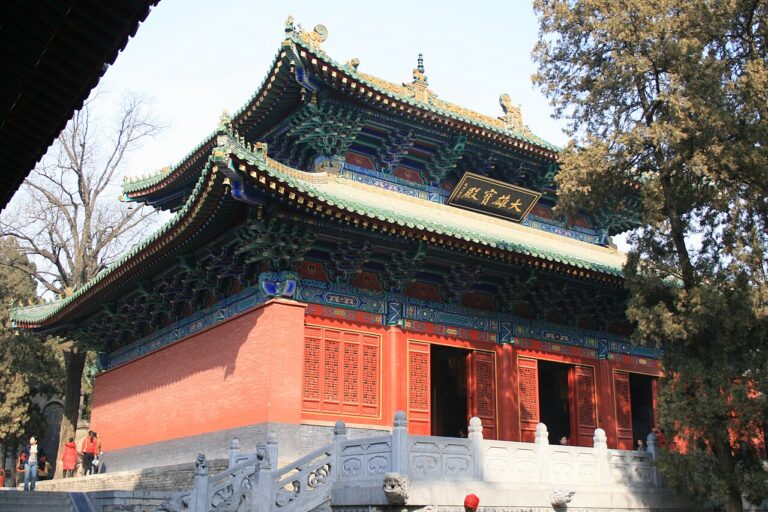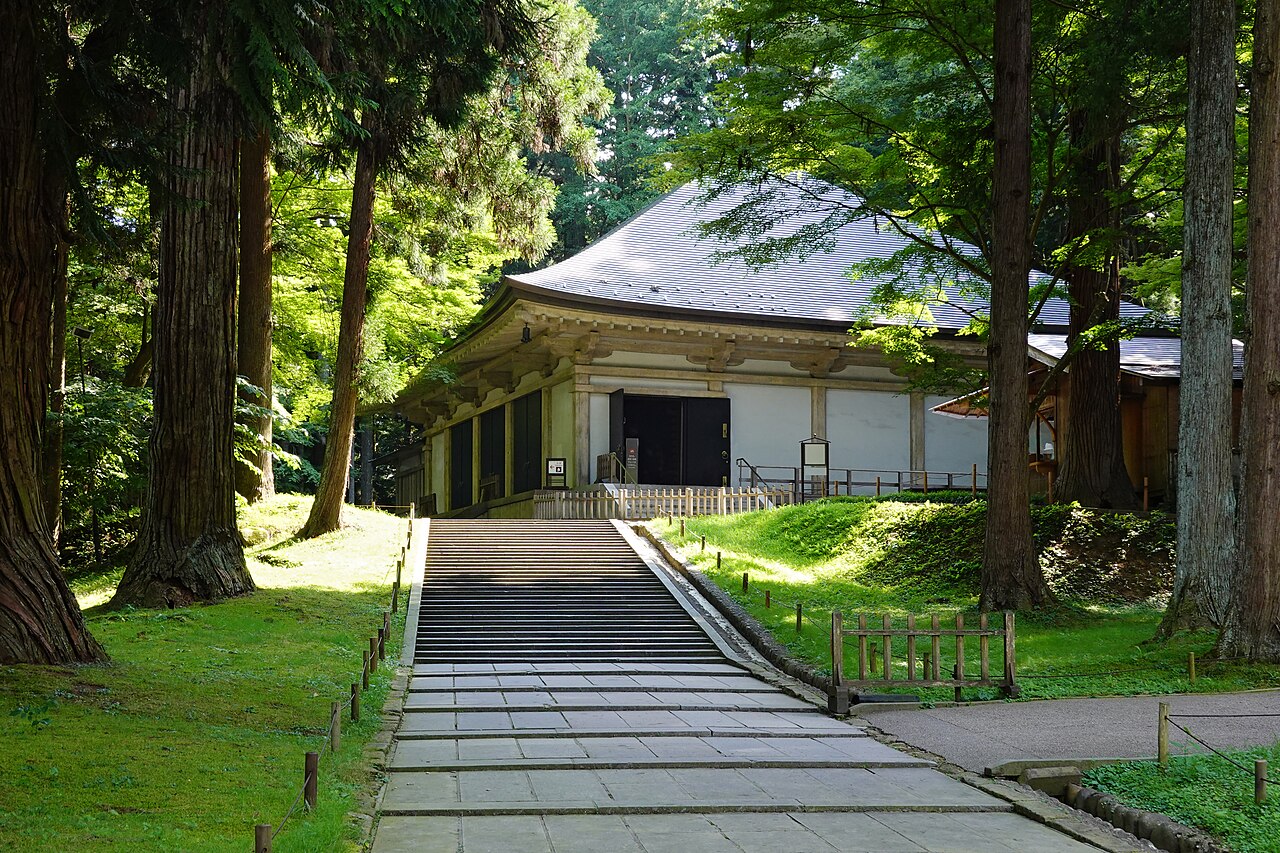
Hiraizumi, inscribed on the UNESCO World Heritage List in 2011, preserves the temples, gardens, and archaeological sites of a 12th-century Buddhist capital built by the Northern Fujiwara clan in Iwate Prefecture, Tōhoku region. At its peak in the early 1100s, this remote northern city rivalled Kyoto in cultural ambition, its lords channelling wealth from gold mines and horse trading into a physical recreation of the Buddhist Pure Land. The site’s centrepiece, the Konjikidō golden hall at Chūson-ji, has stood since 1124 and remains one of the most precisely preserved structures of the Heian period.
The Northern Fujiwara and their Buddhist utopia Chūson-ji / Hiraizumi town centre
The Fujiwara of Hiraizumi were unlike any other aristocratic clan in Japanese history. While the great court families competed for influence in Kyoto, the Fujiwara of the north — Kiyohira, Motohira, Hidehira, and briefly Yasuhira — controlled Tōhoku through two resources that the capital could not produce: gold from the rivers of Iwate and horses bred on the northern plains. With this wealth, Kiyohira (1056–1128) launched an extraordinary project: to build on the edge of the known world a city that would embody the Buddhist Western Paradise, the Pure Land of Amida Buddha, on earth. His motivation was partly spiritual and partly political — by establishing a centre of Buddhist learning and architecture comparable to Kyoto, he asserted legitimacy and autonomy from the distant imperial court.
The result, built over three generations across the first half of the 12th century, was a city of perhaps 100,000 inhabitants — an astonishing figure for northern Japan at the time — with dozens of temples, gardens designed to reproduce the cosmological map of the Pure Land, and a civic culture sophisticated enough to attract poets, craftsmen, and priests from the capital. Of this enormous undertaking, very little survives above ground: the Konjikidō and a handful of structures at Chūson-ji, the gardens and pond at Mōtsu-ji, and the archaeological traces of the broader urban plan now visible through excavation. The destruction came swiftly. In 1189, the Minamoto general Yoritomo — threatened by the fame of his half-brother Yoshitsune, who had taken refuge here — marched north with a vast army. Yasuhira, the fourth Fujiwara lord, was coerced into betraying Yoshitsune. The hero was killed at Takadachi hill overlooking the Kitakami River. Within months, Yoritomo destroyed the Fujiwara clan in any case, and Hiraizumi’s moment as a rival capital ended after barely a century.
The Konjikidō, completed in 1124 under Kiyohira’s direction, is what survived. A wooden hall measuring just 5.5 metres square, it is coated inside and out in urushi lacquer overlaid with gold leaf — the pillars, the altar fittings, the ceiling panels, the entire interior volume — and decorated with mother-of-pearl inlay and ebony ornaments of extraordinary fineness. Three altar platforms stand within the hall, and beneath each rests something uniquely preserved: the mummified remains of the three main Fujiwara lords (Kiyohira, Motohira, and Hidehira). The fourth lord, Yasuhira, is represented only by his severed head, sent south to Yoritomo as a token of submission that did not save him. Today the Konjikidō is housed inside a climate-controlled concrete protective building and viewed through glass — a necessary compromise that preserves its condition against the northern humidity.
Matsuo Bashō, Yoshitsune, and the weight of history Takadachi hill / Mōtsu-ji temple
No visit to Hiraizumi is complete without understanding the dual layer of meaning the site carries in Japanese literary and popular culture. The haiku master Matsuo Bashō arrived here in the fifth month of 1689, travelling the length of northern Honshū on foot and by horse, and recorded his journey in “Oku no Hosomichi” — “Narrow Road to the Deep North” — one of the most celebrated works in Japanese literature. When Bashō climbed Takadachi hill and looked out over the ruined capital, he composed what many consider his most moving poem: “Natsu-kusa ya / Tsuwamono-domo ga / Yume no ato” — “Summer grasses — / All that remains / of soldiers’ dreams.” The poem meditates not only on the destruction of the Fujiwara city but on Yoshitsune, who made his final stand on that hill five centuries before Bashō’s visit.
Minamoto no Yoshitsune is one of the great tragic figures of Japanese history. A brilliant military commander, he led his half-brother Yoritomo’s forces to victory in the Genpei War (1180–1185) that established samurai rule in Japan. Yet his very fame made him a threat. Suspected of seeking independent power, he was driven from the capital and eventually took refuge in Hiraizumi under the protection of Hidehira. When Hidehira died in 1187, his son Yasuhira, under intense military pressure from Yoritomo, sent troops to surround Yoshitsune’s residence at Takadachi. Yoshitsune killed his family and then himself. He was 30 years old. The drama of his life — the loyal servant betrayed by the brother he served — became the archetype of the Japanese aesthetic of tragic heroism, still invoked in literature, film, and popular culture today.
A short walk from Chūson-ji, the Mōtsu-ji temple complex preserves the most complete Heian-period strolling garden surviving in Japan. The temple buildings are gone, but the pond and island layout — designed in the late 11th and early 12th centuries — directly reproduces the Pure Land cosmology: the glittering water represents the sea of paradise, the islands represent the lotus flowers on which souls are reborn, and the surrounding hills reproduce the mountains at the edge of the Buddhist universe. In May, the garden’s 300 irises bloom along the pond margins, and every year a courtly Heian-period festival (Gojōen Matsuri) recreates 12th-century aristocratic culture on the grounds.
Practical information
Hiraizumi is approximately 500 km north of Tokyo. The fastest access is by Shinkansen on the Tohoku Line to Ichinoseki Station (approximately 2 hours 30 minutes from Tokyo), then a 10-minute local train ride on the JR Ōfunato Line to Hiraizumi Station. Buses connect the station to the main sites. Chūson-ji is a 20-minute walk or 5-minute bus ride from the station; Mōtsu-ji is a 10-minute walk. A rental bicycle from near the station is a practical way to cover all sites in a single day.
Chūson-ji is open daily from 08:30 (closing times vary by season: 17:00 in summer, 16:30 in winter). The site entrance fee includes access to the Konjikidō, the Sankozo treasure house, and the main temple precincts. Mōtsu-ji charges a separate entrance fee. The Takadachi hill viewpoint (Gikeidō) is free. The area experiences cold winters with snow from December to March; the most popular visiting periods are late April (cherry blossom on the temple approach) and late October–early November (autumn foliage). The entire UNESCO site can be explored in a full day; overnight stays are available in Ichinoseki (15 km south).
Frequently Asked Questions
What makes the Konjikidō different from other Japanese temple structures?
The Konjikidō is exceptional for several reasons that set it apart even among the exceptional buildings of the Heian period. First, its scale of gold decoration is without parallel: every internal surface — pillars, beams, altar fittings, the ceiling, the altar platforms themselves — is coated in urushi lacquer and gold leaf, with decorative inlay of mother-of-pearl (raden) and carved ebony ornaments. The effect is not the restrained elegance typical of Japanese aesthetic traditions but a deliberate maximalism designed to represent the blinding radiance of Amida Buddha’s paradise. Second, it contains human remains: the mummified bodies of Kiyohira, Motohira, and Hidehira lie beneath the three altar platforms, making the hall simultaneously a religious building, a dynastic mausoleum, and a statement of political power. Third, its survival across nine centuries is itself remarkable. The hall passed through the destruction of the Fujiwara clan, the upheavals of the Sengoku period, and the Meiji reorganisation of Buddhism, each of which eliminated countless comparable structures. The protective outer building installed in the 20th century, while architecturally incongruous, is precisely what has preserved the gold lacquer against humidity and light degradation. No other single structure encapsulates the ambition and the fate of the Northern Fujiwara as directly as this tiny golden room in the forest above Hiraizumi.
Can visitors access Hiraizumi as a day trip from Tokyo?
Yes, Hiraizumi is readily accessible as a day trip from Tokyo, though the day will be full. The fastest option is the Tohoku Shinkansen (Hayabusa or Hayate services) from Tokyo Station to Ichinoseki, which takes approximately 2 hours 20–30 minutes depending on the service. From Ichinoseki, the local JR Ōfunato Line train reaches Hiraizumi in around 10 minutes. With a morning departure (first Shinkansen around 06:30 from Tokyo), visitors can reach Hiraizumi by 09:00, giving approximately 6–7 hours on site before returning in time for a late-evening arrival in Tokyo. This is sufficient to visit Chūson-ji (including the Konjikidō and treasure house), Mōtsu-ji, and the Takadachi overlook, especially if a rental bicycle is used between sites. Visitors wishing to explore the Genbikei Gorge near Ichinoseki or the wider Kitakami River landscape typically find an overnight stay in Ichinoseki more comfortable. The Ichinoseki–Hiraizumi area also has traditional ryokan options for travellers who prefer to experience the northern Tōhoku countryside at a slower pace. The Japan Rail Pass covers all Shinkansen and local train legs of this journey.
What is the significance of “Oku no Hosomichi” and why did Bashō come to Hiraizumi?
Matsuo Bashō (1644–1694) is the central figure in the Japanese literary tradition of haiku, and “Oku no Hosomichi” (Narrow Road to the Deep North) is considered his masterwork in the haibun form — a blend of haiku verse and prose journal. Bashō departed Edo (Tokyo) in the spring of 1689 and travelled north through Tōhoku before crossing to the Japan Sea coast and returning south, covering roughly 2,400 kilometres over 150 days. The journey was explicitly conceived as a pilgrimage through literary and historical memory: Bashō sought out places associated with earlier poets and with the great events of Japanese history. Hiraizumi was the emotional climax of the journey. The ruined capital, the memory of Yoshitsune’s death, the summer grasses growing over the site of epic events — all of this concentrated for Bashō the Japanese aesthetic concept of “mono no aware,” the pathos of transience. His poem at Takadachi — “Summer grasses — / All that remains / of soldiers’ dreams” — is among the most quoted lines in the Japanese language. The text of “Oku no Hosomichi” is studied in Japanese secondary schools; the route Bashō travelled is itself a recognised cultural itinerary. Visiting Hiraizumi today thus involves reading the landscape through at least two centuries of accumulated literary meaning in addition to the archaeological and architectural heritage of the Fujiwara.
Sources
- S1 — Yiengpruksawan, Mimi Hall. Hiraizumi: Buddhist Art and Regional Politics in Twelfth-Century Japan. Harvard University Asia Center, 1998. ISBN 978-0-674-39205-2.
- S2 — Varley, H. Paul. Japanese Culture. University of Hawaii Press, 2000. ISBN 978-0-8248-2152-4.
Spotted an error? Write to editorial@culturalheritageonline.com and we correct it the same day.