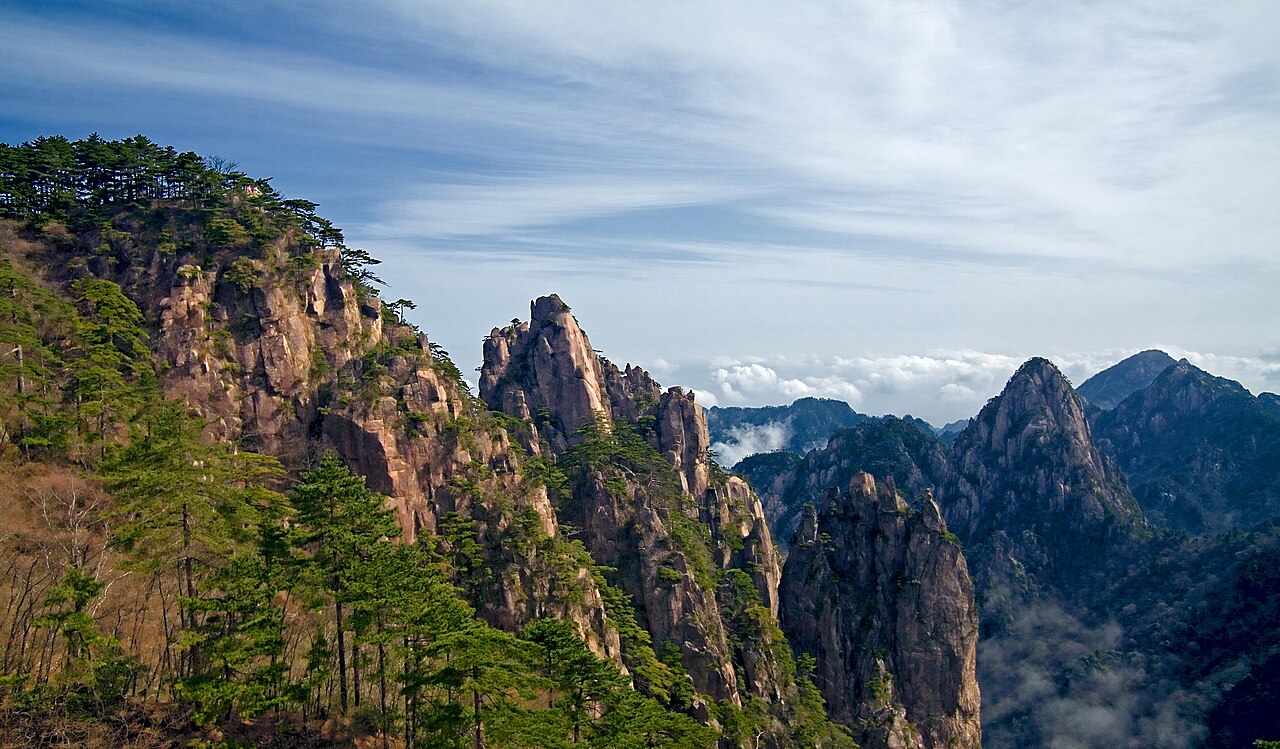
Mount Huangshan (Yellow Mountain), inscribed in 1990, is the most painted and photographed mountain in China — a granite massif in Anhui Province whose sea of clouds, ancient pine trees, grotesque rock formations, and winter ice sculptures have inspired Chinese landscape painting for 1,200 years and served as the prototype for the stylised peaks that characterise the shan shui (mountain-water) genre. The whitewashed Ming-Qing villages of Xidi and Hongcun, 60 km away, complete the Huizhou cultural landscape circuit.
Mount Huangshan: Four Wonders of Chinese Mountain Aesthetics Anhui Province, eastern China
Mount Huangshan, inscribed in 1990 under criteria (ii), (vii), and (x), encompasses the 154 square kilometres of the Yellow Mountain massif in southern Anhui Province — a granite landscape of 77 peaks (of which 72 are named), the three highest being Lotus Peak (Lian Hua Feng, 1,864 m), Bright Summit Peak (Guang Ming Ding, 1,840 m), and Celestial Capital Peak (Tian Du Feng, 1,829 m). Chinese aesthetic tradition attributes four wonders to Huangshan: the strange pines (qísong) that grow at impossible angles from bare rock faces; the bizarre rocks (guàishí), granite towers carved by differential weathering into columns, tortoises, and Buddha-silhouettes; the sea of clouds (yúnhǎi), the inversions that fill the valleys with white cloud while the peaks remain clear above; and the hot springs (wēnquán) at the mountain’s base that have been a bathing resort since the Tang dynasty. The poet Li Bai visited Huangshan in the eighth century; the Qing-dynasty painters Shi Tao and Hong Ren (Jiāng Tāo and Jiāng Tāo 2) developed the “Anhui School” of painting directly from the Huangshan landscape, making its misshapen pines and cloud-sea the central motif of the shan shui tradition that would influence East Asian art for three centuries.
Trail Network and the Ancient Guesthouses Western Steps, Eastern Steps, Northern entry
The mountain is threaded by approximately 80 km of paved stone trails and stairs (some historical paths date from the Tang dynasty, 618–907 CE) connecting the cable car stations, guesthouses, and peaks. Three main cable cars serve the mountain: the Yungu cable car (eastern approach), the Yuping cable car (western approach), and the Xihai Grand Canyon cable car (northern inner valley). The summit zone has four hotels built into the rock above 1,600 metres — including the Beihai Hotel (1958) and the Xihai Hotel (1991), all accessible only by cable car or hiking since no road exists above the treeline. Approximately 4 million visitors use the mountain annually; numbers are managed by ticket quotas that sell out days in advance during Golden Week (national holidays in October and May). The summit trail between Bright Summit and Lotus Peak passes the Mysterious Tree (a four-stemmed pine growing from bare rock at 1,700 metres, estimated 600 years old and the most frequently painted single tree in Chinese art).
Xidi and Hongcun: Huizhou Villages in a Painting 🚗 ~1 hr northwest to Yixian county
The Ancient Villages in Southern Anhui — Xidi and Hongcun, inscribed in 2000 under criteria (iii), (iv), and (v) — are the two best-preserved examples of Huizhou merchant village architecture, 60 km northwest of the Huangshan summit zone. Xidi (founded tenth century, current layout sixteenth–eighteenth century) is a village of 300 buildings — memorial arches (pailou), whitewashed houses with the distinctive Horse-Head Wall (mǎ tóu qiáng, high fire-resistant stepped gables), formal reception halls, and gardens built by salt merchants of the Ming and Qing dynasties who made fortunes in the Huaiyang salt trade and spent them building for home. Hongcun (founded twelfth century) was specifically designed around a water management system: the Nanhu Lake (man-made, 1607) and a network of channels that funnel water through the village courtyard by courtyard — each house has its own water channel (yuè zhǎo, moon pond) that feeds from the main canal, providing running water through every courtyard in the pre-piped era, and the whole village is best seen from above where the water channels form a pattern of veins through the whitewashed block. Hongcun was used as the location for many scenes in the 2000 film Crouching Tiger, Hidden Dragon, bringing international attention to Huizhou architecture.
Practical information
Huangshan (Yellow Mountain) is 400 km from Shanghai (4 hrs by high-speed train to Huangshan North station, then 40 min by bus to the mountain gate). From Beijing: high-speed train to Huangshan North takes 5.5 hours. Tickets must be booked online in advance on the official Huangshan Scenic Area website; daily quotas cap at 20,000 visitors (50,000 in peak season) and sell out during holidays. The recommended approach is to take a cable car up and hike down (or vice versa); a full circuit of the summit zone takes 6–8 hours. Overnight on the summit is strongly recommended to see the sunrise sea of clouds; book summit hotels weeks in advance. The best season is June–October for clear views (October has the most stable weather); winter (November–March) brings ice on the trees and fewer crowds but more closures. Xidi and Hongcun are 60 km from the mountain base; both villages have an entrance fee (approximately 104 CNY combined); the best light for photography is early morning (7–9 a.m.) before tour buses arrive.
Frequently Asked Questions
Is Mount Huangshan a UNESCO World Heritage Site?
Yes. Mount Huangshan was inscribed in 1990 under criteria (ii), (vii), and (x). The criteria reflect both its cultural significance (it has influenced Chinese painting, poetry, and aesthetics for over a millennium) and its natural values (unique geological formations, diverse mountain ecosystems, and dramatic cloud formations). It is one of China’s 57 UNESCO World Heritage Sites — the largest national portfolio after Italy (58 at the same date).
Why is Mount Huangshan so important to Chinese painting?
Chinese landscape painting (shan shui, “mountain-water”) is primarily a genre of ideal mountains — imaginary peaks that express philosophical ideals of remoteness, naturalness, and spiritual retreat. Huangshan became the preferred model for this imaginary mountain because its actual appearance — jagged granite peaks rising above clouds, with ancient pines clinging to bare rock — matches so precisely the painted ideal that Chinese landscape painters could claim to paint “from nature” while still producing highly formalised works. The Anhui School painters of the seventeenth century (Shi Tao, Hong Ren) specifically codified Huangshan’s distinctive forms — the pine’s horizontal branches, the cloud-sea inversion, the granite column — into brushstroke conventions (cun) that became the vocabulary of Chinese landscape painting through the eighteenth and nineteenth centuries and influenced Japanese and Korean landscape traditions as well.
What is a Huizhou Horse-Head Wall?
The Horse-Head Wall (mǎ tóu qiáng) is the defining architectural element of Huizhou village architecture: a high stepped gable wall that rises above the roofline in tiers, each tier slightly set back from the one below, so that the wall profile resembles a horse’s head and neck when seen from outside the building. The walls are white-plastered brick, built higher than the roofline for a specific reason: in the dense, courtyard-plan villages of the Huizhou region, fire could spread from house to house through the roof timbers; the Horse-Head Wall acts as a fire break, stopping the lateral spread of flames between terraced buildings. The combination of the white walls, dark tile roofs, and the stepped gable silhouette against misty hills is the defining visual character of the southern Anhui landscape.