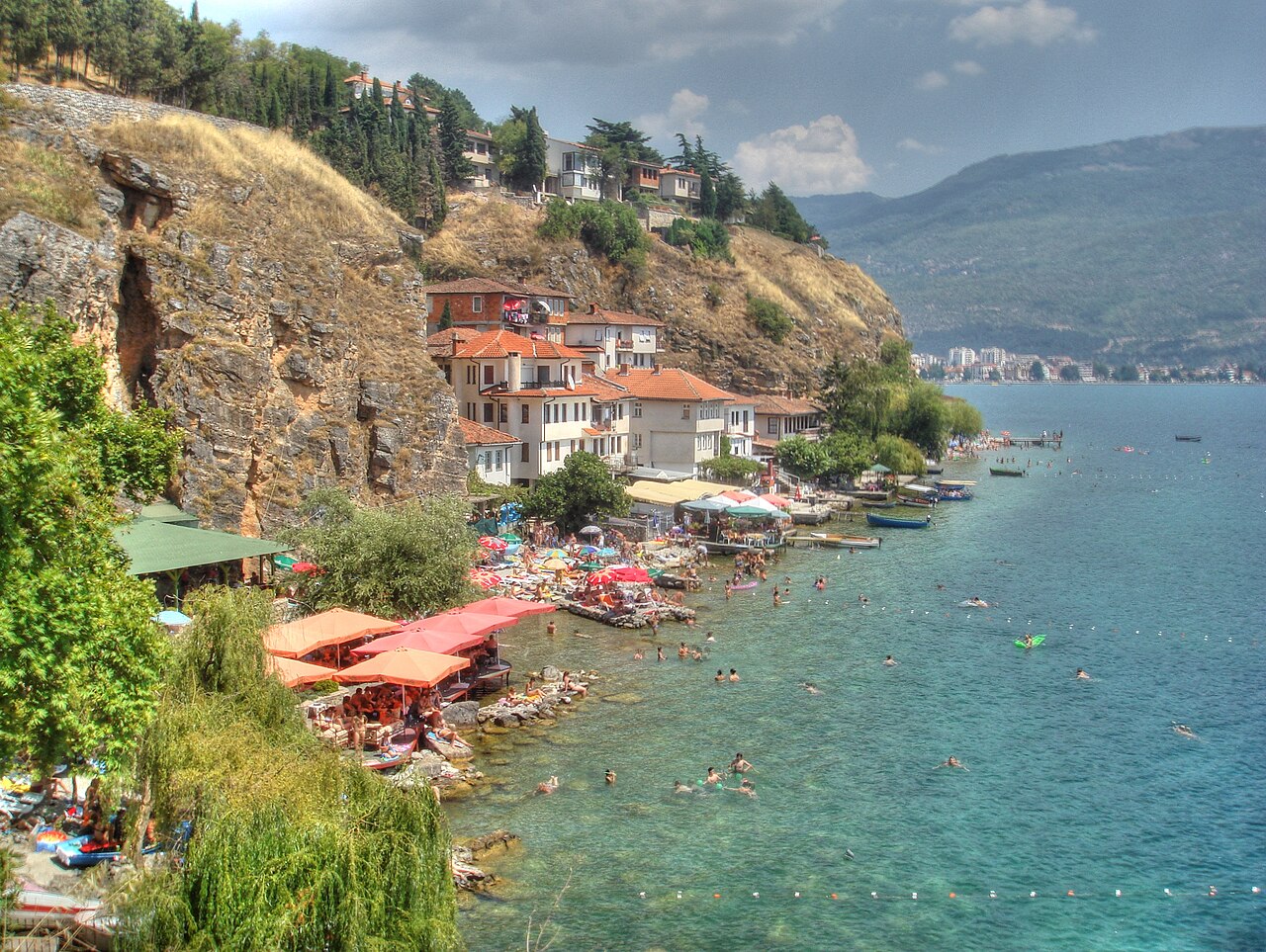
North Macedonia’s sole UNESCO World Heritage Site, the Natural and Cultural Heritage of the Ohrid Region, is a 170-kilometre journey southwest of Skopje — and one of the most layered inscriptions on the World Heritage List, combining one of Europe’s oldest and most biodiverse lakes with a medieval town whose written culture shaped the entire Slavic world. From Cultural Heritage Online.
Natural and Cultural Heritage of the Ohrid Region 170 km · 2.5 hr by road
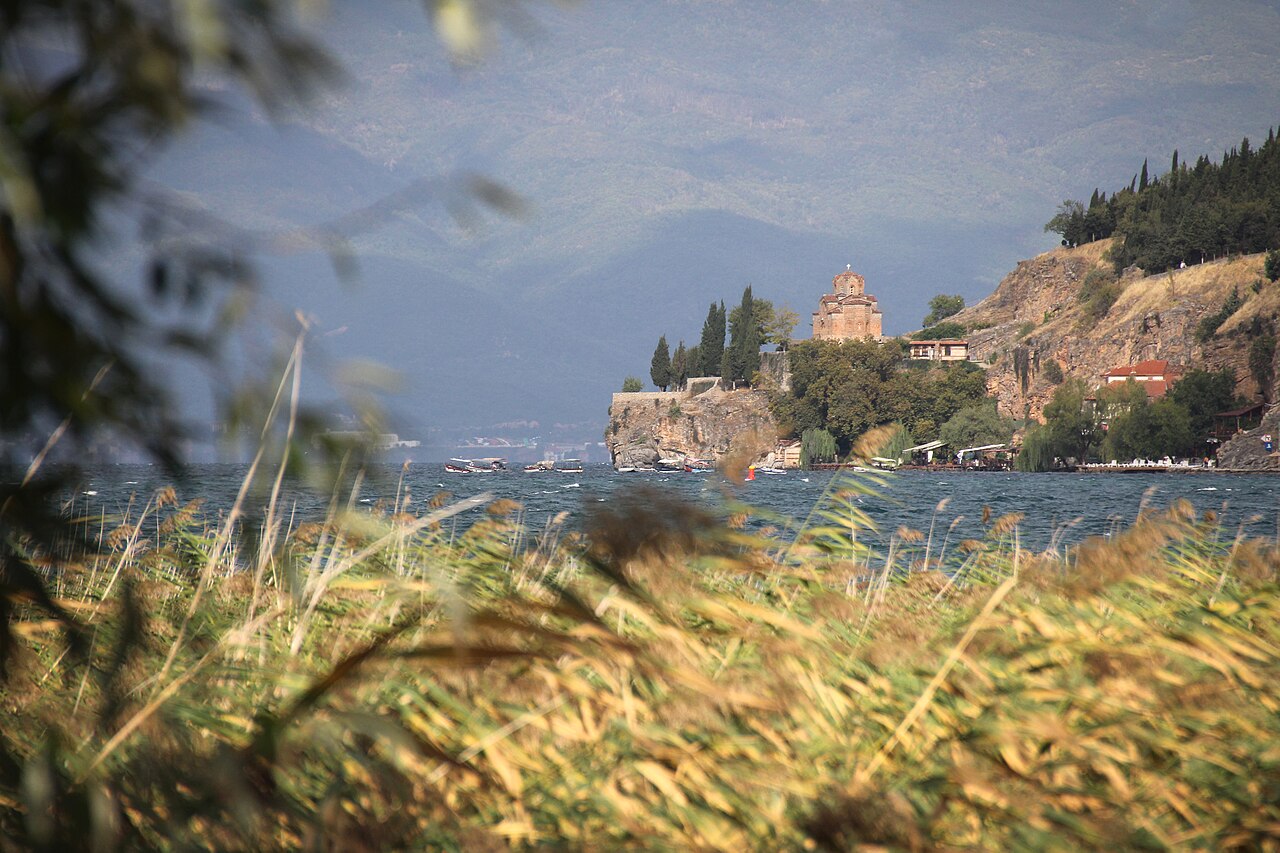
Lake Ohrid is among the oldest bodies of water on earth — approximately three million years old, formed in a tectonic depression and never subsequently drained or frozen over. That unbroken continuity produced an extraordinary biological legacy: around 200 endemic species inhabit the lake, including the Ohrid trout (Salmo letnica) and the Ohrid eel, creatures found nowhere else on the planet. The lake reaches a maximum depth of 288 metres and covers 358 square kilometres, split between North Macedonia and Albania. UNESCO inscribed the Ohrid region in 1979, extending the boundary in 1980 to encompass both its natural and cultural dimensions — a designation that covers the lake, its watershed, and the historic town on the western shore.
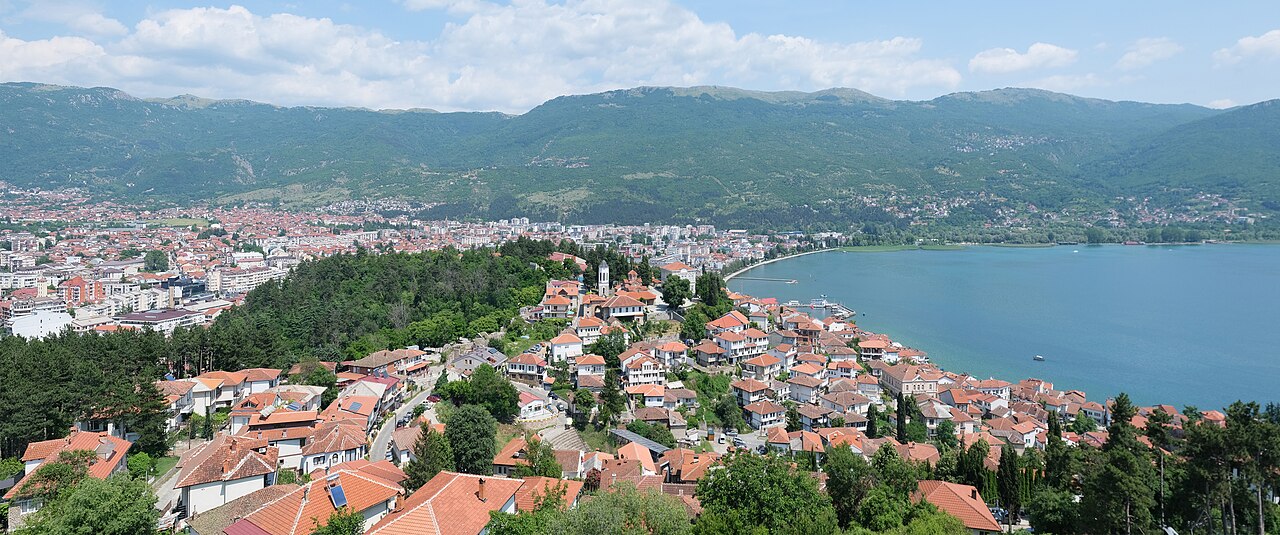
Ohrid’s human occupation stretches back at least to 2500 BC, making it one of the oldest continuously inhabited settlements in Europe. The town’s singular importance to world history, however, dates from the late ninth century, when Clement of Ohrid (840–916 AD) — a disciple of Saints Cyril and Methodius — established a school at the monastery of Saint Panteleimon and codified the Glagolitic and early Cyrillic scripts. The language he standardised became the liturgical and literary foundation for Orthodox Slavic cultures from Bulgaria to Russia. The late 10th century brought Tsar Samuel’s Bulgarian Empire to its height, with Ohrid as its capital from 990 to 1018 AD — a period that left the town’s defining skyline feature: a massive stone fortress whose walls still command the ridge above the lake.
The historic core clusters around the Kaneo promontory and the old bazaar district. On the waterfront cliff stands the 13th-century Church of Saint John at Kaneo, its austere stone exterior and red-tile cupola positioned over a sheer drop to the lake — the image that has defined visual representations of Ohrid for over a century. Uphill, the Church of Saint Sophia (mid-11th century) served as the cathedral of the Ohrid Archbishopric; its interior preserves an exceptional cycle of Byzantine frescoes from the same decade as those at Hagia Sophia in Constantinople. The monastery church of Saint Panteleimon, reconstructed on its late 9th-century footprint, marks the site where Clement taught the first generation of Slavic-literate clergy. Below the old town, the Ancient Theatre of Ohrid — a Hellenistic structure from the 3rd century BC, partly restored — is one of the best-surviving ancient performance spaces in the region and still hosts summer events. Above everything, the walls and towers of Samuel’s Fortress provide orientation to the entire site and broad views across the lake toward the Albanian mountains.
Getting there: From Skopje, drive the A3 motorway southwest via Tetovo and Kičevo to reach Ohrid in approximately 2.5 hours (170 km). Alternatively, domestic flights from Skopje’s Alexander the Great Airport to Ohrid’s St. Paul the Apostle Airport take roughly one hour and operate seasonally. Intercity buses depart Skopje’s main bus station regularly throughout the day. Allow: A minimum of two full days to cover the fortress, the major churches, the archaeological zone, and a boat excursion on the lake. Three days is more comfortable. Best for: Travellers interested in Byzantine art and architecture, early medieval history, lake ecology, or anyone seeking a UNESCO World Heritage destination with minimal crowds outside July and August.
Frequently Asked Questions
How many UNESCO World Heritage Sites are near Skopje?
North Macedonia has one UNESCO World Heritage Site in total: the Natural and Cultural Heritage of the Ohrid Region, inscribed in 1979 and extended in 1980. It lies 170 kilometres southwest of Skopje, reachable by road in approximately 2.5 hours or by domestic flight in about one hour. There are no UNESCO sites closer to the capital.
How long should I spend at the Ohrid UNESCO site?
Two full days covers the main heritage monuments — Samuel’s Fortress, the churches of Saint Sophia, Saint John at Kaneo, and Saint Panteleimon, and the Ancient Theatre — along with a walk through the old bazaar district. A third day allows time for a boat excursion on the lake, a visit to the National Museum of Ohrid in the Robevci House, or a drive to the Albanian side of the lake at Pogradec.
What is the best season to visit Ohrid?
May, June, and September offer the most practical combination of warm weather, open sites, and manageable visitor numbers. July and August are the busiest months, when lakeside accommodation fills early and the Ohrid Summer Festival brings international performers to the Ancient Theatre and the waterfront. Winter visits are quiet and the light on the lake is often exceptional, though a handful of smaller churches may be locked outside the season.
Why is the Ohrid inscription classified as both natural and cultural?
UNESCO applied a mixed criteria designation because the site satisfies outstanding universal value on both counts. On the natural side, Lake Ohrid’s age (approximately three million years), depth (288 metres), and high endemism — roughly 200 species found nowhere else, including the Ohrid trout and Ohrid eel — meet the criteria for biological and geological significance. On the cultural side, the town and its surrounding monasteries represent an exceptional concentration of early medieval Byzantine architecture and the location where the Cyrillic script was codified and disseminated to the Slavic world, meeting criteria for human creative achievement and the exchange of values.
Sources
- S1 — Grozdanov, Cvetan. Ohrid: Architectural and Cultural Heritage. Macedonian Academy of Sciences, 1990. ISBN 978-86-7244-012-6.
- S2 — Fine, John V. A. The Early Medieval Balkans. University of Michigan Press, 1983. ISBN 978-0-472-08149-3.
Spotted an error? Write to editorial@culturalheritageonline.com and we correct it the same day.