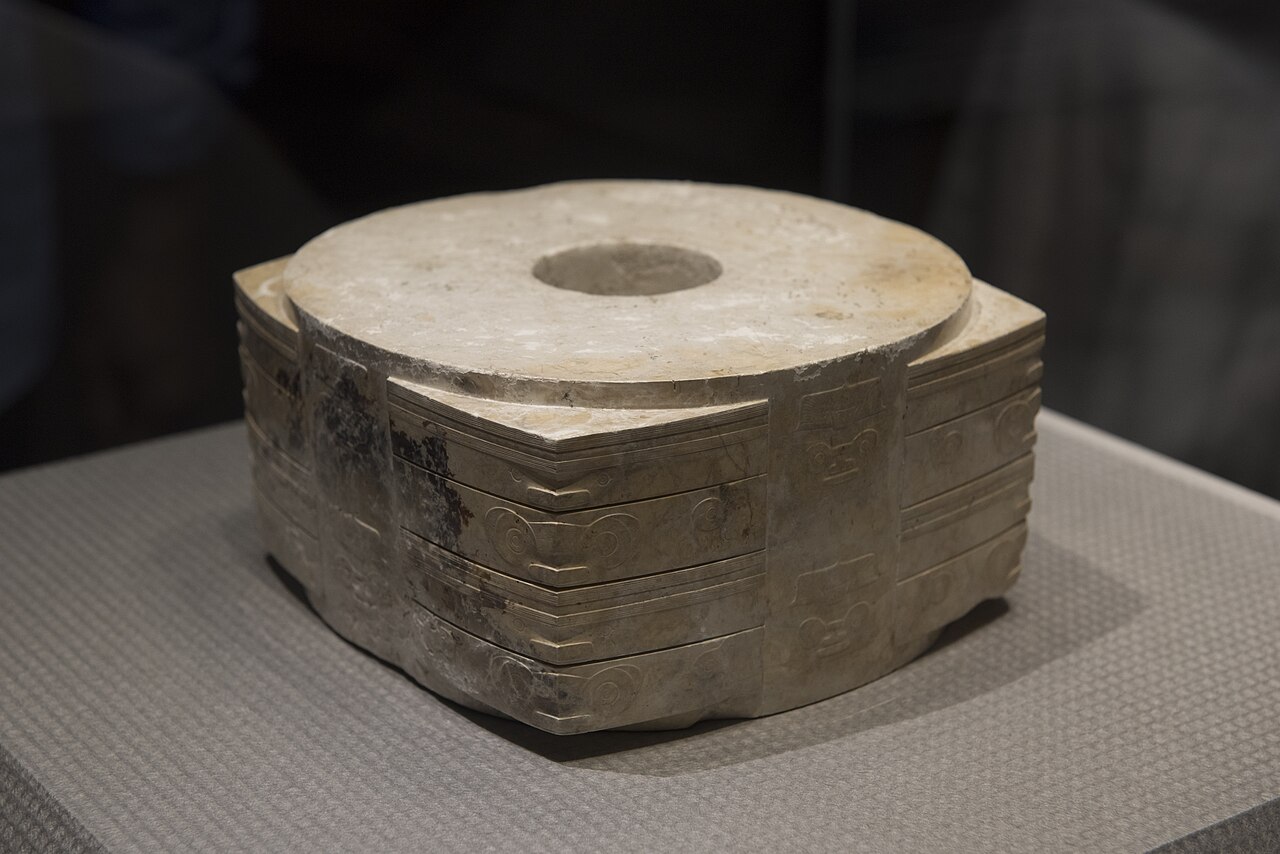
The Archaeological Ruins of Liangzhu City, inscribed by UNESCO in 2019, cover a 1,400-hectare zone of Neolithic urban archaeological remains in Yuhang District, northwest of Hangzhou City, Zhejiang Province — the material evidence of a complex urban civilisation that flourished from approximately 3300 to 2300 BCE on the Yangtze River Delta’s northern plain, 1,000 years before the Xia dynasty (China’s first officially recognised dynasty) and 1,300 years before the Shang dynasty’s oracle-bone writing system, demonstrating that urban-scale social complexity, monumental architecture, long-distance trade networks, and a shared ideological system expressed through ritual jade objects emerged in coastal eastern China approximately 1,000 years earlier than the Yellow River basin civilisations that conventional Chinese historiography identifies as the origin of Chinese civilisation. The inscription’s Outstanding Universal Value rests on three attributes of the Liangzhu site that are each without parallel in East Asian prehistory at this date: the city’s spatial organisation (a walled urban core of approximately 290 hectares surrounded by a suburban zone of functional districts, protected by a water-control system comprising 11 dams and reservoirs with a combined storage capacity of approximately 46.5 million cubic metres — the earliest large-scale flood-control engineering known in East Asia, predating the Yellow River control projects of China’s early dynasties by 1,000 years); the jade industry (a hierarchically organised jade production system that created approximately 5,000 years’ worth of typologically standardised ritual jade objects — jade cong, jade bi, jade yue axes, and jade huang — using workshops, trade networks, and craft specialisation that imply a level of social complexity and resource organisation unprecedented in this period); and the settlement pattern (the city’s planned layout, distinguishing between the walled palace mount, the workshop districts, residential zones, and agricultural areas in a spatial hierarchy that anticipates the urban planning principles of later Chinese Bronze Age cities by a millennium).
Hangzhou’s Neolithic urban legacy: from Liangzhu to West Lake and the Grand Canal West Lake Cultural Landscape Hangzhou · Grand Canal southern terminus · Suzhou Classical Gardens — 20 to 60 km
Twenty Kilometres south of the Liangzhu Archaeological Site by road (approximately 30 minutes from the Liangzhu Museum entrance to the West Lake Scenic Area via the G25 Expressway and urban Hangzhou), the West Lake Cultural Landscape of Hangzhou (inscribed 2011) represents the same Yangtze Delta cultural geography in a different historical register: while Liangzhu documents the emergence of urban complexity in the Hangzhou area 5,300 years ago, West Lake documents the mature expression of Chinese imperial garden culture 1,500 years ago — the same geographic location, producing completely different but historically continuous cultural landscapes. The Liangzhu-West Lake-Grand Canal circuit of Hangzhou’s UNESCO heritage represents 5,000 years of continuous civilisational significance in a single city: Liangzhu (3300–2300 BCE, Neolithic urban civilisation), West Lake (7th–19th century CE, classical garden landscape), and the Grand Canal’s southern terminus at the Gongchen Bridge (605–1793 CE, the imperial logistical infrastructure). From the Liangzhu Museum (the primary visitor facility at the inscription’s northwestern edge, approximately 25 km northwest of Hangzhou city centre), the West Lake scenic area is the most practical same-day combination: Liangzhu Museum (3–4 hours) → Hangzhou urban transit to the West Lake perimeter (approximately 45 minutes by bus or metro to Longjing tea village on the west side of West Lake) → West Lake circuit (2–3 hours walking or cycling along the Su Causeway). The Liangzhu Museum itself (designed by David Chipperfield Architects, opened 2018, 60,000 square metres of exhibition space on a 35-hectare site adjacent to the walled city remains) is the world’s most comprehensive single-site archaeological museum for a Neolithic jade-using culture, with over 5,000 objects on display and state-of-the-art stratigraphic presentation of the city’s urban structure.
Thirty-Five Kilometres north of the Liangzhu site by road and HSR (approximately 35 minutes from Hangzhou East to Suzhou Station on the Shanghai-Hangzhou HSR), Suzhou’s Classical Gardens (inscribed 1997/2000) are the most practically accessible companion sites for international visitors who use Hangzhou as a base. The cultural connection between Liangzhu and Suzhou is the Yangtze Delta’s continuous significance as a centre of Chinese cultural and economic production from the Neolithic through the present: Liangzhu represents the Yangtze Delta’s earliest phase of urban complexity; Suzhou’s classical gardens represent its mature aesthetic expression in the Song-Ming period. From Hangzhou, Suzhou is an easy HSR day trip (approximately 35 minutes) or overnight stop; the Suzhou Classical Gardens circuit (Humble Administrator’s Garden, Lingering Garden, Lion Grove Garden, Master of the Nets Garden) can be completed in a single full day with approximately 2–3 hours at each major garden. The Grand Canal’s Suzhou section (the Panmen Gate water-and-land gate complex and the adjacent Ruiguang Pagoda at the canal entrance to Suzhou) provides the link between the two UNESCO inscriptions — the canal bank walk from Panmen Gate northeast along the outer moat connects the canal heritage to the classical garden heritage within the same 2-kilometre walking circuit.
The Liangzhu jade world: from Hangzhou to the Yangtze Delta archaeological landscape Shanghai · Ningbo · Zhangjiajie — 150 to 800 km
One Hundred and Fifty Kilometres north of Hangzhou by HSR (approximately 50 minutes from Hangzhou East to Shanghai Hongqiao on the Shanghai-Hangzhou HSR), Shanghai is the regional international gateway and the location of the Shanghai Museum’s exceptional Liangzhu jade collection — one of the three major museum collections of Liangzhu jade objects in the world (alongside the Zhejiang Museum in Hangzhou and the Palace Museum in Beijing). The Shanghai Museum’s Neolithic China gallery holds over 200 Liangzhu jade objects, including examples of all the principal jade types (cong, bi, yue axe, huang pendant, and zhang jade tablet), and provides the richest comparative context for visitors who want to understand the full range of Liangzhu jade production before visiting the Liangzhu Archaeological Site itself. Shanghai’s position as the terminus of the Yangtze River (the estuary is 30 km from Shanghai city centre) makes it the geographic downstream end of the river system that connected the Liangzhu culture’s territory (the Yangtze Delta north of Hangzhou Bay) to the broader Yangtze Valley cultural sphere. From Hangzhou East, Shanghai Hongqiao is reached in approximately 50 minutes by the HSR; from Shanghai Pudong Airport, Hangzhou East is approximately 1.5 hours by the Shanghai-Hangzhou HSR.
Practical information
The Archaeological Ruins of Liangzhu City are in Yuhang District, approximately 25 km northwest of Hangzhou city centre. The primary visitor facility is the Liangzhu Museum (良渚博物院, Liángzhǔ Bówùyuàn, the 2018 David Chipperfield-designed museum complex adjacent to the walled city ruin zone), accessible by Hangzhou Metro Line 2 extension to Liangzhu Station (under construction as of 2024; current access by tourist shuttle bus from Hangzhou Railway Station or by taxi/rideshare, approximately 40 minutes from Hangzhou city centre). The Liangzhu National Archaeological Park (the 1,400-hectare inscribed zone of archaeological remains, including the walled city platform, the Mojiaoshan palace mount earthwork, and the outer city suburban zones) is partially open to visitors via marked walking paths around the walled city perimeter, though the subsurface archaeological remains are not visually spectacular compared to sites with standing architecture — the Liangzhu site’s significance is documentary rather than visual, and the museum is essential for understanding the physical remains. The on-site interpretive infrastructure (bilingual Chinese-English signage at the key locations, including the Dam Conservation Institute at the Liangzhu Low Dams — where the Neolithic-period water-control earthworks have been exposed in a climate-controlled conservation shelter) provides sufficient context for an informed visit. Best visiting season: year-round (the museum is temperature-controlled and the archaeological park is minimally affected by weather). The Liangzhu Museum is open Tuesday–Sunday (closed Mondays), admission free. Combined Hangzhou visit recommendation: Liangzhu Museum (half day) + Longjing tea village and West Lake southern shore (half day) + Wuzhen canal town or Lingyin Temple (next day) — a 2-day Hangzhou circuit covering the city’s UNESCO-adjacent heritage from Neolithic to classical.
Frequently Asked Questions
What is a jade cong and what does it reveal about Liangzhu social organisation?
The jade cong (玉琮, Yù Cóng) is the most diagnostic ritual object of the Liangzhu culture and one of the most analysed artefact types in Chinese archaeology. The cong is a squared-tube jade object with a circular bore — externally square or rectangular in cross-section, internally cylindrical — decorated on each of the four faces with a repeated motif of a composite beast-human face (the taotie or “animal mask”, 饕餮, tāotiè) carved in relief between the cylindrical bosses at each corner. The taotie motif combines zoomorphic eyes (bulging circular eye bosses with incised pupil detail), a broad flat nose, and curvilinear lower facial features that may represent a bird of prey beak or a jaw — features that recur throughout Liangzhu jade decoration and reappear 1,000 years later in the bronze casting of the Shang dynasty, suggesting that the Shang bronze-casting tradition partially inherited its iconographic vocabulary from the Liangzhu jade tradition. The cong’s shape — square exterior (earth) with circular bore (heaven) — has been interpreted as a cosmological object mediating between earth and heaven, consistent with the role of similar cylindrical-bore ritual objects in later Chinese bronze-age religion. The most significant cong object recovered from Liangzhu — the Jade Cong King (琮王, Cóng Wáng), now in the Zhejiang Museum in Hangzhou — is 8.9 cm tall, 17.1–17.6 cm in each side dimension, and weighs 6,500 grams, making it the heaviest single Liangzhu jade object known: it was recovered from Grave M12 at the Fanshan cemetery (the aristocratic burial ground on the Mojiaoshan palace mount), which also contained 11 jade bi discs and multiple other jade objects, indicating an extremely high-status burial. The social interpretation of the cong and its distribution in Liangzhu burials reveals a sharply stratified society: elite burials (concentrated on the palace mount cemetery at Fanshan and the adjacent Yaoshan ceremonial platform) contain hundreds of jade objects including multiple cong and large bi discs; middle-status burials contain a few jade ornaments and ceramic vessels; lower-status burials contain only ceramic vessels or no grave goods. This social stratification — the concentration of prestige jade production in a ruling elite group buried on an artificially elevated sacred platform above the walled city — demonstrates that Liangzhu society had already developed hereditary status inequality, specialised craft production controlled by the elite, and a shared ideological system (the taotie jade iconography) that communicated social rank across a territory extending from the Yangtze Delta to sites in Shandong and Guangdong where Liangzhu-type jade objects have been found.
How was the Liangzhu water-control system constructed and why is it considered the world’s earliest flood-control engineering?
The Liangzhu water-control system — comprising 11 dam and embankment structures distributed across the hills and valleys northwest of the walled city, with a combined water storage capacity of approximately 46.5 million cubic metres — was identified through systematic LiDAR (Light Detection and Ranging) aerial survey and ground verification conducted between 2009 and 2015 by researchers from Zhejiang Province’s archaeological institute. Before the LiDAR survey, the dam structures were not recognised as human-made: their earthen construction blended visually with the natural hillside terrain, and the absence of standing masonry architecture made them invisible to conventional surface survey. The LiDAR scan resolved the dam crests and embankment faces as precise linear earthworks oriented to control water flow through the natural valley system northwest of the Liangzhu city core, demonstrating an engineering design of considerable sophistication: the 11 structures form a layered system of high dams (constructed across major valley mouths to create the primary reservoirs) and low dams (constructed across tributary channels to regulate overflow between reservoirs), with alignment optimised to maximise storage while minimising construction volume. Radiocarbon dating of organic material from the dam cores confirms construction in the Liangzhu period (approximately 3300–2200 BCE). The system’s purpose was almost certainly multi-function: flood control (preventing the seasonal Yellow River-analogous flooding of the Yangtze Delta from inundating the walled city’s low-lying location), water supply (providing year-round freshwater for the city’s estimated 20,000–30,000 inhabitants), navigation (maintaining water levels in the canal system that connected the city to its surrounding agricultural hinterland and to the Yangtze River trade network), and possibly agricultural irrigation (maintaining field water levels in the surrounding paddy agriculture zone). The Liangzhu water-control system predates the next known large-scale hydraulic engineering project in China (the Dujiangyan irrigation system in Sichuan, constructed approximately 256 BCE by the Qin engineer Li Bing) by approximately 2,000 years and predates the earliest comparable flood-control systems in the Middle East (the Mesopotamian irrigation canal networks of the Uruk period, approximately 3500–3100 BCE) by approximately contemporary construction dates — making the Liangzhu system one of the earliest known large-scale hydraulic engineering projects in world prehistory.
Why did the Liangzhu civilisation collapse around 2300 BCE and what happened to its people and culture?
The Liangzhu civilisation’s collapse — the abrupt end of the walled city occupation and the cessation of the distinctive jade-production tradition, radiocarbon-dated to approximately 2300–2200 BCE — has been the subject of intense debate in Chinese archaeology since the 1990s. The two main hypotheses are catastrophic flooding (the archaeobotanical evidence from the walled city’s abandonment layer contains a thick deposit of water-laid sediment without occupation material, consistent with a major flood event that inundated the city to a depth sufficient to make reoccupation impractical) and environmental degradation (forest clearance for urban construction and intensive paddy agriculture in the Liangzhu period may have destabilised the watershed upstream of the city, progressively reducing the effectiveness of the water-control dam system and increasing flood frequency until the city was abandoned). The flooding hypothesis has received support from a 2021 study (published in Science Advances) that analysed the sediment sequences at 17 sites across the Liangzhu cultural area and found a synchronous flood-sediment horizon dated to approximately 2270–2200 BCE, consistent with a large-scale flooding event triggered by anomalous monsoon precipitation driven by a well-documented global cooling event (the 4.2 kya climate event, a 200-year period of intense drought and climatic instability affecting civilisations from the Mediterranean to South Asia to East Asia simultaneously — the period associated with the collapse of the Old Kingdom in Egypt, the Akkadian Empire in Mesopotamia, and the Indus Valley Civilisation in South Asia). The Liangzhu jade tradition did not disappear entirely: Shang dynasty bronze-casting iconography (the taotie beast-face mask that appears on virtually all Shang bronze ritual vessels) derives directly or indirectly from the Liangzhu jade iconographic tradition, suggesting that the cultural memory of Liangzhu visual symbolism survived the political collapse of the Liangzhu city through the dispersal of Liangzhu cultural elements into the broader Yangtze Valley cultural sphere. The people of the Liangzhu culture were absorbed into the population of the Yangtze Delta and eventually into the Han Chinese genetic and cultural mainstream — there is no evidence of external population replacement, only of the collapse of the specific urban and jade-production social institution.
Sources
- S1 — UNESCO World Heritage Centre — Archaeological Ruins of Liangzhu City (Ref. 1592) — https://web.archive.org/web/20230601000000/https://whc.unesco.org/en/list/1592/
- S2 — UNESCO World Heritage Centre — Statement of Outstanding Universal Value (Ref. 1592) — https://whc.unesco.org/en/list/1592/
Spotted an error? Write to editorial@culturalheritageonline.com and we correct it the same day.