

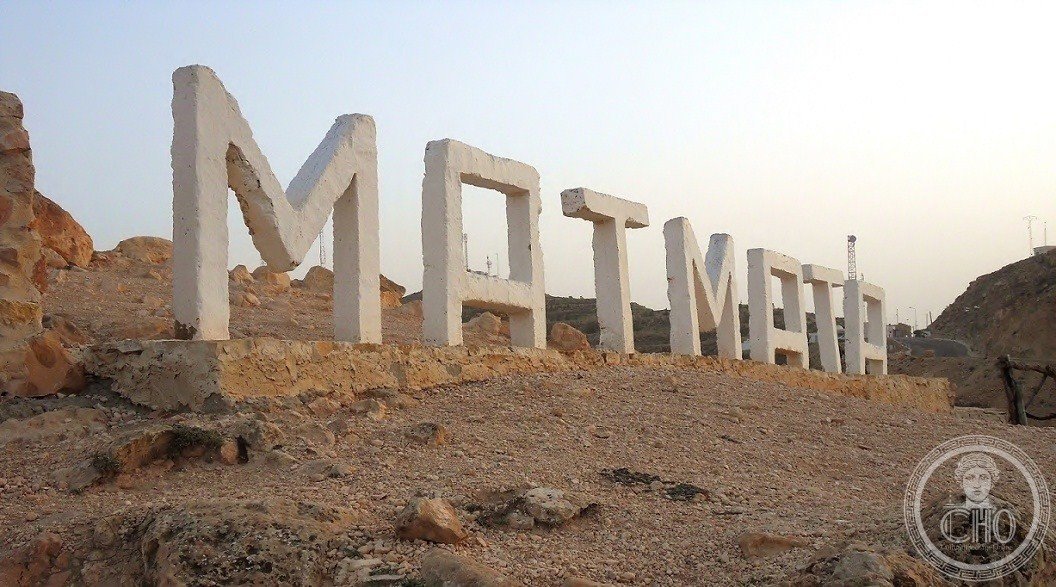
From the road there is almost nothing to see. The plateau south of Gabès is pale, dry and pitted, and the pits are the town. At Matmata people did not build houses on the ground: they dug a wide circular shaft down into it, and then cut the rooms sideways into the walls of that shaft. The courtyard is the hole. The roof is the desert.
It is one of the clearest pieces of climate engineering in North Africa, and it was made with hand tools, by people who had no reason to write any of it down.
A house you dig
The method is consistent enough to be called a type. A large pit is sunk into the soft rock of the plateau — workable with simple tools, firm enough to stand without shoring. Around the perimeter of the pit, artificial caves are cut to serve as rooms. Larger households have more than one pit, joined underground by trench-like passages, so that a family compound can spread sideways under a surface that shows nothing.
The logic is thermal. The pit brings daylight and air down to the rooms, while the thickness of earth around them does the work that insulation does elsewhere: it slows the swing between a summer afternoon on the Tunisian plateau and a winter night on the same spot. Nothing is imported, nothing is manufactured, and the material of the building is the ground that was removed to make it.
The same idea produces the thing visitors notice first, which is that the architecture has no exterior. There is no facade to maintain, no roof to re-lay, no wall exposed to weather. The building has, in a sense, been turned inside out — and with it, so has the idea of what maintaining a house means.
The rain of 1969
What a pit house cannot do is drain. In 1969 rain fell on the region for twenty-two days. Water went into the courtyards, and there was nowhere for it to go; the soft rock softened, and a great many houses flooded and collapsed.
The sequel is the part of the story worth telling. Matmata was not, at that point, on any official map of settled places: the administration understood this stretch of the Djebel Dahar as the territory of nomadic herders, not of a town. A delegation went to Gabès to ask for help, and the request itself was the news. Assistance was granted, and the authorities built a new Matmata on the surface — ordinary houses, above ground, of the kind the twentieth century knew how to fund.
Most of the population did not move into it. They went back down and rebuilt the pits, and only a few families took the new houses. That decision, taken by people who had just been flooded out, is the strongest argument anyone has ever made for the building type: they knew what it cost to repair, and they preferred it to the alternative that had been paid for on their behalf.
The film, and what it changed
In 1976 a crew arrived to shoot a science-fiction film, and used the Hôtel Sidi Idriss — a hotel made out of troglodyte courtyards in the usual way — as the home of Luke Skywalker on the planet Tatooine, in Star Wars: Episode IV – A New Hope. The same rooms were used again in 2002 for Attack of the Clones.
The consequence for Matmata was economic and permanent. A place that the national administration had not known was inhabited in 1969 became, within a generation, a destination people crossed the Mediterranean to find; today much of the town lives on visitors and on showing the houses. Heritage tourism is often described as a threat to vernacular architecture. Here it is closer to the opposite: it is the reason there is still an income attached to owning a pit house.
It is worth being exact. The film did not invent the architecture, did not preserve it, and did not document it. What it did was give an ordinary building type a second reason to be worth money — which, for vernacular architecture, is usually the difference between survival and abandonment.
What conservation means here
Most heritage protection assumes a building that can be repaired while empty: you consolidate the structure, you keep the water out, you open it to visitors. A pit house resists that model at every point. There is no fabric to consolidate in the usual sense; the structure is an absence, cut into rock. Left alone, it does not decay picturesquely — it fills in. The only maintenance that works is the maintenance a household performs by living there: clearing, re-cutting, re-plastering, keeping the water moving.
Which makes Matmata an unusually clean test of a question the whole discipline argues about. A technique that exists only in the hands of the people who use it cannot be conserved by protecting objects. It is conserved, or not, by whether the next generation finds it worth their while to go on digging.
Details
- Where: Matmata, Gabès Governorate, southern Tunisia, on the Djebel Dahar plateau
- What: troglodyte pit dwellings — a sunken circular courtyard with rooms cut into its walls, larger compounds joined by underground passages
- Community: Berber (Amazigh), Berber-speaking
- Population: 2,116 at the 2004 census
- The flood: twenty-two days of rain in 1969; houses flooded and collapsed, and the surface town of Matmata was built afterwards
- On film: the Hôtel Sidi Idriss served as the Lars homestead in Star Wars: Episode IV (1976) and again in Attack of the Clones (2002)
The place page: Matmata — location, coordinates and further detail.
Frequently asked questions
How is a troglodyte house at Matmata built?
A large circular pit is dug into the soft rock of the plateau. Rooms are then cut horizontally into the walls of the pit, which serves as the courtyard and brings in light and air. Bigger households have several pits connected by trench-like underground passages.
Why did people build downwards instead of upwards?
For temperature. The earth around the rooms moderates the extremes of the climate, keeping interiors cooler in summer and warmer in winter, and the material of the house is the ground taken out to make it.
What happened at Matmata in 1969?
Rain fell for twenty-two days and flooded the courtyards; many houses collapsed. A delegation went to Gabès for help — the authorities had not known a settled community was there — and a new town was built on the surface. Most families went back underground and rebuilt.
Was Star Wars filmed at Matmata?
Yes. The Hôtel Sidi Idriss, itself a troglodyte building, was used in 1976 as Luke Skywalker’s family home on Tatooine in A New Hope, and again in 2002 for Attack of the Clones.
Sources
- S1 — Sereni, Emilio. Storia del paesaggio agrario italiano. Laterza, 1982. ISBN 978-88-420-2747-8.
- S2 — Settis, Salvatore. Italia S.p.A.. L'assalto al patrimonio culturale. Einaudi, 2002. ISBN 978-88-06-16973-2.
Spotted an error? Write to editorial@culturalheritageonline.com and we correct it the same day.