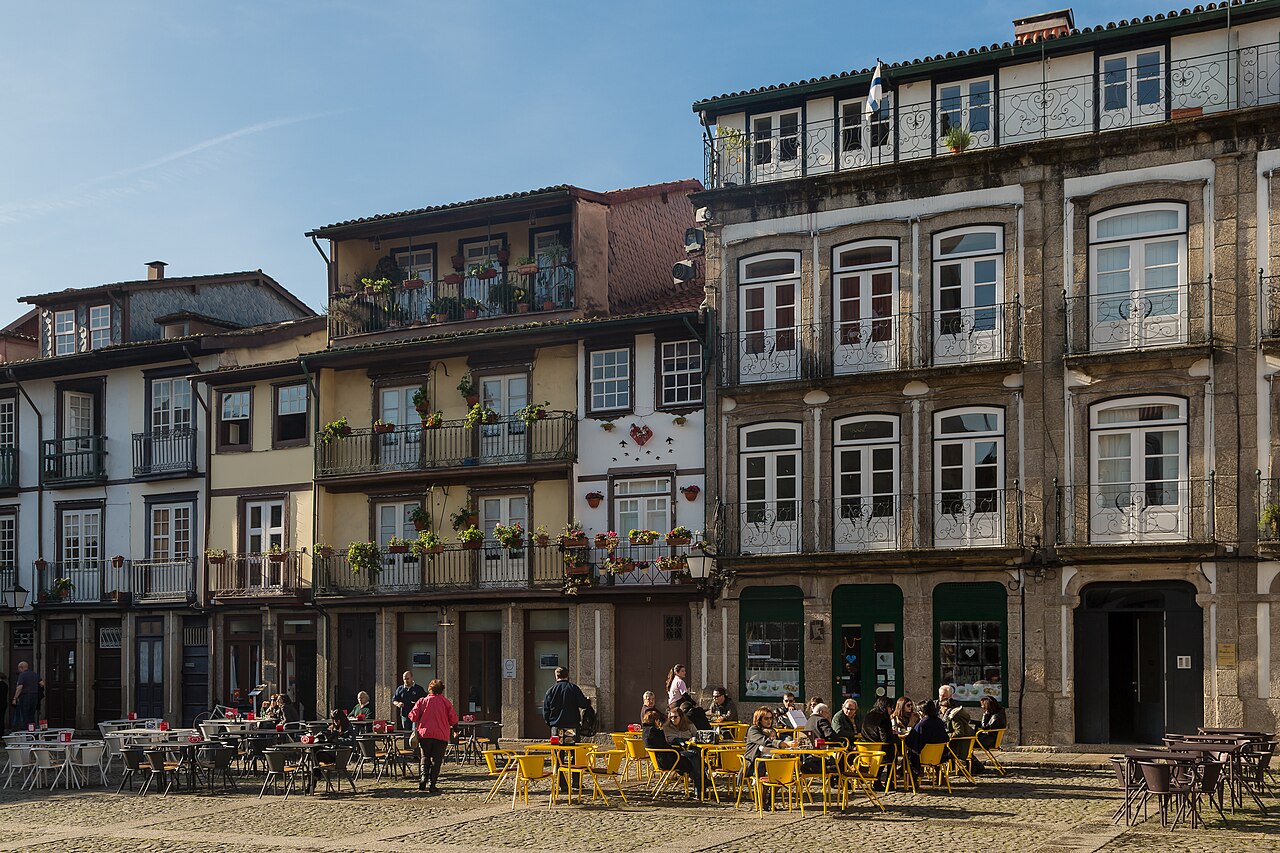
The Historic Centre of Guimarães, inscribed in 2001, is the birthplace of the Portuguese national identity — the “Berço de Portugal” (Cradle of Portugal), the city where Afonso Henriques (c. 1109–1185) was born and proclaimed himself the first King of Portugal in 1139 CE, whose medieval castle and ducal palace, medieval market square, and remarkably intact medieval street fabric make it the founding monument of the Portuguese nation.
Guimarães: The Cradle of Portugal and the First King Braga district, Minho, northern Portugal, 50 km north of Porto
The Historic Centre of Guimarães (inscribed in 2001 under criteria (ii), (iii), (iv)) is a small city of approximately 50,000 inhabitants in the Minho region of northern Portugal whose historic centre (approximately 1 km² of medieval fabric from the tenth to the nineteenth century) has the exceptional distinction of being the birthplace of the Portuguese nation. Guimarães Castle (Castelo de Guimarães, originally built in the tenth century by the Countess Mumadona Dias as a refuge for the monastery of São Mamede and as a residence for the counts of Portucale) is traditionally identified as the birthplace of Afonso Henriques (c. 1109–1185), the count of Portucale who defeated the Moorish forces at the Battle of Ourique in 1139 CE, proclaimed himself King of Portugal (Rex Portugalliae) on the battlefield, and subsequently had his kingship confirmed by the papacy in 1143 CE (Treaty of Zamora with King Alfonso VII of León). The proclamation of Afonso Henriques as the first king of Portugal at Ourique in 1139 CE (after his earlier victories at São Mamede near Guimarães in 1128 CE, which established his independence from his mother Countess Teresa and her Leonese allies) is the founding event of the Portuguese state; Guimarães, as the centre of the county of Portucale and the base of Afonso Henriques’s power, became the “Cradle of Portugal” — the city where the Portuguese national identity was forged. Every Portuguese schoolchild learns the phrase “Aqui nasceu Portugal” (Here Portugal was born), which is inscribed on the wall of Guimarães Castle.
The Palace of the Dukes of Braganza Rua de D. João I, Guimarães
The Palace of the Dukes of Braganza (Paço dos Duques de Bragança, built 1420s CE by the first Duke of Braganza, Afonso, illegitimate son of King João I of Portugal) is the finest secular Gothic palace in Portugal — a large residential palace in the northern Portuguese architectural tradition, with a distinctive silhouette of thirty tall chimneys and an unusual mix of northern European (specifically Burgundian) Gothic and Portuguese Gothic architectural influences. The palace was the principal residence of the Braganza dynasty (the dynasty that ruled Portugal from 1640 to 1910 CE and Brazil from 1822 to 1889 CE) until the transfer of the Portuguese capital definitively to Lisbon; it was subsequently abandoned after the Braganza court moved south in the sixteenth century, fell into ruin, and was comprehensively restored in the 1930s–1950s under the Estado Novo of Salazar. The restoration (which some architectural historians have criticized as too aggressive) converted the ruined palace into a state-administered museum and official presidential residence in Guimarães; it contains significant collections of Flemish tapestries (fifteenth century), Portuguese furniture, and paintings by José de Almada Negreiros. The palace and the adjacent Guimarães Castle are visible from each other and are typically visited together; together they constitute the most important monument complex in northern Portugal after the Cathedral of Braga.
Practical information
Guimarães is 50 km north of Porto (Porto Francisco Sá Carneiro Airport, OPO, with direct international connections from London, Paris, Amsterdam, Frankfurt, Madrid, and many other European cities). Train from Porto (São Bento station) to Guimarães: approximately 1 hour; direct trains approximately every 30–60 minutes. The historic centre is a 15-minute walk from the train station. The medieval quarter (the rua de Santa Maria, the Largo da Oliveira, the Paço dos Duques and the castle) is compact and walkable in 3–4 hours. Best season: May–October (mild northern Portuguese climate, dry in summer). The Festas Gualterianas (São Gualter Festival, first weekend of August) is the city’s most important annual event, with a medieval market and a “Bugiada” procession (a costumed parade representing the Christian-Moorish confrontations).
Frequently Asked Questions
Is Guimarães a UNESCO World Heritage Site?
Yes. The Historic Centre of Guimarães was inscribed in 2001 under criteria (ii), (iii), and (iv). Portugal has 17 UNESCO World Heritage Sites (as of 2024) — the most of any country in the Iberian Peninsula. Portuguese sites include the Historic Centre of Porto (1996), the Cultural Landscape of Sintra (1995), the Monastery of the Hieronymites and Tower of Belém in Lisbon (1983), the Convent of Christ in Tomar (1983), the Cistercian Monastery of Alcobaça (1989), the Monastery of Batalha (1983), the Historic Centre of Évora (1986), and the Historic Centre of Guimarães (2001), among others.
Who was Afonso Henriques and what made him the first King of Portugal?
Afonso Henriques (c. 1109–1185 CE, reigned as King of Portugal 1139–1185) was the count of Portucale (the northernmost county of the Kingdom of León and Castile, centered on the territory between the Minho and Douro rivers in present-day northern Portugal) who separated his county from Leonese suzerainty by military force. His mother, Countess Teresa (an illegitimate daughter of King Alfonso VI of Castile and León), had ruled Portucale as a vassal of León; Afonso Henriques defeated his mother’s forces at the Battle of São Mamede (1128 CE) near Guimarães, assumed control of the county, and began pursuing an independent foreign policy. In 1139 CE, after a major victory over the Almoravid Moors at the Battle of Ourique (in the Alentejo, southern Portugal), Afonso proclaimed himself “Rex Portugalliae” (King of the Portuguese); the papacy recognized his title in 1143 CE (Treaty of Zamora), and Portugal became the first new kingdom in the Iberian Peninsula since the fall of the Visigoths in 711 CE. Afonso Henriques spent the rest of his reign (to 1185) pushing the boundary of Portugal southward against the Moorish principalities (the Reconquista), capturing Lisbon from the Moors in 1147 CE with the assistance of crusaders en route to the Holy Land — the event that established Lisbon as the Portuguese capital. He is buried in the Monastery of Santa Cruz in Coimbra.
What is the significance of the Gothic canopy in Praça de Oliveira?
The Gothic canopy (the Padrão do Salado, 1342 CE) in the Praça de Oliveira (Olive Tree Square) commemorates the Portuguese contribution to the Battle of Río Salado (1340 CE), at which a combined Portuguese-Castilian fleet defeated a Marinid (Moroccan) naval force attempting to transport a new Moroccan army to reinforce the Moorish territories in Iberia — the last major Moroccan military intervention in the Iberian Peninsula. The canopy was erected by King Afonso IV of Portugal at the site of an ancient olive tree that, according to legend, had been planted by Wamba (a Visigothic king) and was miraculously regenerated (despite being cut down) by a dry branch that Afonso Henriques placed at the foot of the original tree as a votive offering after his victories against the Moors. The legend of the olive tree (the “miraculous olive tree of Guimarães”) is the origin of both the square’s name and the dedication of the adjacent church (Igreja de Nossa Senhora da Oliveira — Our Lady of the Olive Tree). The Gothic canopy is the most important Gothic monument in Guimarães after the Ducal Palace and is one of the finest surviving examples of fourteenth-century Portuguese Gothic decorative stonework.
Sources
- S1 — Mattoso, José. D. Afonso Henriques. Círculo de Leitores, 2006. ISBN 978-972-42-3867-8.
- S2 — Smith, Robert C. The Art of Portugal: 1500-1800. Weidenfeld & Nicolson, 1968. ISBN 978-0-297-76412-0.
Spotted an error? Write to editorial@culturalheritageonline.com and we correct it the same day.