Babylon (inscribed by UNESCO in 2019) is a UNESCO World Heritage designation that recognises the archaeological remains of one of the most famous cities in the ancient world — the capital of the Babylonian Empire in the 7th–6th century BCE under the Neo-Babylonian dynasty (approximately 626–539 BCE), particularly under its greatest king Nebuchadnezzar II (reigned approximately 605–562 BCE), who rebuilt Babylon on a monumental scale that made it the largest city in the world at the time (estimated population approximately 200,000–300,000 at its peak), surrounded by the most impressive walls of any city in the ancient Near East and adorned with the legendary Hanging Gardens (one of the Seven Wonders of the Ancient World — though the Hanging Gardens’ existence remains debated by scholars, as no Babylonian source describes them; they may have been at Nineveh, not Babylon) and the great ziggurat Etemenanki (“House of the Foundation of Heaven and Earth” in Sumerian — the actual structure that is the most likely inspiration for the Tower of Babel narrative in the Book of Genesis). The Babylon archaeological site is located approximately 85 km south of Baghdad near the modern city of Hillah in the Babil Governorate of Iraq, in the alluvial plain of the Euphrates River (the Euphrates has shifted its course since antiquity and no longer passes through the ancient city site). The UNESCO World Heritage inscription of 2019 recognised Babylon as an outstanding example of the Neo-Babylonian Empire’s urban planning and monumental architecture, while also acknowledging the site’s complex condition — Babylon has suffered significant damage through decades of conflict, archaeological pillaging, and the construction of a Saddam Hussein-era palace complex directly on and around the ancient ruins between approximately 1987 and 2003 CE.
The Babylon of Nebuchadnezzar II: the Ishtar Gate, the Processional Way, and the great ziggurat Etemenanki Ishtar Gate · Etemenanki Ziggurat · Processional Way · Hillah 5 km · Baghdad 85 km · Karbala 80 km
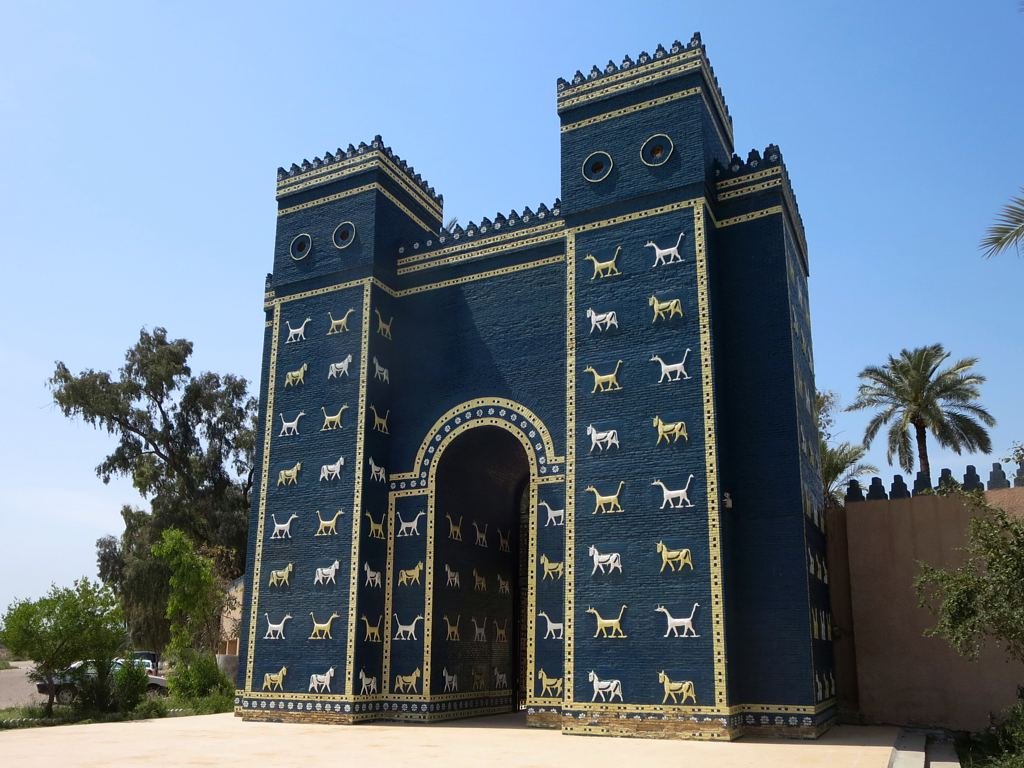
The Babylon rebuilt by Nebuchadnezzar II (approximately 605–562 BCE) was an urban achievement without parallel in the ancient world: the city enclosed an area of approximately 8–10 sq km within a double circuit of walls (the inner “Imgur-Enlil” wall and the outer “Nimitti-Enlil” wall, according to the Babylonian inscriptions) that the Greek historian Herodotus (visiting approximately 450 BCE) described as approximately 14.4 km in circumference and approximately 25 m thick at the base — dimensions that modern archaeological investigation has confirmed as substantially accurate. The plan of Nebuchadnezzar’s Babylon was organised by the Euphrates River (the western boundary of the city) and the great Processional Way (Babylonian: “Aibur-shabu” — “May the arrogant not flourish”) — the monumental street running north-south through the inner city from the Ishtar Gate in the north to the temple complex of Esagila and the ziggurat Etemenanki in the south-centre of the city. The Ishtar Gate (named for Ishtar, the Babylonian goddess of love, fertility, and war) was the most important of the eight fortified gates of the inner city wall — a double-towered gatehouse approximately 14 m tall (in the portion now reconstructed in the Pergamon Museum in Berlin) with walls faced with brilliant cobalt-blue glazed bricks carrying raised-relief images of alternating rows of bulls (representing the storm god Adad) and dragons/mušḫuššu (the “furious serpent” — the symbolic animal of the city god Marduk, depicted as a composite creature with a scaly body, the head of a horned serpent, the forelegs of a lion, and the hind feet of an eagle — the specific visual symbol that identified Babylon and the Babylonian pantheon). The Ishtar Gate and the adjacent sections of the Processional Way walls (decorated with similar glazed brick reliefs of walking lions on a blue ground — the lion was the sacred animal of Ishtar) were excavated by the German archaeologist Robert Koldewey in the excavations of 1899–1917 CE; approximately 45,000 glazed brick fragments were removed from the site and approximately 30,000 were transported to Berlin, where the Pergamon Museum reconstructed the gate to its original approximately 14 m height in an installation (completed approximately 1930 CE) that remains one of the most impressive architectural reconstructions in any museum. The Etemenanki ziggurat (“House of the Foundation of Heaven and Earth”) — the great stepped temple tower of Babylon — stood in an enclosure approximately 420 m × 420 m in the centre of the city, reaching an original height estimated at approximately 90 m (9 storeys) based on a cuneiform tablet from the Seleucid period that records its dimensions; by the time of Alexander the Great’s visit (323 BCE), the Etemenanki was in a ruined state (Herodotus describes it still standing and used as a temple; Alexander reportedly ordered its demolition and reconstruction, but died before the project was completed). The modern archaeological remains of the Etemenanki are a mudbrick mound approximately 4 m above the surrounding plain, heavily disturbed by Saddam-era construction.
Practical information
Babylon is approximately 85 km south of Baghdad, accessible by road (approximately 1.5–2 hours by car) via the Karbala-Hillah expressway. The site is managed by the Iraqi State Board of Antiquities and Heritage and is open to visitors; the Babylon Museum (a small museum in the site complex, rebuilt and reopened approximately 2016 CE) displays artifacts from the excavations. Day trips from Baghdad are possible for visitors with reliable private transport and a security assessment (the Babil Governorate has been relatively stable since approximately 2015 CE, but the security situation in Iraq should be checked before any visit). The site itself (the Babylon archaeological park) covers approximately 10 sq km of partially excavated and partially reconstructed remains; the most significant visible features are: the foundations of the Ishtar Gate (the blue glazed bricks of the reconstruction in situ are modern; the original gate material is primarily in Berlin); a partial reconstruction of the Processional Way with replica glazed brick lions (controversial among archaeologists but appreciated by visitors); the Southern Palace of Nebuchadnezzar (partial walls standing to approximately 10 m height); and the reconstructed Neo-Babylonian city wall. The Saddam Hussein-era palace on the site’s hill overlooks the archaeological area and adds a layer of modern political history to the visit. Best visiting months: October–April (Baghdad summer temperatures regularly exceed 50°C; the spring and autumn are more bearable).
Frequently Asked Questions
Did the Hanging Gardens of Babylon actually exist, and if so, where were they?
The Hanging Gardens of Babylon (one of the Seven Wonders of the Ancient World in the classical Greek list [specifically in the list attributed to Antipater of Sidon, approximately 100 BCE]) present one of the most intriguing puzzles in the archaeology and history of the ancient Near East: unlike the other Seven Wonders (all of which have either surviving physical remains [the Great Pyramid of Giza] or well-documented contemporary descriptions and archaeological evidence [the Temple of Artemis at Ephesus, the Mausoleum at Halicarnassus, the Colossus of Rhodes, the Lighthouse of Alexandria, the Statue of Zeus at Olympia]), the Hanging Gardens are unmentioned in any Babylonian text and are described only by later Greek and Roman authors who were not eyewitnesses (the primary accounts are by Diodorus Siculus [writing approximately 60–30 BCE], Quintus Curtius Rufus [approximately 1st century CE], and Strabo [approximately 64 BCE–24 CE] — all writing centuries after the alleged construction period under Nebuchadnezzar II, approximately 600 BCE). The Babylonian silence is particularly striking because Nebuchadnezzar II is extensively documented in cuneiform records (his royal inscriptions describe his building projects at Babylon in considerable detail, including the construction of the Southern Palace, the Processional Way, the Ishtar Gate, and the city walls) but make no mention of a garden on raised terraces — a construction project that would have required enormous labour and engineering investment and that the king would almost certainly have commemorated in his royal inscriptions if he had built it. This silence has led several scholars (most notably the British classicist Stephanie Dalley, who proposed the hypothesis in 2013 CE) to suggest that the Hanging Gardens were not at Babylon but at Nineveh (the Assyrian capital approximately 900 km north of Babylon, destroyed approximately 612 BCE) — that the “garden on raised terraces” described by the Greek sources was actually the famous water-lifting garden of the Assyrian king Sennacherib (reigned approximately 705–681 BCE), who built a remarkable garden at Nineveh using an aqueduct and water-lifting machinery (described in his own inscriptions) that Greek visitors associated with “Babylon” because they confused the Neo-Babylonian and Assyrian empires in their geography. Dalley’s hypothesis has attracted significant scholarly attention but remains disputed; the alternative hypothesis (that Nebuchadnezzar II built the gardens for his Median wife Amytis, who longed for the green hills of her homeland — the traditional account given by Diodorus and other Greek sources) cannot be disproven by the absence of Babylonian written evidence, as the Babylonian inscriptions are royal propaganda that may have omitted a garden built for a specific personal-dynastic purpose rather than a religious-political one.
What happened to Babylon after Nebuchadnezzar II and how did the city decline?
Babylon under Nebuchadnezzar II (approximately 605–562 BCE) represented the pinnacle of the city’s wealth, size, and cultural significance; the subsequent history is one of gradual decline through conquest, political disruption, and eventually abandonment. The immediate successor dynasties after Nebuchadnezzar’s death were unstable (four kings in six years, with multiple palace coups), until the city was taken without significant resistance by the Persian King Cyrus the Great in 539 BCE — the “fall of Babylon” that the Hebrew Bible celebrates in the Book of Daniel and the Book of Isaiah as the liberation of the Jewish captives taken by Nebuchadnezzar (the “Babylonian exile” of approximately 597–539 BCE). Under Persian (Achaemenid) rule (539–330 BCE), Babylon remained an important city and the winter administrative capital of the empire (the Persian court moved between Persepolis, Susa, Ecbatana, and Babylon depending on the season), and Cyrus and his successors maintained and restored many of Babylon’s temples. The city suffered a major blow under Xerxes I (reigned 486–465 BCE), who suppressed a Babylonian revolt approximately 484 BCE with considerable violence, reportedly looting and destroying the Esagila temple precinct and the Etemenanki ziggurat and removing the golden statue of Marduk (the most sacred object of Babylonian religion) — an act that struck at the religious and symbolic heart of Babylonian identity. Under Alexander the Great (who conquered the Persian Empire 334–323 BCE and entered Babylon in 323 BCE without resistance, reportedly intending to make it the capital of his unified Macedonian-Persian empire), the city experienced a brief revival — Alexander ordered the restoration of the Etemenanki and was planning extensive rebuilding of the city when he died in Babylon in 323 BCE, probably of typhoid fever (some ancient sources suggest poisoning, but most modern historians accept illness). After Alexander’s death, the city became part of the Seleucid Empire (founded by Alexander’s general Seleucus I Nicator) — the Seleucids founded a rival city, Seleucia-on-the-Tigris, approximately 30 km from Babylon, and the commercial population of Babylon gradually shifted to the new city over the following century. By approximately 200 BCE, Babylon was still inhabited and functioning as a religious centre but no longer commercially significant; by approximately 100 CE, the city was effectively abandoned, the remaining population having moved to the growing Parthian city of Ctesiphon nearby; and by the Arab Muslim conquest of Mesopotamia in approximately 636 CE, Babylon was already a largely buried archaeological site known only by local tradition.
EXCERPT: Babylon, Iraq, UNESCO-inscribed 2019 — the legendary capital of Nebuchadnezzar II (605–562 BCE): the Ishtar Gate with brilliant blue-glazed bulls and dragons (reconstruction now 14 m tall in the Pergamon Museum, Berlin), the Etemenanki ziggurat (likely inspiration for the Tower of Babel), and the ancient world’s largest city with an estimated 200,000–300,000 inhabitants.
META: UNESCO World Heritage Sites near Babylon Iraq: Ashur Iraq 300 km north (UNESCO 2003), Hatra Iraq 300 km north (UNESCO 1985), Samarra Iraq 200 km north (UNESCO 2007) — Babylon Iraq UNESCO 2019, Nebuchadnezzar II Neo-Babylonian Empire, Ishtar Gate glazed brick Pergamon Museum Berlin, Etemenanki ziggurat Tower of Babel, Hanging Gardens Seven Wonders Ancient World, Cyrus Great conquest Babylon 539 BCE.
Sources
- S1 — UNESCO World Heritage Centre — Babylon (Ref. 248) — https://web.archive.org/web/20230601000000/https://whc.unesco.org/en/list/248/
- S2 — UNESCO World Heritage Centre — Statement of Outstanding Universal Value (Ref. 248) — https://whc.unesco.org/en/list/248/
Spotted an error? Write to editorial@culturalheritageonline.com and we correct it the same day.