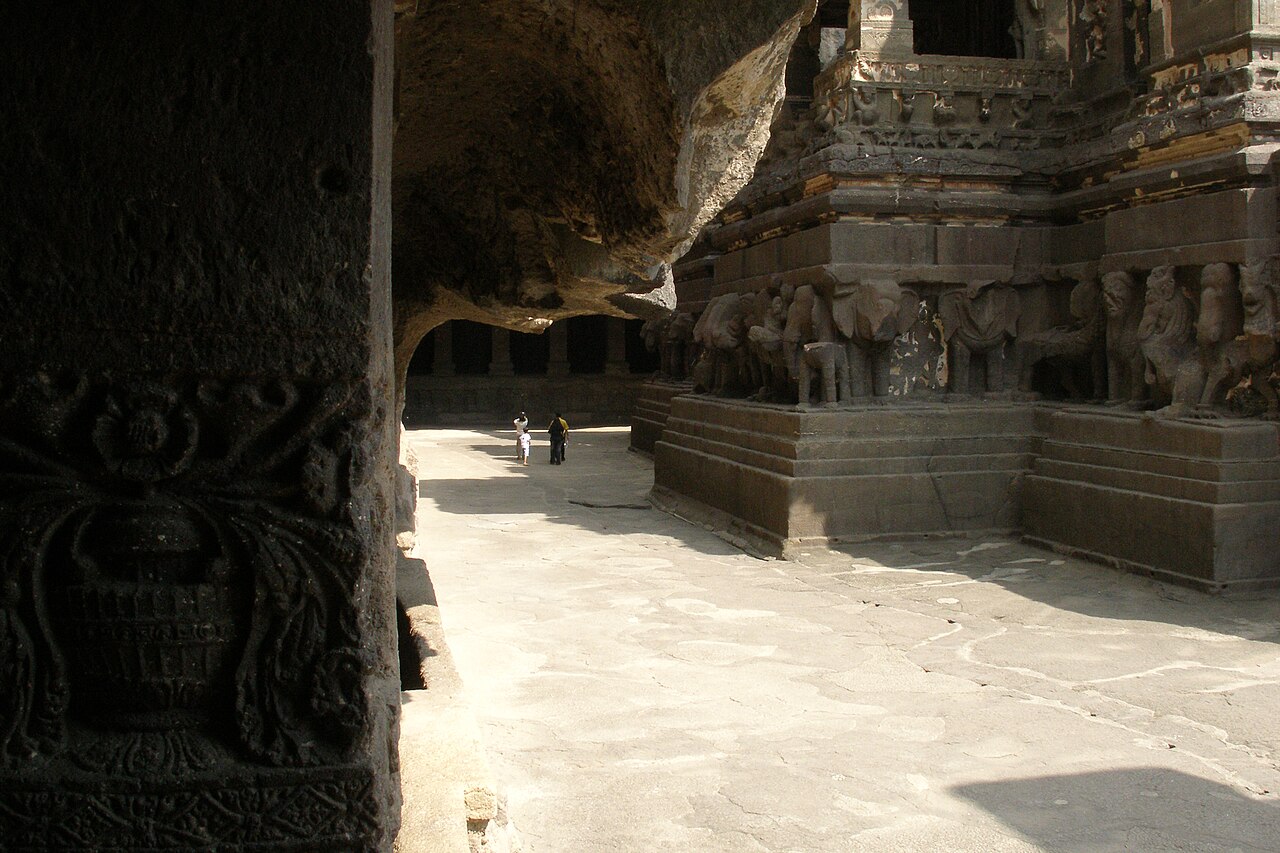
Ellora is a UNESCO World Heritage Site (inscribed 1983) comprising 34 rock-cut temples, monasteries, and prayer halls carved from a 2-kilometre basalt escarpment in Aurangabad district, Maharashtra, between approximately 600 and 1000 CE. The site is unique in world heritage for presenting three religions — Buddhism, Hinduism, and Jainism — in a single continuous complex, with each tradition’s caves carved in adjacent sections of the same cliff face. At its centre stands the Kailasa Temple, a monolithic Hindu shrine from which an estimated 276,000 tonnes of basalt were removed to reveal a structure twice the footprint of the Parthenon in Athens.
Three Religions, One Cliff: How 34 Caves Were Carved Over 400 Years Aurangabad district, Maharashtra, India
The caves at Ellora were not built. They were revealed — cut inward and downward from a living cliff of volcanic basalt by generations of craftsmen working under royal patronage from multiple dynasties. The 34 caves divide cleanly by religion and period: caves 1 through 12, the oldest group, are Buddhist viharas (monasteries) and chaityas (prayer halls) created roughly between 600 and 800 CE; caves 13 through 29 are Hindu shrines and halls carved between 600 and 900 CE; caves 30 through 34 are Jain temples added between 800 and 1000 CE. The sequence is historical as well as spatial — walking from south to north along the escarpment is, in effect, moving through four centuries of religious art produced at the same location.
The Buddhist caves form the largest group by count. Among them, the Vishvakarma Cave (Cave 10) stands out as the most technically ambitious chaitya hall. Its barrel-vaulted ceiling is carved to imitate the ribbed woodwork of an earlier structural tradition: the rock artisan reproduced, in permanent stone, the form of a building type that had previously been built from perishable timber. At the far end of the hall, a 15-metre seated Buddha occupies the apse. Cave 12, known as Tin Thal, is a three-storey monastery with rows of cells on each level, accommodating a substantial monastic community during its period of use.
The Hindu caves show the broadest range of iconographic subjects. Cave 15, the Das Avatara, contains friezes depicting the ten avatars of Vishnu; Cave 21, the Rameshvara, is notable for its large carvings of river goddesses Ganga and Yamuna flanking the entrance. Cave 29, the Dumar Lena, is a cruciform hall with a massive Shiva lingam at the centre and scenes from the Shaiva narrative corpus on its walls. These are not decorative flourishes — they are theological programmes carved in stone, intended to communicate specific doctrinal content to worshippers.
The Jain caves, though smaller in scale, contain some of the most refined carving at the site. Indra Sabha (Cave 32) features a free-standing monolithic pillar in its courtyard and ceiling paintings of apsaras (celestial beings) in the interior — one of the few sites at Ellora where polychrome painting has survived alongside the stone carving. The Jain caves were created under the Rashtrakuta and early Yadava dynasties and demonstrate the degree to which Jain merchant communities commanded significant patronage resources in the Deccan during the 9th and 10th centuries.
The Kailasa Temple: A Monolith Carved Downward from the Summit Cave 16, Ellora
Cave 16, the Kailasa Temple, is not a cave in the ordinary sense. It is a free-standing temple complex — complete with courtyard, entrance gateway, subsidiary shrines, and a soaring shikhara tower — carved entirely from the basalt cliff by removing the surrounding rock rather than by assembling cut stone. The process was the inverse of conventional construction: workers began at the summit of the cliff and cut downward, removing material to reveal the temple beneath, while others carved the detailed sculptural programmes on the walls and pillars of the emerging structure. The result stands approximately 32 metres tall, covers a footprint roughly twice that of the Parthenon in Athens, and rises to approximately 1.5 times the Parthenon’s height.
The temple was commissioned by the Rashtrakuta king Krishna I, who ruled from approximately 756 to 773 CE, and dedicated to Shiva as Mount Kailash — the mythological Himalayan abode of the god. The construction process is estimated to have taken approximately 150 years to complete across multiple reigns, with an estimated 276,000 tonnes of basalt removed during excavation. No mortar or assembly was involved at any stage: every column, every carved figure, every elephant sculpture supporting the plinth, every chain linking the decorative elements is part of the original rock of the cliff.
The interior walls carry friezes depicting scenes from the Ramayana and the Mahabharata in continuous narrative bands. A large lingam shrine occupies the sanctum sanctorum. The plinth of the temple is supported by a row of life-size elephant sculptures — the elephants appear to carry the weight of the entire structure on their backs, though structurally the plinth is solid basalt. The Ravana panel on the south wall, showing the demon king lifting Mount Kailash while Shiva pins him down with his toe, is among the most accomplished relief carvings in Indian stone-carving tradition.
The Kailasa is classified as a UNESCO World Heritage property within the Ellora complex and is protected under India’s Ancient Monuments and Archaeological Sites and Remains Act. Visitor access to the interior of the sanctum is restricted; the courtyard and surrounding galleries are open. The monument has no admission fee beyond the standard site entry charge, which differs for Indian nationals and foreign visitors.
Practical information
Ellora Caves are located 30 kilometres northwest of Aurangabad city (now officially renamed Chhatrapati Sambhajinagar), Maharashtra. The site is open Tuesday through Sunday, 6:00 am to 6:00 pm; it is closed on Mondays and on national holidays. Entry fees apply separately to the archaeological site and to the Kailasa Temple enclosure; foreign visitors pay a higher rate. Aurangabad is served by an airport with domestic connections to Mumbai (approximately 1 hour) and other Indian cities. The nearest major railway station is Aurangabad, connected by express trains to Mumbai (approximately 7 hours). Local taxis and auto-rickshaws connect the city to the caves; guided tours depart from hotels in Aurangabad throughout the day.
Ajanta Caves, the second UNESCO World Heritage Site in Aurangabad district, lie approximately 100 kilometres northeast of Ellora by road — a journey of roughly 2 to 2.5 hours by car. Most travellers combine both sites in a single overnight stay in Aurangabad. Elephanta Caves, a third UNESCO site carved by Rashtrakuta-era craftsmen, lies approximately 300 kilometres southwest near Mumbai and is accessible by ferry from the Gateway of India.
Water and food are available inside the site complex. The caves have no climate control; temperatures in the basalt passages are lower than outside during summer months. Photography is permitted in most areas; flash photography is restricted in caves with surviving pigment. Guides licensed by the Archaeological Survey of India are available at the site entrance.
Frequently Asked Questions
What is the difference between Ellora and Ajanta caves, and can I visit both in one day?
Ellora and Ajanta are separate UNESCO World Heritage Sites located approximately 100 kilometres apart in Aurangabad district, Maharashtra. They differ substantially in character. Ellora is a multi-religion complex of 34 caves spanning Buddhism, Hinduism, and Jainism, with the architectural centrepiece being the Kailasa Temple — a monolithic carved Hindu shrine. Ajanta is an exclusively Buddhist site of 29 caves renowned above all for its ancient mural paintings. Ellora is largely sculpture-focused; Ajanta is painting-focused.
Visiting both in a single day is technically possible but results in surface-level engagement with both sites. Each warrants a minimum of three to four hours to see the principal monuments at a reasonable pace. A same-day visit means approximately seven hours of travel and walking with minimal time to examine the details that make each site significant. Most experienced travellers spend a night in Aurangabad and divide the sites across two days: Ajanta on day one (it is farther from the city and benefits from early-morning light in the gorge) and Ellora on day two. Both sites are closed on different days — Ellora closes on Monday, Ajanta closes on Tuesday — so sequencing the visit over consecutive days fits the closure schedule naturally.
The two sites are not connected by direct public transport; a hired car or taxi is the practical option for visiting both. Tour operators in Aurangabad offer combined day tours, but these typically rush both sites.
How long did it take to carve the Kailasa Temple, and how was it done without modern tools?
Estimates for the construction of the Kailasa Temple (Cave 16) vary; the most widely cited figure is approximately 150 years across multiple reigns, beginning under the Rashtrakuta king Krishna I around 756 to 773 CE and continuing under his successors. No contemporary inscription records the full construction period. The figure of 276,000 tonnes of removed rock is an engineering estimate based on the volume of the excavated cavity above and around the temple.
The technique was vertical rock-cut excavation. Workers began by cutting three trenches into the top of the cliff face, isolating a rectangular mass of basalt — the future temple — from the surrounding rock on three sides and from above. They then worked downward through the isolated mass, carving the temple’s forms from the top of the structure downward: the shikhara tower first, then the mandapa (hall), then the lower-level galleries and elephant sculptures. The tools were iron chisels and hammers; no explosives or heavy machinery were used. Lighting in the lower levels would have been provided by oil lamps or mirrors reflecting daylight. The scale of the logistical operation — sustaining a workforce of stonemasons over generations, removing rubble from a deepening pit, maintaining carving precision through leadership changes — is as remarkable as the physical result.
Is the site at Ellora still religiously active?
The Kailasa Temple and the Hindu caves at Ellora retain some degree of active worship. Small shrines within the Kailasa complex receive offerings from visiting Hindu devotees, and the site is considered sacred by practitioners of Shaivism. However, Ellora is primarily administered as an archaeological monument under the Archaeological Survey of India, and the majority of visitors experience it as a heritage site rather than a place of active pilgrimage.
The Buddhist caves ceased to function as monasteries after the decline of Buddhist monastic patronage in the Deccan, probably by the 11th or 12th century. The Jain caves similarly ceased active religious use centuries ago. The contrast with a site like the Virupaksha Temple at Hampi — which remains in continuous daily worship — is instructive: Ellora’s religious activity is residual rather than continuous. Visitors should behave respectfully in all the cave interiors, remove shoes when entering active shrine areas, and follow posted guidance from the Archaeological Survey of India regarding restricted sections.
Sources
- S1 — UNESCO World Heritage Centre — Ellora Caves (Ref 243) — https://whc.unesco.org/en/list/243/
- S2 — K. V. Soundara Rajan — Cave Temples of the Deccan, Archaeological Survey of India, New Delhi, 1981, ISBN 978-8120808515
Spotted an error? Write to editorial@culturalheritageonline.com and we correct it the same day.