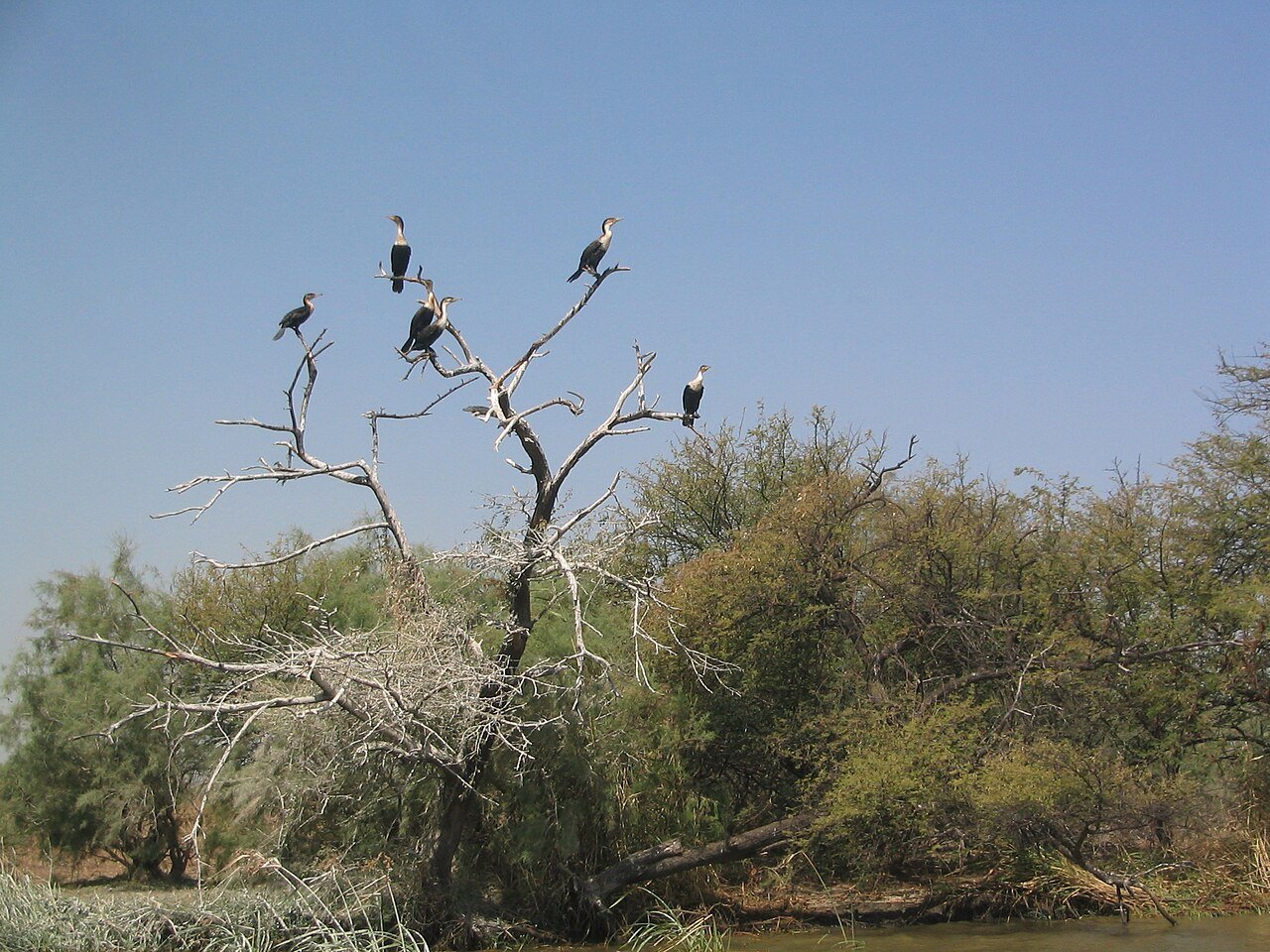
Djoudj National Bird Sanctuary in northwestern Senegal sits at the precise boundary between the Sahara Desert and the Sahel savanna, providing a freshwater refuge at the end of the trans-Saharan migration route for between 1.5 and 3 million birds each year. Covering 16,000 hectares of open water, streams, backwaters, and floating vegetation in the Senegal River delta, it ranks as the third-largest bird sanctuary in the world. UNESCO inscribed it as a World Heritage Site in 1981; it was listed as In Danger twice — from 1984 to 1988 and from 2000 to 2006 — due to invasive aquatic plant infestations that were subsequently brought under control.
Geography and the logic of the migration corridor 60 km northeast of Saint-Louis, on the Mauritanian border
The location of Djoudj is not incidental to its value — it is the entire explanation for it. The sanctuary occupies a section of the Senegal River delta where the river fans out into channels, lakes, and seasonally flooded plains before entering the Atlantic Ocean north of Saint-Louis. To the north lies Mauritania and, beyond it, the open Sahara. To the south lies the Sahel, the narrow belt of semi-arid savanna that stretches across sub-Saharan Africa. Djoudj sits exactly at the junction, making it the first significant freshwater body that trans-Saharan migrants encounter after crossing the desert.
For birds flying south from their European breeding grounds in autumn, the Sahara is an obstacle that must be crossed in a single flight — there is no food or water in the desert interior. A great white pelican, a garganey, or a ferruginous duck arriving at the southern edge of the Sahara is physiologically depleted and must find water and food immediately. Djoudj is what they find. The sanctuary’s position means it functions not merely as a good habitat but as a near-obligatory refuelling stop for the western African flyway: birds that miss it have few alternatives before reaching the denser vegetation zones further south.
The 16,000 hectares encompass a variety of wetland microhabitats — open lake surfaces, channels lined with Typha reeds, shallow backwaters covered in floating vegetation, and exposed mudflats that emerge as water levels drop in the dry season. This heterogeneity allows species with very different feeding ecologies to use the same sanctuary simultaneously. Pelicans and cormorants work the open water. Spoonbills and herons wade the shallows. Waders such as black-winged stilts and various sandpiper species probe the mudflats. The result is 383 documented species using the site across the year, with peak concentrations from October through March.
The sanctuary also supports a notable mammal fauna. African manatees occur in the deeper channels — Djoudj holds the northernmost West African population of this species. Nile crocodiles are present in modest numbers, as are hippopotamus in the river channels at the perimeter. Warthog, monitor lizard, and python occur in the terrestrial buffer zones. The combination of migratory birds and permanent large vertebrates in an accessible wetland setting makes Djoudj genuinely unusual among African protected areas.
The great white pelican colony and the In Danger episodes Senegal River delta, border with Mauritania
The figure that most distinguishes Djoudj from other important wetlands is its great white pelican breeding colony: between 10,000 and 15,000 breeding pairs nest on islands within the sanctuary each year, making it one of the three largest great white pelican colonies on Earth. The spectacle of a colony at this scale — birds arriving and departing in formations of hundreds, the noise and activity of a nesting island, juveniles learning to fly over open water — is among the most concentrated wildlife experiences available anywhere in West Africa.
The colony is complemented by African spoonbill, great flamingo, purple heron, saddle-billed stork, and large numbers of Palearctic migrants including garganey and ferruginous duck. The garganey in particular arrive in numbers that make Djoudj one of the globally important wintering sites for the species. The total annual count of 1.5 to 3 million individual birds passing through or wintering at the site represents a significant fraction of the western African flyway population of many species.
The two In Danger listings were triggered by invasive aquatic plants — the floating fern Salvinia molesta and water hyacinth (Eichhornia crassipes) — that spread across large areas of open water, blocking light penetration, depleting oxygen, and eliminating the open-water habitat on which pelicans and other waterbirds depend. The first invasion, from 1984 to 1988, was addressed through a combination of mechanical removal and biological control using the weevil Cyrtobagous salviniae, which feeds specifically on Salvinia. A second invasion in 2000 required renewed intensive intervention over six years before the site was removed from the In Danger list in 2006. The management experience at Djoudj is now cited in the scientific literature on biological control of invasive aquatic plants. The sanctuary is currently not listed as In Danger, but the threat of re-invasion is considered ongoing, and monitoring programmes remain in place.
Practical information
Djoudj National Bird Sanctuary is located 60 kilometres northeast of Saint-Louis, the colonial-era city on the Senegal River delta that serves as the main base for visitors. From Saint-Louis, the route runs north along the river toward Richard Toll, with the sanctuary entrance reached by a laterite road. The journey takes approximately 90 minutes by vehicle. There is no reliable public transport to the park gate; shared taxis from Saint-Louis can be arranged, or local tour operators based in Saint-Louis offer day trips that include transport and a boat guide. Richard Toll, to the east, is an alternative base.
The optimal visiting season is October through March, when Palearctic migrants are present and the pelican colony is active. April and May see numbers drop sharply as migrants depart; the June–September rainy season brings flooding that limits access. Entry fees are payable at the park gate (check current rates with Senegal’s Direction des Parcs Nationaux, as fees change periodically). Boat tours lasting 1.5 to 3 hours are the primary way to see the sanctuary — motorised pirogues navigate the channels and open lakes, allowing close approach to pelican islands and heron rookeries. Bring binoculars, sun protection, and water; the delta is exposed and temperatures in the dry season reach 35°C by midday.
Frequently Asked Questions
Why is Djoudj so important for migratory birds specifically?
The answer is geographic. The western African flyway — the migration corridor used by birds travelling between European breeding grounds and West African wintering areas — crosses the Sahara Desert, which spans roughly 5,000 kilometres from the Mediterranean coast to the Sahel. The Sahara contains no standing freshwater and almost no food for most bird species; birds that attempt the crossing do so in a single sustained flight, arriving on the southern edge physiologically stressed and in urgent need of water and calories. Djoudj sits at exactly the point where the Sahara ends and the Senegal River delta begins. For millions of birds each autumn, it is the first freshwater body they encounter after the desert crossing. Its 16,000 hectares of open water, reeds, and mudflats provide food resources — fish, invertebrates, seeds, and vegetation — available in no comparable concentration at the equivalent latitude. A bird that overshoots Djoudj heading south enters drier Sahelian vegetation with far fewer resources. This geometry makes Djoudj not simply a good habitat among many alternatives but a near-obligatory stop on one of the world’s major migration routes. Its destruction or severe degradation would affect flyway-wide population dynamics for dozens of species, which is why UNESCO recognised it as a World Heritage Site in 1981, only the third natural site inscribed globally.
What happened during the In Danger listings, and is Djoudj still at risk?
Djoudj was placed on the UNESCO List of World Heritage in Danger twice: first from 1984 to 1988, and then again from 2000 to 2006. Both episodes were caused by invasions of floating aquatic plants — primarily the fern Salvinia molesta and water hyacinth (Eichhornia crassipes). These species spread rapidly across open water surfaces, blocking sunlight from reaching submerged vegetation, depleting dissolved oxygen, and eliminating the open-water habitat that pelicans and diving birds depend on for feeding. The first invasion in the 1980s was addressed through a combination of mechanical clearance and biological control using the weevil Cyrtobagous salviniae, which evolved alongside Salvinia and feeds almost exclusively on it. The combination proved effective, and Djoudj was removed from the In Danger list in 1988. However, water hyacinth reinvaded in the late 1990s, triggering the second listing in 2000. Renewed mechanical and biological control measures over six years brought the invasion under control by 2006, when the site was removed from the list for the second time. Djoudj is currently not listed as In Danger. However, the management authorities consider the threat of re-invasion ongoing — the same environmental conditions that support the sanctuary’s extraordinary bird life (warm, slow-moving, nutrient-rich water) also favour rapid growth of invasive aquatics. Monitoring programmes and control capacity remain in place, and the case is now cited internationally as a model for managing invasive aquatic plants in protected areas.
What large wildlife other than birds can visitors see at Djoudj?
While the sanctuary’s reputation and UNESCO designation rest primarily on its birds, Djoudj supports a notable permanent wildlife community. African manatees (Trichechus senegalensis) inhabit the deeper channels of the sanctuary; Djoudj holds the northernmost confirmed population of the species in West Africa, making it scientifically significant for manatee conservation as well as ornithology. Manatees are most likely to be seen during boat tours in the early morning, surfacing to breathe in the quieter channels away from the main boat routes. Nile crocodiles (Crocodylus niloticus) are present in modest numbers along the river channels at the perimeter of the sanctuary; they are regularly observed from boats but are not considered a significant safety hazard for visitors who remain on board. Hippopotamus (Hippopotamus amphibius) also occur in the river sections, particularly near the northern boundary with Mauritania. In the terrestrial buffer zones surrounding the wetland core, warthog, monitor lizard (Varanus niloticus), African rock python, and various smaller mammals can be seen on foot or by vehicle. The combination of one of Africa’s premier migratory bird sites with African manatees, crocodiles, and hippos in the same accessible area is unusual and makes Djoudj a destination of genuine interest even for visitors who arrive primarily as wildlife rather than bird specialists.
Sources
- S1 — Rodwell, S. P., et al. Wintering Waterbirds in the Senegal River Delta. BirdLife International, 1996. ISBN 978-0-946888-32-0.
- S2 — Morel, Gérard J., and Marie-Yvonne Morel. Les oiseaux de Sénégambie. ORSTOM, 1990. ISBN 978-2-7099-1009-5.
Spotted an error? Write to editorial@culturalheritageonline.com and we correct it the same day.