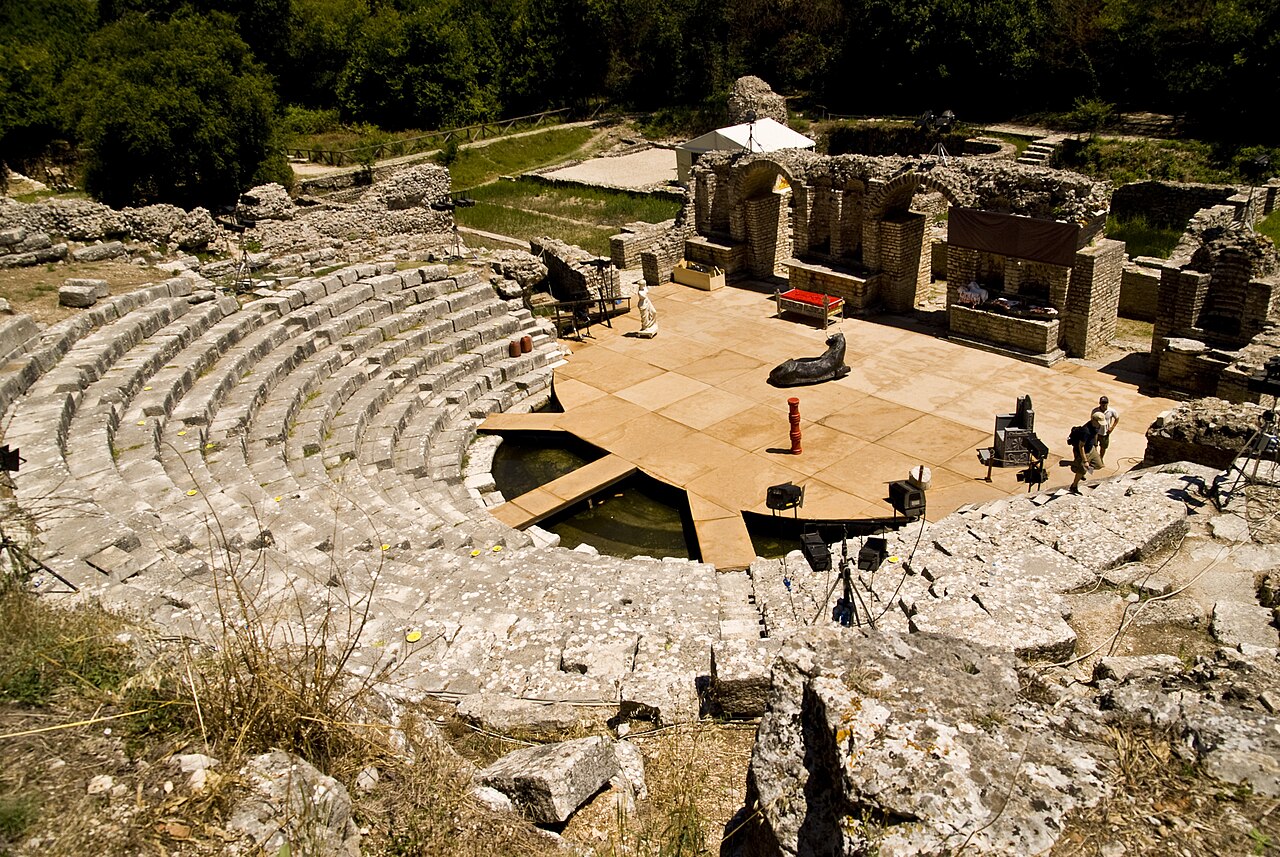
Butrint, inscribed in 1992 and extended in 1999, is one of the most important and best-preserved ancient cities in the Balkans — a Greek colony on the Albanian Riviera continuously occupied from the seventh century BCE through the nineteenth century CE, whose theatre, baptistery (with Albania’s largest floor mosaic), Roman baths, and Venetian towers are set within a national park of exceptional natural beauty. Gjirokastra and Berat, Albania’s two Ottoman stone cities, extend the Albanian heritage itinerary inland.
Butrint: Layers of Occupation on the Vivari Channel Southern Albanian coast, 14 km south of Sarandë
Butrint (inscribed in 1992 under criteria (ii), (iii), and (iv), extended in 1999), is the most comprehensively excavated ancient site in Albania — a peninsula on the Vivari Channel where the lake Butrint drains into the Straits of Corfu, a natural defensive position of exceptional strategic value occupied continuously from at least the seventh century BCE to the Ottoman period. The site documents Greek colonization (Buthrotum, probably founded c. 650–600 BCE as a Corinthian colony), Roman provincial history (the settlement was developed as a proper Roman city by Julius Caesar, who founded a veteran colony there in 44 BCE, and his heir Augustus expanded it), Early Christian architecture (the fifth-century basilica of the Baptistery, the largest Early Christian mosaic in Albania — 15 × 9.5 metres, with geometric and zoomorphic patterns in opus sectile — and the associated basilica complex), Byzantine rule (reflected in the city walls and towers), Angevin occupation (the castle of the Anjou dynasty, 1272–1300, whose towers stand at the highest point of the site), and Venetian use (the Lion of Saint Mark carved in the Venetian Tower, c. 1380–1700, marking the site as a Venetian commercial outpost). The site was buried under vegetation from the early modern period until its discovery by a British diplomat, Arthur John Evans, in 1877; Italian archaeologists excavated it systematically from 1928 to 1943 under Mussolini’s directive to establish the “Greco-Roman roots” of Albanian territory, a politically motivated but archaeologically significant excavation programme.
Gjirokastra: The Stone City of the Mountains 🚗 ~1.5 hrs northeast
Gjirokastra (inscribed 2005, jointly with Berat, under criteria (iii), (iv), and (v)) is 80 km northeast of Butrint — a mountain city of the Albanian Riviera built on the steep slopes below a medieval castle, whose houses of grey local limestone with distinctive tall towers and overhanging jetties form the most completely preserved Ottoman-era urban landscape in the Balkans. The city was described by the Albanian writer Ismail Kadare (born in Gjirokastra in 1936) in his novel “Chronicle in Stone” (1971) as “a city in which even the rain made a stony sound” — a description of the monolithic quality of the urban landscape in which all elements (houses, towers, stairways, retaining walls, pavements) are built from the same dark grey limestone. The Gjirokastra Fortress (begun c. 1336 CE, substantially rebuilt by Ali Pasha of Ioannina in the nineteenth century) now houses a National Weapons Museum and the Ali Pasha Collection; the castle’s panoramic position over the Drino valley is the finest viewpoint in southern Albania. Gjirokastra is also the birthplace of Enver Hoxha (1908–1985), the communist dictator whose 40-year regime isolated Albania from the world and whose birthplace (on the main bazaar street) has been converted to an ethnographic museum.
Berat: The City of a Thousand Windows 🚌 ~3.5 hrs north
Berat (inscribed jointly with Gjirokastra in 2005) is 170 km north of Butrint — the “city of a thousand windows,” famous for the characteristic three-story Ottoman houses whose whitewashed facades with rows of large windows look down from the hillside to the Osumi River below. The Mangalem quarter (Muslim) and the Gorica quarter (Christian) face each other across the river, linked by a stone Ottoman bridge; both quarters preserve seventeenth and eighteenth-century residential architecture of exceptional quality. The Berat Castle (Kalaja, founded Byzantine, extended fourteenth century) on the hill above the Muslim quarter is one of the few still-inhabited medieval castles in the world — approximately 200 families live within the castle walls in houses that have been continuously occupied since the medieval period, alongside active Orthodox churches (the Church of the Holy Trinity, c. 1285, with the best-preserved Byzantine frescoes in Albania) and the Onufri Museum (named for the sixteenth-century Albanian icon painter, in the Cathedral of the Dormition of St. Mary).
Practical information
Butrint is 14 km south of Sarandë (the Albanian Riviera resort town) by bus or taxi; Sarandë is connected to Corfu (Greece) by high-speed ferry (30 minutes). From Tirana (the Albanian capital), Sarandë is 280 km south by road (3.5 hours) or 45 minutes by domestic flight. The Butrint site is open daily 8 a.m.–dusk; the national park entrance includes the archaeological site. Gjirokastra is 80 km northeast of Sarandë (1.5 hours by road); buses run from Sarandë and Tirana. Berat is 170 km north of Sarandë (2.5 hours by road). Albania’s road network has improved significantly in recent years; rental car is the most flexible option for the southern Albania circuit. The Albanian Riviera coastline (Himara, Dhermi, Borsh) offers excellent beaches between Sarandë and Vlorë; combining heritage visits with coastal stays is the standard itinerary. The best season is May–September; the Saranda Archaeological Festival in June is the primary heritage event.
Frequently Asked Questions
Is Butrint a UNESCO World Heritage Site?
Yes. Butrint was first inscribed in 1992 under criteria (ii), (iii), and (iv), and the inscription was extended in 1999 to include the surrounding national park as a cultural landscape. The site was also placed on the UNESCO World Heritage in Danger list in 1997 (when political instability and looting threatened the site) and removed from the danger list in 1999 after protective measures were implemented. It is one of three UNESCO World Heritage Sites in Albania, along with the Historic Centres of Gjirokastra and Berat (both inscribed 2005).
What is the Butrint Baptistery mosaic?
The Baptistery of Butrint is a circular Early Christian building of the late fifth century CE (c. 450–550 CE) adjacent to the basilica complex near the main city gate. Its floor is entirely covered by a mosaic approximately 15 × 9.5 metres — the largest Early Christian floor mosaic in Albania and one of the largest in the Balkans. The mosaic depicts geometric patterns, animals (fish, birds, deer, peacocks), and a central scene in opus sectile (cut stone pieces, rather than tesserae); the iconographic programme combines biblical symbolism with the natural world in a manner typical of Early Christian floor decoration in the Adriatic region (parallel examples survive at Aquileia and Poreč). The mosaic was covered with earth for conservation during the Hoxha period and was fully uncovered and documented in the 2000s; it is now covered with sand for protection and is not permanently visible, but it is periodically uncovered for study and special viewings.
Why was Butrint excavated under Mussolini?
Butrint was excavated from 1928 to 1943 under the direction of Luigi Maria Ugolini, an Italian archaeologist working under the cultural programme of the Italian Fascist government. Albania had been an Italian protectorate since 1926; Mussolini’s regime invested in Albanian archaeology as part of a broader programme of demonstrating the “Greco-Roman roots” of Albanian culture — a way of historically justifying Italian cultural and political claims over the Albanian territory. Despite this politically motivated context, Ugolini’s excavations were scientifically rigorous by the standards of the time; they revealed the site’s major monuments (the theatre, the baptistery, the city walls, the Venetian tower) and published detailed reports. The excavation records in Rome remain important primary sources for current scholarship, and the scientific value of the excavations has outlasted their political purpose.