In 1928, village cobbler Narciso Delladio began hand-crafting iron-studded work boots for timber fellers in the Fiemme valley, planting the seed for what would become the global gold standard in rock climbing and high-altitude mountaineering footwear.
The Val di Fiemme in 1928 was a remote alpine valley carved between the Lagorai mountain range and the pale vertical limestone towers of the Latemar and Pale di San Martino. Life was ruled by the seasons of timber: since the early Middle Ages, the *Magnifica Comunità di Fiemme* had managed the dense resonance spruce forests that supplied wood for Venetian galleys and Stradivarius violins. Lumberjacks spent months high on icy slopes, felling timber with two-man crosscut saws and dragging trunks across scree.
In the village of Tesero, thirty-two-year-old cobbler Narciso Delladio (1896–1983) spent his days resoling heavy peasant clogs. But Delladio noticed the perilous conditions faced by local woodcutters and alpine mountain troops (*Alpini*): regular leather boots soaked through in deep snow, rotted on wet bark, and slipped on slick rock slabs. In 1928, Delladio established his independent artisanal workshop under the name Calzoleria Sportiva, dedicated to fabricating indestructible alpine boots.
The iron calk and the Vibram leap
Delladio worked with thick, oil-treated cowhide (*vacchetta ingrassata*), double-stitched by hand with waxed hemp thread using heavy awls. To guarantee grip on frozen slopes and steep timber chutes, he hand-hammered iron studs and forged steel triconi (*chiodature*) directly into the thick leather outsoles. In 1928, his boots were officially presented at the Milan Trade Fair, earning immediate accolades from the Italian military and early alpine ski clubs.
When the Second World War arrived, Delladio was commissioned to produce extreme cold-weather mountain boots for Italian mountain divisions. But his true transformation came in the 1950s. Relocating to nearby Ziano di Fiemme, Narciso and his son Francesco embraced revolutionary rubber sole technology developed by Vitale Bramani (Vibram). They phased out cumbersome iron calks in favour of vulcanized lugged rubber, pioneering specialized ski boots and leather trekking gear.
The vertical revolution: friction on Dolomite limestone
In the late 1970s and 1980s, under third-generation leader Lorenzo Delladio, rock climbing transformed from a heavy siege sport with iron pitons into free climbing on vertical rock faces. The Delladio family engineered a footwear revolution: the Mariacher and Mega climbing shoes. Replacing thick mountaineering soles with paper-thin, ultra-sticky friction rubber soles, La Sportiva allowed climbers to adhere to microscopic limestone crystals on sheer overhangs.
Virtually overnight, the small family workshop in Ziano di Fiemme became the global epicentre of rock-climbing footwear, trusted by legends from Wolfgang Güllich to Alex Honnold.
What remains today
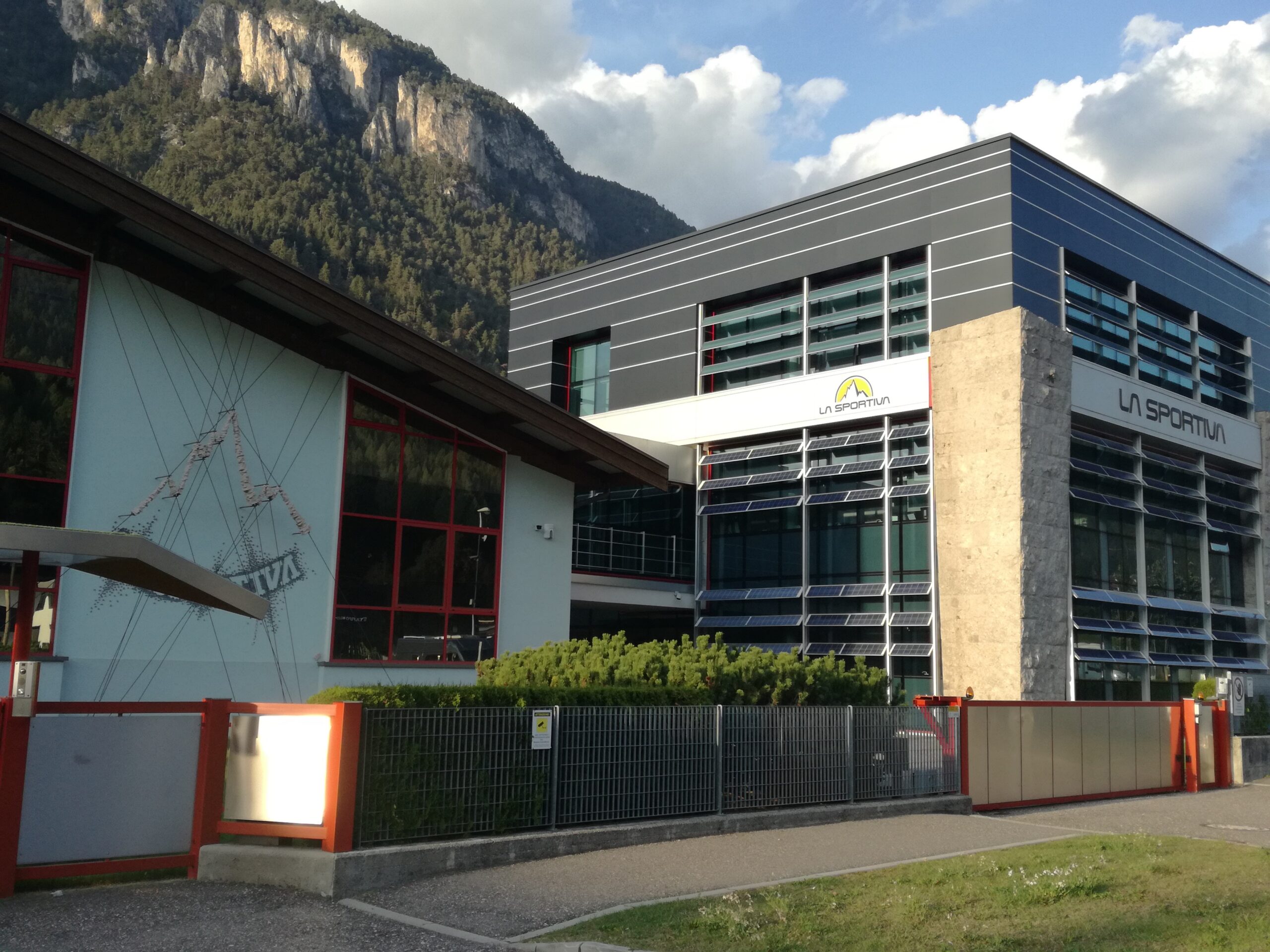
Despite becoming a multinational brand dominating the world cup climbing circuits and Himalayan eight-thousander expeditions, La Sportiva refused repeated corporate acquisition offers and refused to abandon its home valley. Its state-of-the-art manufacturing headquarters on Via Ischia in Ziano di Fiemme still hand-crafts mountaineering boots in sight of the alpine crags where Narciso Delladio first hammered iron calks. The company archive preserves the original wooden lasts, cobbler benches, and vintage footwear models that trace the century-long transition from peasant survival into the vertical frontiers of modern alpinism.
Historic Views & Archives
From the Archives: Historical Newsreels
Sulle Alpi dolomitiche: guide alpine, rifugi e scalate sulle torri di roccia
Spectacular 1932 documentary footage capturing pioneers of rock climbing in the Dolomites, showing the reliance of mountain guides and lumberjacks on rugged, hand-nailed leather alpine boots.
Visiting the Site: Street View & Modern Geography
Ziano di Fiemme lies in the upper Avisio river basin in the Dolomites. The modern headquarters and R&D workshops of La Sportiva sit along Via Ischia, directly adjacent to the pine forests where Narciso Delladio tested his heavy leather calks a century ago.
Historic Address: Via Ischia 2, 38030 Ziano di Fiemme (TN), Italy
Sources
- S1 — Delladio, Lorenzo. La Sportiva: Dalla Val di Fiemme alla conquista delle vette. Fiemme, 2018. ISBN 978-88-943120-0-3.
- S2 — Camanni, Enrico. La nuova vita delle Alpi. Bollati Boringhieri, 2002. ISBN 978-88-339-1412-1.
Spotted an error? Write to editorial@culturalheritageonline.com and we correct it the same day.