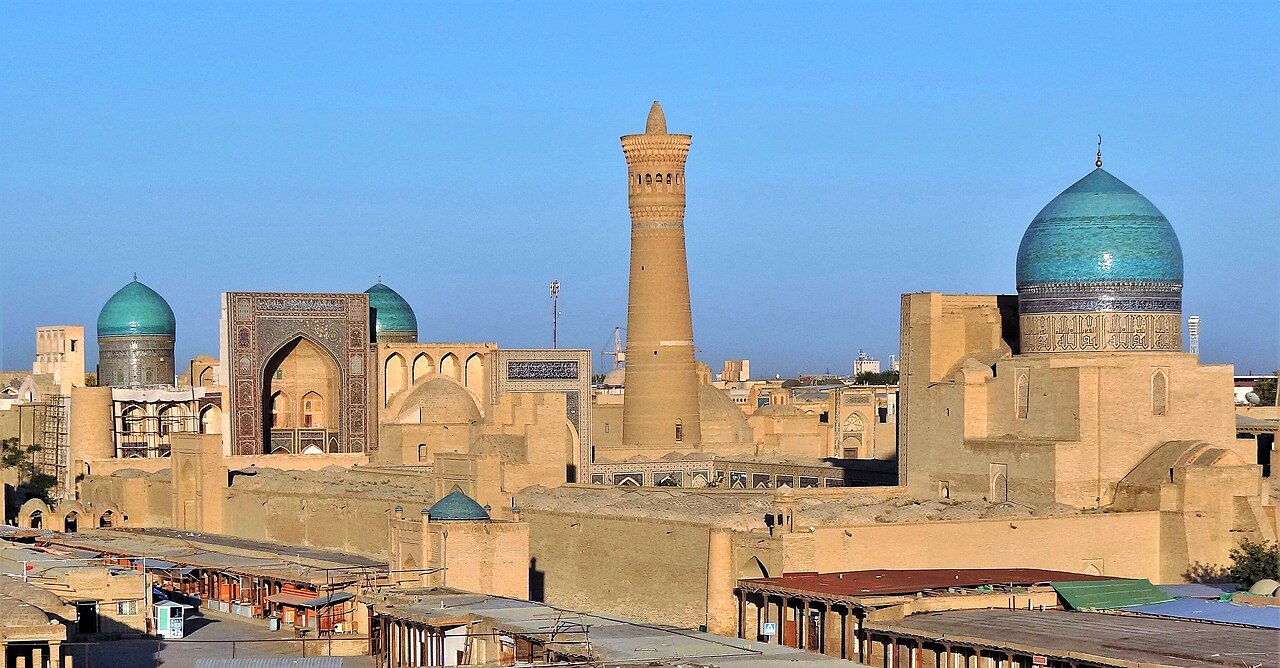
The Historic Centre of Bukhara, inscribed as a UNESCO World Heritage Site in 1993, preserves approximately 2,500 years of continuous urban occupation in the Zerafshan valley of western Uzbekistan. Once the capital of the Samanid dynasty — the first major Persian-Islamic dynasty to emerge after the Arab conquest of the 7th century — Bukhara held a position in the Islamic scholarly world comparable to Baghdad and Cairo. Its historic centre contains the oldest surviving Islamic building in Central Asia alongside a minaret whose 12th-century brickwork survived a Mongol assault that destroyed the rest of the city.
The Kalon Minaret and the fire Genghis Khan ordered stopped City centre, adjacent to the Kalon Mosque
The Kalon Minaret (1127 CE), commissioned by the Qarakhanid ruler Arslan Khan, stands 46 metres above the Poi Kalon square and remains the dominant vertical element in the Bukhara skyline. The tower is constructed entirely of fired brick, with 14 decorative bands running horizontally across its exterior. Each band uses a different geometric pattern, arranged to create a visual variety that prevents the eye from reading the tower as a simple cylinder. The base diameter is 9 metres; the tower tapers steadily to a lantern gallery at the summit ringed by 16 arched openings.
In 1220, Genghis Khan led his forces through Bukhara as part of the campaign that dismantled the Khwarazmian Empire. The city burned and a large portion of its population was killed. Medieval sources, including the Persian historian Juvayni writing 30 years later, record that when Genghis Khan rode into the city and dismounted at the Kalon Mosque, he asked if this were the palace of the Sultan. Told it was the house of God, he climbed to the pulpit. Grain stored in the mosque courtyard was fed to his horses; Qurans were scattered on the ground. The city was then put to the torch. The minaret, by all accounts, was deliberately preserved. The most common explanation offered by later writers is that the Khan was so struck by the structure’s scale and craftsmanship that he ordered the fire stopped around it. Whatever the reason, the Kalon Minaret is one of the very few large pre-Mongol structures to survive intact in Central Asia.
For several centuries after the conquest, the minaret served a secondary purpose that gave it the name “Tower of Death” in popular memory: condemned criminals were reportedly placed in sacks and thrown from the summit gallery. The practice was documented by several European travellers to Bukhara in the 18th and 19th centuries; its endpoint date is uncertain. Today the minaret is not open to the public for climbing, though the adjacent Kalon Mosque — largely rebuilt in the 15th and 16th centuries on the footprint burned in 1220 — is accessible.
The Ismail Samani Mausoleum and the Samanid legacy Samanid Park, 10 minutes on foot from Poi Kalon
The Ismail Samani Mausoleum, built between 892 and 943 CE, is the oldest surviving Islamic building in Central Asia. It was constructed for Ismail Samani, founder of the Samanid dynasty, which ruled from Bukhara from 819 to 999 CE and represented the first significant Persian cultural and political revival after the Arab conquest. The Samanid court sponsored the translation of Arabic scientific and philosophical texts into Persian, employed the physician and philosopher Ibn Sina (Avicenna), and patronised the poet Rudaki, considered the father of classical Persian literature.
The mausoleum is a square structure approximately 10 metres on each side, surmounted by a dome and with a smaller dome at each corner. The exterior is clad entirely in fired brick laid in no fewer than nine distinct bond patterns — a variety achieved not through ornamental add-ons but through the pure arrangement of the bricks themselves. The patterns interact with direct and indirect light in a way that changes the appearance of the surface through the day, a quality noted in multiple medieval and modern descriptions of the building. This optical effect, achieved through masonry geometry alone, represents a technical and aesthetic achievement that influenced mausoleum design across the Islamic world for centuries.
The building predates the Mongol invasion by three centuries and was apparently buried under accumulated silt and earth by the 14th century, which may account for its survival. Russian archaeologists identified and excavated it in the late 19th century.
The rest of historic Bukhara contains the massive Ark citadel — continuously occupied from the 1st century CE, shelled by Soviet forces in 1920 when the last emir fled, approximately 80% destroyed and not restored — and three surviving medieval bazaar domes. The taq (dome-covered bazaar intersections) at Taq-i Zargaron (goldsmiths), Taq-i Sarrafon (money changers), and Taq-i Tilpak Furushon (cap makers) mark the intersections of the main Silk Road trading streets. They remain in use today as craft and souvenir markets, following a commercial function that has been continuous at these points for at least 500 years.
Practical information
Bukhara is served by Bukhara International Airport with connections to Tashkent (approximately 1 hour by air) and seasonal international routes. By rail, the Afrosiyob high-speed service connects Bukhara to Samarkand (approximately 1.5 hours) and Tashkent (approximately 4 hours). From Samarkand, the journey is also manageable by road (270 km, approximately 3 hours by shared taxi or bus).
The historic centre is compact; the Kalon Minaret, Ark citadel, Ismail Samani Mausoleum, and the main covered bazaars can all be reached on foot. Bukhara is generally less crowded than Samarkand and the Registan, particularly outside the June–August peak season.
Khiva and its Itchan Kala walled city lie 450 km to the west, accessible by overnight train or a 1-hour flight from Bukhara Airport. Samarkand is 270 km east. A circuit linking Tashkent, Samarkand, Bukhara, and Khiva constitutes the standard Uzbekistan Silk Road itinerary and covers all three Uzbek UNESCO World Heritage Sites. Accommodation in Bukhara includes several guesthouses in converted merchant houses (caravanserai) within the historic centre.
Frequently Asked Questions
Why is the Ismail Samani Mausoleum considered the prototype of Central Asian Islamic mausoleums?
The Ismail Samani Mausoleum predates all other surviving Islamic mausoleums in Central Asia by several centuries. The form it established — a square chamber surmounted by a dome, with corner elements echoing the central dome in miniature — became the template reproduced across Central Asia, Persia, and eventually into the Indian subcontinent. The Gur-e-Amir in Samarkand, the Taj Mahal in Agra, and hundreds of smaller mausoleums between them all reproduce, in various elaborations, the compositional logic first worked out at Bukhara in the 9th century. What makes the Samani mausoleum technically remarkable is that the dome is not supported by pendentives — the triangular devices used in Byzantine and later Islamic architecture to transition from a square base to a circular drum. Instead, the Samani mausoleum uses a set of small squinch arches in the corners to make the transition, a solution independently developed at Bukhara that was then disseminated across the Samanid sphere of cultural influence. The building also lacks any external applied decoration: everything visible on its surfaces is the brick itself, arranged with exceptional precision and variety. This restraint, achieved at a level of technical mastery that made it look effortless, established a standard of quality against which later buildings were measured.
What role did Bukhara play in the development of Islamic science and literature?
The Samanid court at Bukhara in the 9th and 10th centuries functioned as one of the principal intellectual centres of the Islamic world, comparable to the Abbasid court at Baghdad in its patronage of scholarship. The dynasty sponsored the Shahnameh tradition — the compilation of Iranian national epic traditions — that culminated in Firdausi’s monumental poem, though Firdausi himself worked for the Ghaznavids. More concretely, Bukhara was the birthplace and early home of Ibn Sina (Avicenna, 980–1037 CE), whose Canon of Medicine served as the principal medical textbook in both the Islamic world and Europe until the 17th century. The Samanid library in Bukhara, which Ibn Sina described using as a young man, reportedly held works that he found nowhere else. The dynasty also patronised the mathematician and geographer al-Biruni and supported the translation movement that brought Greek scientific texts into Arabic and then Persian. The city’s role as a centre of Islamic jurisprudence and Sufi thought extended beyond the Samanid period: Bukhara remained a major centre of Islamic legal scholarship under the Qarakhanids, Timurids, and Shaybanids, and the Naqshbandi Sufi order, one of the most influential in the Islamic world, was founded in the vicinity of Bukhara in the 14th century by Baha-ud-Din Naqshband, whose tomb remains an active pilgrimage site 5 km outside the city.
How did the Soviet takeover of Bukhara in 1920 affect the city’s historic fabric?
The Emirate of Bukhara was the last semi-independent state in Central Asia to fall to Soviet power. In August and September 1920, the Red Army under Mikhail Frunze besieged Bukhara; the emir, Said Mir Muhammad Alim Khan, fled to Afghanistan. The siege included artillery bombardment and aerial bombing — among the first uses of aircraft against a Central Asian city. The Ark citadel, the emir’s seat of government, was shelled extensively and approximately 80% of its structures were destroyed. The pre-Soviet madrasahs in Bukhara — which numbered among the most important in the Islamic world and had students from as far as India, China, and the Ottoman Empire — were closed. Many of the 360 mosques the city reportedly contained in the early 20th century were repurposed as warehouses, clubs, or offices. The Soviet period also introduced new urban districts and infrastructure that bypassed the historic centre, which paradoxically helped preserve it from the kind of redevelopment pressure that destroyed parts of Samarkand’s historic fabric. UNESCO’s 1993 inscription covered the surviving historic centre; the Ark citadel is included in the designation but has not been reconstructed, and remains as found.
Sources
- S1 — Cultural Heritage Agency of the Republic of Uzbekistan — Historic Centre of Bukhara Conservation — https://madaniymeros.uz/
- S2 — Attilio Petruccioli (ed.) — Bukhara: The Myth and the Architecture, Aga Khan Program for Islamic Architecture, Cambridge, 1999, ISBN 978-8886805001
Spotted an error? Write to editorial@culturalheritageonline.com and we correct it the same day.