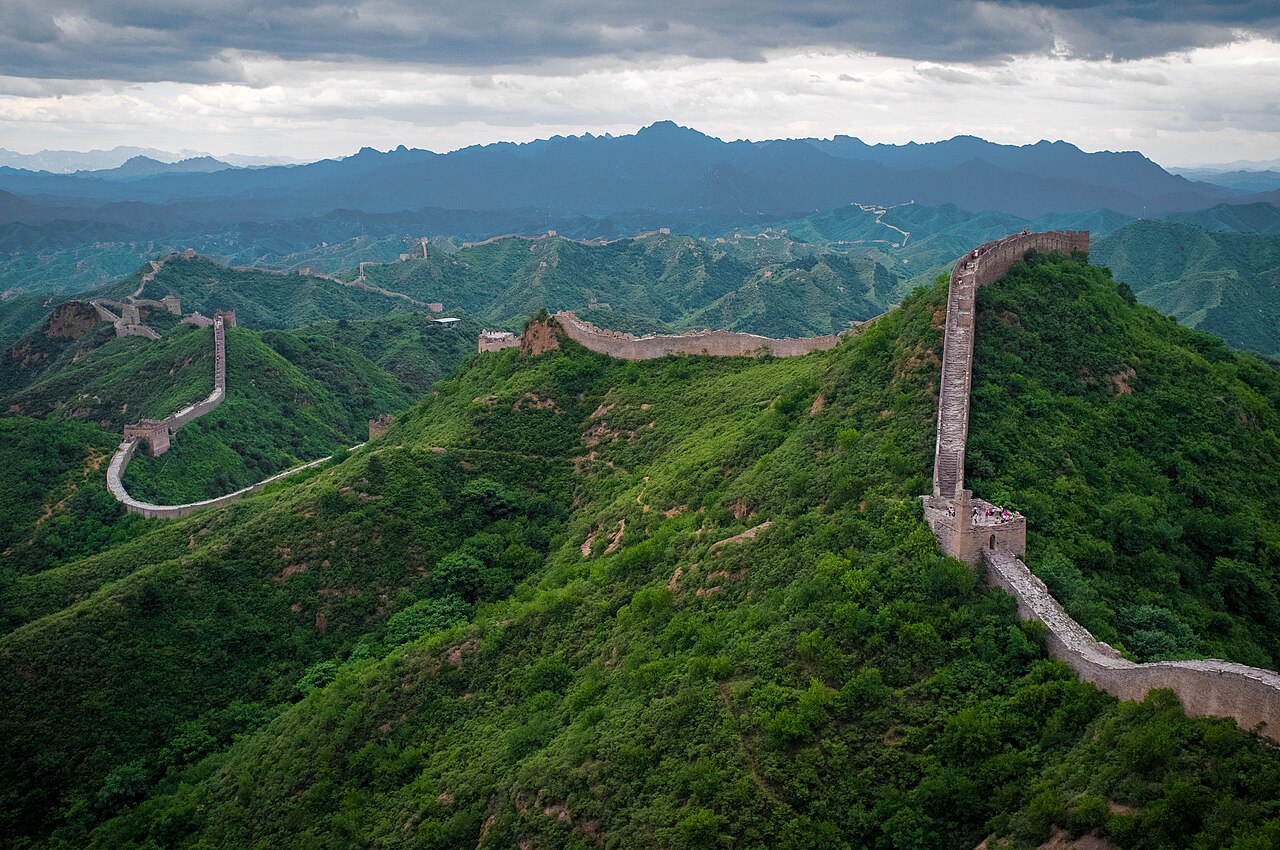
The Great Wall of China, inscribed by UNESCO in 1987, is a serial property of fortification walls, beacon towers, garrisons, and earthworks built from the 7th century BCE to the 17th century CE across the mountains and deserts of northern China. The Ming dynasty (1368–1644) sections most visited today — Badaling, Mutianyu, Jinshanling, and Simatai in the Yanshan Mountains north of Beijing — represent the Wall’s final and most technically complete form: brick-faced, 7–8 metres high, with towers at regular intervals and internal drainage channels. A 2012 State Administration of Cultural Heritage survey measured all periods’ wall segments at a combined 21,196 kilometres; the continuous Ming section from Shanhaiguan on the Bohai Sea coast to Jiayuguan in the Gansu Corridor is approximately 6,259 kilometres.
Beijing and the northern capital circuit Forbidden City · Summer Palace · Ming Tombs — 15 to 80 km
Sixty kilometres south of Badaling by expressway (approximately 60 minutes by car or Badaling Express train), the Imperial Palaces of the Ming and Qing Dynasties — the Forbidden City, inscribed 1987 — is the institution that commanded the Wall’s construction. The Yongle Emperor (Zhu Di), who moved the capital from Nanjing to Beijing in 1420 and built the Forbidden City, directed major brick-facing reinforcement of the Great Wall’s Beijing sections in the same years — the two projects were components of a single defensive-administrative programme for the Ming northern frontier. The Forbidden City’s 72 hectares of palace buildings represent the concentrated indoor expression of imperial power that the Great Wall’s 21,000 kilometres represent in dispersed outdoor form: one is the administrative centre of the empire, the other its northern boundary. From Badaling, central Beijing is reached by the Badaling Express train from Badaling High-Speed Station (approximately 35 minutes to Qinghe Station) or by tourist bus (approximately 90 minutes to Tiananmen).
Forty-five kilometres south of Badaling (approximately 50 minutes by expressway), the Summer Palace (Yiheyuan), inscribed 1998, is the 290-hectare imperial garden-park complex on Kunming Lake that served as the Qing court’s seasonal retreat from the Forbidden City. The Summer Palace’s Longevity Hill structures — the 24-metre Buddhist tower Fo Xiang Ge, built 1750–1764 under Emperor Qianlong — and the 728-metre Long Corridor (a lakeside gallery with 14,000 individually painted panels) are the inscription’s defining features. Emperor Qianlong, who conducted 11 feng and shan pilgrimages to Taishan, also supervised the Summer Palace’s original landscape design in 1750; the cultural patron whose calligraphy appears at Taishan also shaped the lakeside garden visible from Beijing’s western suburbs. From Badaling, the Summer Palace is reached by expressway and Beijing Subway Line 4 in approximately 60 minutes.
Fifty kilometres northwest of Beijing (30 kilometres from Badaling, approximately 30–40 minutes by car), the Imperial Tombs of the Ming and Qing Dynasties — the Changling and Dingling complex at the foot of the Tianshou Mountains, inscribed 2000 — are integrated with the Great Wall’s landscape. The Spirit Way of the Ming Tombs begins 7 kilometres south of Changling with a 7-kilometre avenue of 36 stone animal sculptures; the first emperor buried here (the Yongle Emperor, at Changling) is the same ruler who built both the Forbidden City and directed the Wall’s brick facing. The Dingling tomb, the only fully excavated Ming imperial burial (opened 1956–1957), contains the intact underground palace chambers of the Wanli Emperor and two empresses with approximately 3,000 burial objects, displayed in the Dingling Museum. A single day’s itinerary from Beijing covers the Badaling or Mutianyu section in the morning and Changling/Dingling in the afternoon, connected by car (approximately 45 minutes between sites).
Fifty kilometres southwest of central Beijing (approximately 60 minutes by subway and bus from the Wall), the Peking Man Site at Zhoukoudian (inscribed 1987) preserves the 700,000-year-old Homo erectus occupation of the same North China Plain that the Great Wall was built to defend. The geological relationship between Zhoukoudian’s limestone hills and the granite ridge at Badaling is a continuum of the same Taihang-Yanshan mountain arc that defines Beijing’s northern and western boundary. Homo erectus at Zhoukoudian used the same quartzite and chert stone tools documented across the northern steppe 700,000 years before the Wall defined the boundary between the settled agricultural societies of the plain and the pastoral peoples of the north.
Hebei, Shanxi and west along the Wall Yungang Grottoes · Shanhaiguan · Jiayuguan — 290 to 1,600 km
Four hundred kilometres west of Beijing by high-speed rail (approximately 90 minutes from Beijing North to Datong), the Yungang Grottoes near Datong in Shanxi Province (inscribed 2001) are cut into sandstone cliffs approximately 30 kilometres south of the Great Wall. The grottoes and the Wall occupied the same 5th-century defensive landscape: the Northern Wei state (386–534 CE) carved the first major Yungang caves in 460–524 CE while maintaining the same northern frontier fortification system that the Ming later rebuilt in brick. Cave 20 at Yungang — the outdoor seated Buddha, 13.7 metres high, exposed when the cave’s front wall collapsed — is the most photographed sculpture at the complex. The Northern Wei Yungang caves show a Central Asian Buddhist iconographic tradition directly imported from Gandhara; the Tang Longmen caves 200 years later show the same tradition fully sinified. From the Beijing Great Wall sections, Datong is reached by high-speed rail from Beijing North (approximately 90 minutes).
Two hundred ninety kilometres northeast of Beijing by high-speed rail (approximately 2 hours from Beijing North to Shanhaiguan), the Shanhaiguan Pass marks the eastern terminus of the Ming Great Wall at the Bohai Sea coast. The “First Pass Under Heaven” (Tianxia Diyi Guan) gate tower at Shanhaiguan is the most complete surviving Ming main gate on the entire Wall; the “Old Dragon’s Head” (Laolongtou) coastal battery site shows the Wall descending to the sea at the tidal margin. The Shanhaiguan Pass was the fortification through which Ming armies withdrew and through which the Qing conquest forces entered China proper in 1644 — the fall of Shanhaiguan to Wu Sangui (the Ming general who opened the gate) ended the Ming dynasty. From Shanhaiguan, the Wall runs northeast into the Bohai coast landscape and southwest into the Yanshan Mountains toward Jinshanling.
One thousand six hundred kilometres west of Beijing by high-speed rail (approximately 7 hours from Beijing to Jiayuguan South on the Lanzhou-Xinjiang HSR), the Jiayuguan Fort marks the western terminus of the Ming Great Wall at the edge of the Gobi Desert. The fort’s 733-metre inner keep (three restored gate towers) and the Wall extending west across the desert plain toward the Qilian Mountains define the entry point to the Silk Road’s Hexi Corridor. Merchants, Buddhist monks, and diplomatic missions departing China through Jiayuguan entered Central Asia; the first oasis stop was Dunhuang, 400 kilometres further west where the Mogao Caves document Buddhist patronage on the same route. From Jiayuguan South Station, Dunhuang North is reached by Lanzhou-Xinjiang HSR in approximately 90 minutes.
One hundred thirty kilometres northeast of Beijing by car (approximately 2 hours), the Jinshanling-Simatai sections of the Great Wall in Hebei Province offer the most complete walking experience on the Ming construction. The Jinshanling section straddles restored and unrestored wall within a 4-kilometre walkable circuit, with 67 surviving watchtowers of varying condition including the “General Tower” (Jiangjun Lou) with stone-carved interior arches. The 10-kilometre Jinshanling-to-Simatai hiking traverse crosses unrestored sections with steep pitches and is the most frequently cited authentic wall-walking experience. Simatai (115 km from Beijing) has been partially restored with evening lighting; both sections are reached by tourist bus from Beijing Dongzhimen Bus Station (approximately 2 hours) or by car.
Practical information
The most accessible Great Wall sections from Beijing: Badaling (80 km northwest, Badaling Express train from Qinghe Station in approximately 35 minutes; also tourist bus approximately 90 minutes), Mutianyu (73 km northeast, approximately 90 minutes by car; cable car and toboggan descent), and Jinshanling (130 km northeast, approximately 2 hours by car or tourist bus). Badaling is the most fully restored and the most crowded (approximately 10 million visitors per year). Mutianyu receives approximately 2 million per year and has 22 watchtowers in 4 kilometres of walkable wall. Jinshanling is recommended for walkers seeking an atmospheric experience of original Ming fabric alongside restoration. All sections are best visited on weekdays in spring (April–May) or autumn (September–October) to avoid summer heat and national holiday congestion. For Badaling, the Badaling Express commuter train from Beijing Qinghe Station (Beijing Subway Line 13/Line 8 interchange) takes 35 minutes — far faster than tourist buses. For Mutianyu, there is no direct public transport; car hire or tour is the practical option. The Jinshanling-to-Simatai 10-kilometre hike (4–5 hours) requires advance booking for the Simatai entry section. Accommodation at the wall is available at Gubeikou village near Jinshanling, with guesthouses in the valley below the Wall.
Frequently Asked Questions
How long is the Great Wall of China really?
The most authoritative measurement is a 2012 survey by China’s State Administration of Cultural Heritage, which used GPS, remote sensing, and on-the-ground fieldwork over five years to measure all surviving wall segments, trenches, earthworks, and barrier systems from all periods. The result: 21,196 kilometres of total Great Wall structure, including walls from the Qi state (7th century BCE), the Qin dynasty (221–206 BCE, the first unified wall project), the Han dynasty (206 BCE – 220 CE), the Northern Qi (550–577 CE), and the Ming dynasty (1368–1644). The Ming sections alone measure 8,851 kilometres. The figure commonly cited in tourist materials of “over 10,000 kilometres” refers to the Ming section combined with associated defensive structures. The continuous brick-faced Ming wall from Shanhaiguan to Jiayuguan is approximately 6,259 kilometres — the longest continuous architectural structure ever built. The total of 21,196 kilometres places the Great Wall in a different category from any other construction project in history: no other building programme spans anything approaching this distance. All three figures (6,259 km, 8,851 km, 21,196 km) are technically accurate for different definitions of “the Wall”; the 21,196 km total is the current official Chinese government figure.
What is the difference between the Badaling, Mutianyu, and Jinshanling sections?
The three sections differ in restoration level, visitor density, and walking experience. Badaling (80 km northwest of Beijing) is the most fully restored, rebuilt to Ming brick specification in the 1950s–1980s; it receives approximately 10 million visitors per year, the most of any Wall section, and is the easiest to reach by public transport (Badaling Express, 35 minutes from Qinghe Station). The walkway at Badaling is wide (5–6 metres), well-paved, and equipped with handrails on steep sections — suitable for visitors with limited mobility. Mutianyu (73 km northeast) is similarly restored (rebuilt 1980s) but receives approximately 2 million visitors per year and has more architectural texture: 22 watchtowers in approximately 4 kilometres of walkable wall, a cable car ascent option, and a toboggan descent. Jinshanling (130 km northeast, in Hebei Province) is the recommended section for heritage travellers: approximately 60% of the 4-kilometre circuit is original Ming construction (unrestrored brick and stone in varying states of decay) and 40% is restored, creating a direct visual comparison between authentic fabric and reconstruction. The 10-kilometre Jinshanling-to-Simatai hike traverses unrestrored sections with steep pitches — the walk crosses 67 watchtowers of the Wall in its most atmospheric state. The Simatai section itself (115 km from Beijing, partially open after restoration) has evening lighting for night visits and includes the dramatically positioned “Fairy Tower” on a narrow rock outcrop with sheer drops on three sides.
Was the Great Wall effective as a military defence?
The Great Wall’s military effectiveness is a subject of ongoing historical debate. The short answer is: it was more effective as a logistical and control infrastructure than as an impenetrable barrier. The Wall’s primary military function was not to stop large armies — no wall 21,000 kilometres long could do that — but to control the movement of smaller raiding parties, channel trade and diplomatic traffic through guarded gates (where customs dues were collected), communicate threat signals over vast distances using beacon tower relay systems, and provide supply-base and garrison infrastructure for the frontier troops whose mobility was the actual defence. Nomadic armies that committed to a major invasion — the Xiongnu in the Han dynasty, the Jurchen in the Jin dynasty, the Mongols in the 13th century — breached or bypassed the Wall whenever they chose, by weight of numbers or by corrupting the gate guards. The Mongol conquest of China (1215–1279) made the Wall irrelevant as a military obstacle; after the Mongol defeat and the Ming establishment, the Wall was rebuilt precisely because the Ming had learned from the Mongol experience that the Wall needed to be continuously manned and maintained, not just physically standing. The Ming’s biggest strategic failure with the Wall was the 1644 opening of the Shanhaiguan gate by the Ming general Wu Sangui — not a military breach but a political defection. The Qing dynasty (1644–1912) that replaced the Ming did not maintain the Wall because the Manchu rulers, coming from north of the Wall, understood it as an internal administrative boundary rather than an external military defence.
Sources
- S1 — UNESCO World Heritage Centre — The Great Wall (Ref. 438) — https://web.archive.org/web/20230601000000/https://whc.unesco.org/en/list/438/
- S2 — UNESCO World Heritage Centre — Statement of Outstanding Universal Value (Ref. 438) — https://whc.unesco.org/en/list/438/
Spotted an error? Write to editorial@culturalheritageonline.com and we correct it the same day.