Bridgetown’s UNESCO inscription covers both the colonial city — with its parliament that predates London’s Trafalgar Square monument — and one of the most intact British military garrison complexes in the Americas. From Cultural Heritage Online.
Historic Bridgetown and its Garrison City centre and 2 km south — walkable
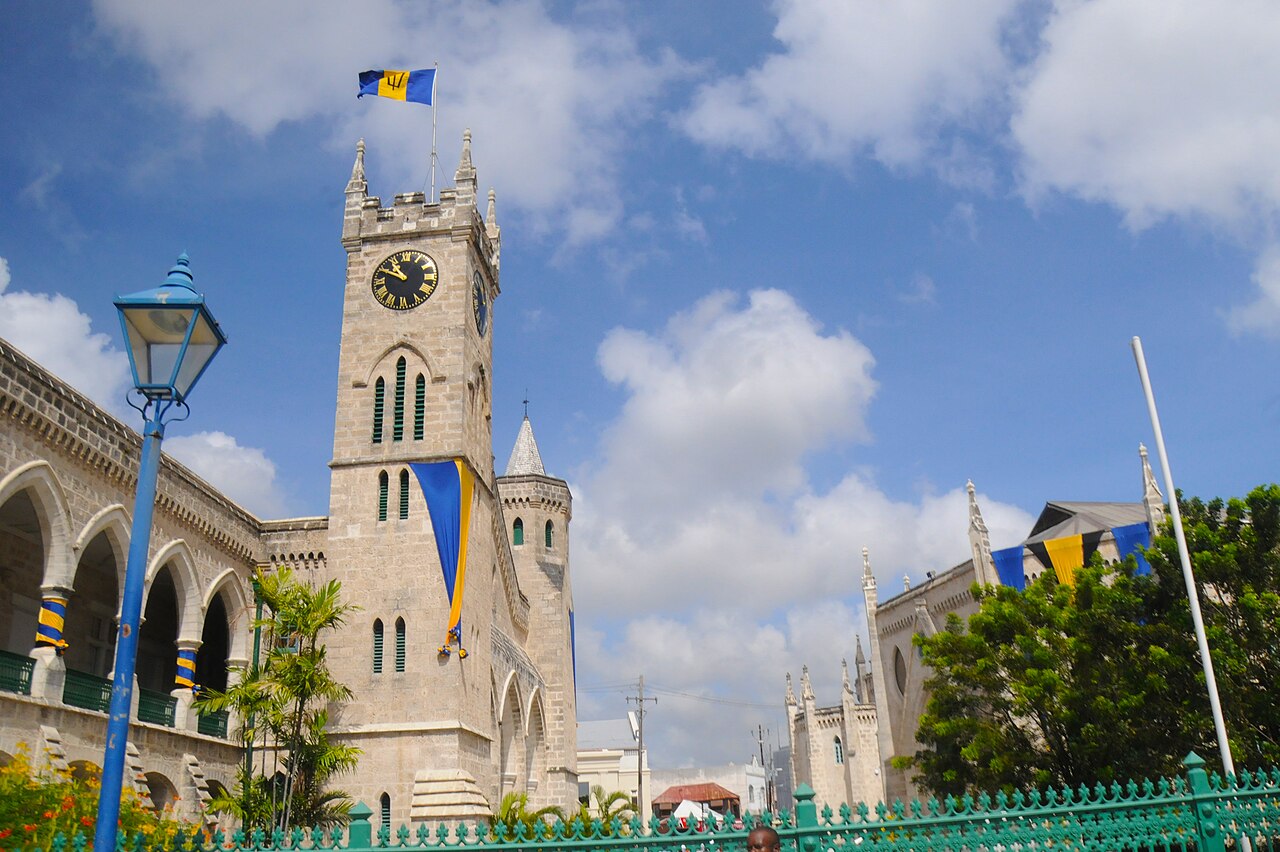
Established in 1628 on a natural harbour at the mouth of the Constitution River, Bridgetown served as the principal trading port of the British Caribbean for nearly three centuries. The city retains its seventeenth-century colonial grid: Broad Street, Parliament Buildings completed in 1874 to a Gothic Revival design, the National Heroes Square where Nelson’s Column has stood since 1813 — a full thirty years before the one in London — and the Chamberlain Bridge, a working swing bridge over the Constitution River that still opens for maritime traffic.
The Parliament Buildings deserve particular attention. Erected in coral stone and imported Portland stone, they house one of the oldest continuously functioning parliamentary chambers in the Western Hemisphere outside Britain itself. The east wing accommodates the Senate, the west wing the House of Assembly. The clock tower, modelled on those of Westminster, rises above both wings and can be seen from most of central Bridgetown. The chamber interior has changed relatively little since the 1870s.
The Garrison Historic Area, approximately 2 km south of the city centre along the coast, represents the military counterpart to the colonial city. The Main Guard building, the garrison savannah (a former parade ground now used for horse racing), and a collection of 394 iron cannon dating from approximately 1650 to 1800 constitute the largest assembly of seventeenth-century iron cannon in the world. The Barbados Museum, housed in the former military prison, provides context for the entire garrison complex. The installation never saw significant military action — it functioned as a command centre and logistics hub for British Caribbean operations rather than as a fortress under siege — which accounts for the exceptional state of preservation of its buildings and contents.
Getting there: The historic city centre is walkable from the cruise terminal; the Garrison is a 2 km walk or short taxi ride south along Bay Street. Allow: 3–4 hours for both zones; add 2 hours for the Barbados Museum. Best for: Travellers interested in colonial history, Caribbean political history, and military heritage.
Frequently Asked Questions
How many UNESCO World Heritage Sites are in Barbados?
One: Historic Bridgetown and its Garrison, inscribed in 2011. The inscription covers two zones — the historic colonial city centre and the Garrison Historic Area 2 km south — which together constitute an outstanding example of British colonial urban and military development in the Caribbean.
What is the Nelson’s Column in Bridgetown?
The column in National Heroes Square was erected in 1813, thirty years before the more famous Trafalgar Square column in London. It commemorates Admiral Horatio Nelson, who visited Barbados three times during his Caribbean service. In 1999 the square was renamed National Heroes Square and a decision was taken to eventually relocate the statue; as of 2026 the column remains in its original position.
Is the Garrison still a military base?
No. The Garrison is now a heritage precinct. The Barbados Museum occupies the former military prison, and the savannah is used for horse racing. Some buildings serve as government offices. The garrison was decommissioned as a British military installation in the nineteenth century and transferred to the government of Barbados.
What are the 394 cannon at the Garrison?
They are seventeenth- and early-eighteenth-century cast-iron guns removed from British warships and stored at the Garrison during the colonial era. The concentration of approximately 394 cannon of this period in a single location is unique worldwide and formed part of the UNESCO inscription’s outstanding universal value.
Sources
- S1 — Alleyne, Warren. Historic Bridgetown. Barbados National Trust, 1978. ISBN 978-976-8012-05-0.
- S2 — Carrington, Sean, et al. A-Z of Barbados Heritage. Macmillan Caribbean, 2003. ISBN 978-0-333-92068-8.
Spotted an error? Write to editorial@culturalheritageonline.com and we correct it the same day.