
Three of Kazakhstan’s five UNESCO World Heritage Sites are reachable from Almaty — among them a Tian-Shan alpine park that begins at the city’s southern edge, a Bronze Age petroglyph sanctuary 170 km northwest, and Silk Road caravanserai ruins two centuries of travel brought to life. From Cultural Heritage Online.
Western Tian-Shan — Ile-Alatau National Park 1 hr from Almaty

Inscribed in 2016 as a transboundary site shared with Kyrgyzstan and Uzbekistan, Western Tian-Shan protects one of Central Asia’s last intact mountain ecosystems. The Kazakhstani component that sits closest to Almaty is Ile-Alatau National Park, whose boundary begins almost immediately south of the city’s suburbs. Drive forty minutes up the Medeu gorge and the urban noise gives way to spruce forest; drive another twenty and the treeline falls away to reveal glacial cirques, scree slopes, and peaks pushing past 4,000 metres.
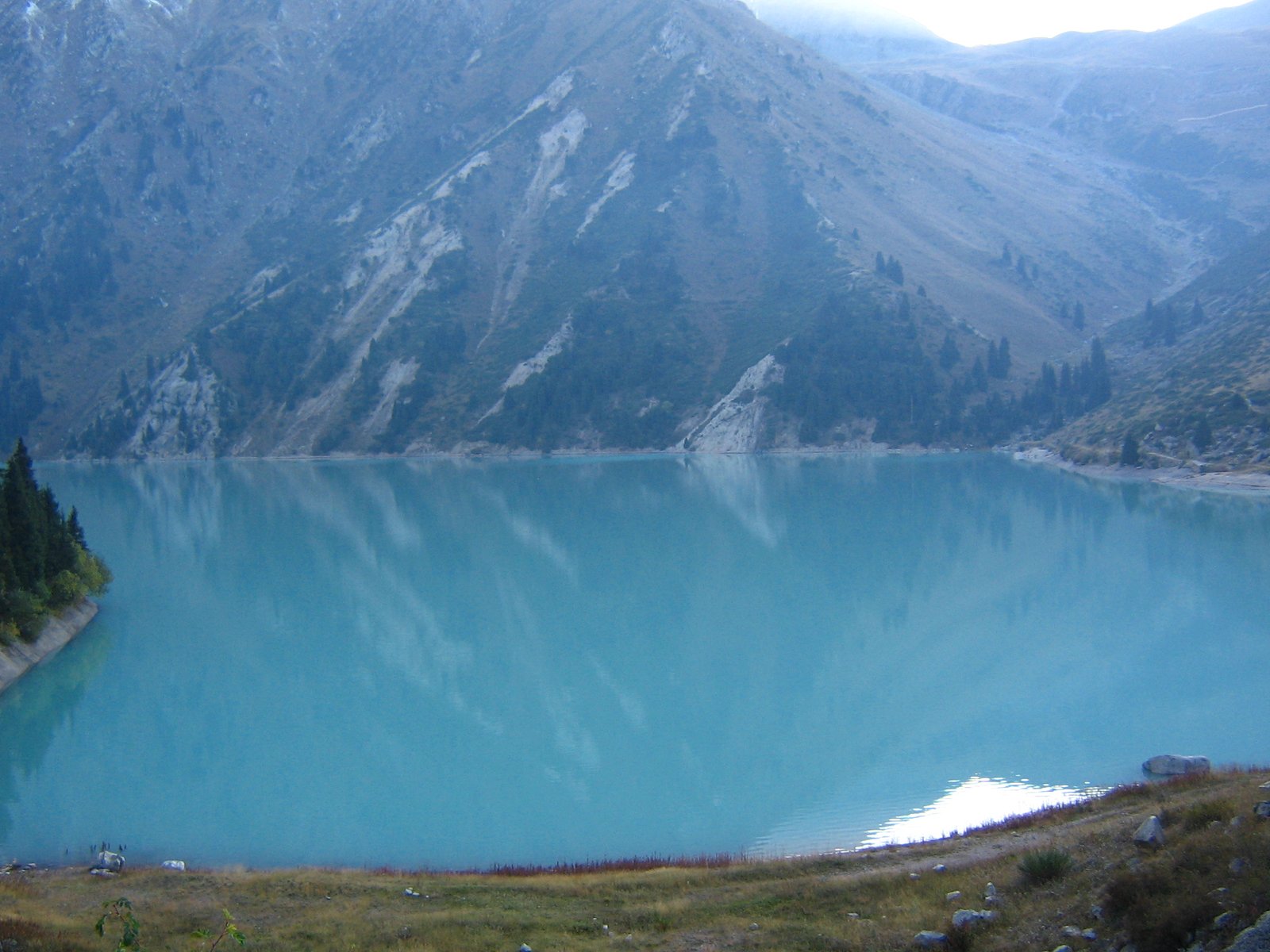
Big Almaty Lake — a high-altitude reservoir that turns an improbable turquoise in summer — lies within the park’s buffer zone and is the most visited point in the entire Western Tian-Shan site. The lake sits at 2,510 metres; above it, the Trans-Ili Alatau range carries permanent snowfields. The park’s lower valleys shelter Schrenk’s spruce and populations of snow leopard, though the cat remains elusive. What visitors consistently encounter is the scale: a gradient from leafy city boulevards to alpine tundra compressed into a single morning’s drive.
Western Tian-Shan received UNESCO inscription for its exceptional biodiversity, including endemic tulips, wild fruit forests considered the ancestors of cultivated apple varieties, and a vertebrate fauna list that runs to several hundred species. The site as a whole spans more than 528,000 hectares across three countries; Ile-Alatau is the most accessible gateway for any traveller based in Almaty.
Getting there: Taxi or hired car from central Almaty to Big Almaty Lake gate, approximately 45–60 minutes. No direct public bus to the lake; marshrutkas run to Medeu ice rink, from where jeep taxis continue up. Allow: Half day for the lake; full day if adding a mountain trail. Best for: Hikers, photographers, and travellers short on time who want immediate high-altitude scenery.
Petroglyphs of the Archaeological Landscape of Tamgaly 170 km · 2.5 hr from Almaty
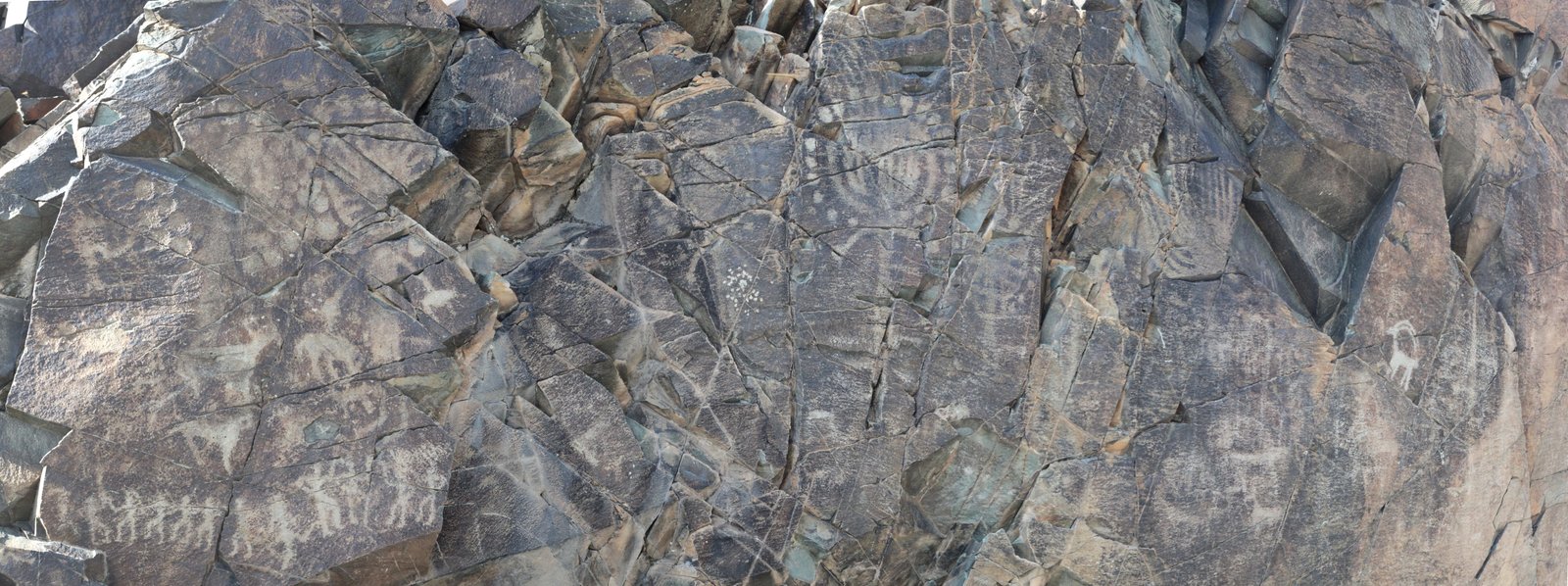
A shallow canyon cut into grey granite hills northwest of Almaty holds more than 5,000 petroglyphs spanning four millennia of human activity. Tamgaly was inscribed in 2004 in recognition of an extraordinary concentration of rock art: Bronze Age carvings of animals, hunters, and ritual scenes press against later Iron Age and medieval images in a palimpsest that reads, if slowly, as a long record of steppe life. The canyon walls catch the afternoon light in a way that makes the incised lines stand out as crisp shadows; morning visits, when the rock is cool, show the detail more clearly.
The exceptional group within the site is the so-called sun-headed deities — anthropomorphic figures with radiating halo-like heads, dating to the late Bronze Age (roughly 1,500–1,000 BCE). Their purpose remains debated among archaeologists, but their scale and formal repetition suggest organised ritual use of the canyon rather than opportunistic marking. Around them are scenes of hunting, herding, and procession that give the site an almost narrative quality.
Tamgaly is also an inhabited landscape: burial mounds, ancient settlements, and pastoral remains continue to be found across the broader area. The site is administered as a protected zone, and a small visitor centre at the entrance provides context maps and brief explanatory panels. The surrounding steppe is flat and featureless en route, which makes the sudden descent into the carved canyon all the more striking.
Getting there: Private car or organised day tour from Almaty; no scheduled public transport. Road is paved to the turnoff, then gravel for the final stretch. Allow: 3–4 hours at the site. Best for: Archaeology and rock art enthusiasts; suitable for most fitness levels as the canyon floor is accessible on foot.
Silk Roads: Zarafshan-Karakum Corridor — Kayalyk & Koylyk 200 km · 2.5–3 hr from Almaty
Kazakhstan joined the Silk Roads transboundary serial inscription in 2023, contributing ancient settlements along the northern branch of the Central Asian trade network. The Kazakhstani components closest to Almaty are the medieval sites of Kayalyk and Koylyk, ruined settlements that functioned as staging posts on the caravan routes linking China to the Mediterranean between roughly the 9th and 14th centuries CE.
Kayalyk — known in medieval Arabic and Chinese sources as a significant town — stands today as a complex of earthen mounds and low walls emerging from the steppe. The site lacks the dramatic vertical presence of a standing monument, but the scale of the ruins makes the extent of the medieval town legible: this was not a waystation but a substantial urban settlement with a mosque, residential quarters, and a market district. Archaeological excavations have recovered ceramics, coins, and glass that map the reach of trade across the Eurasian continent.
These sites require more independent research and initiative than the Tian-Shan or Tamgaly, but the reward is the experience of standing inside a UNESCO-recognised landscape that most visitors to Kazakhstan have not discovered. The surrounding Ili River valley offers additional historical and natural context, including the Charyn Canyon, which makes for a logical combined excursion from Almaty.
Getting there: Private car essential; the sites are off the main road east of Almaty toward the Ili valley. Allow a full day to visit both Kayalyk and the surrounding area. Allow: 4–5 hours including travel from the main road. Best for: History-focused travellers and those specifically interested in Silk Road archaeology.
Mausoleum of Khoja Ahmed Yasawi 710 km · 1 hr domestic flight
The furthest UNESCO site from Almaty is also one of the most architecturally significant structures in Central Asia. Built in the late 14th century on the orders of Timur (Tamerlane) over the grave of the Sufi mystic Ahmed Yasawi, the mausoleum in Turkestan was never quite finished — Timur died in 1405 before the final work was complete — yet it stands as one of the largest medieval buildings on the steppe, its ribbed turquoise dome visible from a distance across flat terrain.
Inscribed in 2003, the mausoleum was recognised for its exceptional architectural achievement: the portal, the internal plan, and the decorative tilework represent a direct translation of Timurid court architecture from Samarkand to the northern steppe. Ahmed Yasawi was the 12th-century poet and mystic who founded the Yasawi Sufi order; his influence across Central Asia was considerable enough that Timur chose the site for a dynastic act of piety and political statement combined. The interior holds a large bronze cauldron — a gift to the shrine — that remains in place as it was installed six centuries ago.
The city of Turkestan has invested significantly in archaeological and heritage infrastructure in recent years, and the mausoleum sits within a reconstructed historic precinct that includes a newly excavated necropolis, a medieval caravanserai, and museum facilities.
Getting there: Domestic flights from Almaty to Turkestan take approximately 1 hour; the airport is close to the city. Alternatively, high-speed train from Almaty (around 5 hours). Allow: Half day for the mausoleum complex; full day if combining with the broader Turkestan archaeological precinct. Best for: Travellers interested in Timurid architecture, Islamic heritage, and Silk Road history.
Frequently Asked Questions
How many UNESCO World Heritage Sites are near Almaty?
Three UNESCO World Heritage Sites are within road or short-flight distance of Almaty: Western Tian-Shan (2016, including Ile-Alatau National Park directly adjacent to the city), the Petroglyphs of the Archaeological Landscape of Tamgaly (2004, 170 km northwest), and the Silk Roads: Zarafshan-Karakum Corridor (2023, with Kazakhstani components including Kayalyk approximately 200 km east). A fourth site, the Mausoleum of Khoja Ahmed Yasawi (2003), is reachable by a one-hour domestic flight to Turkestan, 710 km west.
How do you get to Tamgaly petroglyphs from Almaty?
Tamgaly is 170 km northwest of Almaty, approximately 2.5 hours by road. There is no scheduled public transport to the site; the standard approach is a private car, rental vehicle, or an organised day tour from Almaty. Several Almaty-based tour operators offer Tamgaly as a day excursion, often combined with a stop at the Charyn Canyon on the return. Plan for 3–4 hours at the petroglyph site itself, and return to Almaty the same day comfortably.
What is the best season to visit the UNESCO sites near Almaty?
Late May through September is the most practical window for all three road-accessible sites. Ile-Alatau National Park and Big Almaty Lake are at their most striking in June and July, when snowmelt keeps the lake brilliantly turquoise and the alpine meadows are in flower. Tamgaly and the Silk Road sites are best visited in May–June or September, when temperatures in the open steppe are moderate rather than extreme. July and August can be very hot at the lower-altitude steppe sites. Winter closes access to the high mountain routes but leaves Tamgaly reachable in dry conditions.
Who was Khoja Ahmed Yasawi and why is his mausoleum a UNESCO site?
Ahmed Yasawi (c. 1093–1166) was a Sufi mystic and poet who founded the Yasawi order, one of the earliest Turkic Sufi brotherhoods in Central Asia. His poetry, collected in the Diwan-i Hikmat (“Book of Wisdom”), was written in an early Turkic vernacular and remained widely read across the steppe for centuries after his death. Timur ordered a monumental mausoleum built over his grave in 1389, intending it as a dynastic statement and a place of pilgrimage. UNESCO inscribed the site in 2003 for its outstanding Timurid architecture — the largest and best-preserved of its type outside Samarkand — as well as its significance as a living pilgrimage destination and a key node in the cultural history of the Silk Roads.
Sources
- S1 — Baipakov, Karl M. The Great Silk Road: Monuments of Kazakhstan. Galym, 1991. ISBN 978-5-620-00465-2.
- S2 — Olcott, Martha Brill. The Kazakhs. Hoover Institution Press, 1995. ISBN 978-0-8179-9351-1.
Spotted an error? Write to editorial@culturalheritageonline.com and we correct it the same day.


.jpg)

