Three World Heritage sites lie within 120 kilometres of Koh Ker as the crow flies: Angkor (65 km), the Temple of Preah Vihear (69 km) and Sambor Prei Kuk (115 km). Koh Ker itself joined the list in 2023. For twenty-three years in the 10th century it was a capital of the Khmer Empire, and for sixteen of them the only one.
The World Heritage sites within reach of Koh Ker
The distances below are straight lines between the reference points that UNESCO publishes for each property, measured to the nearest component of a serial site. They tell you what is close. They do not tell you how long the road takes, which depends on the season and the route.
| Site | Country | Distance | Inscribed | Type |
|---|---|---|---|---|
| Angkor | Cambodia | 65 km | 1992 | Cultural |
| Temple of Preah Vihear | Cambodia | 69 km | 2008 | Cultural |
| Sambor Prei Kuk (ancient Ishanapura) | Cambodia | 115 km | 2017 | Cultural |
| Vat Phou and the Champasak landscape | Laos | 182 km | 2001 | Cultural |
| Dong Phayayen-Khao Yai Forest Complex | Thailand | 184 km | 2005 | Natural |
| Cambodian Memorial Sites | Cambodia | 224 km | 2025 | Cultural |
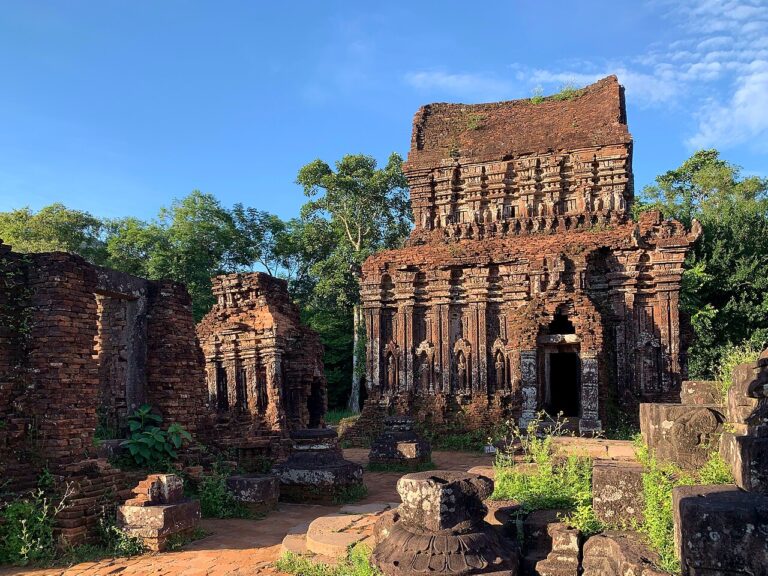
Read together, the three closest sites trace Khmer architecture from start to finish. Sambor Prei Kuk was the capital of Chenla in the late 6th and early 7th centuries, before Angkor existed. Koh Ker is the 10th-century interlude. Angkor holds the capitals from the 9th to the 15th century, and Preah Vihear, whose main sanctuaries date to the first half of the 11th century, shows what Khmer builders did on a cliff edge rather than on a plain.
A capital that lasted twenty-three years
King Jayavarman IV founded Koh Ker, known in its own time as Lingapura or Chok Gargyar, in 921 CE. For seven years it was a rival to Angkor. From 928 to 944 it was the sole capital of the empire; after that the political centre moved back to Angkor, about eighty kilometres to the southwest. The site sits on a gentle slope in dense broad-leaf forest between the Dangrek and Kulen ranges.
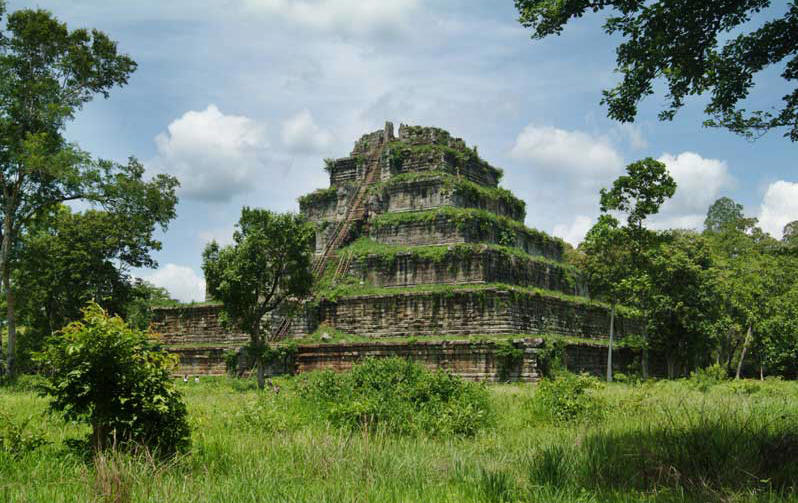
UNESCO’s case for the site rests on that short window. The city was built in a single phase, apparently laid out on Indian ideas of the shape of the universe, and its builders used stone blocks far larger than earlier Khmer practice. That technique opened a long phase of monumental stone temples across the empire. It also left Koh Ker unusually untouched: no later rebuilding, no conjectural reconstruction, and a layout that matches its documentation in the late 19th century. The pyramid of Prasat Thom, in the photograph above, is its best-known building.
The Koh Ker style, and the statues that left the forest
The sculpture made here in those two decades has its own name, the Koh Ker style. UNESCO describes it as bold and expressive, with a sense of movement drawn from the fusion of Indian religious imagery and local craft. It influenced Khmer art for centuries.
The same quality made the site a target. The US Attorney for the Southern District of New York brought a civil forfeiture action over a 10th-century sandstone Duryodhana offered for sale by Sotheby’s, alleging it had been stolen from the Prasat Chen temple at Koh Ker in 1972 by an organised looting network. A settlement approved on 16 December 2013 required its return to Cambodia. Earlier that year the Metropolitan Museum of Art announced it would return two 10th-century Kneeling Attendants after receiving new documentary research on their origin. UNESCO’s 2023 evaluation records that many looted sculptures have now been repatriated.
One authority for Koh Ker and Preah Vihear
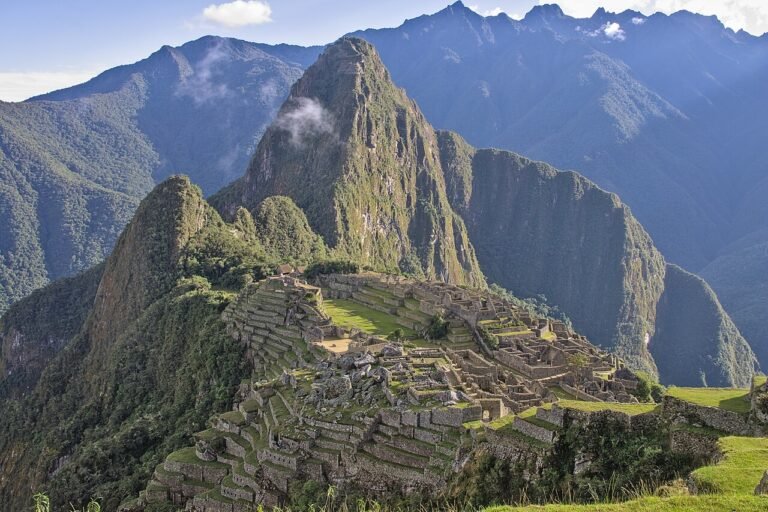
The two closest Cambodian neighbours share a manager. The National Authority for Preah Vihear oversees protection at both temples, from conservation work to the fight against illegal excavation and export. Preah Vihear stands on the edge of a plateau above the Cambodian plain: a chain of sanctuaries linked by pavements and staircases along an 800-metre axis, dedicated to Shiva. Its remote position is the main reason it survives in such good condition. Seeing both shows two answers to the same brief: one temple built on the flat to look like a mountain, the other built on a real one.
Frequently Asked Questions
Which UNESCO World Heritage sites are near Koh Ker?
Angkor is 65 km away in a straight line, the Temple of Preah Vihear 69 km and Sambor Prei Kuk 115 km, all in Cambodia. Further out are Vat Phou in Laos (182 km) and the Dong Phayayen-Khao Yai forests in Thailand (184 km).
When was Koh Ker the capital of the Khmer Empire?
Jayavarman IV founded it in 921 CE. It rivalled Angkor until 928, then served as the sole capital until 944, when the court returned to Angkor. That makes twenty-three years in all.
When was Koh Ker inscribed on the World Heritage List?
In 2023, under criteria (ii) and (iv): for the Koh Ker style of sculpture and for the city as a prototype of grand-scale building with very large monolithic stone blocks.
Have the statues looted from Koh Ker been returned?
Many have. A Duryodhana from Prasat Chen was returned after a 2013 settlement with Sotheby’s in New York, and the Metropolitan Museum of Art returned two Kneeling Attendants the same year.
Sources
- UNESCO World Heritage Centre — Koh Ker: Archaeological Site of Ancient Lingapura or Chok Gargyar (inscribed 2023). https://whc.unesco.org/en/list/1667/
- UNESCO World Heritage Centre — Temple of Preah Vihear (inscribed 2008). https://whc.unesco.org/en/list/1224/
- UNESCO World Heritage Centre — Temple Zone of Sambor Prei Kuk, Archaeological Site of Ancient Ishanapura (inscribed 2017). https://whc.unesco.org/en/list/1532/
- UNESCO World Heritage Centre — Angkor (inscribed 1992). https://whc.unesco.org/en/list/668/
- U.S. Attorney’s Office, Southern District of New York — Return of a 10th-century sandstone sculpture to the Kingdom of Cambodia. https://www.justice.gov/usao-sdny/pr/manhattan-us-attorney-announces-return-10th-century-sandstone-sculpture-kingdom
- The Metropolitan Museum of Art — Press release on the return of two Cambodian sculptures (2013). https://www.metmuseum.org/press-releases/cambodian-returns-2013-news
Spotted an error? Write to editorial@culturalheritageonline.com and we correct it the same day.