The Archaeological Ruins of Liangzhu City, inscribed as UNESCO World Heritage in 2019, document a walled urban settlement of the Liangzhu culture occupied approximately 3300–2300 BCE, making it contemporary with or older than the earliest Egyptian pyramids (Djoser’s Step Pyramid, c. 2650 BCE). The inner city covers 297 hectares enclosed by rammed-earth walls; the outer city covers approximately 630 hectares; and a hydraulic system of 36 dams controlled 8.5 square kilometres of reservoir capacity to manage seasonal flooding of the settlement’s low-lying river terraces. The ruins are located 30 kilometres north of Hangzhou city centre and are reachable by Hangzhou Metro Line 2 to Liangzhu station in approximately 30 minutes.
Hangzhou and the Yangtze Delta: West Lake and the Classical Gardens of Suzhou West Lake Cultural Landscape 30 km south of Liangzhu ruins / 30 min metro; Classical Gardens of Suzhou 120 km northeast / 1h HSR from Hangzhou East
The West Lake Cultural Landscape of Hangzhou, inscribed as UNESCO World Heritage in 2011, is approximately 30 kilometres south of the Liangzhu ruins and reachable from Liangzhu station by direct metro (Line 2 toward Chaoyang) in approximately 30 minutes to the West Lake scenic area stops. Hangzhou is the only city in China to hold two UNESCO inscriptions within its administrative boundaries (the Liangzhu ruins and the West Lake landscape, separated by the two metro stops between Liangzhu station and the West Lake area), a circumstance that reflects the city’s layered significance across approximately 5,000 years of continuous human occupation of the same river-delta terrain. The West Lake inscription covers 3,323 hectares around a 5.66-square-kilometre freshwater lake whose current form results from 1,000 years of deliberate hydraulic engineering: the lake was originally a shallow coastal lagoon that was progressively isolated from Hangzhou Bay by sedimentation, then dredged, dammed and landscaped through successive Tang, Song and Ming dynasties. The Su Causeway, a 2.8-kilometre earthen causeway dividing the lake’s western basin from its main body, was first built by Su Shi (Su Dongpo) during his governorship of Hangzhou in 1089–1091 CE; the current causeway dates primarily to a Ming-dynasty reconstruction of 1508. The temporal contrast between the two Hangzhou inscriptions is stark: the Liangzhu hydraulic system was constructed approximately 5,300 years ago and functioned for approximately 1,000 years before the culture declined around 2300 BCE, while the West Lake landscape represents a continuous accumulation of interventions from the 7th to the 20th century CE. The connection is that both documents show the same river-delta plain being systematically engineered to create habitable, productive terrain from a naturally flood-prone and waterlogged environment — the Liangzhu dam system drained and controlled a 100-square-kilometre river catchment 3,300 years before the first West Lake dredging campaigns began. A combined visit to both inscriptions within Hangzhou is practical as a single day: Liangzhu Museum (adjacent to the ruins, opened 2018; designed by David Chipperfield Architects) takes approximately 2–3 hours; the metro to West Lake takes 30 minutes, and the lake perimeter circuit on foot or bicycle requires 2–4 hours.
The Classical Gardens of Suzhou, inscribed as UNESCO World Heritage in 1997 and extended in 2000, are approximately 120 kilometres northeast of Hangzhou, reachable in approximately 1 hour by high-speed rail from Hangzhou East to Suzhou. The inscription covers nine classical scholar gardens constructed between the 11th and 19th centuries, including the Humble Administrator’s Garden (Zhuozheng Yuan, largest at 5.2 hectares, initially constructed in 1513 CE), the Lingering Garden (Liu Yuan, 2.3 hectares, reconstructed in the 1870s from a 1593 original) and the Master of Nets Garden (Wangshi Yuan, 0.5 hectares, originally 12th century, restructured in 1770). The Suzhou gardens represent a design tradition that codified over 1,000 years the principles of composing miniature landscapes within urban enclosures using the same four elements — water, rock, architecture and planting — that Chinese garden theory classifies as the constitutive elements of landscape. The intellectual relationship between the Suzhou gardens and the Liangzhu ruins is indirect but documentable: the garden’s fundamental aesthetic principle of representing the natural landscape in miniature (a philosophical position formalised in Yuan-dynasty painting theory and operationalised in the gardens of the Ming and Qing dynasties) developed in the same Yangtze Delta region where the Liangzhu culture first created large-scale hydraulic landscape modification 4,000 years earlier. The continuity is geographic rather than cultural: no direct cultural transmission connects Liangzhu culture practices to Song-dynasty garden theory, but both emerged in the same ecological zone of the lower Yangtze flood plain, where the management of water — its control, containment and aesthetic deployment — has been the central human engineering challenge for 5,000 years. The two inscriptions together span a larger portion of Chinese landscape history than any other pair of sites within 150 kilometres of each other in China.
Distance comparators: the Grand Canal and Kaiping Diaolou Grand Canal Hangzhou section at Gongshu District within Hangzhou city; Kaiping Diaolou 800 km south / 5h HSR from Hangzhou East via Guangzhou
The Grand Canal of China, inscribed as UNESCO World Heritage in 2014 as a serial property covering 27 sections and 58 associated heritage sites across 8 provinces, includes the Hangzhou section in its southern terminal segment. The Jiangnan Canal (Hangzhou section) runs through Gongshu District approximately 5 kilometres from the Hangzhou East high-speed rail station and is accessible from the West Lake area by taxi or bus in approximately 20 minutes. The Grand Canal’s southern terminus in Hangzhou at the Gongchen Bridge (Gongchen Qiao, 17th century, 98 metres long, 16 arches) is the canonical endpoint of the entire 1,776-kilometre waterway linking Hangzhou to Beijing; the southern terminal basin at Wulin Gate was the historical commercial hub of the Song-dynasty capital Lin’an (Hangzhou served as the Southern Song capital from 1127 to 1279). The temporal relationship between the Grand Canal and Liangzhu is one of the most striking chronological contrasts in Chinese UNESCO inscriptions: the Liangzhu dam system, which controlled a 100-square-kilometre water storage network using earthen dams across 36 channels, predates the first segments of the Grand Canal (the Hangou channel connecting the Yangtze to the Huai River, attributed to the state of Wu in 486 BCE) by approximately 1,800 years. The hydraulic engineering problem solved by both systems is structurally similar — moving and controlling water across a low-gradient river delta to support agricultural and urban populations — but at radically different scales: the Liangzhu system served a city of an estimated 20,000–30,000 inhabitants in a 630-hectare area; the Grand Canal at its Sui-dynasty construction peak (605–618 CE) served the logistical needs of an empire of approximately 46 million people over a 2,500-kilometre corridor. The Gongshu section of the Grand Canal inscribed property in Hangzhou includes the Gongchen Bridge, the Fuyi Canal (a branch canal documented from the Song dynasty), the Guangji Bridge in Tongji (a five-arched stone bridge of 1334), and the associated canal-town historic districts; a walking and cycling path follows the canal bank through the inscribed section for approximately 3 kilometres.
The Kaiping Diaolou and Villages in Guangdong Province, inscribed as UNESCO World Heritage in 2007, are approximately 800 kilometres south of Hangzhou, reachable in approximately 5 hours by high-speed rail from Hangzhou East to Guangzhounan (approximately 3.5 hours) then by bus from Guangzhou to Kaiping (approximately 1.5 hours). The 1,833 surviving diaolou towers represent a mode of architectural production as different from Liangzhu jade ritual culture as is possible within a single country: the towers were built by individual Cantonese-speaking emigrant family members returning from the Americas, Southeast Asia and Australia in the 1880s–1940s, using reinforced concrete and decorating with European, Islamic and Southeast Asian architectural vocabularies. The juxtaposition of Liangzhu and Kaiping in a single research or travel itinerary is instructive precisely because of the contrast: Liangzhu documents the earliest phase of Chinese state-formation, 5,000 years ago, through collective public works (the dam system, the urban walls, the ritual centres) and the production of jade objects that circulated across a regional exchange network; Kaiping documents modern Chinese emigrant individuality through privately owned towers built to display personal financial success. The shared thread is the capacity of Chinese communities to mobilise sophisticated building techniques — rammed earth and hydraulic engineering at Liangzhu, reinforced concrete and cosmopolitan ornament at Kaiping — in the service of collective identity-formation, whether that identity is the clan-lineage solidarity of a Neolithic city-state or the transnational family network of modern overseas Chinese.
Practical information
The Liangzhu ruins and the adjacent Liangzhu Museum are in Liangzhu Town, Yuhang District, Hangzhou. From central Hangzhou (Hangzhou East HSR station), take Metro Line 1 to Wenchang Road station, then transfer to Line 2 (direction Liangzhu) and ride 12 stops to Liangzhu station; the museum is approximately 1 kilometre from the station on foot or by shared bicycle. Admission to the Liangzhu Museum is free; the outdoor ruins site (accessible from the museum) is also free. The museum’s permanent collection includes approximately 200 Liangzhu culture jade objects, the most significant being the large jade cong ritual cylinders and bi discs that are the defining material culture of the Liangzhu phase; the museum building is notable for its architectural quality (David Chipperfield Architects, 2018) and its integration of building and landscape. Opening hours are Tuesday to Sunday 09:00–17:00; the museum is closed Mondays. The outdoor ruins extend across approximately 100 hectares of partially excavated terrain and include reconstructed sections of the city walls and the dam system; signage is in Chinese and English. Hangzhou is served by Hangzhou Xiaoshan International Airport (approximately 45 minutes from the city centre by airport bus or metro) with direct flights from most Chinese cities and several international routes. The best months to visit are March to May (spring) and September to November (autumn); Hangzhou’s summer heat and humidity are significant. Combining Liangzhu with West Lake and a day trip to Suzhou requires a minimum of 3 nights in Hangzhou.
Frequently Asked Questions
How do archaeologists know the Liangzhu dam system was hydraulic engineering rather than natural river embankments?
The identification of the Liangzhu earthen structures as intentionally constructed water-management infrastructure rather than natural levees or secondary formation rests on several converging lines of archaeological evidence developed through excavations conducted primarily by Zhejiang Provincial Institute of Cultural Relics and Archaeology between 1986 and the 2000s, with systematic publication accelerating after the UNESCO nomination process began in 2012. First, the dam structures contain alternating layers of yellow clay and dark grey clay derived from different geological sources: the yellow clay is a clean alluvial deposit from the mountain catchments above the settlement, while the dark grey clay is characteristic of the organic-rich waterlogged sediments in the low-lying valley floors. The alternating-layer construction technique (tiantu fangzhi) is the same hydraulic earthen dam-building method documented in later Chinese hydraulic texts; natural levee formation does not produce this distinctive layered stratigraphy. Second, the orientation and plan of the dam network is inconsistent with natural drainage patterns: the 36 identified dams form a spatial system of upstream reservoir dams (11 dams in the mountain valleys north and west of the city, retaining approximately 13 million cubic metres of water in the reservoir catchment) and downstream discharge dams (25 dams at lower elevations controlling water flow into and through the urban area). The spatial organisation is topographically rational as water management but inexplicable as natural formation. Third, the dams overlie evidence of human activity (carbon-dated to the Liangzhu cultural phase, approximately 3300–2300 BCE) and are themselves overlain by sediment dated to after the city’s abandonment, providing a temporal bracket consistent with deliberate construction during the settlement’s occupation period. Fourth, the dam materials in several cases contain artefacts (pottery sherds, worked stone fragments) characteristic of the Liangzhu culture that would not be present in a natural deposit, confirming human agency in the construction of the earthen structures.
What is a jade cong, and why did only the Liangzhu culture produce them?
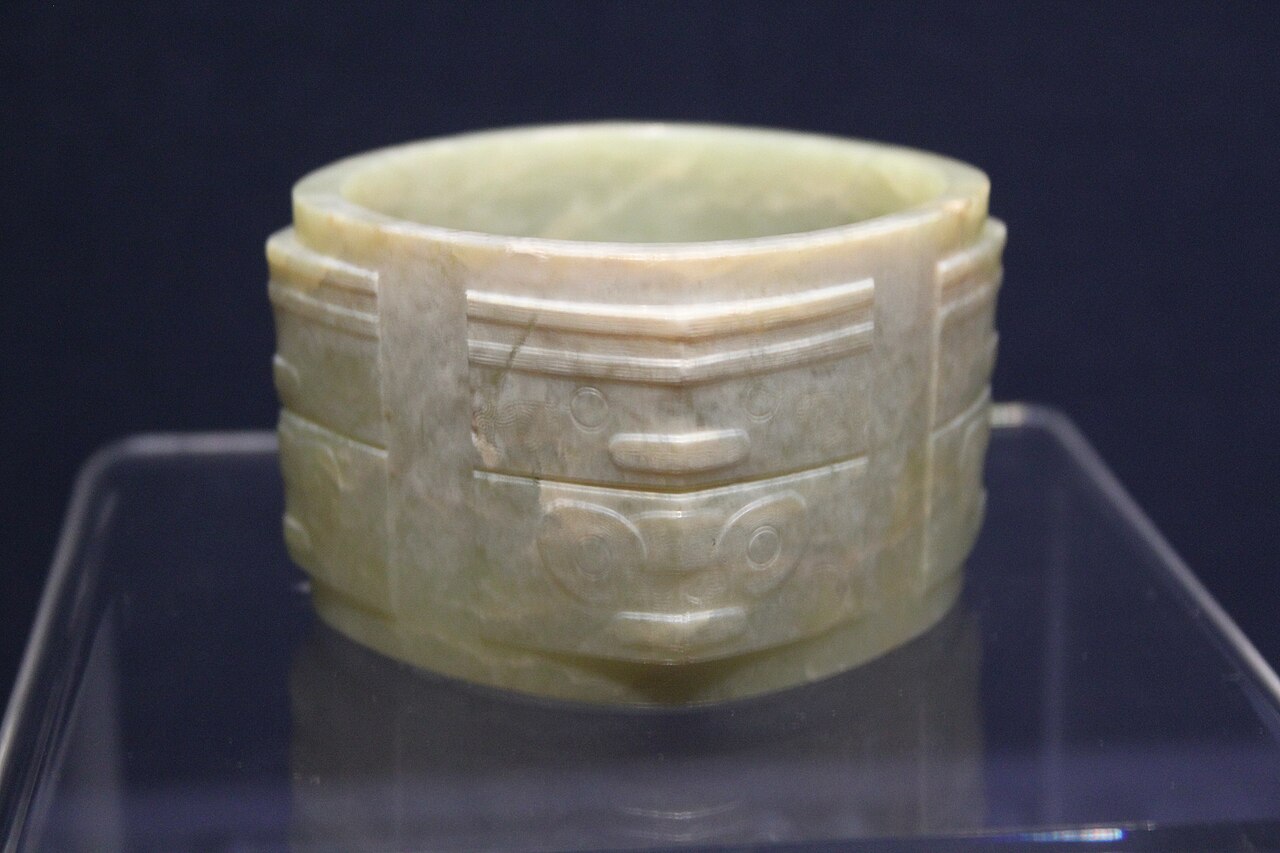
A cong (the character combines the radicals for “earth” and “work” or “artisan”) is a hollow rectangular-sectioned tube of nephrite jade with a circular bore running through its full length: the exterior profile is square with chamfered corners and notched horizontal banding, while the interior is circular in section, producing the distinctive combination of round-hole-in-square-body that appears in early Chinese cosmological diagrams as the representation of heaven (circle) and earth (square). Liangzhu cong range from small objects a few centimetres tall to large ritual pieces up to 49 centimetres in height containing 17 banded horizontal segments; the largest surviving example, in the Zhejiang Provincial Museum, weighs 6.5 kilograms and contains more than 1,000 fine engraved lines per centimetre forming the composite “divine figure” (shen ren) motif that appears across Liangzhu jade objects. The claim that no later Chinese culture replicated the cong is broadly accurate but requires qualification: cong shapes appear in later periods (Zhou-dynasty bronze vessels reference the cong profile, and Ming-dynasty Daoist ritual objects occasionally use cong forms) but the technically demanding combination of large-scale nephrite tube boring, fine engraving and the specific symbolic vocabulary of Liangzhu decoration does not reappear after the Liangzhu culture’s decline around 2300 BCE. The reason for this discontinuity is not fully understood. The Liangzhu culture’s decline was rapid (the urban complex appears to have been abandoned within decades rather than centuries, possibly due to catastrophic flooding consistent with the geological record of a major Yangtze Delta flood event around 2300 BCE), and the specialised craftsmen who produced the jade objects and their ritual and social context disappeared with the culture. Nephrite jade workshops operating in later Chinese cultures (the Shang, Zhou, Han and subsequent dynasties) produced bi discs, huang pendants, huan rings and other forms, but the cong as a consistently produced ritual object type is specific to the Liangzhu phase and the related contemporaneous cultures (Dawenkou, Hongshan) of the late Neolithic.
What happened to the Liangzhu culture around 2300 BCE, and why was the site forgotten for so long?
The Liangzhu urban complex shows stratigraphic evidence of rapid abandonment around 2300 BCE, with a thick layer of waterlogged sediment overlying the final occupation surfaces in multiple excavated areas of the city. The sediment layer is consistent with a single large flood event rather than gradual silting, and its composition (high organic content, characteristic aquatic plant remains, fish bones) indicates that the city was submerged under standing water rather than abandoned and then gradually covered by alluvial deposition. Paleoclimatological records from the lower Yangtze Basin document a period of increased flood frequency and severity in the 24th and 23rd centuries BCE associated with a regional climate perturbation; the leading hypothesis among Chinese archaeologists (developed by Liu Li and Chen Xingcan among others) is that a catastrophic flood event overwhelmed the Liangzhu dam system and permanently inundated the urban core, rendering the site uninhabitable. This hypothesis is consistent with later Chinese historical texts: Mencius (4th century BCE) and earlier sources record that the legendary ruler Yao (traditionally dated to approximately 2300 BCE) faced a catastrophic flood that required the engineering heroics of the equally legendary Yu the Great to control; the coincidence of dates between the Liangzhu flood sediment layer and the traditional date of Yao’s flood has prompted speculation that the Liangzhu collapse may be the historical reality underlying the legendary flood narrative. The site was “forgotten” in the sense that the Liangzhu culture left no writing system (the jade objects carry engraved symbols that have not been deciphered as a writing system) and was therefore invisible to the textual historical record that documented later Chinese dynasties from the Shang period onward. The first modern archaeological identification of Liangzhu culture objects as a distinct cultural horizon was made by Shi Xingeng at Liangzhu Town in 1936; systematic excavation began in 1959 and the urban scale of the site was not recognised until the discovery of the city walls in 2007.
Sources
- S1 — UNESCO World Heritage Centre — Archaeological Ruins of Liangzhu City (Ref. 1592) — https://web.archive.org/web/20230601000000/https://whc.unesco.org/en/list/1592/
- S2 — Liangzhu Museum and Archaeological Site Park — https://whc.unesco.org/en/list/1592/
- S3 — Bahn, Paul G. <em>The Cambridge Illustrated History of Prehistoric Art</em>. Cambridge University Press, 1998. ISBN: 978-0-521-45473-5.
Spotted an error? Write to editorial@culturalheritageonline.com and we correct it the same day.